SpaceX's second wave of lock-up expirations is here; how should investors position themselves in spa

13F Filings Revealed | SpaceX Shareholder Lineup Exposed! Besides Musk, Who Is Heavily Investing in the Trillion-Dollar Space Empire?
The commercial space industry is undergoing a significant transformation: evolving from government-led exploration projects into an independent asset class allocable by institutional capital.
Goldman Sachs Global Institute recently released"The Second Space Age"report, pointing out that as launch costs drop significantly, private capital accelerates its inflow, and space companies continue to list on public markets,the space economy is becoming a "new pillar of the industrial economy."
$SpaceX (SPCX.US)$ The latest shareholder map is the most intuitive reflection of this trend.
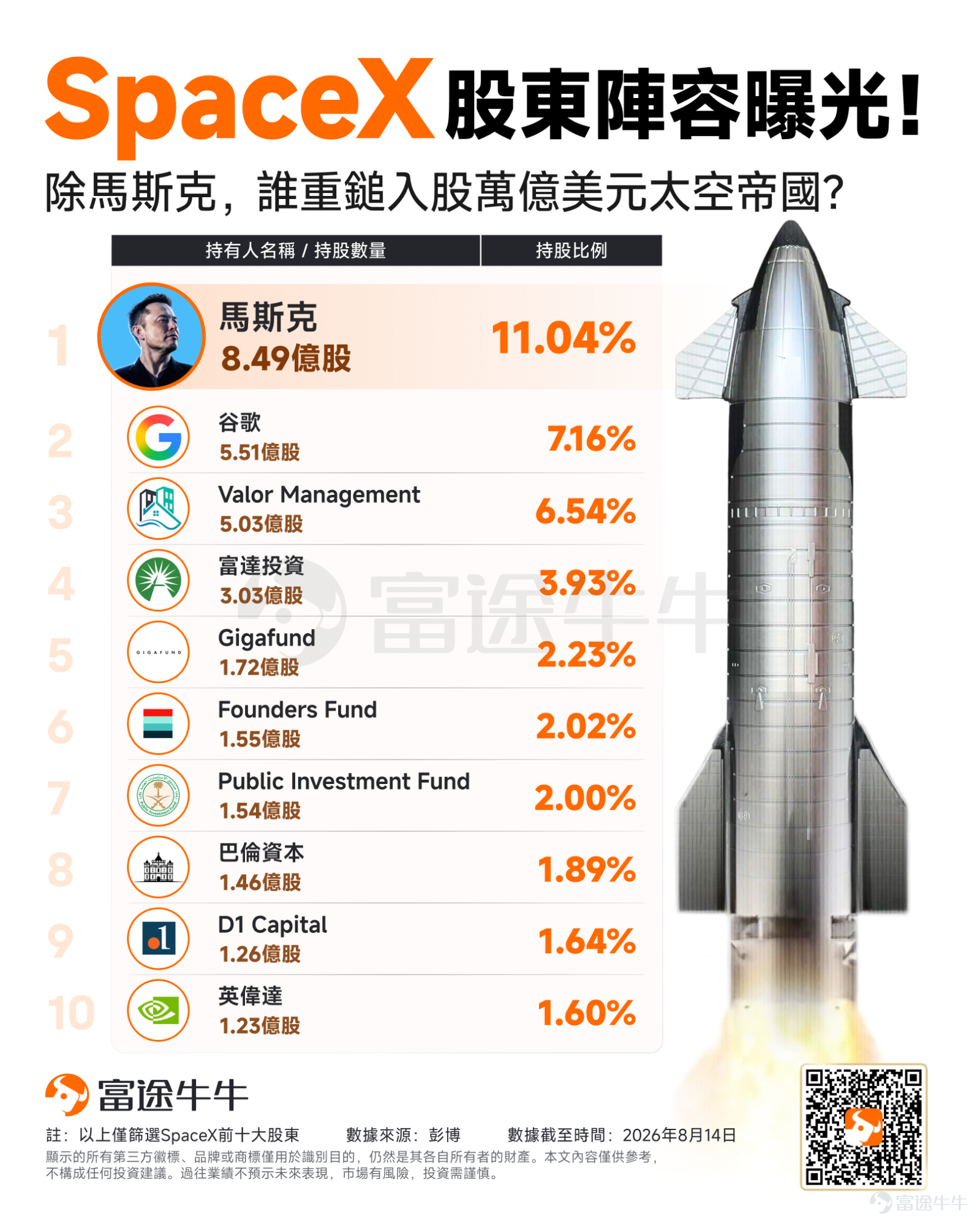
Beyond Musk, institutional shareholders already hold nearly 30% of the shares.
According to Bloomberg data, Musk remains the largest shareholder of SpaceX, holding 849 million shares, representing approximately 11.04% of the company.
However, what deserves more attention is the lineup of institutional investors behind Musk.
$Alphabet-C (GOOG.US)$ [Entity] holds 551 million shares, accounting for 7.16%, making it the second-largest shareholder; Valor Management holds 503 million shares, accounting for 6.54%; Fidelity Investments holds 303 million shares, accounting for 3.93%. In addition, Gigafund, Founders Fund, Saudi Arabia's Public Investment Fund (PIF), Baillie Gifford, D1 Capital, and $NVIDIA (NVDA.US)$ are also among the top ten shareholders.
--
--
--
This means that SpaceX is no longer just a star company supported by its founder and early venture capital, but has become a core asset jointly allocated by tech giants, long-term asset managers, sovereign wealth funds, and growth capital.
Why are institutional funds concentrating their bets on SpaceX?
1. From reducing launch costs to validating the business model
The answer first lies in the change in the underlying costs of commercial spaceflight.
A Goldman Sachs report shows that in 1981, the cost of sending one kilogram of payload into low Earth orbit using the US Space Shuttle was approximately $65,400; today, SpaceX's Falcon Heavy has reduced this cost to around $1,500, a decrease of about 97.7%.
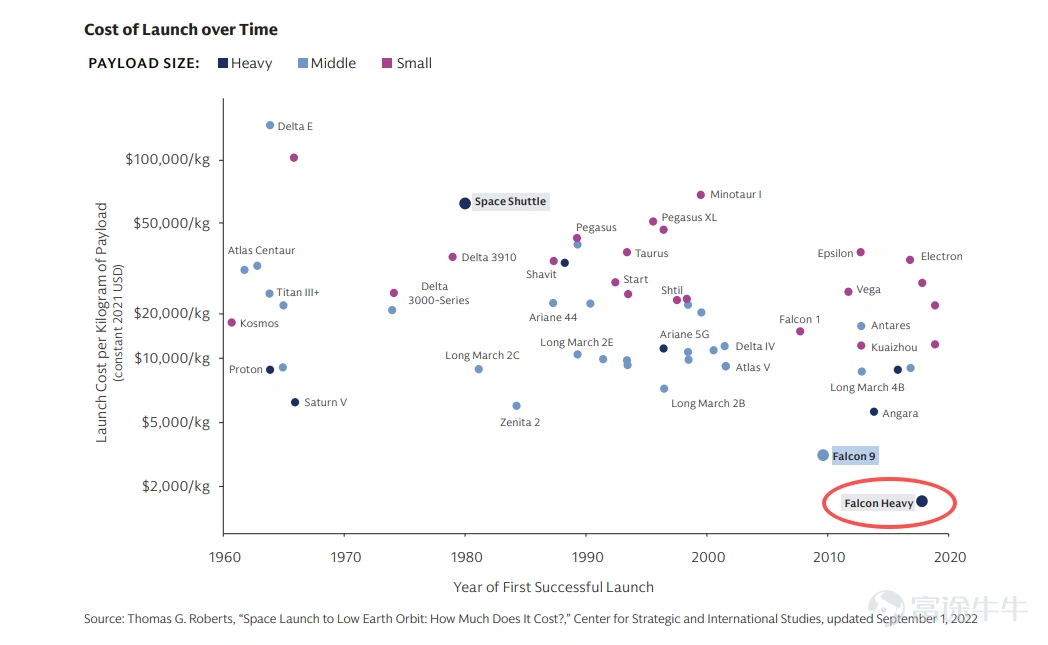
Source: Goldman Sachs
Reusable rockets have transformed high-priced launch vehicles, which were previously single-use, into reusable infrastructure. With lower launch costs, large-scale deployment of small satellites and low-Earth orbit satellite constellations has become possible, turning commercial spaceflight from a high-barrier project accessible only to a few governments into an industry capable of generating sustainable revenue.Furthermore, Starlink has demonstrated that low-cost launch capabilities can be translated into a viable business model.
Data cited by Goldman Sachs shows that Starlink serves over 10 million customers, with revenues exceeding $11 billion in 2025. Its low-Earth orbit (LEO) satellite constellation comprises nearly 10,000 satellites, with approvals for deploying thousands more in the coming years.
Consequently, the valuation logic for SpaceX has shifted from merely questioning "whether rockets can launch successfully" to assessing its ability to leverage low-cost launch capabilities to continuously expand its satellite network, grow its user base and revenue, and then reinvest cash flow and capital market financing into further expansion.
Low-cost launches, satellite deployment, telecommunications revenue, and capital investment are forming a mutually reinforcing commercial flywheel.
2. Institutions are not betting on rockets, but on a space infrastructure platform.
This also explains why Google, NVIDIA, Fidelity, and sovereign wealth funds all appear on SpaceX's shareholder list.
SpaceX has integrated rocket launches, satellite manufacturing, LEO constellations, and terminal communication services into a single platform. It controls the most critical upstream bottleneck in commercial aerospace—low-cost launch capability—while also gaining direct access to the global telecommunications market through Starlink.
For tech giants, SpaceX connects cloud computing, artificial intelligence, global networks, and data infrastructure. For long-term institutional investors, Starlink transforms SpaceX from an aerospace company heavily reliant on project-based revenue into an infrastructure platform with recurring revenue streams.
In other words, these institutions are not betting on individual rocket launches, but on SpaceX's control over future space communication gateways, orbital resources, and launch capabilities.
From a single company to a new institutional asset class
Changes in SpaceX's shareholder structure are occurring in tandem with the broader capitalization of the space industry.
Goldman Sachs projects that the global space economy could reach $1.8 trillion by 2035. In 2025, the space industry attracted over $55 billion in investment; in Q1 2026 alone, investment hit a record $36 billion.
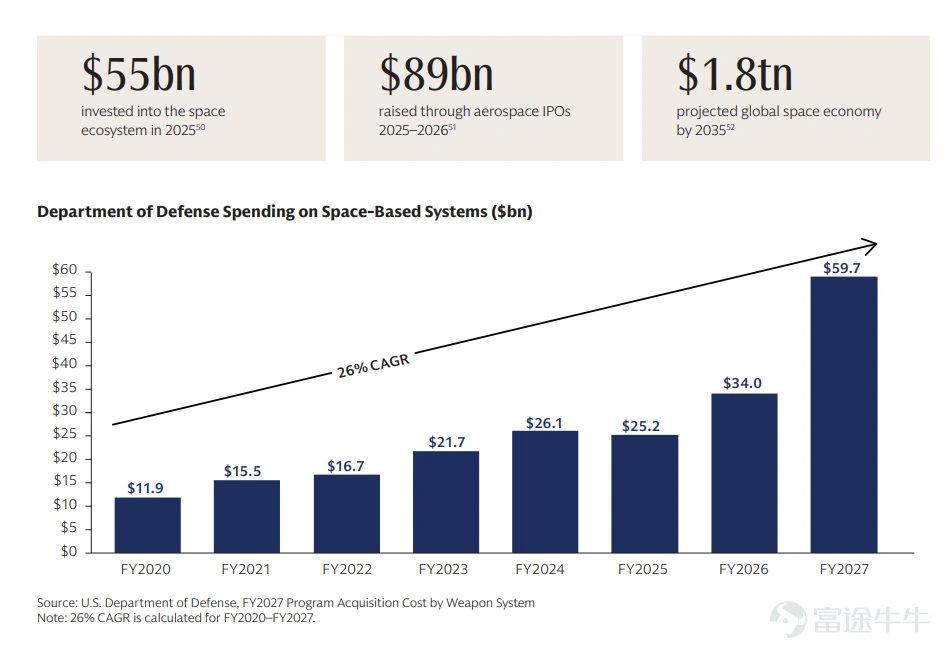
Source: Goldman Sachs
Meanwhile, financing channels for aerospace companies are gradually expanding from government budgets and private venture capital to public markets. According to Goldman Sachs data,Since 2025, aerospace companies have raised approximately $89 billion through IPOs, with SpaceX accounting for the vast majority.
The entry into public markets has not only provided aerospace companies with the substantial capital needed to build launch capabilities, satellite factories, and communication networks, but has also brought greater transparency to valuations, holdings, and capital flows within the space industry. This allows traditional asset managers to formally incorporate commercial space ventures into their portfolios.
Therefore, the SpaceX shareholder map is more than just a ranking of holdings. It truly reflects the space economy's transition from a niche track in venture capital to a mainstream market where large institutions jointly participate in price discovery.
From Google and NVIDIA to Fidelity and sovereign wealth funds, global capital is racing to secure early access to the core gateways of the space age. The market is betting not just on SpaceX, but on a new industrial cycle that could reach a scale of $1.8 trillion.
Risk Disclaimer: The above content only represents the author's view. It does not represent any position or investment advice of Futu. Futu makes no representation or warranty.Read more


Comments (29)
to post a comment
95
202