English
Back
Open Account
US-Japan Intervene to Prop Up Yen — What's Next for US Stocks?

Option Mover The Moo
joined discussion · Aug 17 17:34

Daily Options Income Strategy | SNOW rebounds nearly 150% from lows, major banks frequently raise target prices: How to use options for precise positioning?

I. Market Barometer
The US AI application software sector experienced a pullback in the previous trading session, $Snowflake (SNOW.US)$ After consecutive gains, it spiked and then fell back, closing down 2.51%. Profit-taking pressure at high levels within the sector became evident, and increased volatility provided a favorable window for option selling strategies.
II. Watchlist Highlights
SNOW: Major banks intensify target price hikes vs. high-level consolidation and pullback to find support
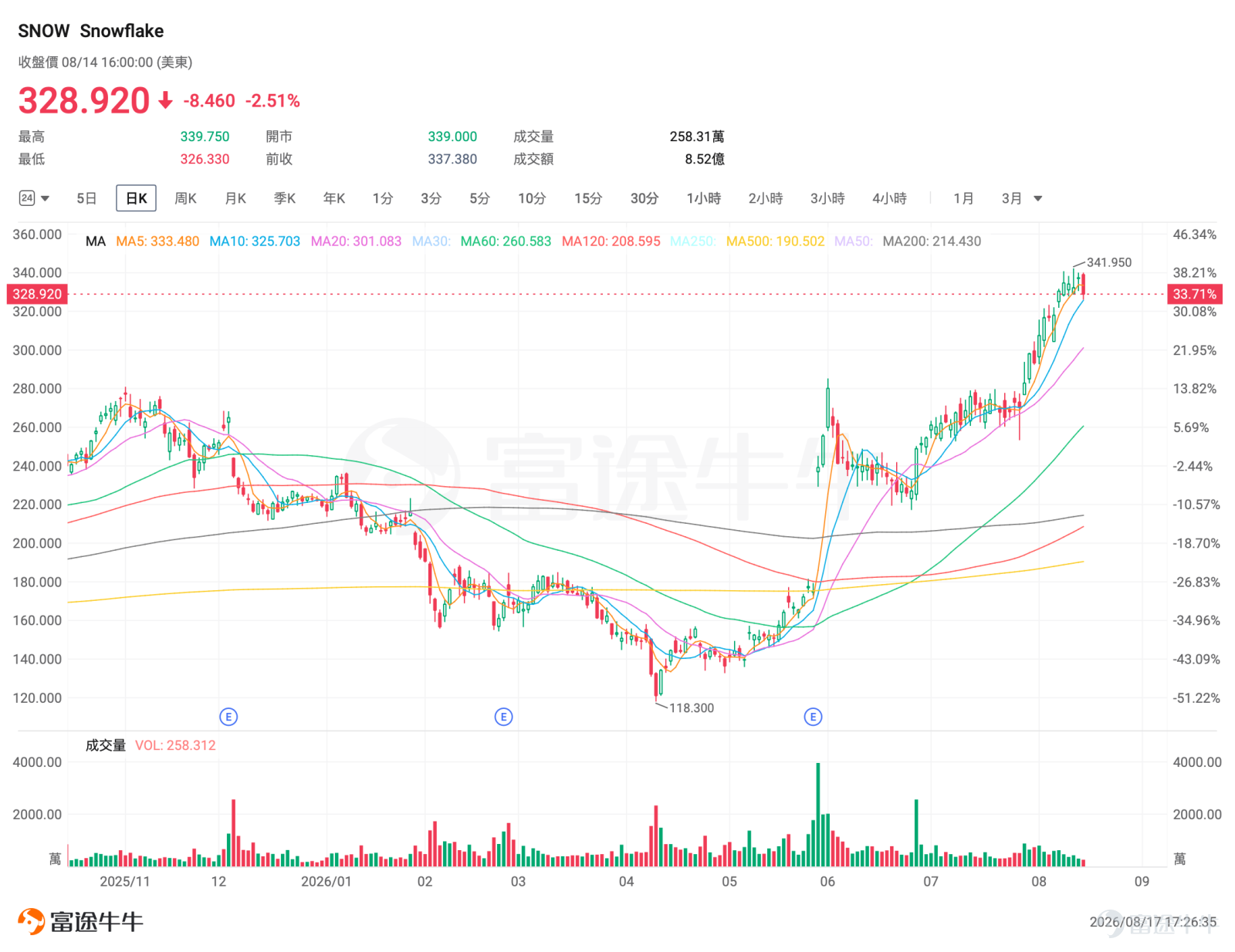
$Snowflake (SNOW.US)$ After opening higher at $339.00 in the previous trading session, the stock quickly surged to $339.75, then fluctuated lower throughout the day, finally closing at $328.92, a drop of 2.51%. The company's share price has rebounded nearly 150% from its year-to-date low of $118.3. Trading volume in the previous session was $852 million, with a volume ratio of only 0.589, indicating that the selling pressure was not driven by panic selling on heavy volume, but rather by active profit-taking from holders looking to reduce positions at highs.
I. Market Barometer The US AI application software sector experienced a pullback in the previous trading session, $Snowflake (SNOW.US)$ After consecutive gains, it spiked and then fell back, closing down 2.51%. Profit-taking pressure at high levels within the sector became evident, and increased volatility provided a favorable window for option selling strategies. II. Watchlist Highlights SNOW: Major Banks Frequently Raise Target Prices vs. High-Level Consolidation and Pullback Seeking Support $Snowflake (SNOW.US)$ In the previous trading session, the stock opened higher at $339.00, quickly surged to $339.75, then trended lower throughout the day, finally closing at $328.92, a drop of 2.51%. Since rebounding from its year-to-date low of $118.3, the company's share price has risen by nearly 150%. Trading volume on the previous day was $852 million, with a volume ratio of only 0.589, indicating that the selling pressure was not due to panic selling with heavy volume, but rather active position reduction by investors taking profits at high levels. From a technical perspective, SNOW initiated its main upward wave from around $175 following its earnings release in late May, accelerated upwards from late July to early August, and hit a recent high of $341.95 on August 12. Currently, the stock is in a state of high-level consolidation and pullback. While the moving average system remains in a bullish alignment, a solid bearish candlestick appeared after several days of narrow fluctuations in the $320–$340 range, suggesting short-term technical correction pressure. Recently, multiple major Wall Street banks have frequently raised their target prices for SNOW...
From a technical perspective, SNOW initiated its main upward wave from around $175 following its earnings release in late May, accelerated upwards from late July to early August, and hit a recent high of $341.95 on August 12. The current share price is in a state of high-level consolidation and pullback. While the moving average system remains in a bullish alignment, a solid bearish candlestick has appeared after several days of narrow fluctuations in the $320–$340 range, indicating short-term pressure for a technical correction.
Recently, multiple major Wall Street banks have intensively raised their target prices for SNOW. Jefferies significantly increased its target price from $310 to $385, maintaining a "Buy" rating; RBC Capital raised its target price from $313 to $372, maintaining an "Outperform" rating. The concentrated upward revisions by major banks indicate growing institutional recognition of SNOW's AI data cloud strategy. However, as the share price has already surged more than 80% from its post-earnings low, short-term valuation digestion pressure is simultaneously increasing.
I. Market Barometer The US AI application software sector experienced a pullback in the previous trading session, $Snowflake (SNOW.US)$ After consecutive gains, it spiked and then fell back, closing down 2.51%. Profit-taking pressure at high levels within the sector became evident, and increased volatility provided a favorable window for option selling strategies. II. Watchlist Highlights SNOW: Major Banks Frequently Raise Target Prices vs. High-Level Consolidation and Pullback Seeking Support $Snowflake (SNOW.US)$ In the previous trading session, the stock opened higher at $339.00, quickly surged to $339.75, then trended lower throughout the day, finally closing at $328.92, a drop of 2.51%. Since rebounding from its year-to-date low of $118.3, the company's share price has risen by nearly 150%. Trading volume on the previous day was $852 million, with a volume ratio of only 0.589, indicating that the selling pressure was not due to panic selling with heavy volume, but rather active position reduction by investors taking profits at high levels. From a technical perspective, SNOW initiated its main upward wave from around $175 following its earnings release in late May, accelerated upwards from late July to early August, and hit a recent high of $341.95 on August 12. Currently, the stock is in a state of high-level consolidation and pullback. While the moving average system remains in a bullish alignment, a solid bearish candlestick appeared after several days of narrow fluctuations in the $320–$340 range, suggesting short-term technical correction pressure. Recently, multiple major Wall Street banks have frequently raised their target prices for SNOW...
SNOW is scheduled to release its earnings report on September 2. Market focus is centered on whether revenue growth can continue to maintain a high rate of around 30% in Q2 of fiscal year 2027, and whether the pace of narrowing losses meets expectations.
3. Options Premium Collection Strategy
1. Cash Secured Put
Sell 1 contract of $Snowflake (SNOW.US)$260904 280P, estimated margin required (for reference only): $28,000
I. Market Barometer The US AI application software sector experienced a pullback in the previous trading session, $Snowflake (SNOW.US)$ After consecutive gains, it spiked and then fell back, closing down 2.51%. Profit-taking pressure at high levels within the sector became evident, and increased volatility provided a favorable window for option selling strategies. II. Watchlist Highlights SNOW: Major Banks Frequently Raise Target Prices vs. High-Level Consolidation and Pullback Seeking Support $Snowflake (SNOW.US)$ In the previous trading session, the stock opened higher at $339.00, quickly surged to $339.75, then trended lower throughout the day, finally closing at $328.92, a drop of 2.51%. Since rebounding from its year-to-date low of $118.3, the company's share price has risen by nearly 150%. Trading volume on the previous day was $852 million, with a volume ratio of only 0.589, indicating that the selling pressure was not due to panic selling with heavy volume, but rather active position reduction by investors taking profits at high levels. From a technical perspective, SNOW initiated its main upward wave from around $175 following its earnings release in late May, accelerated upwards from late July to early August, and hit a recent high of $341.95 on August 12. Currently, the stock is in a state of high-level consolidation and pullback. While the moving average system remains in a bullish alignment, a solid bearish candlestick appeared after several days of narrow fluctuations in the $320–$340 range, suggesting short-term technical correction pressure. Recently, multiple major Wall Street banks have frequently raised their target prices for SNOW...
Opportunity Rationale:
For investors who agree with $Snowflake (SNOW.US)$ For investors who recognize the long-term value of the AI data cloud but have not yet established positions, the risk of chasing highs increases in the short term as the stock pulls back after hitting new highs.
The intensive bullish actions by institutions provide institutional endorsement for medium-to-long-term upside potential. By selling put options, investors can earn premium income in a high implied volatility (IV) environment if the stock consolidates in the high-price region or continues to rise; if the stock pulls back to around $280 due to profit-taking pressure, there is also an opportunity to establish positions at a more attractive price.
2. Covered Call
Hold 100 shares $Snowflake (SNOW.US)$, sell 1 contract of $Snowflake (SNOW.US)$ 260911 395C
I. Market Barometer The US AI application software sector experienced a pullback in the previous trading session, $Snowflake (SNOW.US)$ After consecutive gains, it spiked and then fell back, closing down 2.51%. Profit-taking pressure at high levels within the sector became evident, and increased volatility provided a favorable window for option selling strategies. II. Watchlist Highlights SNOW: Major Banks Frequently Raise Target Prices vs. High-Level Consolidation and Pullback Seeking Support $Snowflake (SNOW.US)$ In the previous trading session, the stock opened higher at $339.00, quickly surged to $339.75, then trended lower throughout the day, finally closing at $328.92, a drop of 2.51%. Since rebounding from its year-to-date low of $118.3, the company's share price has risen by nearly 150%. Trading volume on the previous day was $852 million, with a volume ratio of only 0.589, indicating that the selling pressure was not due to panic selling with heavy volume, but rather active position reduction by investors taking profits at high levels. From a technical perspective, SNOW initiated its main upward wave from around $175 following its earnings release in late May, accelerated upwards from late July to early August, and hit a recent high of $341.95 on August 12. Currently, the stock is in a state of high-level consolidation and pullback. While the moving average system remains in a bullish alignment, a solid bearish candlestick appeared after several days of narrow fluctuations in the $320–$340 range, suggesting short-term technical correction pressure. Recently, multiple major Wall Street banks have frequently raised their target prices for SNOW...
Opportunity Rationale:
For investors already holding Snowflake, the short-term share price faces significant resistance after hitting new highs. The RSI has retreated from extremely overbought territory, indicating a need for further short-term consolidation.
If investors are bullish on the company's long-term growth in the AI data cloud sector but concerned about a technical pullback following short-term overbought conditions, they can sell call options. If the stock price consolidates at current levels, the premium income can gradually reduce the position cost; if the Q2 earnings beat expectations and drive the stock price to break its previous high of $395, resulting in assignment, it would effectively amount to taking partial profits near historical highs.
IV. Risk Management Advisory
Although seller strategies have a high win rate, investors must still implement proper risk management:
Position management is everything.: The biggest risk for option sellers lies in black swan events. It is recommended that margin allocated to any single underlying should not exceed 20% of total capital. Never sell options beyond your capacity to absorb losses just for the sake of collecting higher premiums.
Covered Call and Timely Rolling: When a covered call becomes deeply in-the-money (i.e., the stock price far exceeds the strike price), if you remain bullish on the underlying stock, you should decisively 'roll' the position—buy to close the current option and simultaneously sell a longer-dated call with a higher strike price—to avoid having your shares called away at an unattractive price.
Cash-secured put options: Beware of 'left-tail risk': For cash-secured puts, if the stock price crashes due to fundamental deterioration (rather than a normal pullback), don’t hold on stubbornly. In such cases, exit with a stop-loss or roll the position down to buy time while waiting for volatility to normalize.
Make good use of the Options Seller Hub to understand income strategies for selling options and earnOption premiums
I. Market Barometer The US AI application software sector experienced a pullback in the previous trading session, $Snowflake (SNOW.US)$ After consecutive gains, it spiked and then fell back, closing down 2.51%. Profit-taking pressure at high levels within the sector became evident, and increased volatility provided a favorable window for option selling strategies. II. Watchlist Highlights SNOW: Major Banks Frequently Raise Target Prices vs. High-Level Consolidation and Pullback Seeking Support $Snowflake (SNOW.US)$ In the previous trading session, the stock opened higher at $339.00, quickly surged to $339.75, then trended lower throughout the day, finally closing at $328.92, a drop of 2.51%. Since rebounding from its year-to-date low of $118.3, the company's share price has risen by nearly 150%. Trading volume on the previous day was $852 million, with a volume ratio of only 0.589, indicating that the selling pressure was not due to panic selling with heavy volume, but rather active position reduction by investors taking profits at high levels. From a technical perspective, SNOW initiated its main upward wave from around $175 following its earnings release in late May, accelerated upwards from late July to early August, and hit a recent high of $341.95 on August 12. Currently, the stock is in a state of high-level consolidation and pullback. While the moving average system remains in a bullish alignment, a solid bearish candlestick appeared after several days of narrow fluctuations in the $320–$340 range, suggesting short-term technical correction pressure. Recently, multiple major Wall Street banks have frequently raised their target prices for SNOW...
Options Risk Disclosure
An option is a contract that gives the holder the right—but not the obligation—to buy or sell an underlying asset at a predetermined price on or before a specified date. Option prices are influenced by multiple factors, including the current price of the underlying asset, the strike price, time to expiration, and implied volatility. Implied volatility reflects the market's expectation of future volatility over the life of the option and is derived by back-solving from the Black-Scholes option pricing model. It is commonly viewed as an indicator of market sentiment. When investors anticipate higher volatility, they may be willing to pay more for options to hedge their risk, leading to higher implied volatility. Traders and investors use implied volatility to assess the attractiveness of option prices, identify potential mispricings, and manage risk exposure.
Disclaimer
This content does not constitute an offer, solicitation, recommendation, advice, opinion, or any guarantee regarding any securities, financial products, or instruments. The risk of loss in trading options can be substantial. In certain circumstances, your losses may exceed the initial margin deposit. Even if you place contingent orders, such as 'stop-loss' or 'limit' orders, there is no guarantee they will prevent losses. Market conditions may render such orders unexecutable. You may be required to deposit additional margin on short notice. If you fail to meet the required margin within the specified timeframe, your open positions may be liquidated. Nevertheless, you remain fully responsible for any resulting deficit in your account. Therefore, prior to trading options, you should thoroughly study and understand options and carefully consider whether such trading aligns with your financial situation and investment objectives. If you trade options, you should become familiar with the procedures for exercising options and handling expiration, as well as your rights and obligations upon exercise or expiration. Options trading involves substantial risk and is not suitable for all investors. Investors should carefully read 'Characteristics and Risks of Standardized Options' before engaging in any options trading strategy.
Risk Disclaimer: The above content only represents the author's view. It does not represent any position or investment advice of Futu. Futu makes no representation or warranty.Read more
Heart
1
Thumbs Up
2
39K Views
Report
Comments
Write a Comment...
3
7