
US CPI data released Wednesday! Combined with major Hong Kong stock earnings reports, what should yo

[This Week's Market Watch] Alibaba, Xiaomi, Pop Mart, and Walmart are set to release earnings sequentially. With four major investment opportunities emerging, how should you position your portfolio for maximum stability?
Hello, fellow investors!
As we enter mid-to-late August, the strategic博弈 in global financial markets has intensified once again. The diverging policy paths of the US and Japanese central banks, evolving geopolitical dynamics, and the dense disclosure of earnings reports in both Hong Kong and the US are jointly reshaping market pricing logic. For investors seeking steady returns and aiming to optimize global asset allocation, this week represents a critical window of opportunity. This article will review the core market changes from last week and provide an in-depth analysis of macroeconomic and sector-specific investment opportunities for the current week.
🔍 Last Week's Market Core Review: Intertwined Bull-Bear Dynamics and Sector Divergence
The core market dynamics of last week can be summarized in the following five points:
– US stocks fluctuated at high levels, with long-end interest rates remaining under pressure: Although softer-than-expected US July CPI and PPI data fueled market expectations for a Fed rate cut in September, the yield on the 10-year US Treasury note remained elevated near 4.69%. This reflects persistent fiscal supply pressures and inflation expectations, meaning high-valuation growth stocks have not seen a broad-based valuation expansion.
– Hong Kong stocks showed weak performance, with platform stocks releasing risk ahead of earnings: The Hang Seng Index fell 2.15% for the week, while the Hang Seng Tech Index dropped 3.10%. Platform stocks such as Tencent, JD.com, and Kuaishou saw significant pullbacks ahead of their earnings releases, indicating cautious market sentiment during the reporting period. Although trends in gold, silver, and innovative drugs remain intact, valuations are no longer cheap, making the risk-reward ratio for chasing highs significantly less attractive.
– Oil prices driven by events, energy sector surges against the trend: Shipping disruptions in the Strait of Hormuz pushed Brent crude oil to $88.52 per barrel. Stimulated by this, the US energy sector surged 7.67% for the week, defying the broader market trend. However, such opportunities are highly dependent on geopolitical developments and may not be suitable as long-term trend positions.
– The AI industry enters a "financialization" phase, with clear internal divergence: NVIDIA has partnered with several top-tier institutions to establish a financing platform worth up to $500 billion. Market focus is shifting from mere capacity expansion to financing costs and return on investment (ROI). Individual stock performance is highly divergent: Taiwan Semiconductor and AMD remain strong, while some equipment stocks with high expectations (such as AMAT) have pulled back.
– Memory chips have become the strongest sub-sector, but short-term gains are overly rapid: Driven by positive industry news, SanDisk (SNDK) surged 35.38% in a single week, and Micron (MU) also rose 10.72%. However, stock prices have quickly priced in these positives in the short term; it may be prudent to wait for a pullback to digest the gains.
I. Major Macro Events and Market Opportunities
[Event 1] Divergence in US and Japanese Monetary Policy: Fed Minutes and Japanese Economic Data
This week, the two focal points of the global macro market are the Federal Reserve (Fed) and the Bank of Japan (BOJ). On August 19, the Fed will release the FOMC meeting minutes, allowing the market to gauge the latest divergence among officials regarding the interest rate cut path. Meanwhile, Japan will release its Q2 GDP data this week, followed by CPI data on August 21. Currently, market expectations for a BOJ rate hike in September have soared to the 76%-80% range.
– Opportunity Analysis:The narrowing interest rate differential between the US and Japan is one of the most certain macro trends for the second half of the year. If Japan's GDP and CPI data continue to strengthen, it will further pressure the BOJ to tighten monetary policy. This will not only push up the yen but may also trigger an accelerated repatriation of funds from global "yen carry trades," causing liquidity squeezes for high-beta growth assets worldwide.
– Investor Focus:Investors should remain highly vigilant in their asset allocation.If you hold a significant position in high-premium US tech stocks, it is advisable to moderately control your leverage ratio. At the same time, look for opportunities to buy dips in yen-denominated assets or the Japanese banking sector,leveraging the yen's appreciation trend to provide a natural hedging barrier for your portfolio.
[Event 2] Release of China's July Core Economic Data and LPR Rate Announcement
Today (August 17), mainland China released key macroeconomic data, including industrial value-added and total retail sales of consumer goods. Additionally, the new Loan Prime Rate (LPR) will be announced on August 20, serving as a crucial indicator for assessing China's monetary and credit environment.
– Opportunity Analysis:Current pricing in the Hong Kong stock market has already fully reflected pessimistic expectations. If this week's economic data shows signs of stabilization, or if the LPR quote signals unexpectedly loose monetary policy, it could help reverse the current weakness in HK stocks, bringing about a phased valuation repair for oversold HK equity assets.
– Investor Focus:Regarding investment strategies for HK stocks, we do not recommend simply betting on whether the data is 'good' or 'bad,' nor relying solely on 'oversold bounce-backs.' Investors may consider adopting a 'defensive as offensive' strategy,focusing on dividend-paying assets from central and state-owned enterprises (SOEs) that feature stable cash flows, low valuations, and high dividends (such as large Chinese telecom stocks and the coal sector). Before macroeconomic data becomes clear, accumulating positions in batches is a more prudent choice.
II. Key Industry Developments and Market Opportunities
[Event 1] HK Stocks Super Earnings Week: Testing the 'Quality' of Platform Stocks and Global Expansion Leaders
This week, HK stocks enter a dense period of earnings verification. Xiaomi Group ( $XIAOMI-W (01810.HK)$ , August 18), Kuaishou-W ( $KUAISHOU-W (01024.HK)$ , August 19), Alibaba-SW ( $BABA-W (09988.HK)$$Alibaba (BABA.US)$ , August 20), NetEase-S ( $NTES (09999.HK)$$NetEase (NTES.US)$ , August 20) and other tech giants, as well as Pop Mart, the leader in overseas consumer goods ( $POP MART (09992.HK)$ , August 20), will sequentially release their latest earnings.
– Opportunity Analysis:In the current market environment, capital is extremely strict in scrutinizing the technology and consumer sectors. For platform stocks, the market no longer buys into mere "stories," but instead focuses on whether AI investments can be effectively converted into cloud business revenue, as well as the profit margins and free cash flow status of companies amidst fierce competition; for overseas expansion sectors like Pop Mart, it is necessary to verify the quality of same-store sales growth abroad and the realization of operating leverage.
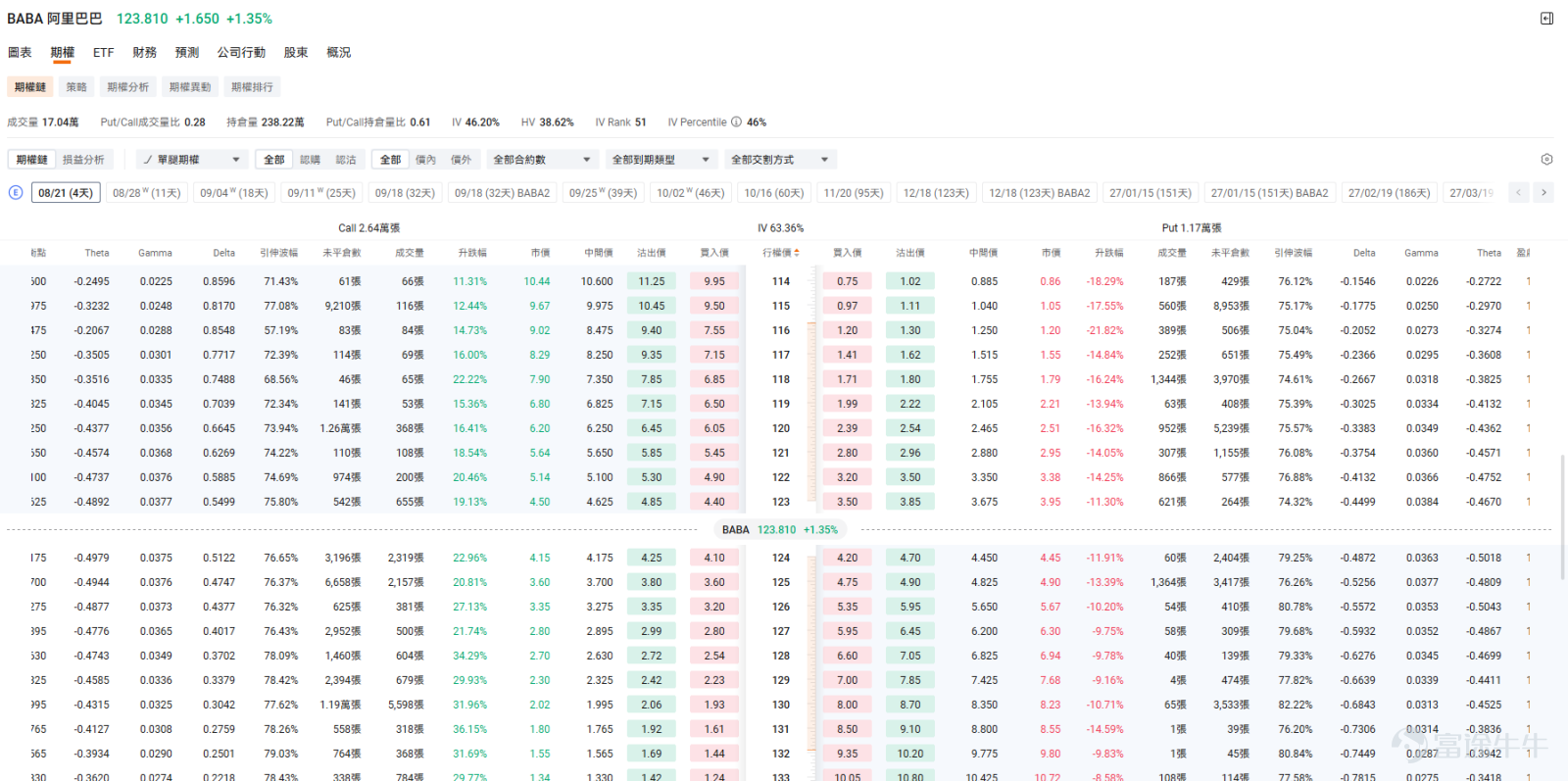
◦ Regarding $TENCENT (00700.HK)$As for Alibaba ($BABA-W (09988.HK)$$Alibaba (BABA.US)$): pay attention to the intensity of share buybacks and the growth rate of cloud business in its financial report.
◦ Regarding $POP MART (09992.HK)$: Due to the significant prior price increase and extremely high market expectations, pay attention to the health of its overseas inventory and gross margin indicators.
◦ For $KUAISHOU-W (01024.HK)$ , be wary of the pressure on short-term profit margins caused by the slowdown in e-commerce business growth.
– Investor Focus:
If you are bullish on the above stocks, you may consider holding the underlying shares or using option strategies to seek higher returns. You can find the "Options" section on the individual stock detail pages for relevant stocks.

[Event 2] Kickoff of US Retail Earnings and Valuation Reset in the AI Sector
The US stock market faces multiple tests this week. On one hand, retail giants such as Walmart (WMT), Home Depot (HD), and Target (TGT) are releasing their earnings reports sequentially, which will directly reflect the true state of US private consumption. On the other hand, with NVIDIA establishing its financing platform, the AI infrastructure sector (particularly memory chips) is facing a tug-of-war between valuation levels and the pace of earnings realization.
– Opportunity Analysis:Same-store sales and inventory data from retailers serve as key indicators for verifying whether the US economy is achieving a 'soft landing.' If consumer data remains resilient, it will provide support for the broader market. In the AI sector, while the industrial logic for memory chips (such as SNDK, MU) remains strong, stock prices have significantly priced in earnings expectations for the next few quarters following recent short-term surges.
– Investor Focus:
◦ Defensive Consumer Allocation in US Stocks: This Thursday will see earnings releases from several consumer giants, such as $Walmart (WMT.US)$、 $Target (TGT.US)$、 $Home Depot (HD.US)$、 $Lowe's Companies (LOW.US)$、$TJX Companies (TJX.US)$ and $Ross Stores (ROST.US)$ These companies cover various consumer segments including supermarkets, home improvement, and discount retail. Their results will help verify whether US consumption, same-store sales, inventory levels, and profit margins continue to cool down, thereby assisting investors in judging whether subsequent US household consumption will remain strong or slow down.
◦ Continue to monitor whether earnings expectations in the memory sector can keep pace with stock prices: $SanDisk (SNDK.US)$ 、 $Micron Technology (MU.US)$ The industrial logic remains strong, but the Bollinger Bands (BOLL) have clearly heated up. It is recommended to watch whether EPS continues to rise and whether memory prices remain strong. If earnings expectations fail to keep up, there may be a pullback following the realization of positive news.
◦ AI Infrastructure Shifts from Order-Based Trading to Financing/ROIC-Based Trading: $NVIDIA (NVDA.US)$ $500 billion financing platform, $CoreWeave (CRWV.US)$ / $NEBIUS (NBIS.US)$Capital expenditure and financing costs will become the new framework for analysis. Demand has not been disproven, but future valuation disparities will be driven more by asset utilization, interest costs, free cash flow (FCF), and return on capital.
Investing is not a 100-meter sprint, but a marathon that tests endurance and discipline. Amidst the mix of bullish and bearish factors this week, staying calm, diversifying assets, and actively managing risk are the only secrets to steady and long-term success in wealth management. We hope this week's investment navigation inspires your financial decisions. Wishing you all successful investing this week!
Risk Disclaimer: The above content only represents the author's view. It does not represent any position or investment advice of Futu. Futu makes no representation or warranty.Read more


Comment (1)
to post a comment
21
13