Institutional Q2 Holdings Revealed! What Is "Smart Money" Buying?

13F Secrets Revealed | Top Institutions' Q2 Holdings Disclosed: Buffett Buys Google, Cathie Wood Bets on SpaceX
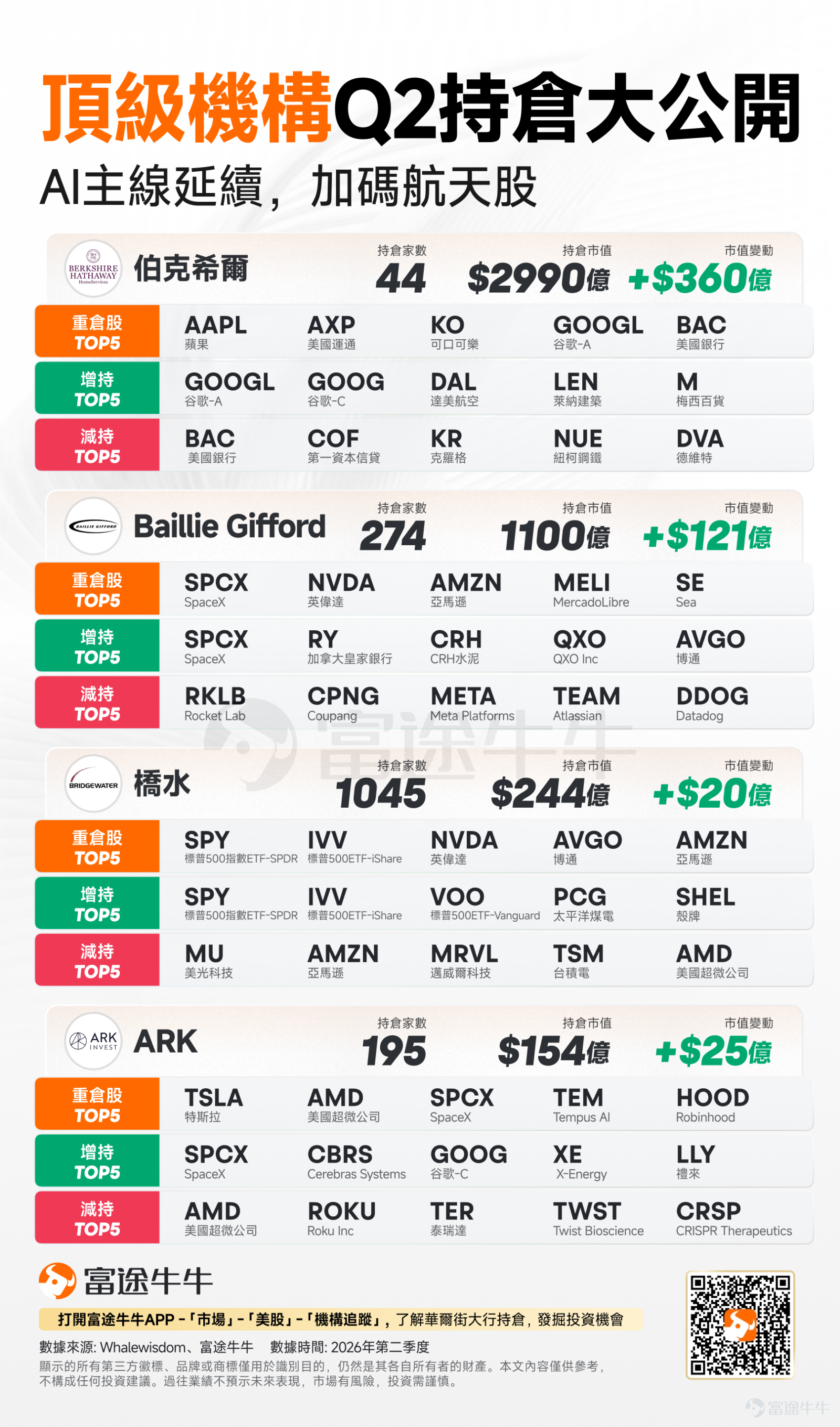
The 13F filings for the second quarter of 2026 are being released sequentially. Based on the latest portfolio changes from Berkshire Hathaway, Baillie Gifford, Bridgewater, and ARK, although their investment styles differ significantly, one common trend is clearly evident—AI remains the core theme in institutional allocations, while the aerospace industry is emerging as the next major focus after AI.
Looking at specific portfolio adjustments, institutions are not simply chasing hot concepts; instead, they are reallocating capital across AI, computing infrastructure, aerospace technology, and economic cycle recovery.
Specifically:
1. Berkshire Hathaway: Embracing Tech Giants, Balancing Cyclical Allocations
Berkshire Hathaway's top five holdings still consist of $Apple (AAPL.US)$ 、 $American Express (AXP.US)$ 、 $Coca-Cola (KO.US)$ 、 $Alphabet-C (GOOG.US)$ and $Bank of America (BAC.US)$ , but the most significant change this quarter is undoubtedly the continued increase in its stake in Google, alongside a reduction in financial stocks such as Bank of America.
In the past, market discussions about $Alphabet-C (GOOG.US)$ focused more on its monopoly status in search business; however, in the AI era, Google possesses the Gemini large language model, Google Cloud, the YouTube ecosystem, and vast data resources, making it one of the few global tech platforms with a complete AI ecosystem loop. For Berkshire, which has always prioritized moats and free cash flow, such assets that combine growth potential with profitability are becoming increasingly attractive.
On the other hand, Berkshire's increased holdings in $Delta Air Lines (DAL.US)$ 、 $Lennar Corp (LEN.US)$ and $Macy's (M.US)$ also indicate that it is not betting entirely on tech, but is simultaneously positioning for consumption and real estate recovery opportunities against the backdrop of a soft landing for the US economy.
2. Baillie Gifford: Sticking to Growth, Betting on Frontier Tech and Commercial Spaceflight
As one of the most representative growth investment institutions globally, Baillie Gifford's most notable move this quarter was disclosing $SpaceX (SPCX.US)$ its position in its portfolio.
If Baillie Gifford correctly bet on $Tesla (TSLA.US)$ 、 $Amazon (AMZN.US)$ super-growth stocks like NVIDIA over the past decade, then SpaceX is now clearly being viewed as the next potential trillion-dollar platform.
From an industry perspective, $SpaceX (SPCX.US)$ its value no longer stems solely from rocket launch services. Starlink's satellite internet is gradually generating stable cash flows, while reusable rocket technology continues to lower launch costs, establishing a high barrier to entry in the global commercial space market.
Meanwhile, Baillie Gifford increased its holdings in $Broadcom (AVGO.US)$ , signaling its continued optimism about the growing demand for high-speed networks and customized chips in the AI era.
Notably, the institution chose to reduce its holdings in $Rocket Lab (RKLB.US)$ 、 $Datadog (DDOG.US)$ and $Meta Platforms (META.US)$ ...and other underlying assets. The reduction in RKLB holdings is particularly representative, reflecting a shift within the aerospace sector towards allocating capital to market leaders, with funds further tilting toward SpaceX.
3. Bridgewater: Macro hedging; AI chip stocks see "profit-taking"
Unlike growth-oriented institutions, Bridgewater's portfolio adjustments always carry a distinct macro-allocation character.
This quarter, Bridgewater significantly increased its holdings in $SPDR S&P 500 ETF (SPY.US)$ 、 $iShares Core S&P 500 ETF (IVV.US)$ and $Vanguard S&P 500 ETF (VOO.US)$ S&P 500 ETFs, while also increasing its allocation to Pacific Gas & Electric (PCG) and Shell (SHEL).
This indicates that Bridgewater remains relatively optimistic about the US economy and corporate earnings, but chooses to capture market returns through indexed investing rather than concentrating bets on individual hot stocks.
More noteworthy is its adjustment to the AI semiconductor sector.
This quarter, Bridgewater reduced its holdings in $Taiwan Semiconductor (TSM.US)$ 、 $Advanced Micro Devices (AMD.US)$ 、 $Micron Technology (MU.US)$ and $Marvell Technology (MRVL.US)$ several companies in the AI supply chain. This does not mean Bridgewater is bearish on AI; on the contrary, it retains$NVIDIA (NVDA.US)$ and $Broadcom (AVGO.US)$ market-leading companies in its core holdings.
Following a sustained rally in the AI hardware sector, Bridgewater has begun taking phased profits to reduce portfolio volatility, reallocating some capital into energy, utilities, and index assets.
4. ARK Invest: Extreme Innovation, Positioning for the Next Generation of AI and the Space Economy
ARK continued to increase its holdings this quarter, $SpaceX (SPCX.US)$ 、 $Alphabet-C (GOOG.US)$ as well as emerging AI chip players, $Cerebras Systems (CBRS.US)$ while also positioning itself in nuclear energy companies. $X-Energy (XE.US)$ and $Eli Lilly and Co (LLY.US)$ 。
This aligns with Cathie Wood's consistent style of innovative investing:AI computing power expansion → Surge in electricity demand → Beneficiaries in new energy and nuclear power.
In other words, ARK's perspective is no longer limited to AI itself but is extending across the entire AI infrastructure chain.
Among them, $Cerebras Systems (CBRS.US)$ is regarded as one of the most promising new challengers in the AI chip sector; while $X-Energy (XE.US)$ represents ARK's forward-looking positioning for the impending explosion in future energy demand.
On the other hand, ARK reduced its holdings $Advanced Micro Devices (AMD.US)$ 、 $Roku Inc (ROKU.US)$ and $CRISPR Therapeutics (CRSP.US)$ in certain targets, signaling that it is taking profits from some mature growth stocks and reallocating capital to earlier-stage, high-potential emerging companies.
Compared to other institutions, ARK's strategy is the most aggressive:extending from AI applications to AI computing power, energy supply, and the space economy, aiming to capture the core beneficiaries of the next technological revolution.
5. Core Consensus on Institutional Portfolio Rebalancing
By comparing these four top-tier institutions horizontally, we can identify the following key similarities and differences:
AI remains the absolute main theme, but divergence is beginning to emerge: No institution has completely abandoned AI, but there are clear divergences in stock selection. Berkshire Hathaway chose Google, leveraging its massive consumer-facing scenarios and data moat; Baillie Gifford focuses on infrastructure leaders like NVIDIA and Broadcom; Bridgewater maintains core AI positions while reducing sector concentration; ARK is positioning early in next-generation AI chips and emerging applications.
"Commercial Spaceflight" Becomes a New Consensus Among Top-Tier Institutions: $SpaceX (SPCX.US)$ It appears in the top five heavyweight holdings and增持 (increased position) lists of both Baillie Gifford and ARK. This indicates that commercial spaceflight is gradually moving from the venture capital stage into the allocation scope of mainstream institutions. With Starlink's user growth, the acceleration of satellite internet commercialization, and rising global demand for space infrastructure, commercial spaceflight is becoming the new sector with the greatest potential for imagination after AI.
Summary:
The changes in top institutional holdings this quarter reflect not the end of the AI rally, but an upgrade in the logic behind AI investing.
Judging by capital flows, market styles have clearly diverged: conservative funds are beginning to reduce their positions in high-valuation semiconductors, rotating back into index funds and defensive assets; value-oriented funds are increasing their stakes in tech giants with strong moats; while growth-focused funds have extended their focus to commercial aerospace, nuclear energy, and next-generation AI infrastructure.
For retail investors, understanding the flow of institutional capital helps in objectively assessing market trends. If the main theme of the past two years was "AI chips," then future market attention is likely to gradually shift toward:the implementation of AI applications, security of energy supply, and the comprehensive rise of the commercial aerospace industry chain.
Understand institutional holdings to stay aligned with the latest investment trends. Market > US Stocks > Institutional Tracking

Risk Disclaimer: The above content only represents the author's view. It does not represent any position or investment advice of Futu. Futu makes no representation or warranty.Read more


Comments (8)
to post a comment
59
119