US Stock Market Talk | The Fed Resumes Rate Hikes After a Three-Year Pause! Is a New Shift Ahead for
Wall Street Brief (August 15): US stocks diverged at high levels on Friday, with small-cap stocks strengthening against the trend; the market did not enter a phase of systemic risk aversion. Cooling consumption data weighed on the broader market, while the software and cloud services sectors faced significant pressure.
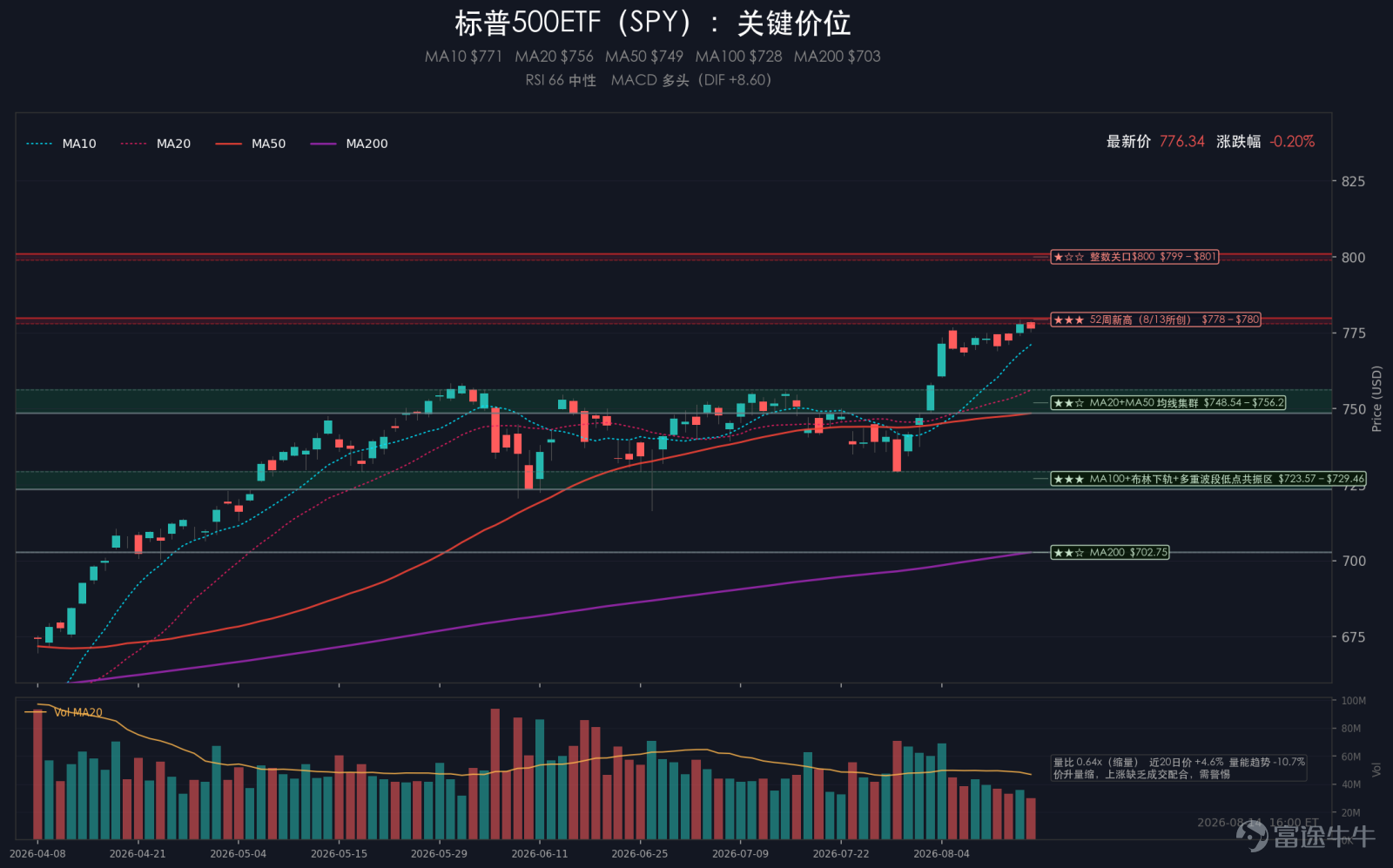
Summary: On Friday, US stocks showed divergence at high levels. The S&P 500 fell 0.17%, the Nasdaq dropped 0.28%, the Dow Jones declined 0.20%, and the Russell 2000 rose 0.51%. The four major indices did not weaken in unison; large-cap indices saw slight pullbacks, while small-cap stocks strengthened against the trend, indicating that the market is still rotating within risk assets. The VIX dropped to 14.25, down 2.60% for the day, suggesting the market is more likely consolidating at high levels rather than entering systemic risk aversion. The key variables of the day were the unexpected decline in US July retail sales and consumer confidence coming in below expectations. The market is concerned about cooling consumption but also sees stronger justification for the Federal Reserve to pause rate hikes. In terms of sector performance, cloud computing, software, and cybersecurity faced more pronounced pressure. The "Magnificent Seven" tech stocks were generally weak but did not suffer deep declines. Across major asset classes, the 10-year US Treasury yield rose to 4.696%, up 1.19%; gold closed at $4,375.63, up 0.58%; crude oil closed at $81.49, up 0.34%; Bitcoin closed at $62,886.88, down 1.01%; and the US Dollar Index closed at 99.635, down 0.32%.

I. Major Events
US July retail sales unexpectedly declined, and consumer confidence came in below expectations.
The US Department of Commerce announced on August 14 that July retail sales fell 0.6% month-over-month, the largest decline since May 2025; June saw a growth of 0.2%. On the same day, the preliminary University of Michigan Consumer Sentiment Index also came in below market expectations, as residents grew more cautious about the economy and high prices. Cooling consumption will lower corporate revenue expectations, particularly for retail, discretionary consumption, and some smaller companies; however, the data also weakens the necessity for further rate hikes. US stocks did not experience a one-sided decline on Friday; instead, small-cap stocks strengthened. This is because capital is simultaneously trading on slowing growth and reduced policy pressure.
II. Major Trends
Friday's index structure did not reflect a broad retreat. The S&P 500, Nasdaq, and Dow Jones saw slight pullbacks, while the Russell 2000 rose 0.51%, with small-cap stocks continuing to catch up as large-cap indices slowed. This looks more like a gear shift at high levels rather than a sudden reversal in risk appetite.
Looking at the two-week horizon, QQQ is up 6.26%, remaining the strongest among major index ETFs; IWM is up 4.77%, with short-term momentum accelerating. Large-cap tech stocks are still recovering, but the follow-through strength in small-cap stocks is clearer, indicating that market breadth has not been completely compressed back into a few heavyweight stocks.
Over a three-month horizon, the market is not solely supported by technology. DIA rose 7.57% and IWM rose 7.51%, both outperforming QQQ's 1.68% gain; RSP surged 9.81%, significantly beating SPY's 4.03% rise. Mid-term capital continues to seek more diversified opportunities in traditional large-cap, small-cap, and equal-weight indices.
In terms of style, the value-oriented SPYV rose 6.22% over three months, continuing to outperform the growth-oriented SPYG, which rose 2.32%. While the market acknowledges the long-term narrative of AI and big tech, it has not abandoned sectors with lower valuations and broader benefit bases.
III. Market Sentiment
The VIX closed at 14.25, down 2.60% for the day, remaining at a low absolute level. Although indices retreated slightly, demand for protection did not spike simultaneously, suggesting the market is consolidating at high levels rather than entering systemic risk-off mode. The CNN Fear & Greed Index dropped to 65 from 67, remaining in the 'greed' zone. Sentiment cooled slightly from the previous day but has not reached a level requiring significant defensive positioning.
Signals from the options market are more balanced. The CBOE total Put/Call ratio stands at 0.82, with the index option Put/Call at 0.99 and the equity option Put/Call at 0.71. Protection demand on the index side is near equilibrium, while the individual stock side still leans toward bullish trading. Capital has not completely dismissed high-level risks but remains willing to seek opportunities in individual stocks and thematic plays.
IV. Market Scan
1. Index ETFs
On Friday, the S&P 500 (SPY) fell 0.17%, the Nasdaq 100 (QQQ) dropped 0.28%, the Dow Jones (DIA) declined 0.20%, while the Russell 2000 (IWM) rose 0.51%. Among the four major indices, only small caps gained. Capital did not withdraw entirely from risk assets but rotated from high-valuation large-cap indices toward directions with higher elasticity and more dispersed prior gains.
2. Sector Performance
Among primary sectors, Energy (XLE) led with a 1.39% gain, followed by Utilities (XLU) up 0.61%, Materials (XLB) up 0.44%, and Industrials (XLI) up 0.39%. Healthcare (XLV) fell 0.60%, and Technology (XLK) dropped 0.40%. Strength was concentrated in energy, defensive, and resource-related chains, while the tech sector was weighed down by anticipated pressure on semiconductor equipment stocks.
At the sub-industry level, Oil Services (OIH) rose 2.62%, Gold Miners (GDX) gained 1.93%, Social Media (SOCL) advanced 1.70%, and Aerospace & Defense (ITA) rose 1.41%. Conversely, Cybersecurity (CIBR) fell 2.54%, Cloud Computing (SKYY) dropped 2.11%, and Software (IGV) declined 2.07%, with high-valuation software and cloud services facing more pronounced pressure. DRAM stocks rose 0.69%, showing relative resilience compared to the broader tech sector, though their strength was insufficient to drive a broader tech rebound on its own.
Differentiation continues within the AI supply chain. AI storage stocks averaged a 4.12% gain, with Seagate (STX) up 5.65%, Western Digital (WDC) up 4.41%, and Micron (MU) up 2.30%. Optical communication/module stocks averaged a 3.56% rise, led by AAOI surging 15.53% and LITE gaining 5.19%, although CIEN fell 3.17%, indicating significant internal divergence.
3. The Magnificent Seven Tech Stocks
The Magnificent Seven tech stocks were generally weak but did not suffer deep declines. Tesla (TSLA) rose 0.68% and Apple (AAPL) gained 0.22%; NVIDIA (NVDA) fell 0.06%, Google (GOOG) dropped 0.12%, Netflix declined 0.10%, Microsoft (MSFT) fell 0.30%, and Meta dropped 0.86%. Big Tech did not form a new coordinated offensive front, nor was there concentrated selling; rather, it appears to be a deceleration following the previous rebound.
4. Chinese ADRs
Chinese concept stocks overall outperformed US tech heavyweights. KWEB rose 0.60%, Bilibili (BILI) gained 2.17%, Tencent Music (TME) rose 2.08%, NetEase (NTES) advanced 2.01%, and Alibaba (BABA) increased 1.35%; Baidu (BIDU) fell 0.96% and JD.com (JD) dropped 0.82%. Capital favored content and platform recovery themes, while divergence persisted within the e-commerce sector.
5. Cryptocurrencies
Bitcoin fell 1.01%, with crypto-related stocks underperforming. MARA dipped 0.11%, RIOT dropped 1.02%, Coinbase declined 3.53%, MSTR fell 4.18%, and CRCL slid 5.01%. While Bitcoin itself saw only a modest pullback, high-beta crypto proxies suffered steeper losses as investors continue to de-risk exposure to this sector.
$S&P 500 Index (.SPX.US)$ $SPDR S&P 500 ETF (SPY.US)$ $NASDAQ 100 Index (.NDX.US)$ $Invesco QQQ Trust (QQQ.US)$ $Dow Jones Industrial Average (.DJI.US)$ $State Street® SPDR® Dow Jones Industrial Average® ETF Trust (DIA.US)$ $Russell 2000 Index (.RUT.US)$ $iShares Russell 2000 ETF (IWM.US)$ $Roundhill Magnificent Seven ETF (MAGS.US)$ $USD (USDindex.FX)$ $U.S. 10-Year Treasury Notes Yield (US10Y.BD)$ $iShares 20+ Year Treasury Bond ETF (TLT.US)$ $XAU/USD (XAUUSD.CFD)$ $SPDR Gold ETF (GLD.US)$ $CBOE Volatility S&P 500 Index (.VIX.US)$ $CME-Bitcoin RR Futures (SEP6) (BTCmain.US)$ $iShares Ethereum Trust ETF (ETHA.US)$ $NVIDIA (NVDA.US)$ $Tesla (TSLA.US)$ $Meta Platforms (META.US)$ $Amazon (AMZN.US)$ $Alphabet-C (GOOG.US)$ $Microsoft (MSFT.US)$ $Apple (AAPL.US)$
Risk Disclaimer: The above content only represents the author's view. It does not represent any position or investment advice of Futu. Futu makes no representation or warranty.Read more


Comments
to post a comment
6