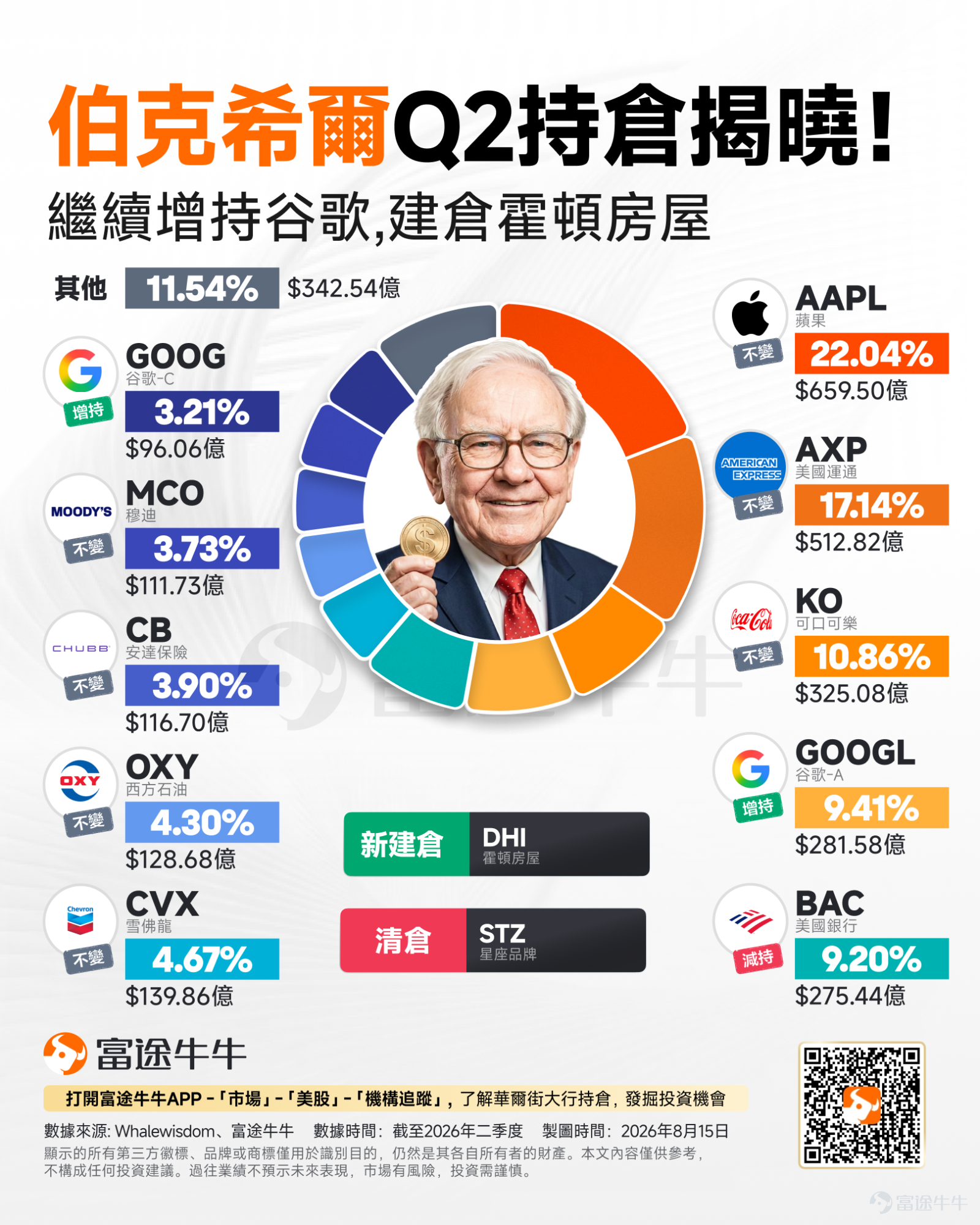
Institutional Q2 Holdings Revealed! What Is "Smart Money" Buying?

13F Filings Revealed | Berkshire Hathaway's Q2 Holdings Disclosed: Significant Increase in Google Stake Again; Housing and Aviation Emerge as New Themes
In the second quarter following Buffett's departure as CEO, Berkshire Hathaway significantly accelerated the pace of portfolio adjustments.
On August 14, Eastern Time, $Berkshire Hathaway-A (BRK.A.US)$ filed its Q2 13F document with the U.S. Securities and Exchange Commission. As of the end of June, the market value of its U.S. equity portfolio was approximately $299.3 billion, a significant increase from $263.1 billion at the end of the first quarter.
--
--
--
What truly deserves attention is not the change in portfolio market value, but the flow of capital.
Berkshire continued to significantly increase its holdings in $Alphabet-C (GOOG.US)$$Alphabet-A (GOOGL.US)$ , with a combined increase of approximately 48.1 million shares across these two types of stocks; $Delta Air Lines (DAL.US)$ saw increased positions for the second consecutive quarter, $Lennar Corp (LEN.US)$ Positions continue to expand, with symbolic re-buying $D.R. Horton (DHI.US)$ Meanwhile, $Bank of America (BAC.US)$ 、 $DaVita (DVA.US)$ 、 $The Kroger Co. (KR.US)$ and $Ally Financial (ALLY.US)$ financial, consumer, and industrial stocks such as [implied: Bank of America, etc.] continued to be reduced.
Looking at the first and second quarters together, a clearer investment theme is emerging for Berkshire under Abel’s era: retaining traditional core holdings like Apple, American Express, and Coca-Cola, while concentrating new capital into Google, airlines, and the U.S. housing supply chain.
Biggest Move: Increasing Stake in Google Again
The most notable trade in the second quarter was undoubtedly the continued increase in the Google position.
Berkshire's holdings of $Alphabet-A (GOOGL.US)$ increased from approximately 54.25 million shares to 78.79 million shares, an addition of about 24.54 million shares in a single quarter; $Alphabet-C (GOOG.US)$ while [implied: another holding] surged from approximately 3.59 million shares to 27.19 million shares, an increase of about 23.60 million shares.
After two consecutive quarters of accumulation, Google has rapidly evolved from a new position in Berkshire's portfolio into a core holding.
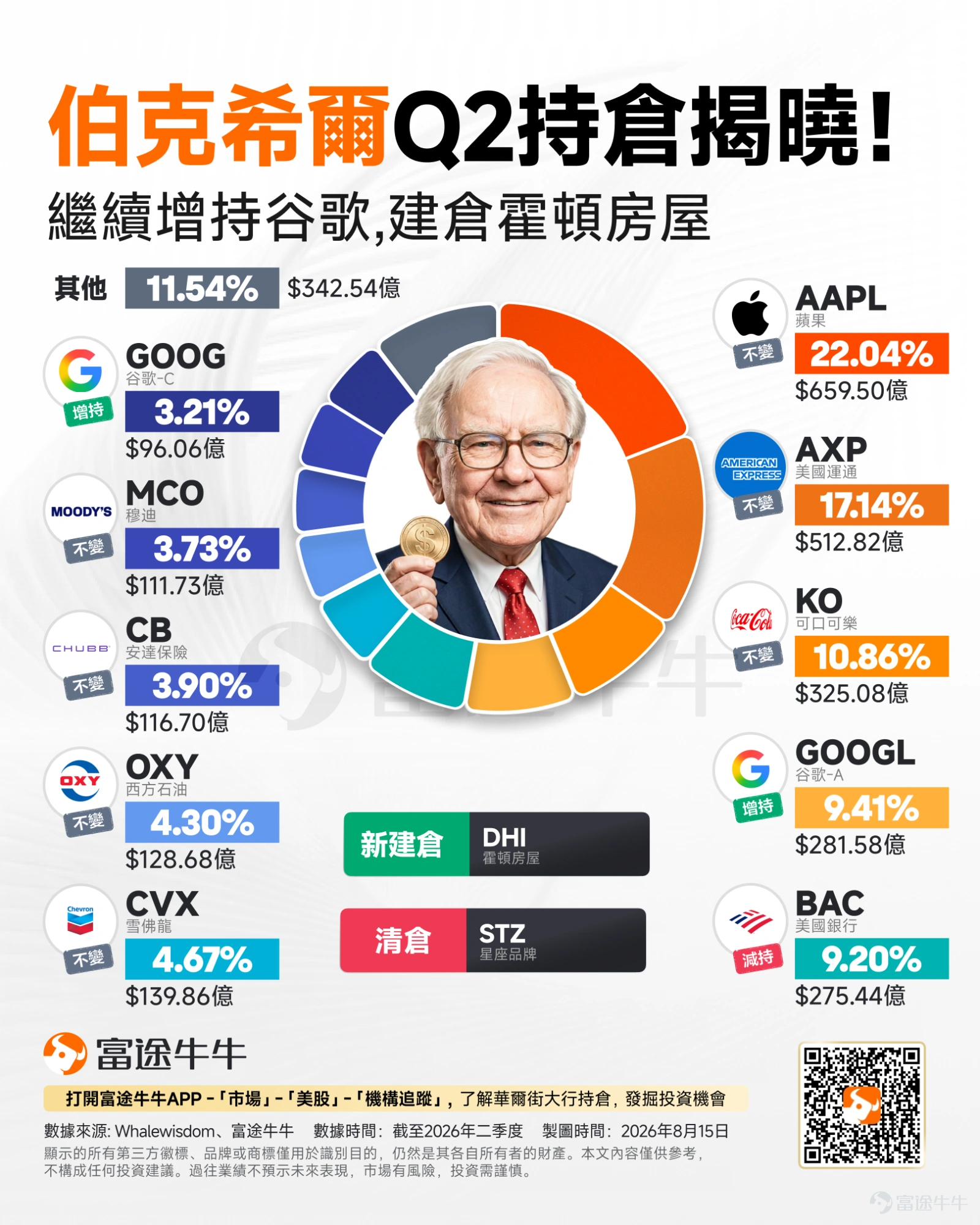
As of the end of Q2, the market value of Berkshire's Class A Google holdings was approximately $28.16 billion, accounting for 9.41% of the portfolio, jumping from the seventh-largest holding in Q1 to the fourth. The market value of Class C shares held was approximately $9.61 billion, representing 3.21%, entering the top ten holdings for the first time.
If both classes of stock are combined, Berkshire holds approximately 106 million shares of Google, with a total market value of about $37.76 billion, accounting for approximately 12.62% of its U.S. equity portfolio.
This means that, on a company basis, Google has surpassed Coca-Cola to become Berkshire's third-largest U.S. equity bet, trailing only Apple and American Express.
Tech holdings shift from 'Apple dominance' to a 'dual-core' structure
While Google rises rapidly, $Apple (AAPL.US)$ the position of [Apple] has not been fundamentally shaken.
In Q2, Berkshire continued to hold approximately 227.9 million shares of Apple, keeping the position size unchanged. The market value at period-end was approximately $65.95 billion, accounting for 22.04% of the portfolio, remaining the undisputed largest holding.
After reducing its Apple stake for three consecutive quarters previously, Berkshire has not adjusted its Apple position for two consecutive quarters since entering 2026. This indicates that while Apple remains the absolute core of the portfolio, the focus of new capital allocation has shifted.
From a portfolio structure perspective, Berkshire's tech exposure is gradually shifting from the previous 'Apple single-core' to an 'Apple + Google dual-core' model.
Both companies possess strong cash flows, user ecosystems, and competitive moats, but Google adds growth potential driven by cloud computing and artificial intelligence. This asset profile of 'mature cash cow + new growth curve' is likely a key reason for Berkshire's continued accumulation of the stock.
Therefore, increasing its stake in Google does not mean that Berkshire Hathaway has suddenly abandoned value investing to fully chase AI trends; rather, it resembles a rebalancing of weights within the technology sector.
Delta Air Lines saw position increases for two consecutive quarters, signaling that airline stocks are no longer just a tentative test.
Beyond Google, $Delta Air Lines (DAL.US)$ this was another notable increase in holdings worth watching in the second quarter.
Berkshire re-established its position in Delta Air Lines in the first quarter by purchasing approximately 39.81 million shares; it further increased its holdings by about 17.51 million shares in the second quarter, a rise of roughly 44%, bringing the total position to 57.32 million shares with a market value of approximately $5.37 billion at period-end.
This means that after exiting the U.S. airline industry for about six years, Berkshire has not only re-entered the sector but also expanded its position for two consecutive quarters.
If the purchases in the first quarter could be interpreted as testing the waters, the continued increase in the second quarter indicates that this investment is no longer merely a symbolic monitoring position.
This move stands in sharp contrast to Buffett's liquidation of airline stocks during the pandemic and serves as one of the key signals for observing Berkshire's new investment direction.
However, since 13F filings do not disclose who specifically executed the trades, we cannot simply attribute all purchases of Delta Air Lines or Google to Abel. What can be confirmed is that under Abel's tenure as CEO, Berkshire's overall capital allocation has become significantly more aggressive.
Horton Homes represents only a 'small position'; the real major move lies in the broader housing industry chain.
Real estate is also a key area where Berkshire Hathaway continued to strengthen its position in the second quarter.
Berkshire increased its holdings in $Lennar Corp (LEN.US)$ 、 $Lennar Corp-B (LEN.B.US)$ , with combined additions of approximately 3.07 million shares across both classes, resulting in an end-of-period position value of about $1.21 billion; meanwhile, it repurchased $D.R. Horton (DHI.US)$ , although the latter holding amounted to only 3,564 shares, with an end-of-period market value of approximately $580,000.
Therefore, judging solely by position size, D.R. Horton appears more like a watchlist position rather than a significant bet for now.
However, when combining the 13F filings with Berkshire’s underlying business operations, its housing strategy looks entirely different.
Berkshire already owned Clayton Homes along with a suite of businesses in building materials, housing finance, and residential development. On July 24, the company completed its acquisition of Taylor Morrison, with an equity value of approximately $6.8 billion and an enterprise value of about $8.5 billion. Post-transaction, Taylor Morrison will be integrated with Clayton’s homebuilding operations, creating the fourth-largest single-family homebuilder in the United States.
This means Berkshire’s layout in the housing industry is not just about buying shares of a few builders, but rather advancing on three fronts simultaneously:
Leveraging Clayton Homes to establish a presence in manufactured housing, housing finance, and land development;
Expanding its single-family homebuilding scale through the acquisition of Taylor Morrison;
Gain exposure to listed real estate companies through stocks like Lennar Corporation and D.R. Horton.
In other words, although Berkshire's position in D.R. Horton is small, its overall bet on the U.S. housing industry chain is significant.
Bank of America continues to reduce its holdings, making further room by trimming financial stocks.
While concentrating on increasing its position in Google on the buy side, the most notable move on the sell side remains the reduction of financial stocks.
Berkshire reduced its holdings in the second quarter $Bank of America (BAC.US)$ by approximately 30.23 million shares, with its position decreasing by 5.89% to about 483.4 million shares. After the reduction, the market value of its Bank of America holdings at the end of the period was approximately $27.54 billion, accounting for 9.20% of the portfolio. Its ranking dropped from fourth in the first quarter to fifth, having been overtaken precisely by Google Class A shares.
$Capital One Financial (COF.US)$ The reduction was even more pronounced, with holdings dropping from 7.15 million shares to 3 million shares, a single-quarter decrease of about 4.15 million shares, representing a decline of approximately 58%; $Ally Financial (ALLY.US)$ also saw a reduction of approximately 2 million shares.
However, this does not mean that Berkshire is broadly bearish on financial stocks. $American Express (AXP.US)$ It still ranks second with a holding market value of approximately $51.28 billion, and Bank of America remains the fifth-largest heavyweight position.
More precisely, Berkshire further concentrated its positions within the financial sector: continuing to hold core assets like American Express, while reducing stakes in Bank of America, Capital One Financial, and Ally.
Positions in consumer and industrial sectors continue to be "slimmed down".
Beyond financial stocks, Berkshire also reduced some holdings in consumer, healthcare, and industrial sectors.
$The Kroger Co. (KR.US)$ Reduced by approximately 11 million shares, with a 22% decrease in holdings; $Nucor (NUE.US)$ Reduced by approximately 2.05 million shares, a drop of 52.45%; $DaVita (DVA.US)$ Reduced by approximately 1.22 million shares, a decline of about 4.05%.
Meanwhile, Macy's saw an increase of approximately 4.31 million shares, boosting holdings by 141.8%; holdings in The New York Times also increased slightly.
These moves continue Berkshire's Q1 portfolio "slimming" strategy: exiting or reducing scattered smaller positions to further concentrate capital in fewer companies and industries deemed more important.
In the "post-Buffett era," it is not the principles that change, but the ranking of core assets.
As of the end of Q2, Berkshire's top ten holdings are, in order: $Apple (AAPL.US)$ 、 $American Express (AXP.US)$ 、 $Coca-Cola (KO.US)$ 、 $Alphabet-A (GOOGL.US)$ 、 $Bank of America (BAC.US)$ 、 $Chevron (CVX.US)$ 、 $Occidental Petroleum (OXY.US)$ 、 $Chubb Ltd (CB.US)$ 、 $Moody's (MCO.US)$ 、 $Alphabet-C (GOOG.US)$ The top ten holdings collectively account for approximately 88.5% of the portfolio, indicating that the traditional strategy of concentrated holdings remains unchanged.
Therefore, the Q2 13F filings should not be simplistically interpreted as "the end of Buffett-style investing."
Traditional core assets such as Apple, American Express, Coca-Cola, and Moody's remain firmly at the forefront, demonstrating that Berkshire Hathaway continues to emphasize economic moats, cash flow, and concentrated investing. What has truly changed is the allocation direction of new capital and the internal ranking of core assets.
Alphabet’s two share classes combined have jumped to become the third-largest company exposure; Delta Air Lines has seen increased holdings for two consecutive quarters; and the housing supply chain has been strengthened through both equity investments and physical acquisitions. On the other hand, positions in Bank of America, Capital One Financial, and certain consumer and industrial stocks continue to shrink.
This outlines the preliminary shape of changes in Berkshire’s portfolio during the Abel era: the core assets left by Buffett have not been overturned, but new capital is flowing toward new growth engines and industrial directions.
Rather than saying Berkshire is bidding farewell to Buffett, it is more accurate to say it is continuing Buffett’s investment framework while searching for the next core asset capable of absorbing massive capital over the long term.
Understand institutional holdings to stay aligned with the latest investment trends. Market > US Stocks >Institutional Tracking

Risk Disclaimer: The above content only represents the author's view. It does not represent any position or investment advice of Futu. Futu makes no representation or warranty.Read more


Comment (1)
to post a comment
69
142