HBM shortages drive up chip prices: Is the memory supercycle continuing?

ETF Battle | SanDisk Investor Day reignites the memory sector! After a deep correction in July, is it still a good time to buy into memory ETFs?
The hottest news in the US stock market last night was undoubtedly SanDisk's Investor Day, which ignited the entire US memory sector! After a significant pullback in July, the memory sector has been rebounding since early August, with market sentiment turning markedly bullish. Is the memory industry returning to the core focus of investors? ?
?
?Goldman Sachs sets a price target of $2,200! What major signals did SanDisk release at its Investor Day?
Many fellow investors may still view the memory industry as a "cyclical stock that relies on pricing"—reaping huge profits when the market is strong and suffering heavy losses when it weakens, with stock prices riding a rollercoaster along with the industry cycle. But this time, $SanDisk (SNDK.US)$ the long-term plan announced at the Investor Day was nothing short of a "blockbuster," shocking the market;Goldman Sachs furtherreiterated its "Buy" rating on SanDisk., offering a target price as high as$2,200for the next 12 months!
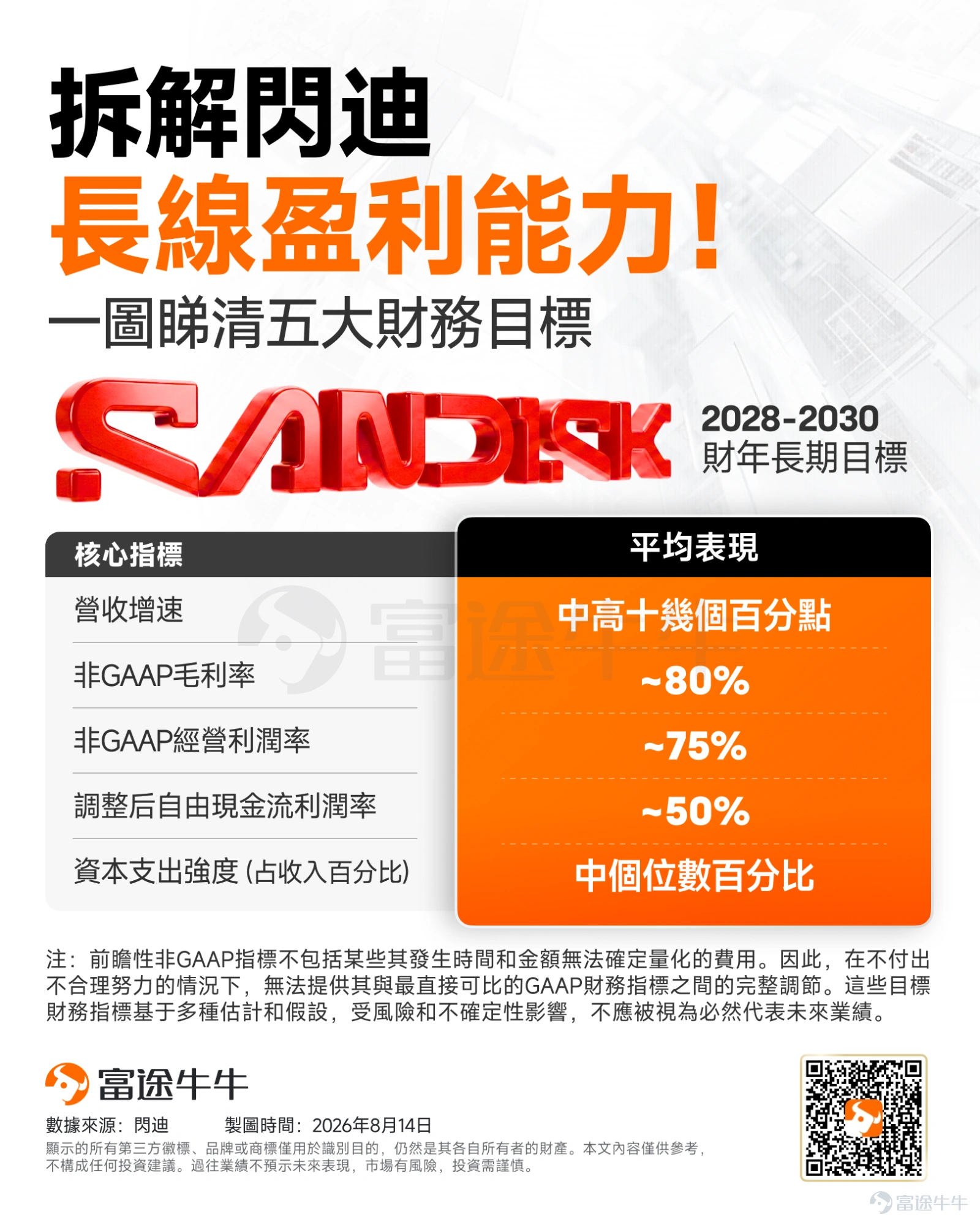
1. Long-term gross margin target of 80%: Not chasing short-term quick profits, but pursuing sustained high profitability.
SanDisk announced its long-term financial targets for fiscal years 2028 to 2030, with a non-GAAP gross margin target reaching up to 80%.This means that for every $100 of products sold over the next three years, the goal is to generate $80 in gross profit. Historically, profitability in the memory industry has fluctuated sharply with chip pricing, leading the market to worry that current high profits are merely a fleeting peak in the memory cycle. The three-year average guidance serves as a clear statement from management:High margins are not a short-term bonus from price hikes, but a long-term capability supported by structural factors.
2. NBM long-term contracts lock in orders, significantly reducing profit volatility.
Long-term cooperation agreements under the NBM model provide SanDisk with the strongest foundation for setting an 80% gross margin target. In the past, the industry negotiated prices quarterly, causing profits to swing wildly with market conditions. Now, multi-year contracts have been signed with eight major customers (including three top U.S. cloud providers), locking in purchase volumes and price ranges in advance. The total contract value exceeds $90 billion, and more than half of the shipments for 2027–2028 are already pre-committed, significantly enhancing the certainty of operating profits.
3. 100% of excess cash returned to shareholders, with continued execution of large-scale share buybacks.
Regarding profit distribution, SanDisk has a clear policy: prioritize operational investment and maintain robust cash flow, while returning 100% of all remaining excess cash to shareholders, primarily through share buybacks. The remaining share buyback authorization currently stands at approximately $15.5 billion,Continued share buybacks will reduce the float, boost earnings per share (EPS), and deliver tangible returns to long-term shareholders.
4. HBF secures a strategic position in AI inference scenarios, opening up long-term growth potential.
SanDisk's High Bandwidth Flash (HBF) memory was the standout new highlight of the event, directly addressing the "memory wall" bottleneck in the AI industry. Reportedly, this technology offers read speeds approaching those of high-end HBM memory, while providing 8–16 times the capacity. This significantly improves GPU utilization efficiency in AI inference scenarios and reduces overall computing costs. SanDisk's first HBF product has completed trial wafer production, with samples expected in 2027.Google, SK Hynixand other industry players have already joined the technology alliance, which institutions view asan additional long-term growth warrant for the company.
![The hottest news in the US stock market last night was undoubtedly SanDisk's Investor Day, which sparked a rally across the entire US memory sector. The memory sector, which underwent a significant correction in July, has been rebounding since early August, with noticeably improved bullish sentiment. Is the memory industry returning to the core focus of investors?[Shocked]? Goldman Sachs sets target price at $2,200! What major signals did SanDisk release at its Investor Day? Many fellow investors may still view the memory industry as a 'cyclical stock dependent on pricing'—generating hefty profits during upturns but suffering significant losses during downturns, with stock prices swinging like a roller coaster along the industry cycle. But this time, $SanDisk (SNDK.US)$ the long-term plan unveiled at the Investor Day was nothing short of a 'blockbuster,' shocking the market;Goldman Sachs furtherreiterated its 'Buy' rating for SanDisk, assigning a high$2,20012-month target price! 1. Long-term gross margin target of 80%: Not chasing short-term quick profits, but pursuing sustained high profitability. SanDisk announced its long-term financial targets for fiscal years 2028 to 2030, with a non-GAAP gross margin target as high as 80%.This means that for every $100 of products sold in the next three years, the target is to generate $80 in gross profit. Historically, profits in the memory industry have fluctuated sharply with chip pricing, leading the market to worry that current high profitability is merely a fleeting peak in the memory cycle. The three-year average guidance amounts to a clear statement from management:High profits are not just a short-term bonus from price hikes, but are supported by structural long-term factors...](https://nnqimage.futunn.com/sns_client_feed/999960/20260814/web-1786705702187-KhbpLktELe.png/big?area=2&is_public=true&imageMogr2/ignore-error/1/format/webp)
After a deep pullback in July, is the memory sector poised for a verification rally in August following the sharp decline?
Having discussed SanDisk, let's turn our attention to the broader memory sector. Many fellow investors likely experienced significant corrections in AI tech stocks in July, with memory chips being hit particularly hard, sending market sentiment to rock bottom. Entering August, leading US memory stocks have sequentially released their latest operational data, and their share prices have begun to rebound and repair, with several leaders recovering part of their losses:
$SanDisk (SNDK.US)$ : Cumulative drop of 46.57% in July; currently rebounded more than 39% from the July low.
$SK hynix (SKHY.US)$ : Cumulative drop of 3.54% in July; currently rebounded more than 27% from the July low.
$Micron Technology (MU.US)$ Cumulative decline of 28.69% in July; currently rebounded more than 15% from the July lows.
However, the rebound in the memory sector since August is markedly different from the unilateral uptrend seen in the first half of the year, with significantly increased volatility.Following the deep correction in July, the memory industry is currently in a unique phase:While the fundamentals of individual companies and the long-term growth logic for memory remain intact, short-term capital flows have become more conservative and selective.
From a fundamental perspective, manufacturers such as SanDisk, SK Hynix, and Western Digital have reported impressive revenue figures. In the long term, AI demand continues to surge, and the tight global supply of memory chips has not yet reversed. However, risks to watch include:The momentum behind recent memory chip price hikes has slowed significantly.Morgan Stanley's latest report points out thatas price increases narrow and manufacturer inventories gradually build up, the memory chip industry cycle will enter its late stage in the fourth quarter.
Want to capitalize on the memory sector rebound? Here are three types of ETFs you must know.
After the deep pullback in July, the memory market has gradually warmed up in August, and many fellow investors may be looking to reposition in the memory sector! Below is a summary of three major categories of memory-related ETFs for your reference based on your risk tolerance.
1. Semiconductor-themed ETFs: Diversified exposure, holding both memory and other sub-sectors
If you want to benefit from the memory industry rally while avoiding concentrating all your capital in a single memory sub-sector, consider semiconductor ETFs that include memory leaders. These ETFs hold constituents across the entire semiconductor supply chain, including chip design, manufacturing, equipment, and memory. In addition to memory giants, they also include AI chipmakers and semiconductor equipment manufacturers, effectively providing exposure to the broader semiconductor industry through a single ETF. You can profit from strength in memory stocks while not missing out on rallies in other semiconductor sub-sectors, with relatively milder overall price volatility. Suitable for: Conservative fellow investors who are bullish on the overall semiconductor trend but prefer not to bet on a single sub-sector.
2. Pure-play memory-themed ETFs: A basket of all major memory leaders
If you are bullish on the profitability of memory leaders and expect a market rebound, pure-play memory ETFs allow you to buy into all core targets in the industry at once. These ETFs cover manufacturers of various memory types, including HBM, NAND, and DRAM, incorporating nearly all industry leaders such as SanDisk, Micron Technology, SK Hynix, and Samsung.
Relevant ETFs to watch: $Roundhill Memory ETF (DRAM.US)$ (The world's first memory-themed ETF), $Roundhill T-REX 2X Long DRAM Daily Target ETF (RAM.US)$ 、 $Tema Memory ETF (DISK.US)$ 、 $XFUNDS Memory Income ETF (DRMY.US)$
3. Leveraged ETFs tracking memory leader stocks: Suitable for short-term swing trading, extremely high risk
If you are optimistic about the fundamentals of memory leaders and anticipate strong momentum in the upcoming rebound, and wish to further amplify your investment returns, consider leveraged ETFs linked to memory leaders in the US stock market.
However, please be sure to note:Leveraged ETFs are only suitable for short-term trading and are absolutely not suitable for long-term holding. Most leveraged ETFs adopta daily return reset mechanism,which can lead toa "volatility decay" effectin volatile markets. Even if the underlying stock price returns to its original level, the leveraged ETF may still incur losses. Therefore, these products are only suitable for investors with comprehensive trading experience who can monitor the market in real time for short-term swing trades. Novices must exercise caution and should never buy and hold for the long term. Suitable audience: fellow investors with extensive trading experience, a bullish outlook on short-term trends, and the ability to withstand significant stock price volatility. Below is a summary of the corresponding bullish leveraged ETFs for the top three US-listed memory concept stocks by market capitalization:
- SK Hynix: $GraniteShares 2X Long SK Hynix Daily ETF (SKUU.US)$$Leverage Shares 2X Long SK Hynix Daily ETF (SKHX.US)$$ProShares Ultra SK hynix ETF (SKHU.US)$$T-REX 2X Long SK Hynix Daily Target ETF (HYNX.US)$$Direxion Daily SK Hynix Bull 2x ETF (SKHL.US)$$Corgi SK hynix 2x Daily ETF (SK.US)$$Tradr 2X Long SK Hynix Daily ETF (SKHA.US)$
Additionally, fellow investors can also useFutubull AIFilter memory-related ETFs with a single click and receive in-depth analysis based on your current holdings.
![The hottest news in the US stock market last night was undoubtedly SanDisk's Investor Day, which sparked a rally across the entire US memory sector. The memory sector, which underwent a significant correction in July, has been rebounding since early August, with noticeably improved bullish sentiment. Is the memory industry returning to the core focus of investors?[Shocked]? Goldman Sachs sets target price at $2,200! What major signals did SanDisk release at its Investor Day? Many fellow investors may still view the memory industry as a 'cyclical stock dependent on pricing'—generating hefty profits during upturns but suffering significant losses during downturns, with stock prices swinging like a roller coaster along the industry cycle. But this time, $SanDisk (SNDK.US)$ the long-term plan unveiled at the Investor Day was nothing short of a 'blockbuster,' shocking the market;Goldman Sachs furtherreiterated its 'Buy' rating for SanDisk, assigning a high$2,20012-month target price! 1. Long-term gross margin target of 80%: Not chasing short-term quick profits, but pursuing sustained high profitability. SanDisk announced its long-term financial targets for fiscal years 2028 to 2030, with a non-GAAP gross margin target as high as 80%.This means that for every $100 of products sold in the next three years, the target is to generate $80 in gross profit. Historically, profits in the memory industry have fluctuated sharply with chip pricing, leading the market to worry that current high profitability is merely a fleeting peak in the memory cycle. The three-year average guidance amounts to a clear statement from management:High profits are not just a short-term bonus from price hikes, but are supported by structural long-term factors...](https://nnqimage.futunn.com/sns_client_feed/999960/20260814/web-1786706257192-pDSyDeJzH2.png/big?area=2&is_public=true&imageMogr2/ignore-error/1/format/webp)
August operating data from memory manufacturers is gradually confirming the trend, and SanDisk's Investor Day has further boosted confidence in the memory sector! What is your outlook on the future performance of memory stocks? Can this rebound sustain?
🎁 The August ETF Challenge is in full swing!After a sharp decline, the memory sector is rebounding. Has your ETF portfolio successfully recovered its losses?Fellow investors building their ETF portfolios, whether you are a novice just entering the market or a seasoned veteran, join the ETF Challenge now! Share your ETF trading stories for a chance to win points, coupons, Futubull merchandise, and other great prizes!Click to join now >>
![The hottest news in the US stock market last night was undoubtedly SanDisk's Investor Day, which sparked a rally across the entire US memory sector. The memory sector, which underwent a significant correction in July, has been rebounding since early August, with noticeably improved bullish sentiment. Is the memory industry returning to the core focus of investors?[Shocked]? Goldman Sachs sets target price at $2,200! What major signals did SanDisk release at its Investor Day? Many fellow investors may still view the memory industry as a 'cyclical stock dependent on pricing'—generating hefty profits during upturns but suffering significant losses during downturns, with stock prices swinging like a roller coaster along the industry cycle. But this time, $SanDisk (SNDK.US)$ the long-term plan unveiled at the Investor Day was nothing short of a 'blockbuster,' shocking the market;Goldman Sachs furtherreiterated its 'Buy' rating for SanDisk, assigning a high$2,20012-month target price! 1. Long-term gross margin target of 80%: Not chasing short-term quick profits, but pursuing sustained high profitability. SanDisk announced its long-term financial targets for fiscal years 2028 to 2030, with a non-GAAP gross margin target as high as 80%.This means that for every $100 of products sold in the next three years, the target is to generate $80 in gross profit. Historically, profits in the memory industry have fluctuated sharply with chip pricing, leading the market to worry that current high profitability is merely a fleeting peak in the memory cycle. The three-year average guidance amounts to a clear statement from management:High profits are not just a short-term bonus from price hikes, but are supported by structural long-term factors...](https://nnqimage.futunn.com/sns_client_feed/999960/20260814/web-1786706449836-lcmmcXnQvV.png/big?area=2&is_public=true&imageMogr2/ignore-error/1/format/webp)
Risk Disclaimer: The above content only represents the author's view. It does not represent any position or investment advice of Futu. Futu makes no representation or warranty.Read more


Comments (3)
to post a comment
34
33