
Mini Review of Hundred-Strike Options | From "Sell Puts, Buy Calls" to "Puts and Calls Dancing Together"! LITE earnings call surged 260% before rapidly evaporating; SNXX jumped 5x overnight
Hello fellow investors, it's time for our Friday market recap~
Remember the 'Opportunity Pool' from this Monday? The market's main narrative was 'Sell Storage, Buy Optical'—capital was dumping storage stocks (NAND/DRAM) while flooding into optical communications. But this week, the script was rewritten:On the optical communications side, $Lumentum (LITE.US)$the underlying stock briefly soared past $1,000 after earnings, igniting the options chain instantly; meanwhile, the storage sector wasn't idle either, $SanDisk (SNDK.US)$leveraging the Investor Day event to surge 13% in a single day, with the 2x leveraged ETF SNXX skyrocketing 27% overnight. The 'Sell Storage, Buy Optical' trade didn't play out as expected; instead, it became a case of 'Storage and Optical Dancing Together'.
In this issue, we dissect two contrasting options stories: one involves LITE call options where IV wasn't extreme before earnings, the direction was right, but the exit wasn't timely; the other features... $Tradr 2X Long SNDK Daily ETF (SNXX.US)$ ...near-expiry calls that jumped nearly 5x in a single day, fueled by the Investor Day catalyst. One teaches you 'when to take profits,' the other teaches you 'how to read catalysts.' Let's break them down one by one.
LITE: A rollercoaster ride where IV wasn't extreme before earnings, the directional bet was correct, but the position wasn't exited in time
Let's start with a recap. In Monday's "Opportunity Pool," we specifically highlighted LITE: Lumentum's share price was simply too expensive—around $890 at the time—making the notional principal for a single option contract extremely high, with hardly any contracts available at a premium of just a few hundred dollars. Therefore, we suggested using the 2x long leveraged ETF "LITX" to express this view.
But what we're breaking down today isthe options on LITE's underlying stock (which have higher trading volume and more pronounced trends),allowing for a clearer view of the true nature of "betting on earnings reports."
Let's start with the underlying stock. After hours this past Tuesday (August 11), LITE, as the second domino in the "sell inventory, buy optics" narrative following $Applied Optoelectronics (AAOI.US)$ [missing context], released its earnings. Market expectations for AI infrastructure—specifically optical modules—were already sky-high. As soon as LITE's report came out, it ignited the after-hours session, surging over 13% that day.
Keep in mind that LITE's 52-week range is $111 to $1,085—a nearly tenfold amplitude within a year itself demonstrates just how volatile this beast is. By the close on Thursday (August 13), the underlying stock had pulled back to $880.41, down 5.58% for the day.
(The illustrative graphics shown on screen are for demonstration purposes only and do not constitute investment advice or guarantees; market conditions change frequently, and the displayed option prices do not reflect real-time data.)
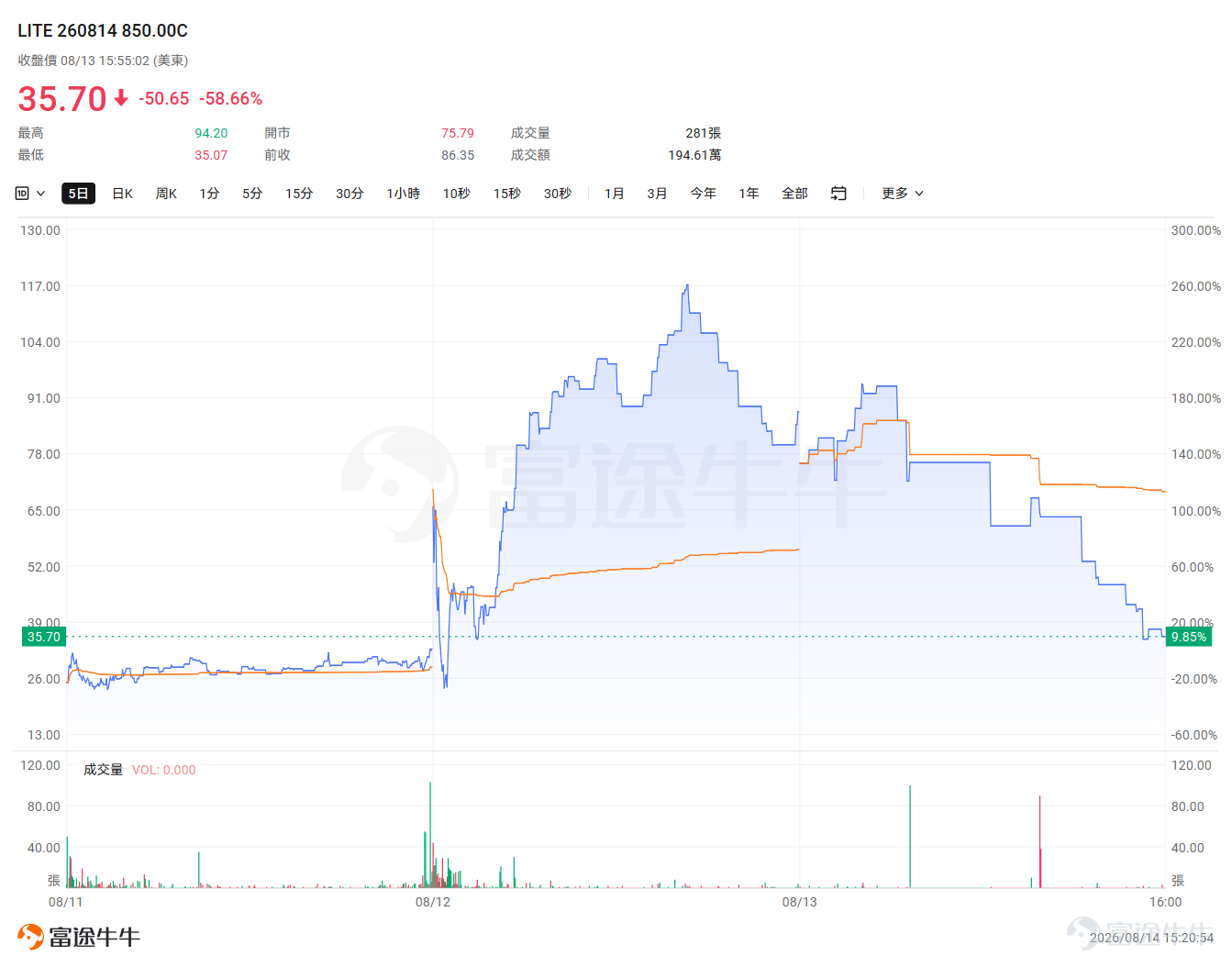
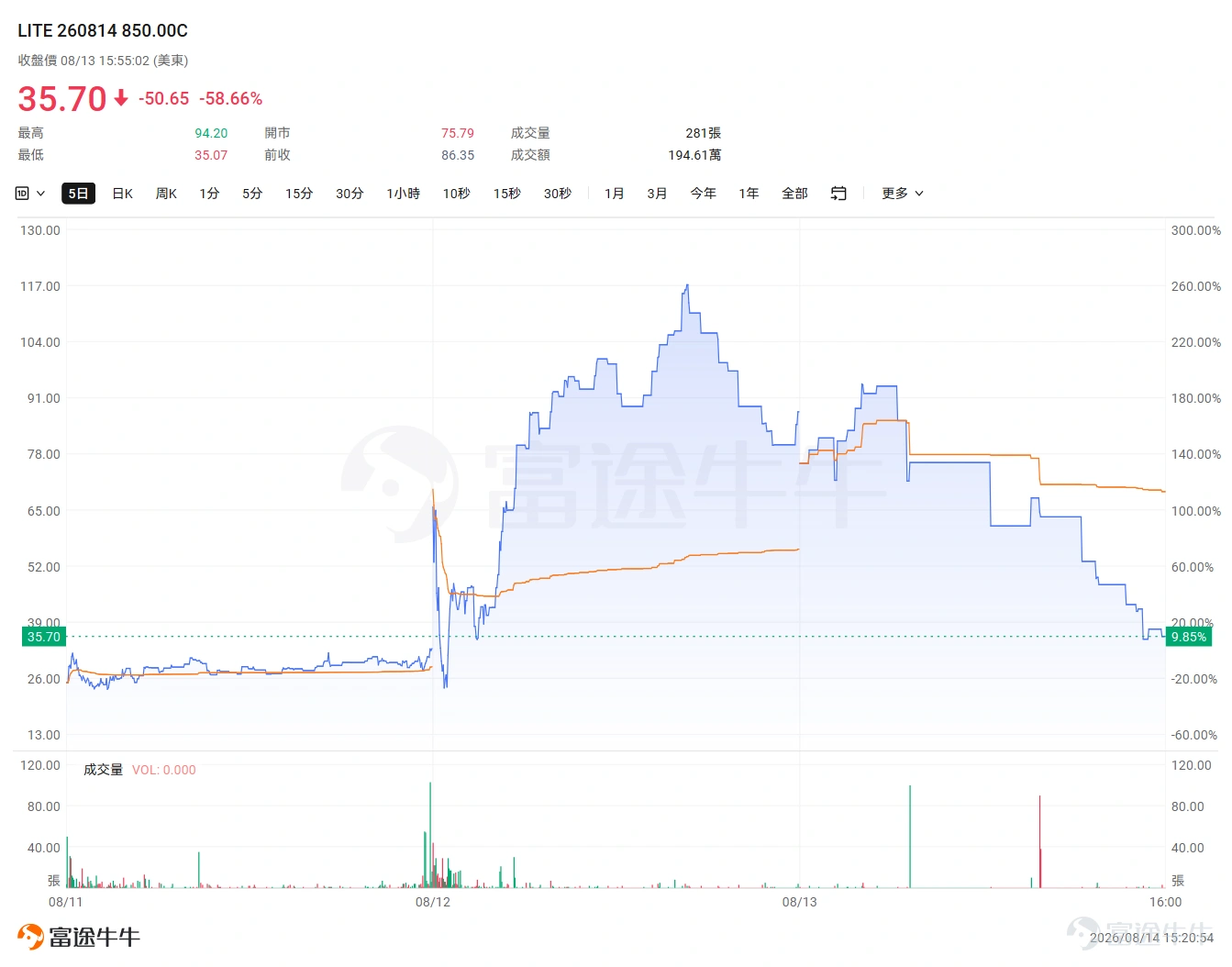
Now let's break down the options: LITE 260814 850.00C, which refers to the call option with a strike price of $850 expiring on August 14.Note that these are options on a high-priced blue-chip stock. While the cost per contract isn't exactly "cheap," its price chart is one that every fellow investor looking to bet on earnings reports should frame and study.
Check the timeline:
Before the earnings release (prior to August 11), this call option washovering around $26,trading sideways at approximately $2,600 per contract.
After the earnings release (on August 12), it gapped up instantly, with an intraday spike reachingaround $66,before pulling back and consolidating.
The real climax occurred during trading hours on August 12—this call option surged to a high of $94.20, valuing each contract at $9,420.
Then it was a steady decline: closing at$35.70 on August 13, plunging 58.66% in a single day, leaving each contract worth only $3,570.
Let’s run the numbers: If you had positioned yourself ahead of the earnings report at $26, your floating profit per contract would have been around $6,820 when the price spiked to $94.20—3.6 times your entry price. In percentage terms, that’s nearly a 260% gain on the entire contract. But if greed kept you from exiting at the peak and you held until Thursday’s close at $35.70, your contract would be up only 37% from your entry price—even though you had clearly seen a 260% floating profit just two days prior.
This is the cruelest aspect of earnings options: the flash of brilliance is dazzling, but it fades in seconds.
Let’s revisit two key predictions from the Opportunity Pool.
First, regarding IV Crush. We have repeatedly emphasized in the Opportunity Pool that the biggest trap with earnings plays is IV Crush. Once uncertainty is resolved, implied volatility drops sharply, meaning you can lose money even if you guessed the direction correctly. The severity of this hit depends on how high implied volatility was pumped up before the earnings release. For established stocks like LITE, where the market has certain expectations for earnings reactions, if the pre-earnings IV rank and percentile haven’t reached extreme highs over the past year, the post-earnings IV Crush will be far less severe than for hyped-up stocks trading at sky-high valuations.This is also why, to determine whether 'the blood is worth drinking' (i.e., whether the trade is worth the risk), you should look at IV Rank and IV Percentile as your thermometers, rather than the absolute IV number.
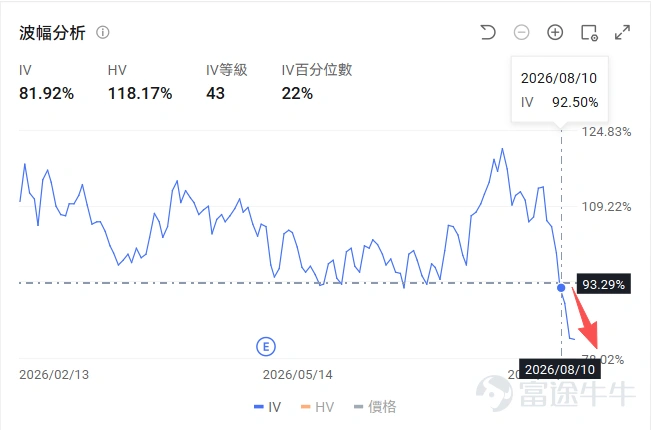
(IV Crush after LITE's earnings report)
As seen in the volatility analysis chart following LITE's earnings, the red arrow points to the post-earnings drop in IV. While IV did indeed retreat, the underlying stock's directional move was strong enough to drive this call option to a floating profit of 260%.
This aligns perfectly with what we mentioned in last week's review: $SpaceX (SPCX.US)$ Case study: The more extreme the IV run-up before earnings, the more severe the IV crush afterward. Applying the same logic in reverse to LITE—If IV wasn't excessively inflated before entering the trade, the impact of the IV crush would naturally be much milder.
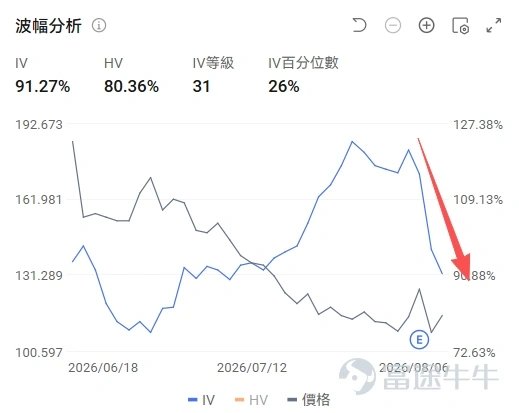
(IV Crush after SPCX's earnings report)
Second, and the most painful lesson this time: When betting on earnings, you must take profits in a timely manner. Look at the price curve of this call option—it peaked at $94.20 on the first day after earnings (August 12) and has been declining ever since.
For stocks like LITE, where pre-earnings IV isn't extreme, the market typically digests the earnings reaction within a single day.Your original goal was to trade the 'earnings event.' Once the event has played out and the direction is correct, that one-day surge has already delivered your maximum return.If you don't exit now, your trade shifts from "betting on earnings" to "betting on whether the uptrend can continue"—which becomes an entirely different game. Think of the last few grains of sand in an hourglass: on earnings night, the sand drains away all at once. You need to harvest your profits while the sand is still flowing.
SNXX: SanDisk Investor Day ignites the storage sector; 2x leveraged ETF options surge 5x overnight
Let’s start with the background on the underlying stock. The biggest surprise in this week's "sell storage, buy optical" narrative came from the storage side. SanDisk (SNDK)—the giant focused on NAND storage—completely ignited market sentiment this week due to its Investor Day.SNDK surged 13.67% on Thursday and continued to rise in pre-market trading today.
So what exactly was said at this Investor Day that sparked such a market reaction? The core message is:The pricing power narrative is continuing and strengthening. The key signal released by management during the conference was—AI-driven data center demand is rapidly tightening the supply and demand balance for NAND. Management provided clear upward guidance for pricing and gross margins of future products over the next few years, outlining a path of "tight capacity and rising prices."
For a memory stock previously treated by the market as a "cyclical casualty" and sold off by capital, management's personal endorsement—putting "better-than-expected demand + price hikes" on the table—was essentially a slap in the face to the shorts.The market loves this kind of "expectation reversal": yesterday, everyone was calculating whether the cycle had peaked; today, management tells you it's impossible.The shift in sentiment naturally comes fast and fierce.
As the segment most directly benefiting from AI infrastructure, memory chips were once again "sold off" by the market since July. Once Investor Day provides better-than-expected demand guidance or a narrative of price hikes, the reversal in market sentiment will be swift and intense.This is also why the market started the week saying "sell memory," but by Friday it had turned into "memory and optical communications dancing together." Capital realized that at the AI feast, neither memory nor optical communication was left out.
(The design image shown on screen is for illustrative purposes only and does not constitute any investment advice or guarantee. Market conditions change frequently; the displayed option prices do not reflect real-time data. Options shown are filtered based on an initial price below $3 per contract.)
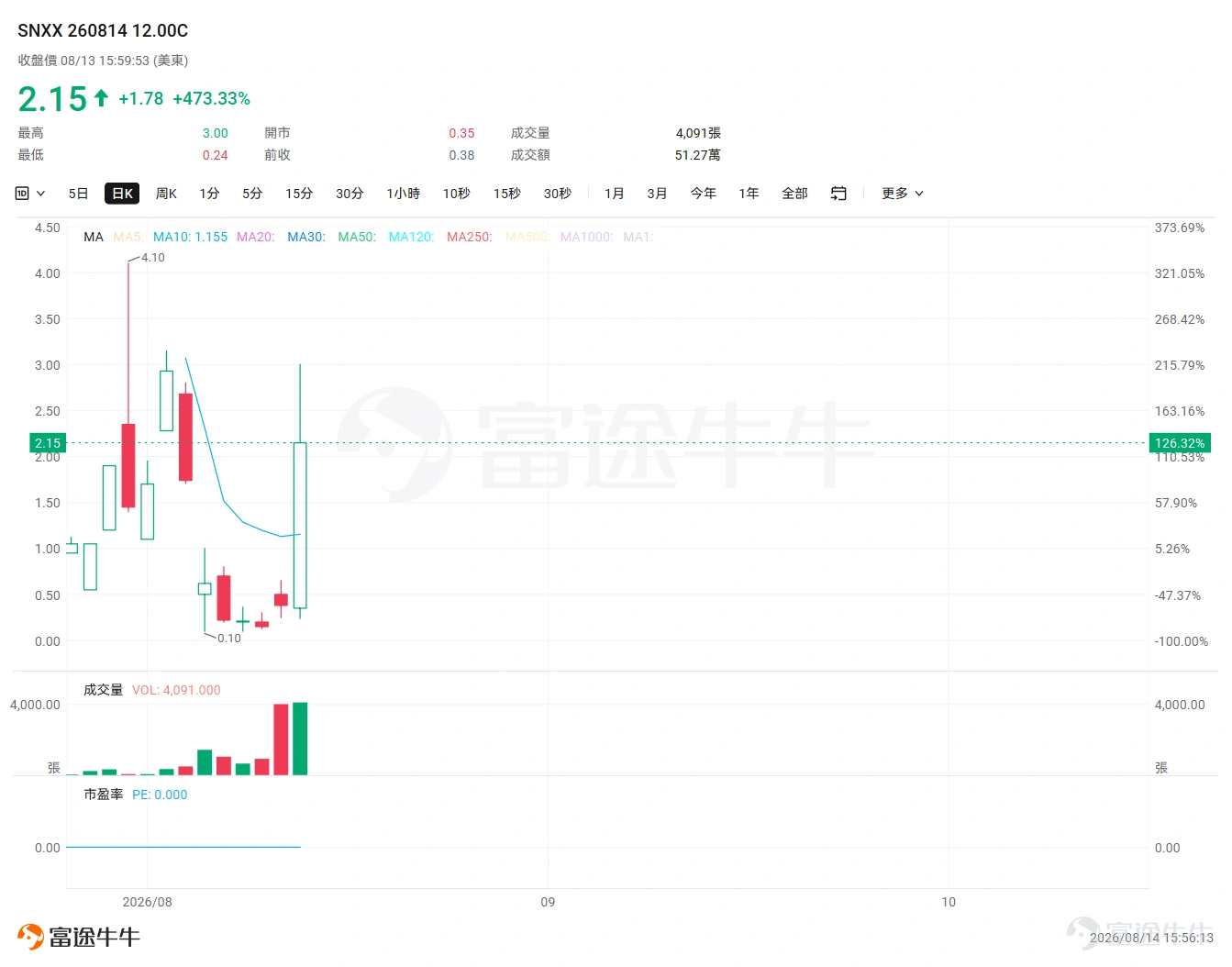
Looking at it now:SNXX Aug 14 '26 $12.00 Call。
Let's introduce the protagonist, SNXX—it is the "Tradr 2X Long SNDK Daily ETF," which is a daily 2x leveraged ETF going long on SanDisk.When the underlying stock SNDK rose 13.67% in a single day, the 2x leveraged SNXX surged directly by 27.28%, closing at $14.09. And this call option with a $12 strike price expiring on August 14—a so-called "0DTE" (zero days to expiration) call—is yet another layer of leverage built on top of the leveraged ETF.
Check out its price timeline:
Earlier, this call option dipped as low as$0.10—just $10 per contract, truly "less than the cost of a meal."
Opened at $0.35 on August 13, with the previous close at $0.38.
After being highlighted by investors, this call surged to an intraday high of$4.10(that long upper shadow on the candlestick chart), valued at $410 per contract.
It finally closed at$2.15, surging 473.33% in a single day.$230 per contract.Trading volume surged from the usual trickle to 4,091 contracts.——Real money poured in. Moreover, trading volume had already picked up significantly the day before Investor Day (Wednesday), indicating that substantial capital was positioned specifically for this investor conference.
Let’s run the numbers to appreciate the risk-reward ratio: If you bought one contract near the $0.35 opening price, it cost you just $35; with a closing price of $2.15, that single contract is now worth $215—more than six times your entry cost. This is the "Doomsday Call on a Leveraged ETF"—think of it as a switch: An unexpectedly positive catalyst for the underlying stock, amplified through two layers—a "2x Leveraged ETF" and an "out-of-the-money doomsday call"—can instantly turn tens of dollars into hundreds.
But pay close attention: This extreme scenario is a rare flash-in-the-pan opportunity, not the norm. Three risks must be clearly stated:
First,Doomsday calls have an extremely high probability of expiring worthless. This call option expires on August 14. If the underlying stock fails to stay above the strike price, the value of this $230 or even $410 position will drop to zero at expiration. While turning $10 into $410 feels great, the reverse—watching $410 vanish back to $0 right before your eyes—is equally possible.
Second,Leveraged ETFs are not suitable for long-term holding. SNXX is a product with daily 2x reset, tracking twice the "single-day" movement of SNDK, not double the long-term performance. In volatile markets, daily resets cause "volatility decay," causing actual long-term returns to deviate significantly from "2x." It is a blitz tool for trading "single-day events," not for long-term retirement holding.
Thirdly,For catalysts like Investor Day, sentiment is priced in extremely quickly.Similar to earnings reports, the market often fully prices in "positive events" within a day or two. Looking at this SNXX call option dropping back to 2.15, it gave back nearly half of its unrealized gains within the same day—It’s the same old lesson: the explosive moves driven by events offer a fleeting window to take profits.
Summary: Two charts, two lessons on taking profits
The two cases in this issue actually illustrate two sides of the same coin.
LITE tells you: If implied volatility (IV) isn't extreme before earnings, and you bet on the right direction, you need to lock in profits within a day—because the market typically digests earnings reactions within a day. Your goal is to "trade the earnings event," not to "ride the trend." That call option falling from 94.20 back to 35.70 was essentially a penalty ticket for greed.
SNXX tells you: Catalysts (like Investor Day) can be amplified through leveraged ETFs, turning $10 into $410—but the risk of expiring calls going to zero is extremely high, and leveraged ETFs are unsuitable for long-term holding. You should also exit within a day or two.
Entering with a hundred dollars and gaining thousands—options indeed provide the possibility of leveraging small capital for big opportunities. Of course, high odds don't come for free; picking the right direction, timing, and managing position size are all essential. Understand first, then act. With the right rhythm, opportunities are never scarce. See you in the next review~
Not familiar with options basics? Study up before jumping in.
If, while reading this recap, you’re still fuzzy on concepts like 'What is a long call?' or 'How do I read strike prices?', don’t rush into placing orders—take some time first to solidify your fundamentals. We’ve compiled practical beginner resources below; consider bookmarking them:
Finally, we’ve got a little perk for our fellow investors—feel free to claim it!Options Starter Pack
*This promotion is exclusively available to invited Hong Kong users. Click to learn more.Detailed terms and conditions of the promotion >>

Disclaimer
This content does not constitute an offer, solicitation, recommendation, opinion, or any guarantee regarding any securities, financial products, or instruments. The risk of loss in trading options can be substantial. In certain circumstances, your losses may exceed the initial margin deposit. Even if you place contingent orders, such as 'stop-loss' or 'limit' orders, there is no assurance that losses will be avoided. Market conditions may prevent these orders from being executed. You may be required to deposit additional margin on short notice. If you fail to meet the required margin within the specified time, your open positions may be liquidated. Nevertheless, you remain liable for any deficit balance in your account resulting from such events. Therefore, you should thoroughly research and understand options before trading, and carefully consider whether such trading is suitable for you based on your financial condition and investment objectives. If you trade options, you should familiarize yourself with the procedures for exercising options and handling expiration, as well as your rights and obligations upon exercise or expiration.
Risk Disclaimer: The above content only represents the author's view. It does not represent any position or investment advice of Futu. Futu makes no representation or warranty.Read more


Comment (1)
to post a comment
53
30