
August ETF Trading Challenge! Share your trading stories and win great prizes 🎁

[Must-Read for New Investors] Not making money with Dollar-Cost Averaging (DCA)? What did this DCA strategy get right to earn over $70,000 in two years?
We all work hard every day, but have you ever had this doubt:
"Everyone recommends that beginners start investing with 'monthly stock installments' (Dollar-Cost Averaging), saying it helps diversify risk. So why, after contributing for over half a year, is my account still in the red? Is monthly installment investing actually unprofitable?"
Then look at your colleagues or friends; they are also doing monthly installments, yet some manage to work effortlessly whileearning an extra 70,000 painlessly within two years, with annualized returns on monthly installments reaching as high as 29.51%!*
Starting from the same point, why can some people turn their "spare change" into a second income, while others see lukewarm results or even end up "paying tuition" (losing money)?
What exactly did sophisticated monthly installment investors do right? Today, we'll use real historical data to break down the numbers for you!

📊 I. Real Data Breakdown: What happened to her portfolio over these two years?
Let's take a direct look at this actual monthly investment projection chart:
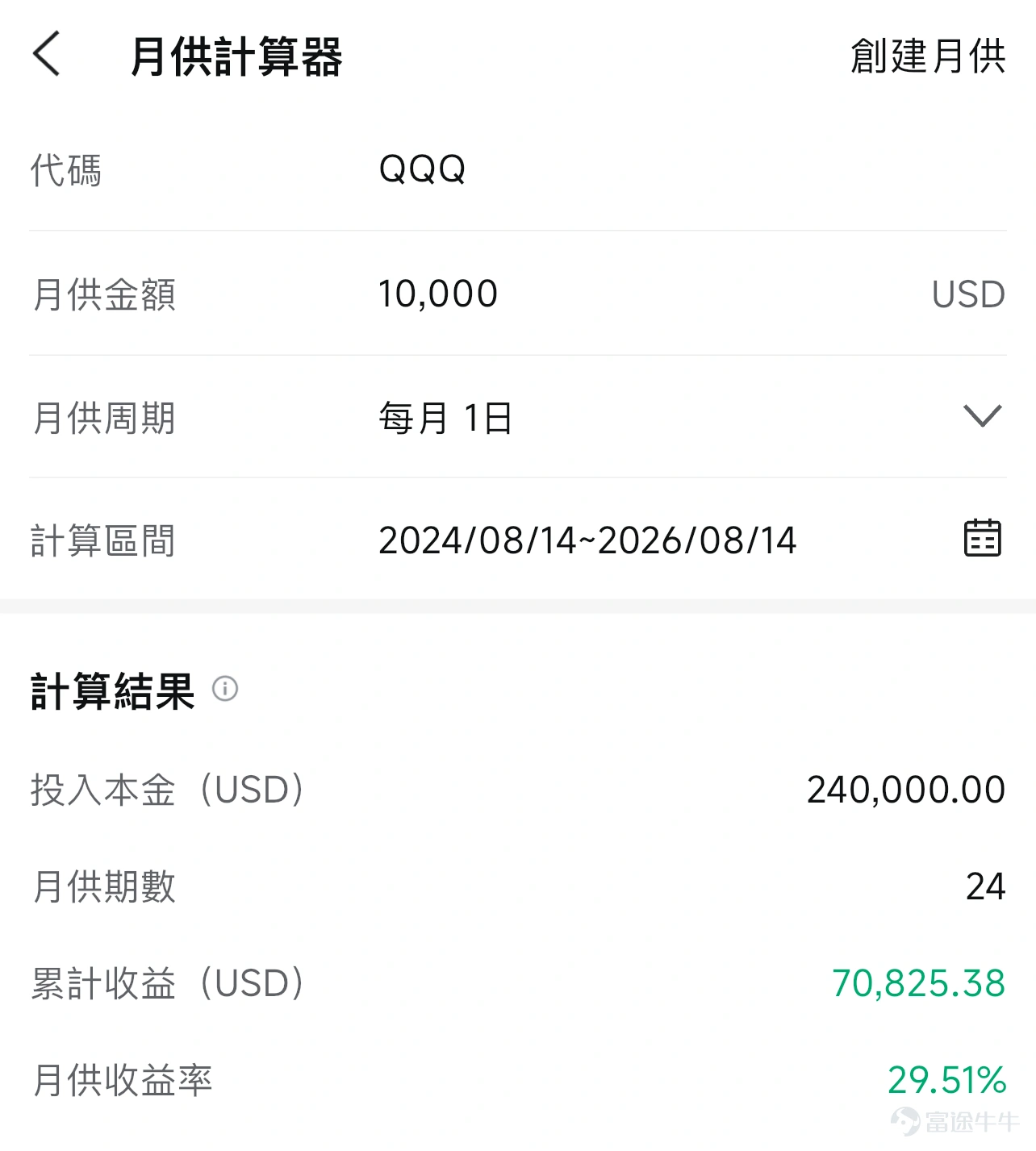
🔍 Data Projection Notes:
– Monthly Investment Target: US Stocks $Invesco QQQ Trust (QQQ.US)$ (Nasdaq 100 Index ETF, aggregating the world's top tech giants)
– Monthly Investment Amount: 10,000 / month
– Investment Schedule: Deducted on the 1st of each month
– Calculation Period (exactly 2 years): August 14, 2024 to August 14, 2026
– Total number of monthly contributions: 24 months
🧮 Performance report over the past two years:
– Principal invested: $10,000 × 24 months = $240,000.00
– Cumulative returns:$70,825.38
– Monthly contribution yield:29.51%
💡 Tips for employees: Although the calculation in the chart is based on a "high-net-worth" amount of $10,000 per month,The logic of compound interest in wealth management is exactly the same.! If your monthly budget is only HK$2,000,based on the same trend and a 29.51% return rate, you could alsoearn an "extra bonus" of approximately HK$14,000 over two years!Even small amounts can snowball into a significant future.
❌ II. Why do some regular investment plans fail to generate profits? First, check if you've fallen into these two traps!
After seeing the impressive data, let's return to the most realistic question: Why do many beginners fail to make money when trading on their own? It’s usually because they’ve fallen into the following two traps:
1. Choosing the wrong target: Treating "speculative stocks" as "regular investment stocks"
The essence of regular investment lies in "the compounding effect of time." If you choose sectors with extreme volatility, no solid performance support, or strong cyclicality, once the market trend adjusts, you are highly likely to face a situation where the stock price does not recover for a long period, ultimately leading to greater losses with each contribution.
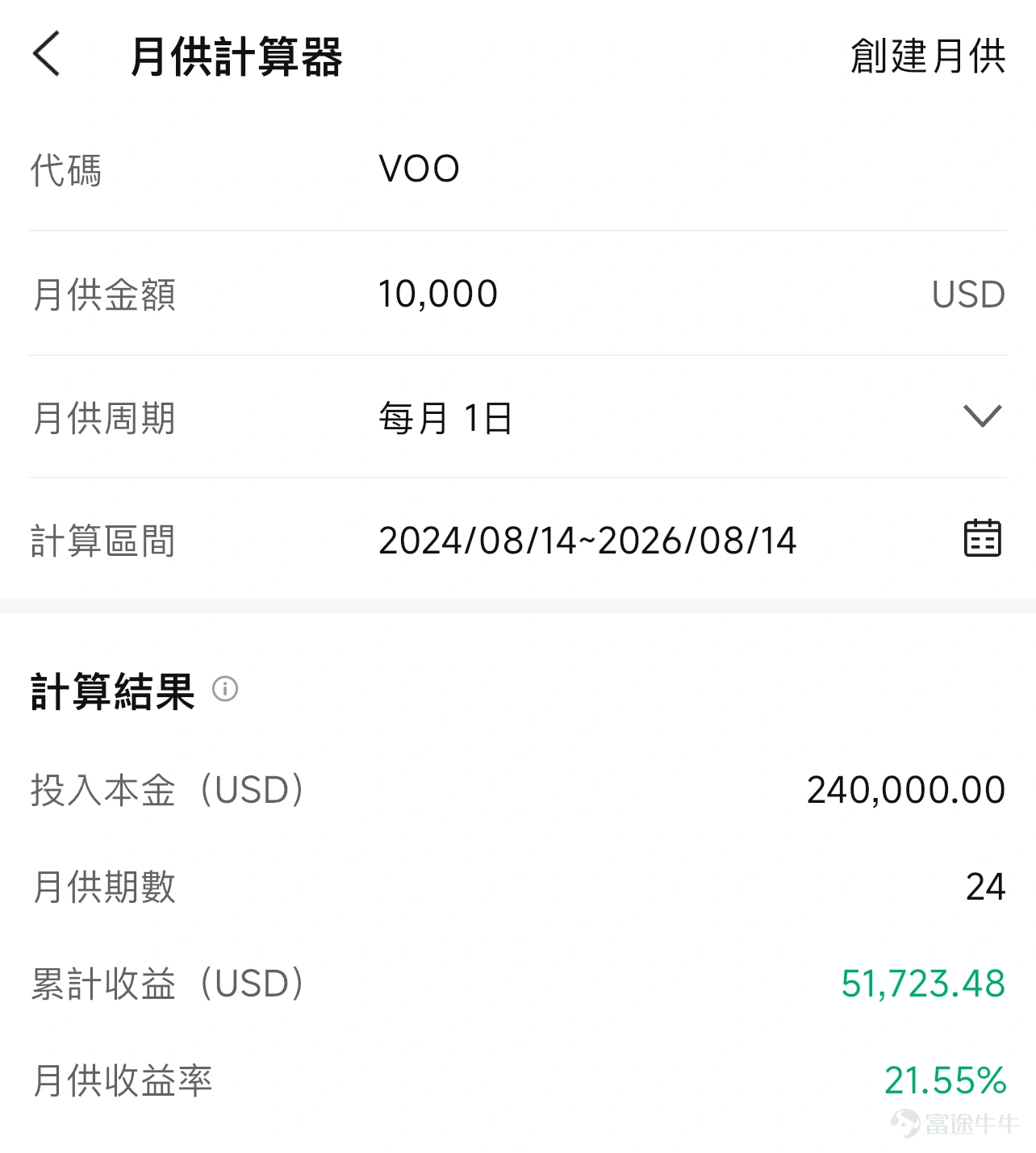
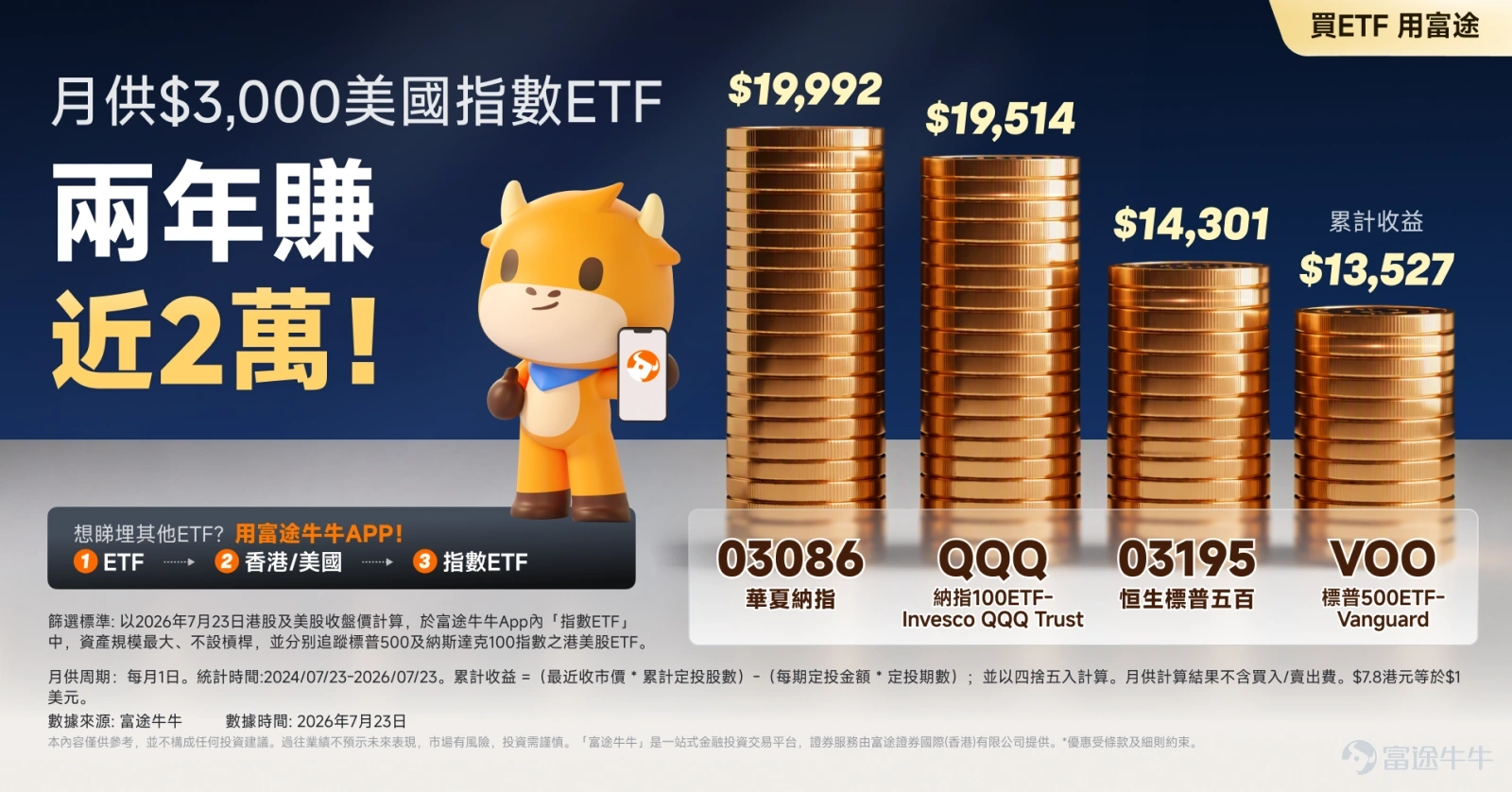
The success of the above calculation is attributed to selecting a high-quality, broad-based US stock index like QQQ, which represents the mid-to-long-term trend of technological development. If we were to switch to another broad-based US stock index representing the overall US market, such as the $Vanguard S&P 500 ETF (VOO.US)$ , using the monthly investment calculator shows that even after experiencing market volatility,over two years, it still delivered an impressive return of 21.55%!
2. Giving Up Halfway: Falling in the "Darkness Before Dawn"
When the stock market drops, panic sets in, leading some to simply stop their monthly contributions or even cut losses and exit the market. This actually goes against the original intent of "Dollar-Cost Averaging (DCA)!" The biggest mistake in monthly investing is stopping contributions when prices are low, because you miss the golden opportunity to accumulate the most shares at bargain prices.
📊 Data Speaks the Truth: Why Persisting at Low Levels Helps You "Break Even Faster and Earn More"? Let's break it down with simple math:
– Assume the price of a high-quality ETF is $100in the first month, drops to $50in the second month, and rebounds to $100。
– Lump-sum investor (bought at the peak): Bought at $100, suffered a 50% unrealized loss when the price dropped to $50; only in the third month, when the stock price rebounded to $100, did they justbreak even (0% return)。
– Dollar-cost averaging adherent (never missed contributions during the dip): In the first month, bought 10 shares with $1,000; in the second month, when the price fell to $50, the same $1,000 couldbuy 20 shares! At this point, the average holding cost was significantly lowered to $66.7. When the stock price rebounded to $100 in the third month, the account saw explosive growth,achieving a turnaround with profits as high as 50%!
Data proves that choosing the right target for dollar-cost averaging and sticking to contributions during market lows can significantly shorten the break-even period, and allow account profits to rebound quickly when market conditions improve.
📈 3. Behind the >29% Monthly Investment Plan Returns: Getting These Four Things Right
🔄 Tip #1: Leverage the "Monthly Investment Calculator" to back your investment decisions with historical data
As mentioned earlier, many people fail to achieve expected returns from long-term monthly investments simply because they chose the wrong underlying assets. This is where Futu's "Monthly Investment Calculator" becomes your best ally:
– How to use it? Select the individual stocks or ETFs you plan to invest in via monthly contributions, input the investment amount and frequency, and review the calculated results based on a 2-3 year historical period.
– How does it help you? By comparing historical performance, it effectively helps youfilter out speculative assets that "look impressive on the surface but are highly volatile in reality,"and identify "long-term champions" with stable, upward trends over the medium to long term.Choosing the right underlying assets is the first step toward high-quality monthly investments and steady wealth growth!
⏳ Tip #2: Stick to your monthly investment plan; don't give up during market downturns
There are no undefeated generals in the investment market, but time is the retail investor's best friend. When facing market volatility, sophisticated investors treat "market dips" as "limited-time sales." Overcome fear with discipline, quietly accumulate cheap chips amidst market panic, and patiently wait for time to yield results.
🛡️ Tip #3: Direct debit via bank eDDA, focusing on the "save first, spend later" principle
The reason ordinary people struggle to save money is that they are accustomed to the formula "Income - Expenses = Savings"—saving whatever is left after spending each month, which often leaves nothing at all.
In contrast, sophisticated employees deeply understand the golden rule of "Income - Savings = Expenses."
– Futubull - Bank eDDA Direct Monthly Investment: You can link your bank card and set it up toautomatically deduct funds on the day after payday. Funds are seamlessly transferred directly from your bank card to your monthly investment plan, eliminating the need for manual transfers every month.
– "Save first, spend later": Before your urge to spend kicks in, your investment funds are already automatically deployed. It’s hassle-free, convenient, and helps you cultivate excellent financial discipline!
💸 Tip #4: Prioritize transaction costs; zero-commission regular savings plans help you "save to the max"
Transaction costs are the "invisible killer" on the path to compound interest. Traditional regular savings channels often have high minimum fees or commissions. For beginners with small monthly contributions, profits can easily be eaten away by these fees.
💡 Solution: Savvy investors always choose platforms with lower costs. At Futu,Regular savings plans for HK stocks come with $0 commission, and fractional share regular savings plans for US stocks also offer $0 commission!Truly ensuring that "every cent goes toward investment," minimizing friction costs to the lowest level.
🛠️ 4. Practical Guide for Beginners: 3 Steps to Start Your "Painless Growth Plan"
If you want to say goodbye to the "anxious employee" mindset, you can spend just 1 minute today in the Futubull App to set up an automated "piggy bank" for yourself:
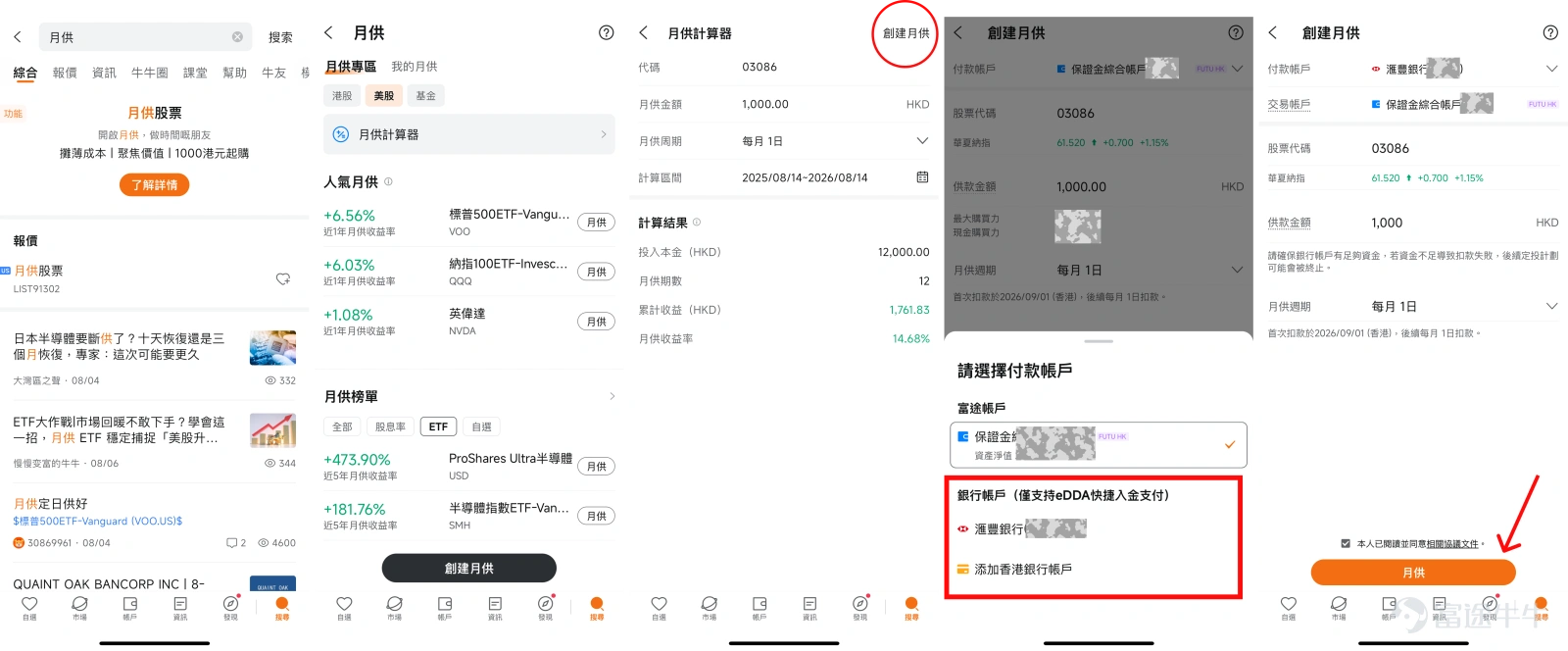
1. Step one: Open the Futubull App, enter in the search barMonthly Investment PlanEnter the专区.
2. Step 2: Use the built-in "MIP Calculator" in the Appto filter the assets you wish to include in your Monthly Investment Plan.Enter based on your financial capacitythe monthly installment amount (as low as HK$1,000 or US$10), and the deduction date, then click "Create MIP",redirecting to the MIP creation page, where you can adjust the payment account toBank account (eDDA), and you can get started easily!
3. Step 3: Once your monthly investment plan is created, you can view it anytime in"My Monthly Investments", and flexibly adjust, pause, or terminate it at any time based on your financial situation. Highly flexible!
🔍 What to invest in? Exclusive monthly investment tips for Futu fellow investors:
We have compiled detailed past ETF monthly investment allocation guides for fellow investors with different risk preferences. We strongly recommend saving and reading them:
💡 Summary
Instead of worrying daily about uncertain macroeconomic data, it is better to leave professional matters to "time," "discipline," and "good tools."
Use eDDA direct debit to build ironclad discipline for "saving before spending." Enjoy the platform advantage of zero commissions on monthly investment plans for Hong Kong and US stocks, and use the spare change saved each month to prepare a continuous stream of passive income for your future self.
Quickly choose the monthly investment portfolio that suits you best and start your journey of growing your idle cash! 👇

[Disclaimer] Note: The above monthly investment calculation data is derived from simulated backtesting results based on historical actual market conditions (2024/08/14-2026/08/14) using Futubull's "Monthly Investment Calculator." The underlying assets are QQQ and VOO, both ETF indices featured in the Monthly Investment Zone - US Stocks - Popular Monthly Investments. The settings assume a deduction of 10,000 USD on the 1st of each month for a total of 24 installments. The monthly investment calculation results cover the period from the first trading day after the start date to the last trading day before the end date, with returns calculated based on the closing price on each monthly investment date. The calculation results do not include buying/selling fees. The above content is for promotional and historical data sharing purposes only and does not constitute any investment advice, commitment, or guarantee. Past performance does not indicate future results; investing involves risks, so please proceed with caution.
Risk Disclaimer: The above content only represents the author's view. It does not represent any position or investment advice of Futu. Futu makes no representation or warranty.Read more


Comments (5)
to post a comment
21
47