Samsung's earnings surged; how long can the high prosperity in the memory chip sector last?

SanDisk Investor Day Ignites Market: 80% Gross Margin, Massive Cash Flow, and HBF... How to Rewrite Memory Valuation Logic?
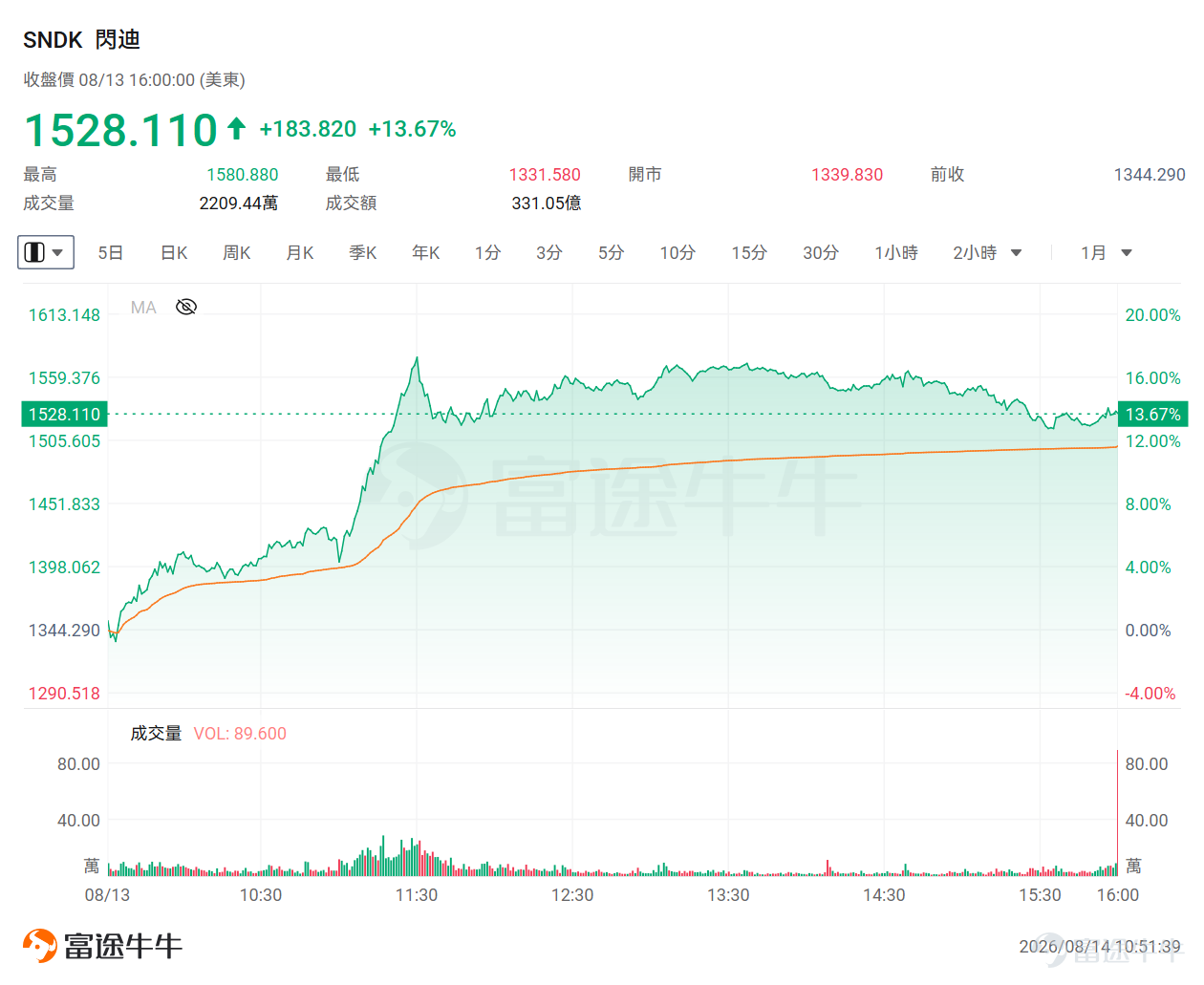
Against the backdrop of share price pressure following the earnings report, a series of major announcements from SanDisk's Investor Day quickly reversed market sentiment, driving the stock up nearly 14%.
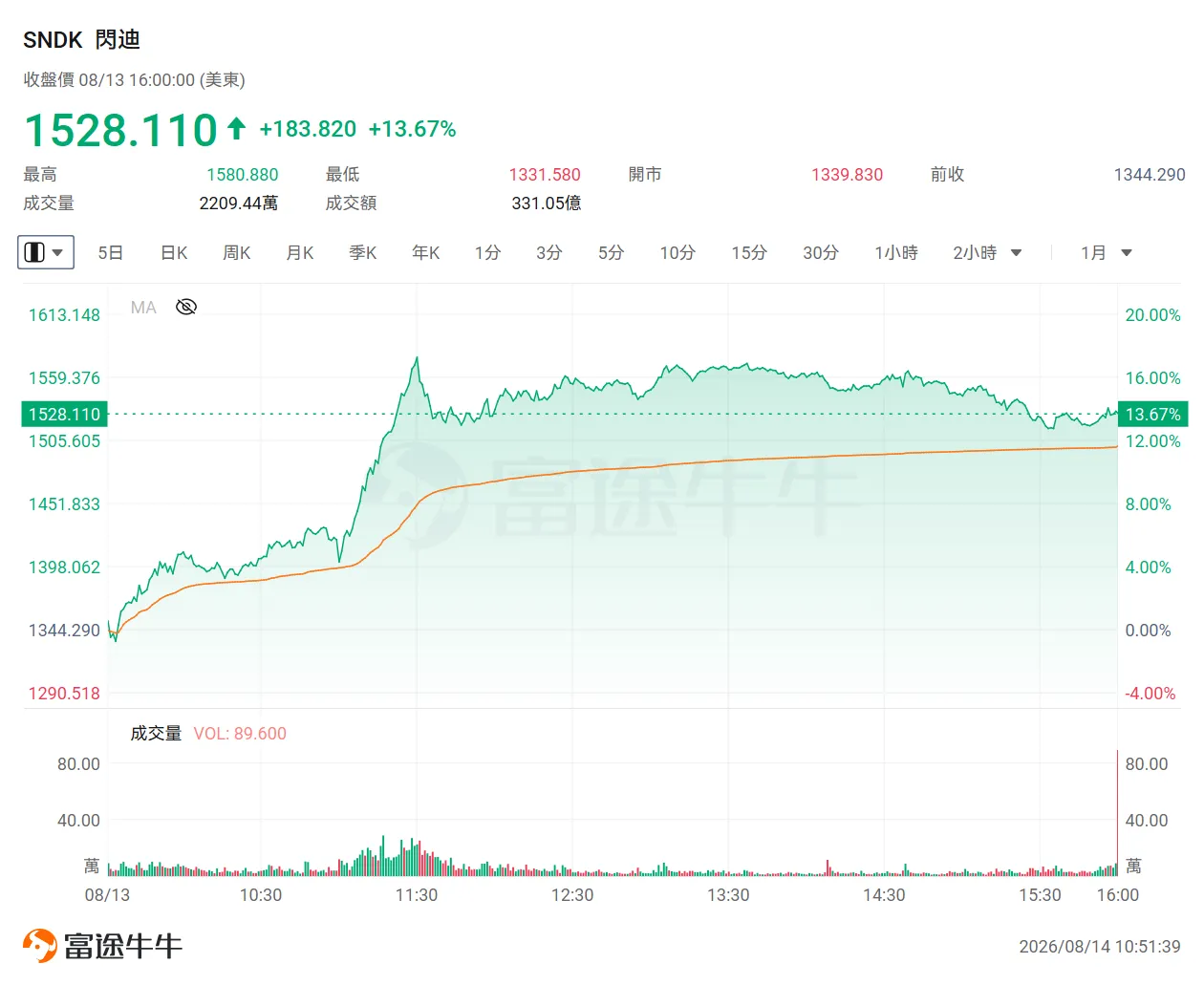
What truly excited investors was not any single new product, but management's attempt to prove:SanDisk is no longer just a cyclical company profiting from rising NAND prices, but has the opportunity to transform into a 'compounding machine' that consistently generates cash flow through long-term contracts, technological upgrades, and large-scale buybacks.
This Investor Day primarily ignited four expectations.
The first 'bombshell': An 80% gross margin, far exceeding traditional perceptions of the NAND cycle.
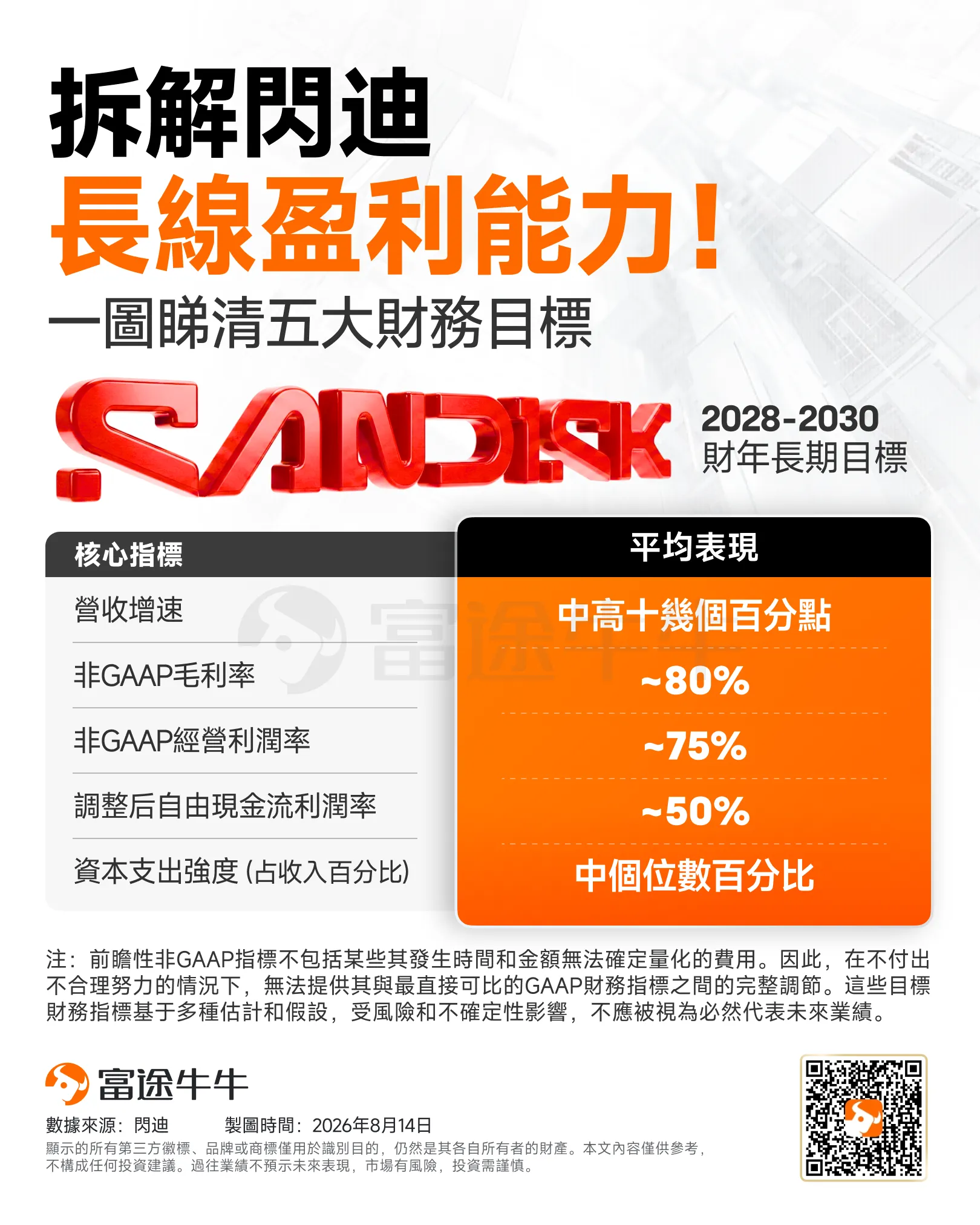
At the Investor Day event, SanDisk unveiled a multi-year financial framework covering fiscal years 2028 to 2030.
--
--
--
Among these, the most shocking figure for the market was the gross margin target of approximately 80%.
NAND has long been viewed as a classic highly cyclical industry: rising demand drives up prices, prompting manufacturers to expand capacity, which eventually leads to oversupply, falling prices, and sharp fluctuations in corporate profits. Therefore, even though SanDisk’s current profit performance is strong, the market previously worried that the company was merely at the peak of this memory cycle.
However, what SanDisk provided this time was not just a high gross margin for a single quarter, but an average target for fiscal years 2028 to 2030. This implies that management believes the current improvement in profit margins has a structural basis, rather than being solely the result of short-term price increases.
SanDisk already demonstrated this profitability in Q4 of fiscal year 2026: annualized revenue reached approximately $36 billion, non-GAAP gross margin rose to 84.6%, and annualized adjusted free cash flow was around $20 billion. In other words, while the long-term gross margin target of 80% is aggressive, it is not entirely detached from current operational performance.
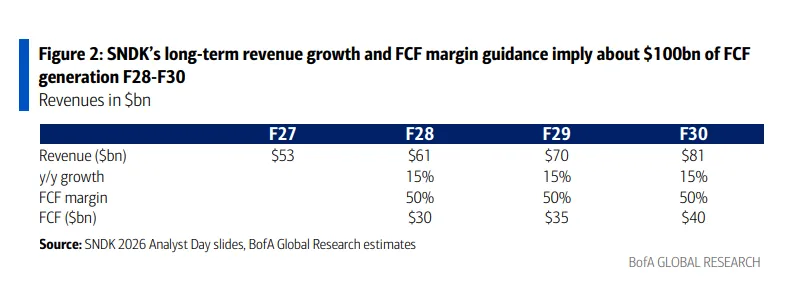
Based on this, Bank of America estimates that if SanDisk can achieve the aforementioned financial framework, the company could generate cumulative cash flow of approximately $100 billion during fiscal years 2028 to 2030.The real question has shifted from 'Can SanDisk make money?' to 'How long can such high profits be sustained?'
The second 'bombshell': Long-term NBM contracts, attempting to rewrite the NAND cycle
SanDisk’s confidence in setting such aggressive long-term targets,stems primarily from its long-term NBM contracts.
In the past, NAND manufacturers typically negotiated prices with customers on a quarterly basis, causing product prices and profit margins to fluctuate significantly with slight changes in market supply and demand. The NBM model upgrades this relationship from quarterly purchasing to deep cooperation lasting several years.
These contracts not only stipulate the procurement period but also clearly define the product mix, procurement volumes, and pricing mechanisms on a quarterly or even monthly basis. Some years feature fixed pricing, while longer-term contracts set price floors and ceilings. Additionally, customers provide financial guarantees to ensure performance by both parties.
SanDisk has currently signed NBM agreements with eight customers primarily driven by data center demand, including three U.S. hyperscale cloud providers. Two of these customers have already expanded their existing contracts.
The weighted average term of these contracts exceeds four years, with a maximum duration of up to five years. As of now:
Approximately half of the shipment capacity for fiscal year 2027 is covered under NBM; approximately two-thirds of the shipment capacity for fiscal year 2028 is covered under NBM;
The total contract value for the eight customers, calculated based on price floors, amounts to $93.9 billion;
Remaining performance obligations stand at $91.1 billion;
Financial guarantees provided by customers reach $16.5 billion.
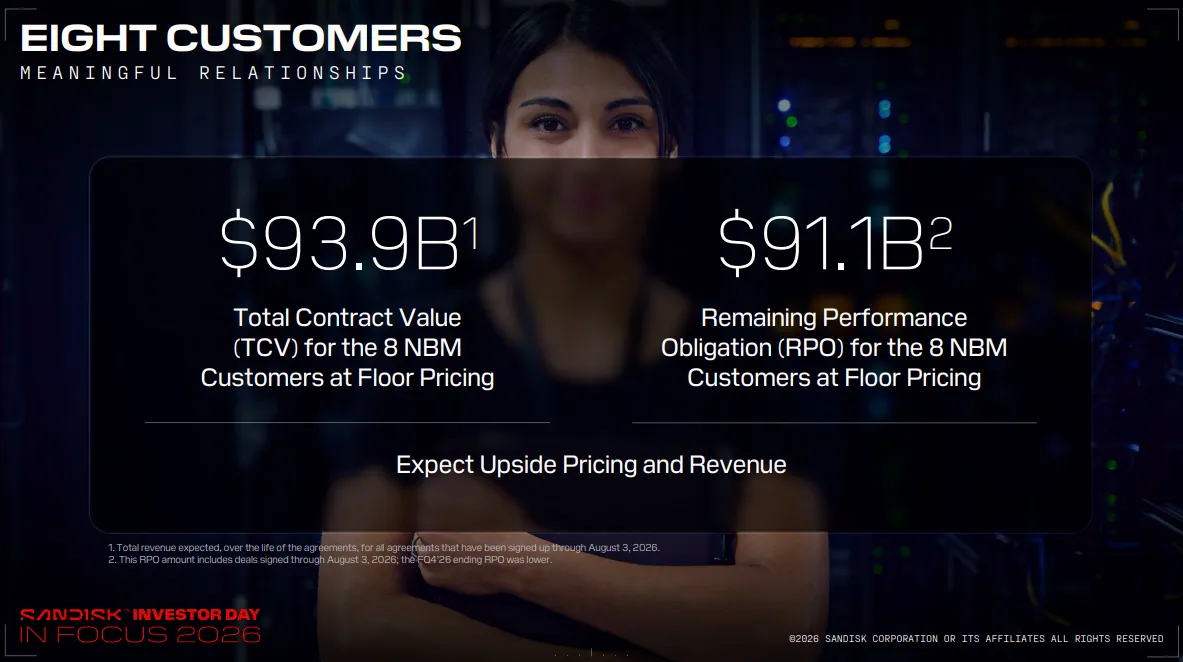
More importantly, the $93.9 billion figure is calculated based on price floors.Management expects that the final realized prices and revenue may still exceed this level.
This means that even if NAND spot prices fluctuate in the future, a significant portion of SanDisk's sales, product mix, and profit margins have already been locked in. While NBM cannot completely eliminate cyclicality, it is expected to reduce the sensitivity of the company's profits to quarterly price negotiations.
This is also the core thesis of the Investor Day: the market has historically valued SanDisk based on spot prices, whereas SanDisk aims for the market to start valuing the company based on long-term contracts and predictable cash flows.
In addition to securing demand, SanDisk emphasized that structural changes have already occurred on the NAND supply side.Following the industry downturn from 2022 to 2023, global NAND wafer capacity has decreased by approximately 30% from its 2022 peak, with about 560,000 wafers per month of capacity exiting the market. Currently, industry capacity utilization has returned to near 100%.
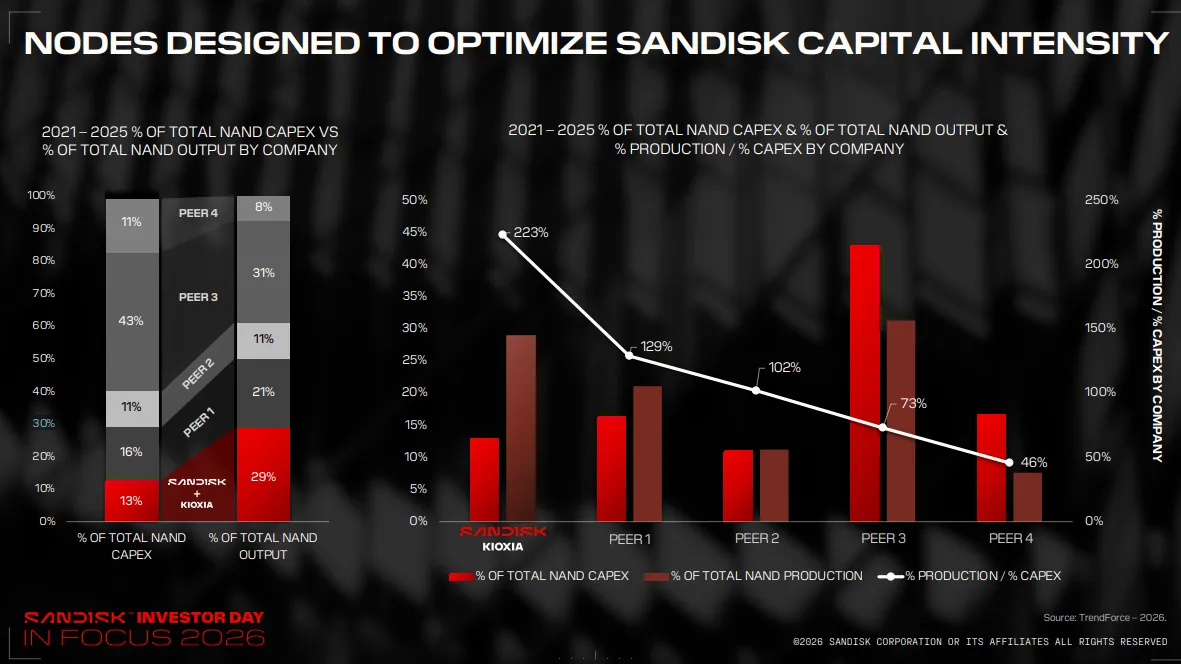
Meanwhile, SanDisk plans to primarily rely on process technology upgrades to increase shipment volumes, rather than undertaking large-scale construction of new wafer fabs.The joint venture fab between the company and Kioxia has been renewed until 2034. Together, they account for approximately one-third of global NAND wafer production. From 2021 to 2025, SanDisk and Kioxia contributed about 29% of the industry's NAND output, while their share of corresponding capital expenditures was only around 13%.
From BiCS5 to BiCS11, SanDisk expects an average bit density growth per wafer of 54% per generation; compared to BiCS8, the 2Tb QLC chips in BiCS10 can produce approximately 65% more dies per wafer.
This strategy gives SanDisk the opportunity to achieve mid-to-high double-digit shipment growth while maintaining capital intensity in the single digits. For shareholders, this means more revenue can be converted into free cash flow rather than being reinvested into endless capacity expansion.
The third 'bombshell': Returning 100% of excess cash to shareholders
If high profit margins determine how much money SanDisk can make, then its capital allocation policy determines where those profits ultimately go.
SanDisk has laid out a very clear capital allocation priority:First, invest in business and technological innovation; second, maintain healthy cash levels and a debt-free balance sheet; third, return 100% of excess cash to shareholders.
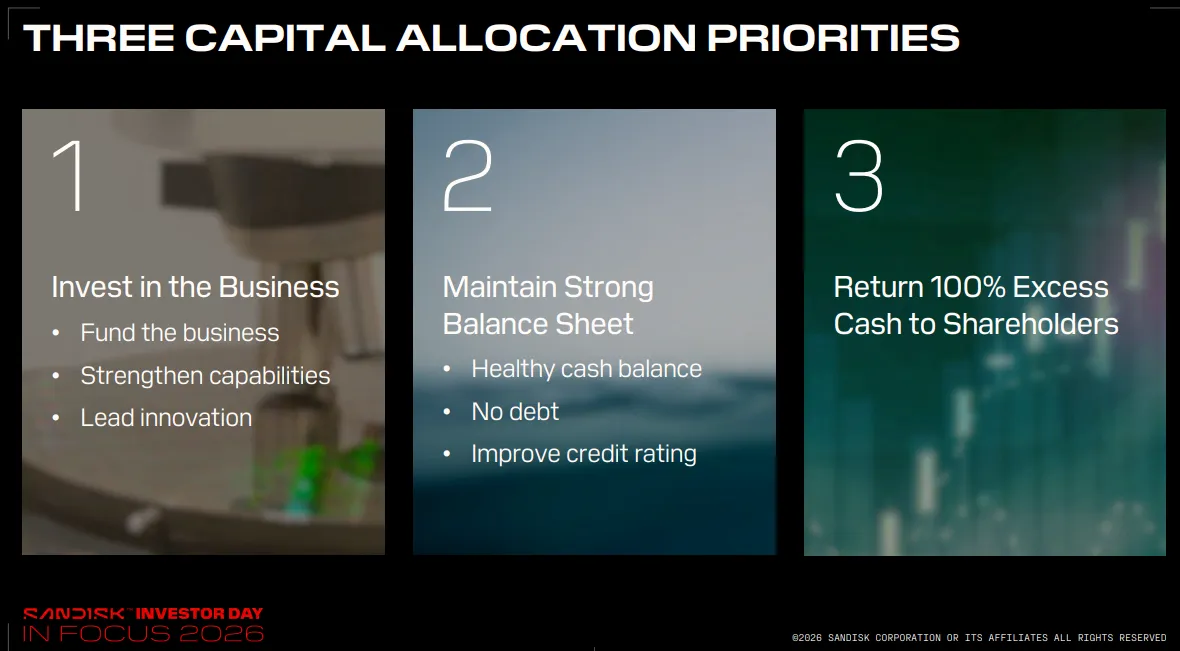
Management also explicitly stated that, at this stage, they prefer share buybacks over dividends for returning capital.Previously, SanDisk had secured a $6 billion buyback authorization and completed approximately $4.5 billion in buybacks; subsequently, the Board added another $14 billion in authorization, leaving a remaining buyback capacity of approximately $15.5 billion.
Bank of America estimates that if the approximately $100 billion in cash flow generated from fiscal years 2028 to 2030 is primarily used for buybacks, it could theoretically repurchase shares equivalent to nearly half of the current market capitalization.
In other words, if this cash is primarily used for buybacks, it will significantly reduce share count and boost earnings per share (EPS). TMTB's calculations show that, assuming management's long-term framework materializes, continuous buybacks could further lift CY2030 EPS from approximately $345 to a range of $467–$787, with $600 falling in the middle of this range.
This implies that SanDisk may not only become a cash flow machine but also convert earnings growth into EPS growth through continuous buybacks.
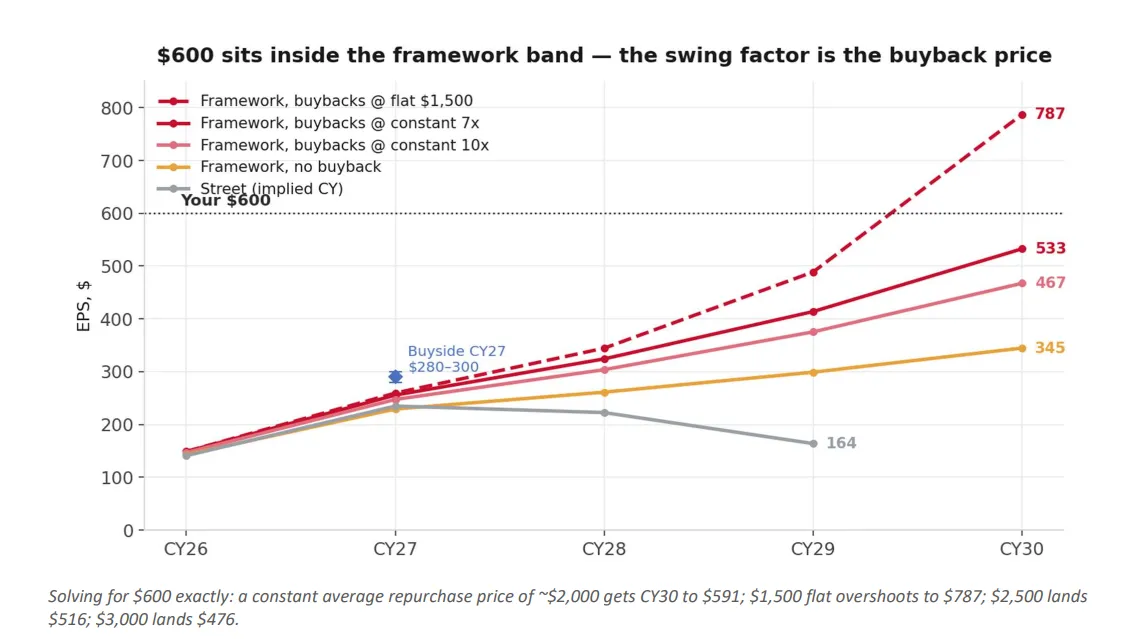
Source: TMTB
Chart legend: The gray line represents Wall Street's previous consensus expectation, where the market believes the NAND cycle will weaken after 2028, causing EPS to decline from approximately $235 to $164; Orange line: No buybacks, EPS stands at $345; Dark red/pink lines: Buybacks based on 7x and 10x valuation multiples respectively, resulting in EPS of $533/$467; Red dashed line: Share price maintained at $1,500, maximizing share repurchases, with CY2030 EPS reaching $787.
The fourth 'bombshell': HBF is not just a new product, but a valuation option in the AI inference era.
If NBM and share buybacks support SanDisk's core fundamentals,then HBF offers additional upside potential.
HBF, or High Bandwidth Flash, is a new architecture launched by SanDisk to address the "memory wall." According to company disclosures, HBF can provide read bandwidth close to that of HBM, while offering 8 to 16 times the capacity, making it particularly suitable for large MoE models, long-context processing, and massive KV caches.
In SanDisk's internal simulations:At the minimum configuration for running the same large model, one GPU equipped with HBF can replace eight GPUs equipped with HBM, improving capital efficiency by approximately 8x; four GPUs with HBF can achieve the same token output as eight GPUs with HBM, doubling GPU utilization efficiency.
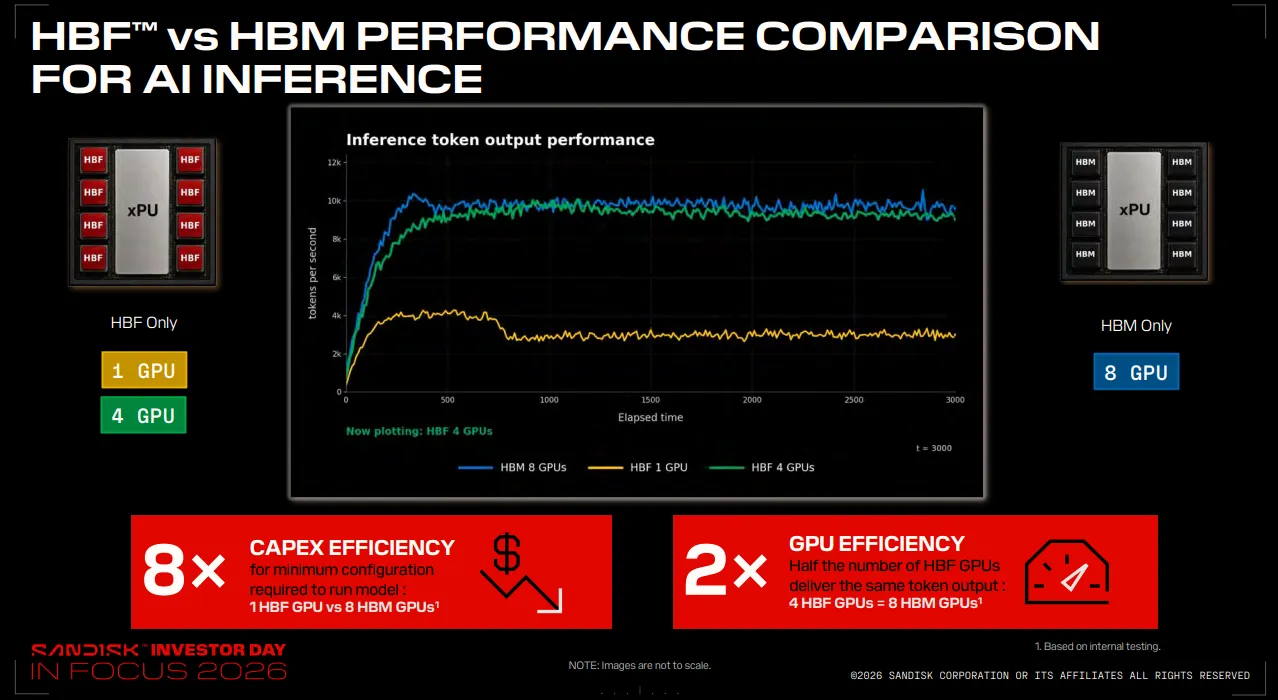
Currently, SanDisk has completed the tape-out of its first HBF memory die, with the first batch of HBF inference product samples expected to launch in 2027. The HBF Technology Alliance has already attracted participation from companies such as SK Hynix, Google, Meta, and Tenstorrent, and legendary chip architect Jim Keller has joined the HBF Technical Advisory Committee.
Meanwhile,SanDisk is also advancing long-term technology roadmaps including BiCS9 through BiCS13 and 3D Matrix Memory.
HBF will not become a major profit contributor in the short term, and its ability to scale for commercial deployment remains to be verified.Therefore, Goldman Sachs prefers to view it as an "upside option" beyond SanDisk's core NAND business. Once HBF enters AI accelerators and inference systems, the market's perception of SanDisk may shift further from a NAND manufacturer to an AI memory platform.
Has SanDisk truly broken free from cyclicality?
The outlook presented at the Investor Day was optimistic, but several questions still require further validation.
First, the company projects that the global flash memory market size will expand from a historical average of approximately $60 billion to over $300 billion by 2026, and approach $500 billion by 2027.This forecast is highly dependent on AI data center demand and NAND prices remaining at elevated levels, significantly above traditional cyclical norms.
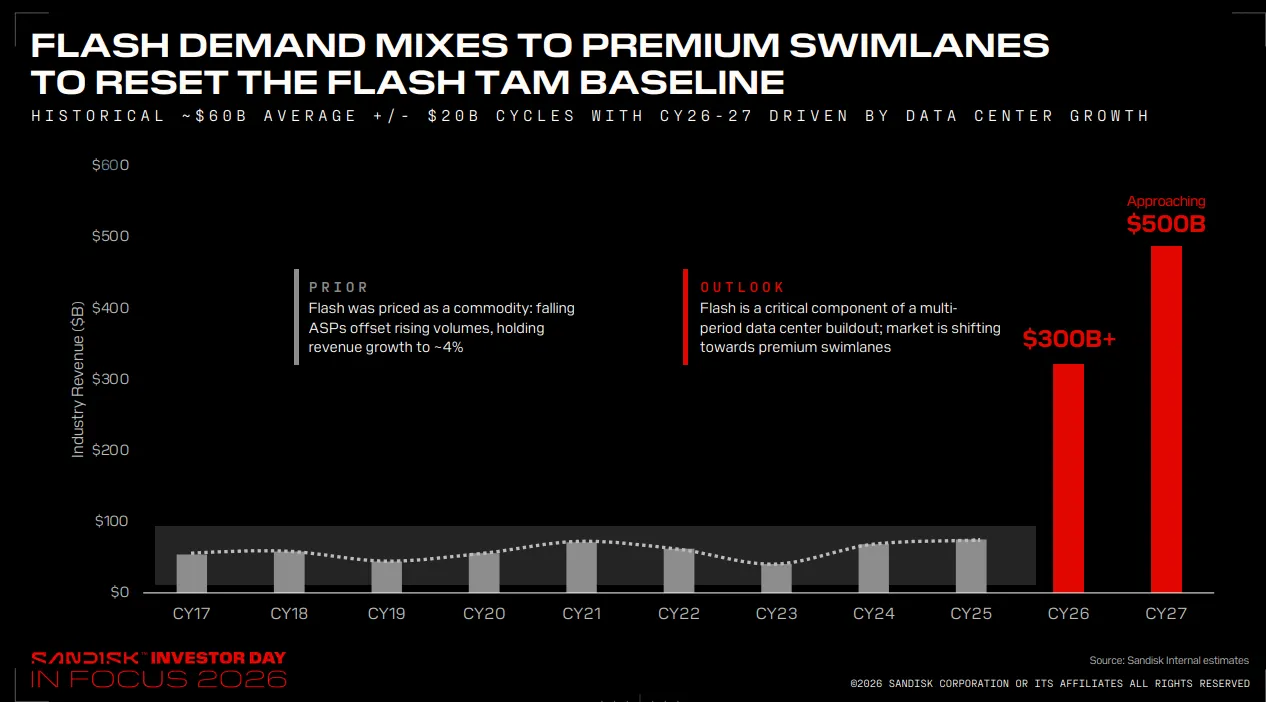
Second, while NBM (NAND Bit Mix) enhances visibility into demand and pricing, it has not yet been tested through a full industry downcycle.For customers not included in the NBM framework, shipment volumes and prices will continue to fluctuate with market conditions.
Third, increased supply from Chinese manufacturers, a reversion of NAND prices to the mean, and slowing capital expenditure by cloud providers could still impact SanDisk's long-term targets.
Finally, the first samples of HBF (High Bandwidth Flash) are not expected until 2027; currently, it represents more of a technological roadmap and a valuation option rather than certain revenue.
Therefore, this Investor Day does not prove that the NAND cycle has disappeared.What has truly changed is that SanDisk is locking in demand through long-term orders, controlling supply through process technology upgrades, freeing up cash flow via low capital intensity, and converting that cash flow into earnings per share through buybacks.
This is precisely why the Investor Day generated such excitement. The market's enthusiasm stems not just from the 80% gross margin, nor solely from the new HBF technology, but from SanDisk clearly outlining a complete value chain for the first time:AI-driven demand is expanding the flash memory market. NBM reduces earnings volatility, while technological upgrades lower capital expenditure. Strong free cash flow is driving large-scale share buybacks, ultimately creating a compounding cycle of sustained EPS growth.
Moving forward, there is only one thing left for SanDisk to prove: whether this is merely a super memory cycle or if the NAND business model has truly undergone a structural revaluation.
Risk Disclaimer: The above content only represents the author's view. It does not represent any position or investment advice of Futu. Futu makes no representation or warranty.Read more


Comments (33)
to post a comment
86
304