What was your first ETF purchase?

ETF Battle | AI Stages a Strong Rebound! How to Choose ETFs for Storage, Optical Communication, Cloud, Software, and Cybersecurity
In the past two weeks, the US AI sector has heated up again.
But compared to the previous rally led by hardware and storage, this round is clearly more diversified: since late July, optical communication has remained hot, Neocloud stocks surged after earnings, software trends are moving upward, and storage is also beginning to recover driven by positive catalysts.
This reflects that, amid the rebound in the main AI theme, the market is entering a phase of rapid rotation among sub-sectors.For ordinary investors like us, this raises a new question: how can we capture opportunities from these sub-sector rotations? How exactly should we choose AI-related ETFs?
To understand AI ETFs, you can first break down the entire industry chain simply. Different ETFs essentially represent different positions along this chain. Therefore, before buying an "AI ETF," the first question isn't which one has risen the most recently, but rather:Which segment of the AI industry chain do you actually want to invest in?
AI Hardware: Further segmentation from "chips" into storage and optical communications
If you are simply bullish on the overall AI hardware sector,$VanEck Semiconductor ETF (SMH.US)$ it remains one of the easiest choices to understand.
SMH primarily invests in large global semiconductor companies. The index itself leans toward industry leaders with higher market capitalization and liquidity, making it a useful benchmark for tracking AI semiconductor trends.
SOXX has a similar positioning. For fellow investors just starting to explore this type of ETF, it is generally unnecessary to hold both simultaneously.
However, a significant change in the AI market this year is that capital is beginning to segment further beyond simply "buying the entire semiconductor sector."
If you are bullish on storage demand such as HBM, DRAM, and NAND,DRAMthen this is a more direct tool.
It focuses on the global storage industry, covering companies related to HBM, DRAM, and NAND. Compared to SMH, it is more sensitive to storage prices, supply-demand cycles, and AI memory demand.
In simple terms:SMH bets on the overall semiconductor sector, while DRAM bets on the logic that "AI requires increasingly more storage."
The advantage is a purer thematic focus, which may offer greater elasticity when market rallies occur; however, conversely, if expectations for storage prices and supply-demand dynamics weaken, drawdowns could be more concentrated.
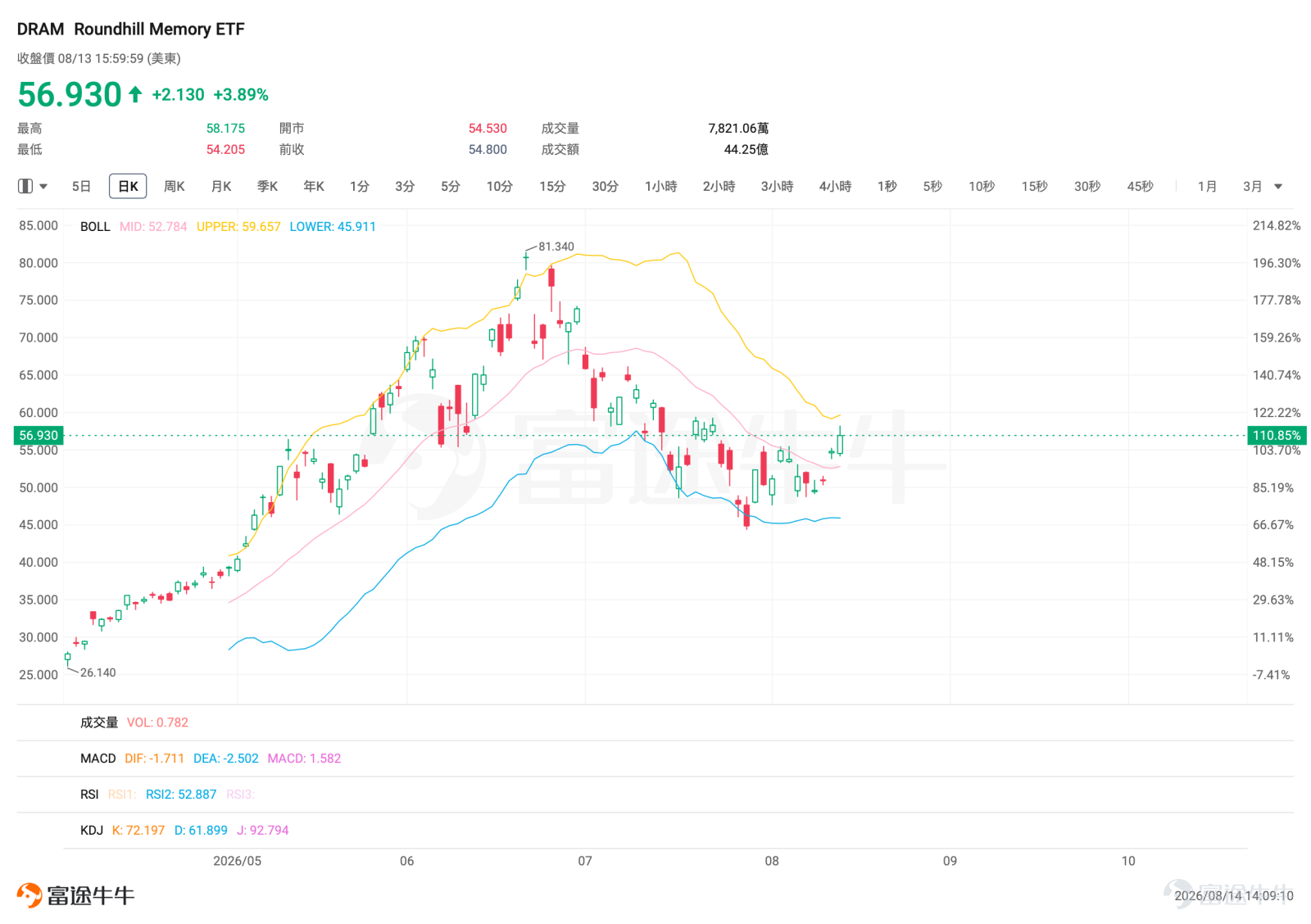
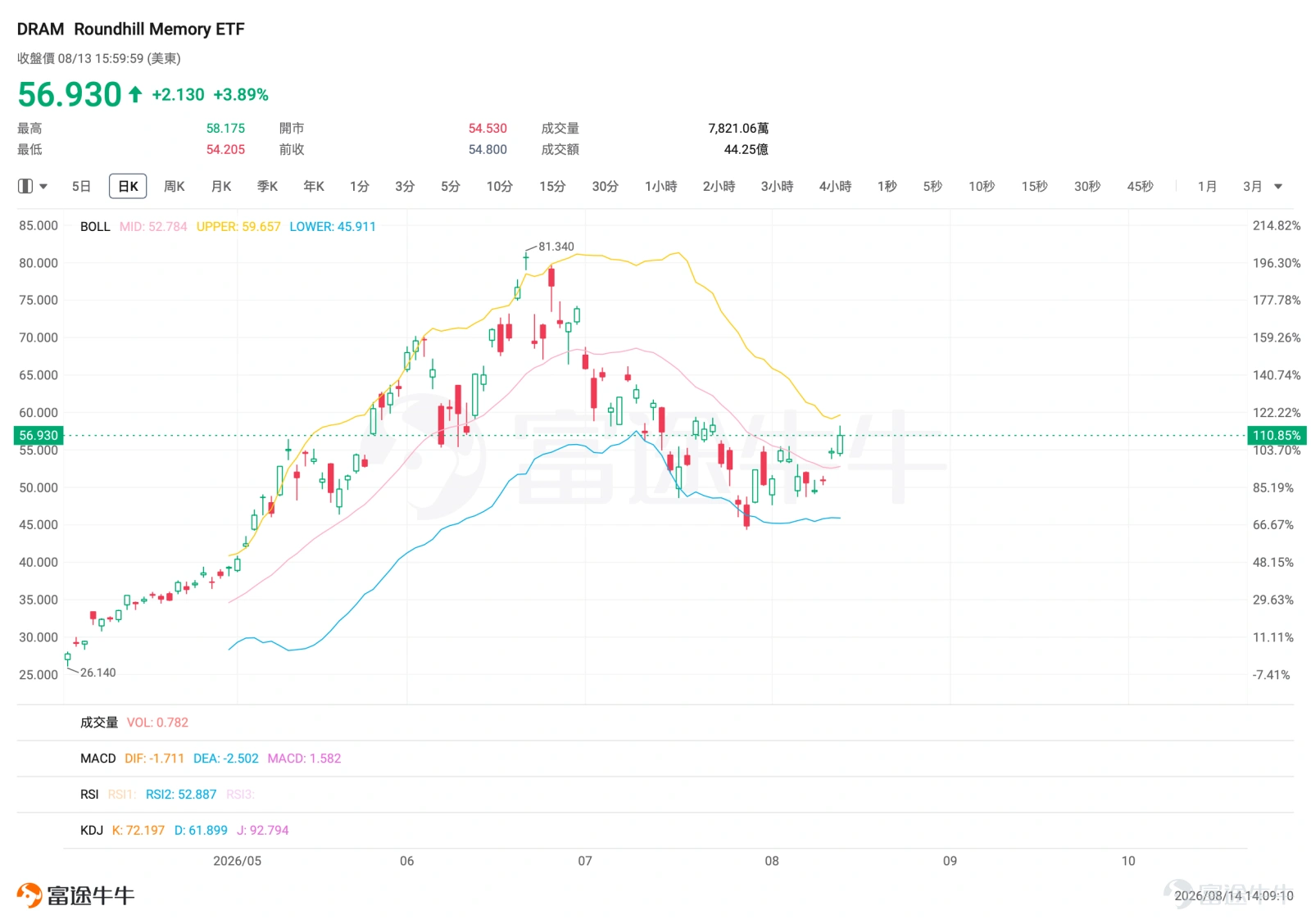
DRAM has also been a phenomenal ETF in the US stock market this year. Since its launch in April, trading volume and AUM have surged continuously, with the latest AUM reaching $25.3 billion and daily trading volume consistently exceeding billions of dollars, indicating strong liquidity.
There is also a 2x leveraged long ETF tied to DRAM, $Roundhill T-REX 2X Long DRAM Daily Target ETF (RAM.US)$ with its latest AUM approaching $600 million. This shows robust market demand for investing in memory chips. However, it is important to consider that RAM itself belongs to the highly volatile memory sector, and the 2x leverage further amplifies this volatility.
SanDisk announced its long-term performance guidance and a series of updates during its Investor Day event on August 13, directly stimulating a rebound in the memory sector. Keep an eye on the recent trend.
– $Roundhill Photonics & Optics ETF (LYTE.US)$ : The hottest optical communication theme in AI this year
As the number of GPUs increases, another bottleneck emerges:How to transmit data at high speed between these GPUs?
This is also why optical transceivers, lasers, and optical interconnects have continued to attract market attention in recent years.
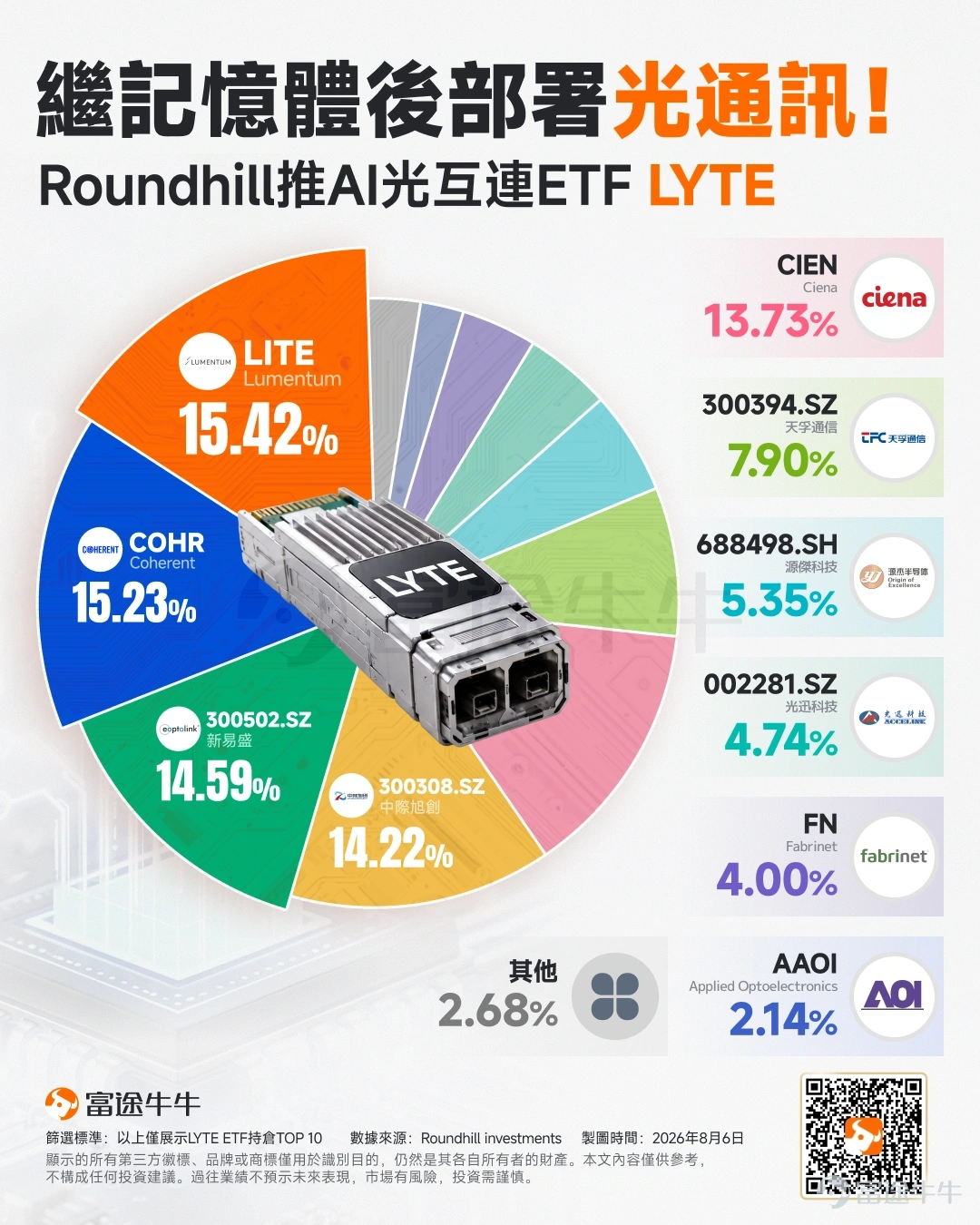
Roundhill Photonics & Optics ETF (LYTE) is a new product specifically targeting this sector, covering companies related to photonics, optical communications, and optics. LYTE was officially listed on August 6, 2026, and as of August 12, its assets under management had reached approximately $191 million, making it a very new ETF.
Therefore, LYTE's strengths are also its risks:The theme is highly pure, but industry concentration is high, and the current product has a very short trading history.
AI Cloud: NCLD, SKYY—these are actually two different types of "Cloud"
Don't assume they are the same just because they include "Cloud." These three ETFs actually correspond to three different directions within the AI cloud industry.
$Roundhill Neocloud ETF (NCLD.US)$ : High-beta Neocloud
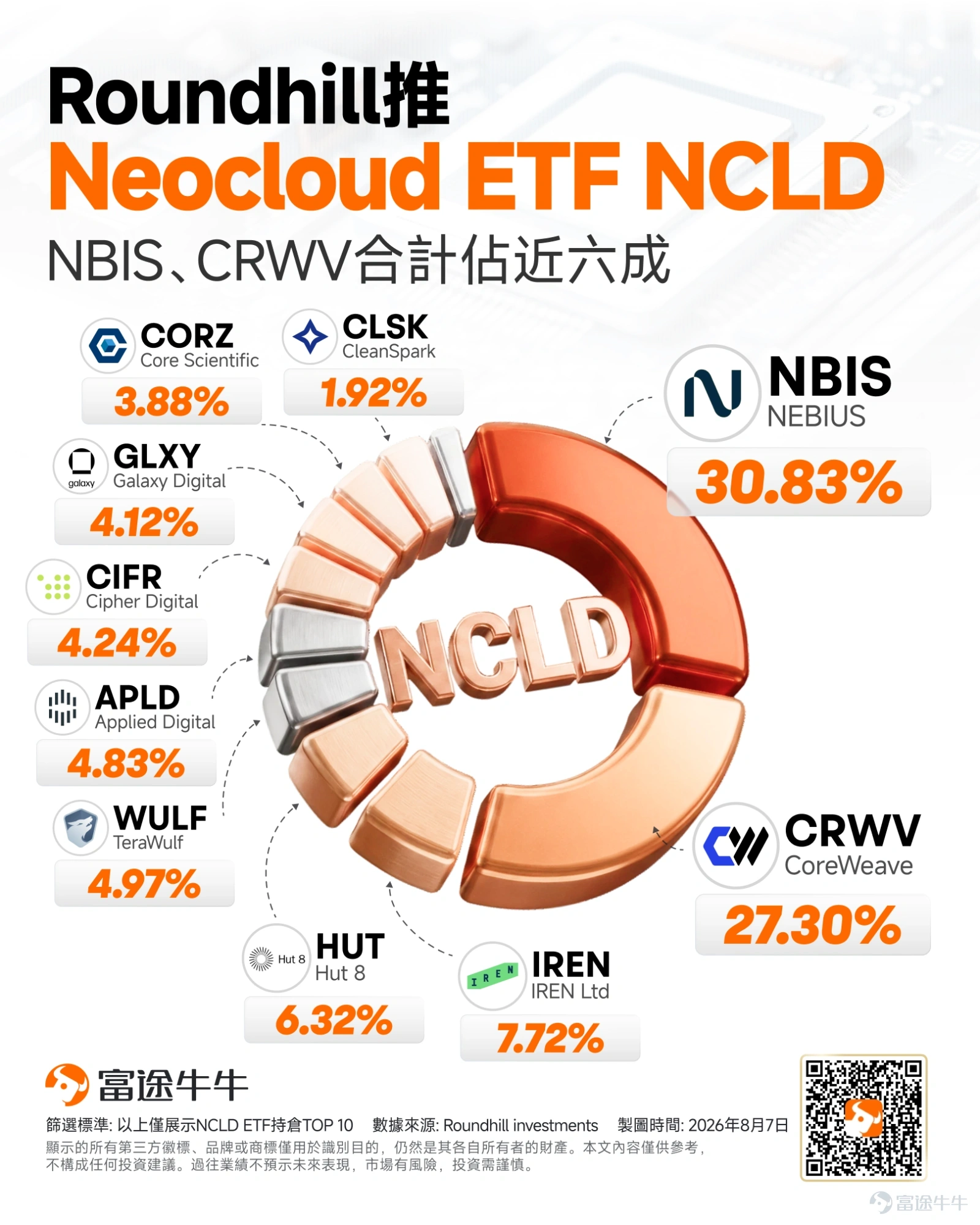
NCLD focuses on the rapidly emergingNeocloud, namely new cloud service providers that specialize in providing GPU computing power for AI and high-performance computing.
The fund primarily seeks companies related to GPU-as-a-Service and similar offerings, making it more sensitive to AI infrastructure development compared to traditional cloud computing ETFs. NCLD also began trading on August 6, 2026.
In simple terms:NVIDIA sells GPUs, while Neocloud companies purchase large quantities of GPUs and lease out the computing power.
Revenue for these companies can grow rapidly, but they also require substantial capital expenditure and financing, making them more sensitive to interest rates, debt levels, GPU supply, and customer demand.
Therefore, NCLD can be considered one of the most talked-about AI cloud ETFs currently, but it is also among this group of productswith relatively higher volatility and risk.
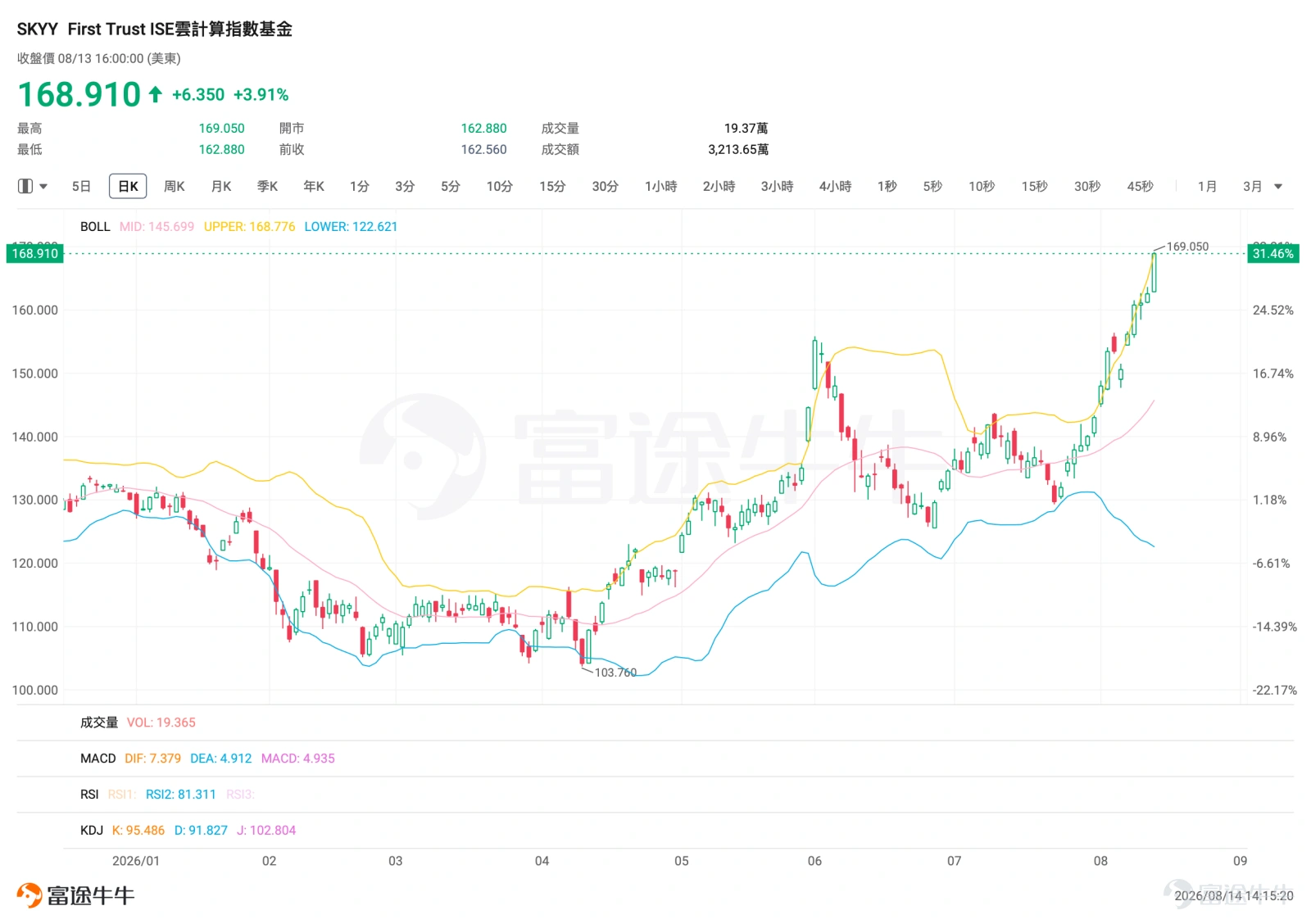
$First Trust Cloud Computing ETF (SKYY.US)$ : A More Mature Cloud Computing Choice
If you don't want to place all your bets on Neocloud, you can look at more traditional options. SKYY。
SKYY tracks companies in the cloud computing industry, offering much broader coverage than NCLD, not limited to just AI GPU computing power.
Thus, the difference between the two can be simplified as:
NCLD = AI Computing Power Cloud
SKYY = The entire cloud computing industry
The former offers pure thematic exposure and high flexibility; the latter has more mature and diversified business operations.
Recent market sentiment has been quite hot, with a trend of continuous new highs. Fellow investors looking to chase buys at this stage need to have a certain tolerance for volatility.
As AI shifts from "infrastructure build-out" to "application," IGV and CIBR are starting to deserve attention.
During the AI bull market of the past few years, most capital was concentrated on one thing:Spending on building AI infrastructure.
Buying GPUs, buying HBM, building data centers, and upgrading networks.
But capital expenditure cannot be the market's only narrative forever. AI ultimately needs to answer another question:Can these investments truly translate into software revenue and corporate productivity?
This is also why IGV is starting to deserve renewed attention.
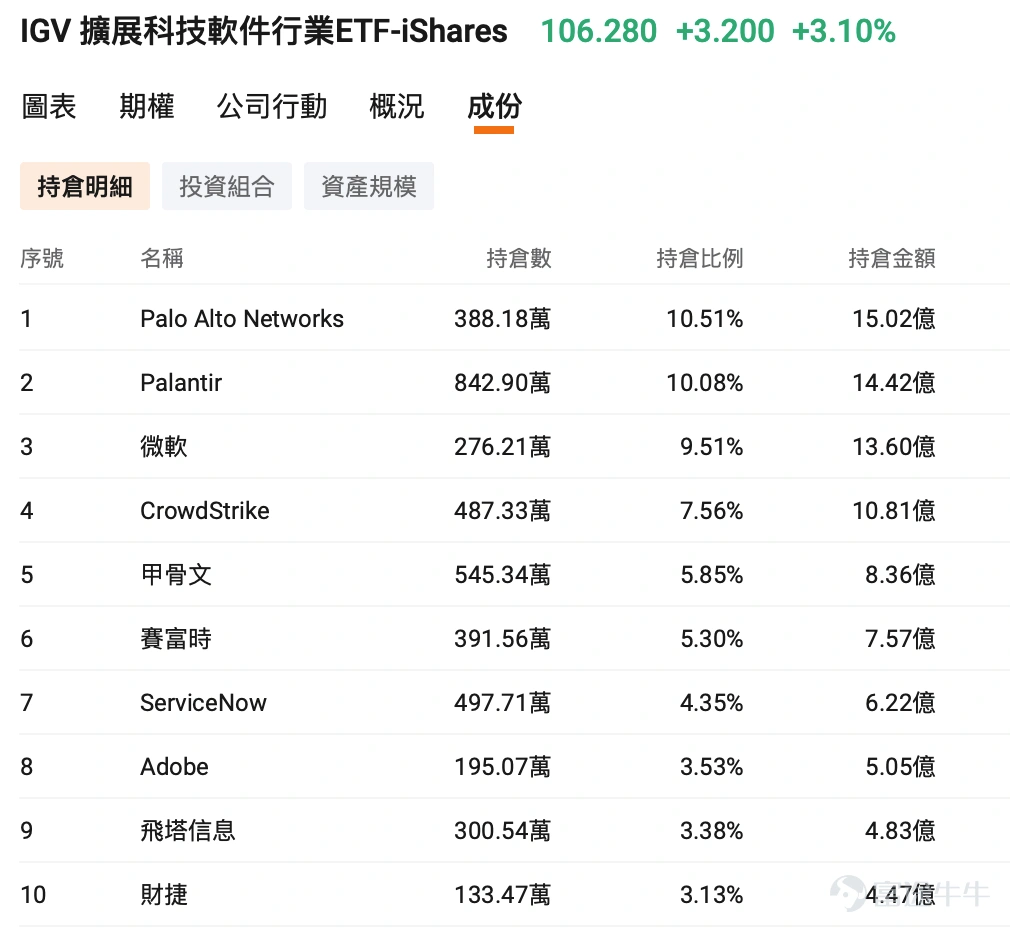
$iShares Expanded Tech-Software Sector ETF (IGV.US)$ It primarily invests in North American software companies, while also including some interactive media and related enterprises, making it a key tool for monitoring the US stock software sector.
If DRAM and LYTE trade on the theme of "what is needed to build AI," then IGV trades more on:"Can AI truly generate profits in the end?"
However, one risk factor to watch is that early this year, the market began repeatedly trading the narrative of "whether AI will disrupt traditional SaaS and software business models". Therefore, when looking at IGV now, one should not only focus on the opportunity of "AI software monetization," but also pay attention to the other side—which software companies can truly leverage AI to increase average revenue per user (ARPU), stickiness, and revenue, and which may instead see their product value compressed by AI.。
Another easily overlooked direction is thatCybersecurity。
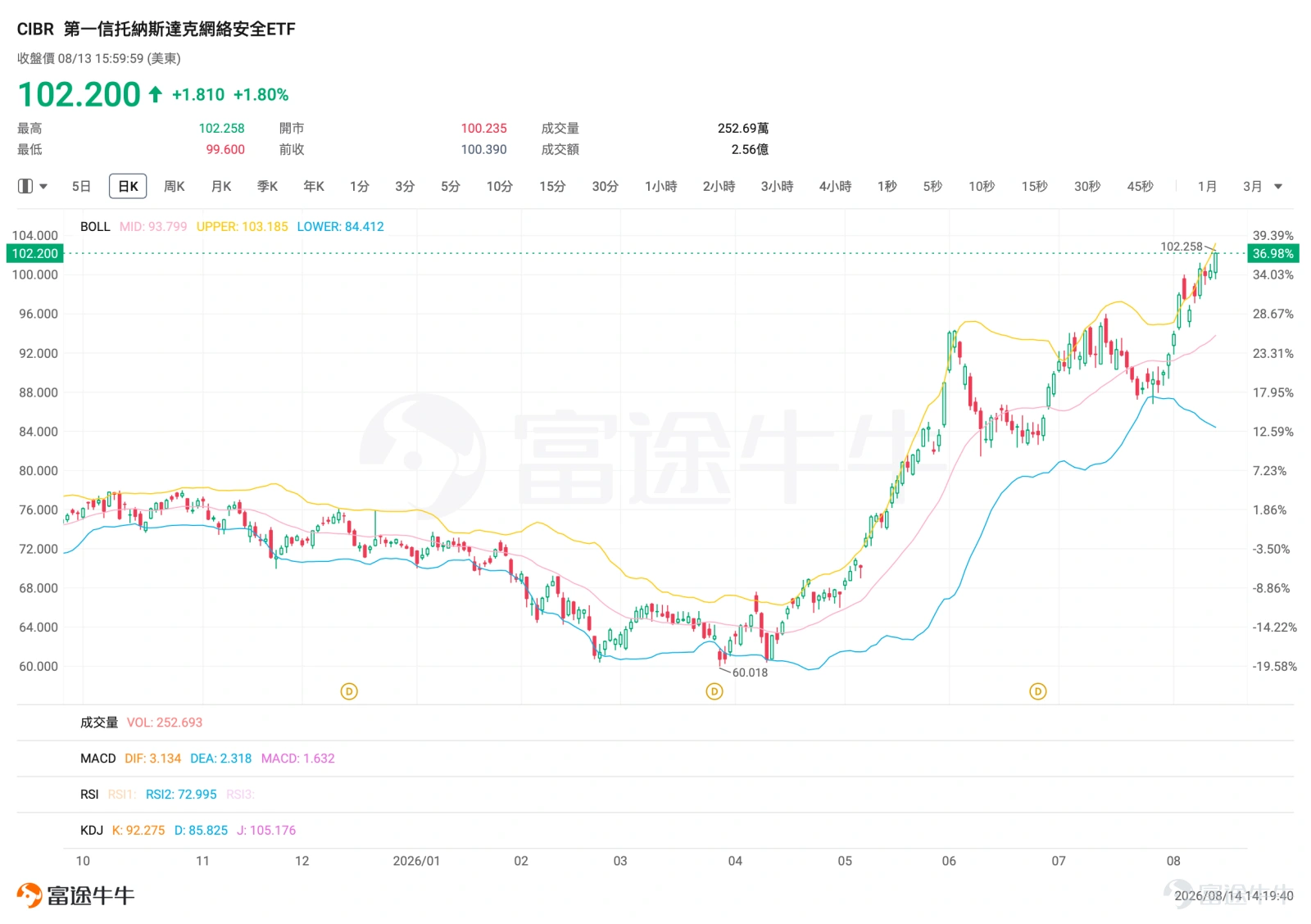
the widespread adoption of AI will also increase demand for enterprise data protection, identity verification, cloud security, and cyberattack defense. The representative ETF $First Trust Exch Traded Fund 2 Nasdaq Cybersecurity Etf (CIBR.US)$ tracks the Nasdaq CTA Cybersecurity Index and held 42 stocks as of August 12, with major holdings including Palo Alto Networks and CrowdStrike.
Therefore, if you prefer not to bet directly on a single cybersecurity company, CIBR can serve as a relatively diversified cybersecurity investment vehicle.
From a market perspective, the cybersecurity sector has shown a strong upward trend since late March. Even during the AI correction in July, the pullback was quite contained, and the sector has recently hit new highs.
Don't want to dig into the details? AIQ and CHAT are simpler options.
Reading this, some fellow investors might already be getting a headache:
Storage, optical communications, Neocloud, SaaS... How do I know who's next in line?
If you don't have a particularly strong view on specific sub-sectors, there's no need to force a guess.
$Global X Artificial Intelligence & Technology ETF (AIQ.US)$ It is a typical broad-based AI ETF, with an investment scope that includes both the development and application of AI technology, as well as hardware companies supporting AI and big data computing.
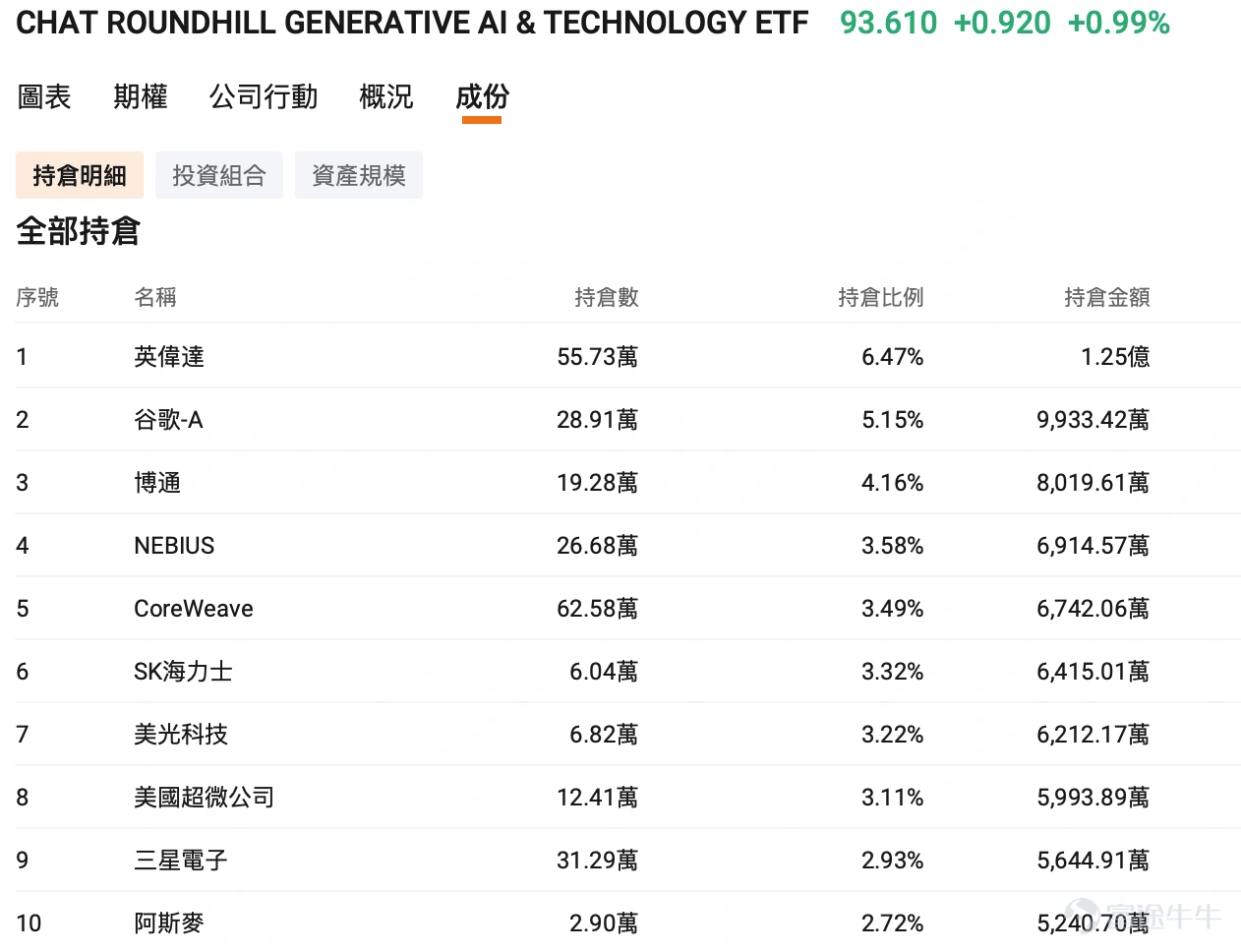
$ROUNDHILL GENERATIVE AI & TECHNOLOGY ETF (CHAT.US)$ It is an actively managed generative AI thematic ETF, capturing opportunities in generative AI and related tech companies from a broader perspective.
The benefits of such products are:You don't need to guess whether storage or optical communications will perform better next.
The trade-off is a dilution of thematic purity. If a specific AI sub-sector suddenly surges, its elasticity typically won't be as pronounced as that of specialized ETFs like DRAM, LYTE, or NCLD.
ETFs can mitigate company-specific risks associated with individual stocks, butthis does not mean they are free from industry risk.。
Specialized ETFs such as DRAM, LYTE, and NCLD are concentrated in specific segments of the AI supply chain. They tend to exhibit higher elasticity during market upswings but may also experience significant drawdowns when the sector corrects. Notably, LYTE and NCLD are new products listed only in August 2026, so their fund size, liquidity, and long-term trading performance still require ongoing observation.
Furthermore, holding multiple AI ETFs simultaneously, such as SMH, DRAM, LYTE, and NCLD, may seem like diversification, but in reality, you could still be highly exposed to the same AI capital expenditure cycle.
ETFs are merely tools. It is often more important to first clarify which segment of the AI supply chain you wish to participate in before selecting products, rather than simply chasing recent price gains.
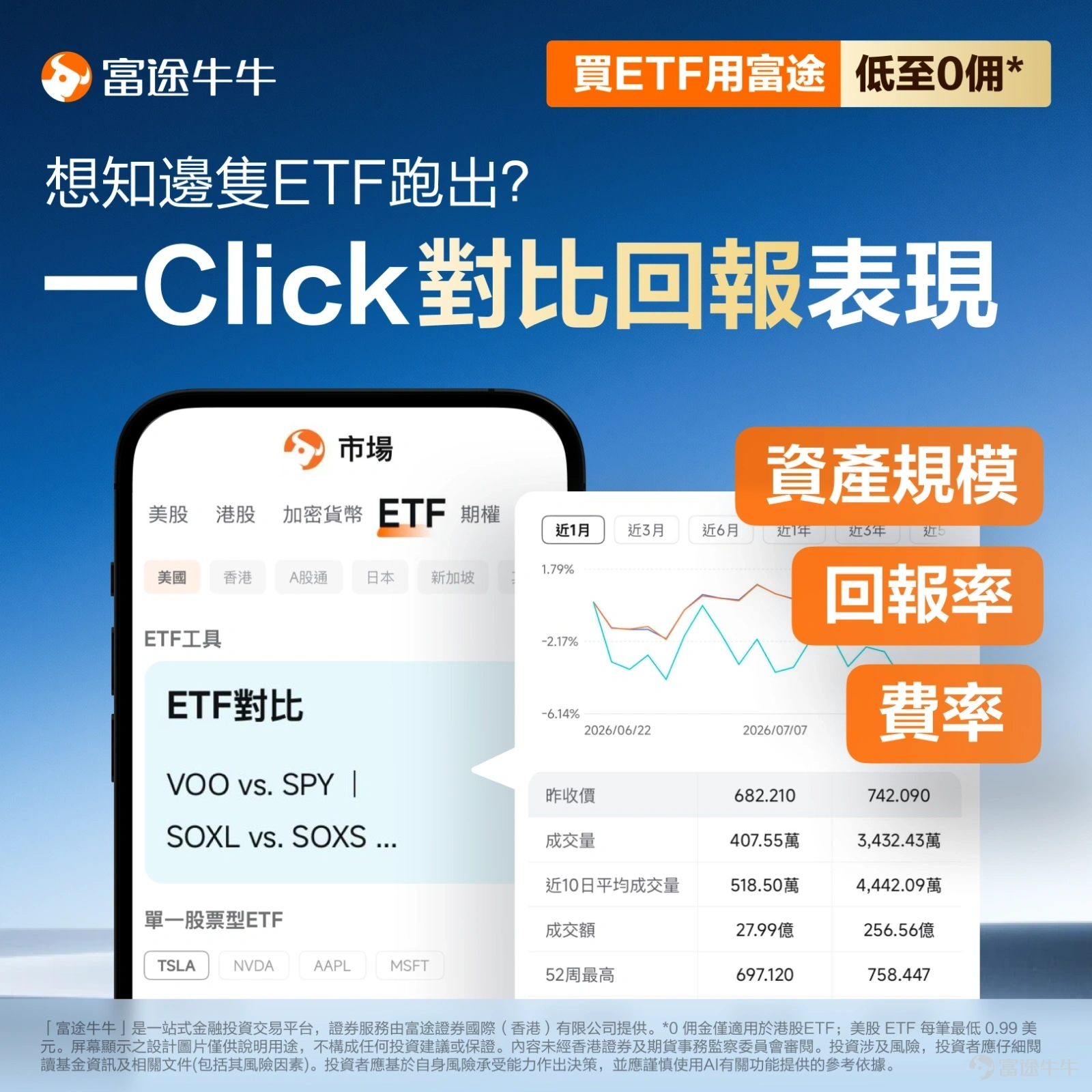
How do price movements differ across various ETFs? Use Futubull’s ETF tools to effectively compare product differences:
Risk Disclaimer: The above content only represents the author's view. It does not represent any position or investment advice of Futu. Futu makes no representation or warranty.Read more


Comments
to post a comment
31
88