NEBIUS and CoreWeave raise prices: Is the surge in AI computing demand here to stay?

Cerebras plunges! Hardware revenue unexpectedly declines as demand volatility hinders its path to challenging NVIDIA
Author: Yang Chen, Wall Street Journal
Cerebras Systems' unexpected decline in hardware sales has exposed the volatility of its chip product revenue, though strong growth in its cloud computing business has somewhat alleviated market concerns.
Cerebras reported its Q2 2026 financial results on Wednesday, showing GAAP revenue rising 74% year-over-year to $180.1 million. Core revenue reached $210 million, up 103% year-over-year.
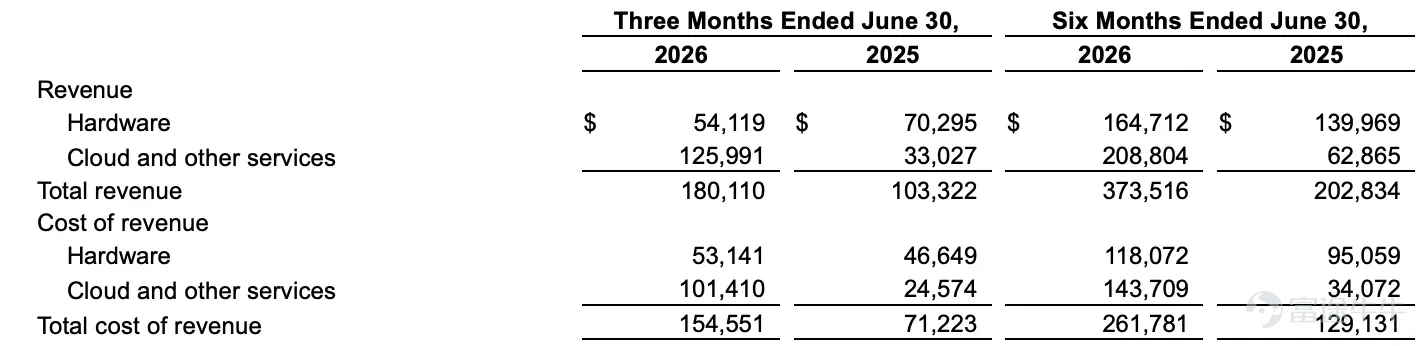
Q2 hardware revenue stood at $54.1 million, down 23% year-over-year, while cloud computing and other services revenue hit $126.0 million, surging 281% year-over-year.

These results also highlight a shift in Cerebras' business model: cloud computing has surpassed hardware as the company's largest revenue source. CEO Andrew Feldman stated that hardware sales will experience 'lumpy' growth, which is inherent to the nature of this business.
Cerebras shares fell as much as 17% in after-hours trading, following an 11.6% gain in Wednesday's regular session.

From a structural perspective, the most noteworthy change for Cerebras in Q2 was the stark contrast between its hardware and cloud businesses.
The earnings report showed that Q2 hardware revenue dropped 23% to $54.1 million from $70.3 million in the same period last year. Meanwhile, cloud computing and other services revenue surged 281% to $126.0 million from $33.0 million. On a core basis, cloud and other services revenue totaled $127.7 million, up 287% year-over-year.
This indicates that Cerebras is no longer just a chip company relying solely on sales of AI computing systems. As customers like OpenAI expand their demand for AI inference computing, the company is increasingly generating revenue by providing computing power via the cloud.
Cerebras CEO Andrew Feldman stated that the company will continue to pursue a 'dual-track' strategy of hardware and data center services, adding, 'We aim to meet customer demand where their growth is fastest.'
However, the decline in the hardware business remains a core concern for the market. Cerebras had previously positioned its wafer-scale engine (WSE) chip as a challenger to NVIDIA's GPUs, but the drop in hardware sales suggests that this business has yet to establish a stable, linear growth trajectory.
Feldman noted that the hardware business is inherently subject to significant volatility.

Despite the slump in its hardware business, Cerebras provided future guidance that was significantly stronger than market expectations.
The company expects Q3 core revenue to be approximately $214 million to $216 million, with a midpoint of $215 million, exceeding the market consensus of $212 million. Core gross margin is projected at 38% to 40%, also surpassing the market expectation of around 36%.
Full-year guidance was also raised. Cerebras now forecasts 2026 core revenue of $880 million to $890 million, up from its previous estimate of $855 million to $865 million.
Full-year core gross margin is expected to be 41% to 43%, compared to the previous range of 38% to 41%. Analysts had previously estimated Cerebras' full-year adjusted gross margin at just 35.89%.
In other words,Looking at the forward guidance, Cerebras' figures are clearly better than market expectations; however, the unexpected decline in hardware revenue within the current quarter's business structure has sounded an alarm for investors.
The company's financial report showed that Q2 core total revenue was $209.9 million, a year-over-year increase of 103%. Core gross margin reached 40.6%, an improvement of approximately 9.4 percentage points from the same period last year. The core net loss narrowed significantly to $6.908 million, down from $40.5 million in the same period last year.

The market's reaction to the earnings report indicates that investors are not only focused on whether Cerebras can beat next quarter's revenue expectations but are also reassessing the quality and sustainability of the company's growth.
Cerebras' stock has surged significantly since its IPO, as the market previously bet that its unique wafer-scale chip architecture would allow it to capture share from NVIDIA in the AI inference market. Therefore, even with rapid cloud business growth and an raised full-year guidance, a 23% year-over-year decline in hardware revenue easily triggered profit-taking.
southbound capital is not retreating systematically but actively reallocating: reducing exposure to old-economy and valuation-pressured tech-internet names while increasing allocations to AI computing power and semiconductor hardware.Cerebras' valuation already prices in fairly high growth expectations; simply "beating estimates" in guidance may not be sufficient to offset concerns arising from the decline in its core hardware business.
Notably, the company's GAAP hardware gross margin in the second quarter was only 1.8%, although the non-GAAP hardware gross margin reached 38.8%.
The earnings report shows that Cerebras adjusted key metrics for items such as amortization of customer warrants, stock-based compensation, and data center expenses, resulting in a significant discrepancy between GAAP and non-GAAP figures.

Cerebras is currently betting on the AI inference market.
Unlike training large models, inference occurs after users send requests to AI applications such as chatbots. As AI applications gradually move from model training to scaled commercial deployment, demand for low-latency, high-throughput inference computing power is growing rapidly.
Cerebras' core product, the WSE, adopts a wafer-scale architecture that integrates massive computing resources onto a single giant chip. The company believes this architecture can reduce data transmission between numerous chips in traditional GPU systems and accelerate AI inference speeds.
The company stated that its systems can currently support OpenAI's GPT-5.6 Sol at a speed of 750 tokens per second, and it is collaborating with AMD to develop disaggregated inference solutions, expected to enter production in the fourth quarter of 2026. Meanwhile, the company plans to introduce related technologies to AWS's Amazon Bedrock in the first quarter of 2027.
Cerebras also stated that it has signed new cloud computing capacity agreements, with clients including AI coding firms Cognition and Lovable. The company is already serving customers such as Block, Figma, AlphaSense, GSK, and CrowdStrike.

Amid widespread supply constraints and rising prices for High Bandwidth Memory (HBM) affecting the AI chip industry, Cerebras is attempting to leverage its proprietary architecture to gain a cost advantage.
The company stated that its wafer-scale architecture does not rely on HBM, nor does it utilize CoWoS advanced packaging or the 3nm process node, all of which are currently bottleneck segments in the AI chip supply chain.
Feldman noted that the sharp increase in NVIDIA's AI chip prices is linked to rising HBM costs. Since Cerebras does not use HBM, it may gain a certain advantage in an environment of rising component prices.
However, whether this advantage can ultimately translate into sustained hardware sales growth remains to be verified. The year-over-year decline in hardware revenue precisely illustrates that Cerebras still faces challenges in converting its technological edge into stable commercial revenue.

Cerebras' current strongest asset stems from its substantial order backlog and capital reserves.
As of the end of June, the company's remaining performance obligations reached $25.4 billion, indicating a significant volume of contracted but yet unconfirmed revenue.The company stated that it plans to more than triple its revenue by 2027.
Meanwhile, the company raised approximately $6.4 billion in its IPO this year. As of the end of June, it held a combined total of approximately $8.6 billion in cash, cash equivalents, restricted cash, and short-term investments, along with an $850 million debt financing facility.
To fulfill these orders, the company is rapidly expanding its production capacity.
Cerebras stated that its manufacturing capacity will expand more than tenfold by 2026, with new production lines already added at Flex, Sanmina, and Rocket EMS. As of the end of June this year, the company had secured, was constructing, or had already put into operation data center capacity scheduled for delivery by the end of 2027, totaling over 600 MW.

Risk Disclaimer: The above content only represents the author's view. It does not represent any position or investment advice of Futu. Futu makes no representation or warranty.Read more
Comments
to post a comment