HK Stock Market Barometer | HK stocks continue to fluctuate and pull back! How much room for recover

Free cash flow turns negative: Is Tencent at a crossroads in the AI game?
What was bound to happen has finally arrived.
Domestic social media giantTencent<$TENCENT (00700.HK)$>announced its Q2 2026 results. Quarterly revenue rose 10.99% year-on-year to RMB 204.785 billion (all figures in RMB unless otherwise stated), while non-IFRS net profit attributable to shareholders increased by only 8.51% year-on-year to RMB 68.415 billion.
Tencent has long maintained robust free cash flow, leveraging its monopolistic position as a social media powerhouse and its rich ecosystem. This has served as the core safety cushion enabling it to navigate industry cycles and sustain dividends and share buybacks. However, in Q2 2026, Tencent finally followedAlibaba <$BABA-W (09988.HK)$>in the footsteps of others, with free cash flow turning negative from positive, which may be a key reason for the sharp decline in its stock price following the earnings release.
Stock price drop post-earnings: Paying for the "future"?
Although Tencent's Q2 2026 revenue maintained double-digit growth and non-IFRS net profit remained positive, its American Depositary Receipts (ADRs) fell first after the earnings announcement. Subsequently, during the next day's Hong Kong stock trading session, H-shares dropped 4.46%, closing at HKD 441.00. With a market capitalization of HKD 4 trillion (approximately RMB 3.4 trillion), it was overtaken by the A-share listed memory chip supplierChangXin Technology<$CXMT Corporation (688825.SH)$>with a market cap of RMB 3.5 trillion, losing its status as the most valuable Chinese-listed company.
The first factor causing market concern is likely free cash flow.
In Q2 2026, Tencent recorded a net free cash outflow of RMB 13.8 billion, compared to a net inflow of RMB 43.0 billion in the same period last year and RMB 56.7 billion in the previous quarter (see chart below). This marks the first time in many years that Tencent has reported a net free cash outflow.
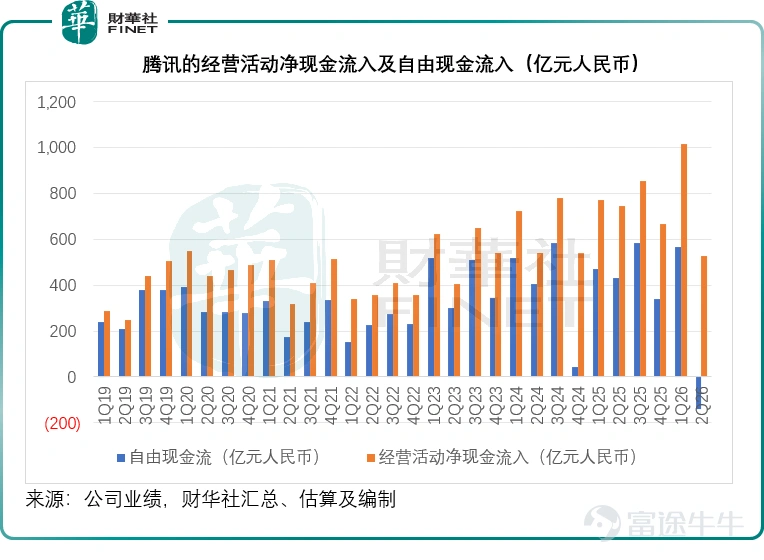
For an internet giant that has averaged over RMB 100 billion in annual free cash flow over the past decade and is accustomed to "printing money," this signals a break in momentum, which the capital markets may need time to digest.
Although profit growth has slowed, Tencent's fundamental business remains solid. In Q2 2026, Tencent generated net cash inflow from operating activities of CNY 52.71 billion. While this figure is lower than the CNY 74.376 billion recorded in the same period last year and the CNY 101.351 billion from the previous quarter, it still represents a net inflow exceeding CNY 50 billion. The primary driver behind its negative free cash flow was a surge in capital expenditures.
In Q2 2026, Tencent's capital expenditures reached CNY 52.784 billion, representing a 176.25% increase year-over-year and a 65.28% increase quarter-over-quarter, far exceeding market expectations of approximately CNY 30 billion. As shown in the chart below, Tencent's capital expenditures have increased significantly over the past two years, reaching a peak in Q2 2026.
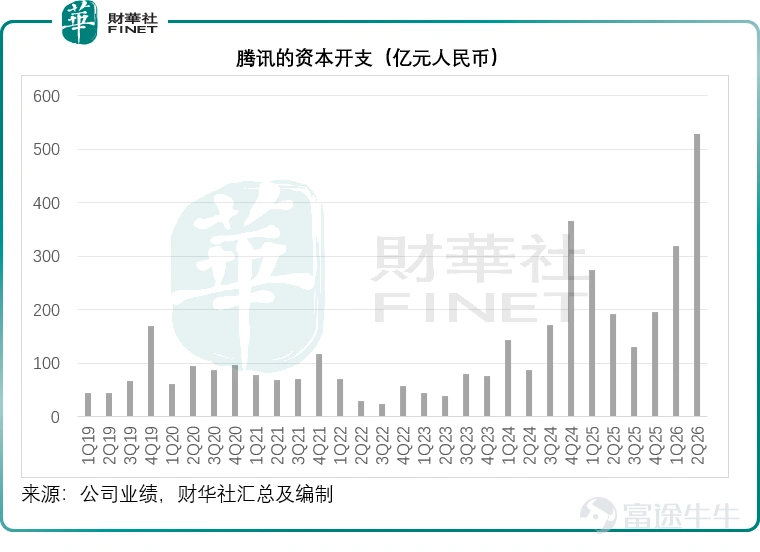
These funds were primarily directed toward AI infrastructure, including stockpiling computing power for the upgrade of the Hunyuan large model, reserving inference resources for the future growth of WorkBuddy and CodeBuddy, paving the way for AI integration within the WeChat ecosystem (such as the Xiao Wei assistant), and meeting external customer demand for Tencent Cloud's AI services.
In the financial report, Ma Huateng explicitly stated that Tencent has 'significantly increased its procurement of computing power' and is advancing its AI strategy on three levels: the intelligence layer (Hunyuan model), the application layer (WorkBuddy, CodeBuddy, Yuanbao, and Xiao Wei), and the infrastructure layer (computing power reserves). During the conference call, Martin Lau likened this investment to a 'kick-start' initial outlay. The subtext from management is clear: they are actively choosing to endure short-term cash flow pressure in exchange for a ticket into the AI era.
However, the market is no longer buying the 'paying for the future' narrative as readily as it did in early 2023. A common question remains: When will this round of capital expenditures yield tangible returns? If the commercialization of AI applications proceeds slower than expected, will these investments become sunk costs?
Deconstructing Cash Flow: Operational Cash-Generating Capacity Remains Intact, but Signals Cannot Be Ignored
It is worth noting that negative free cash flow does not imply an issue with Tencent's cash-generating ability. As mentioned earlier, its operating activities continue to generate net cash flow. Management provided a key adjusted figure during the conference call: after excluding prepayments for computing power procurement, the free cash flow for the quarter was actually positive at CNY 37.6 billion.
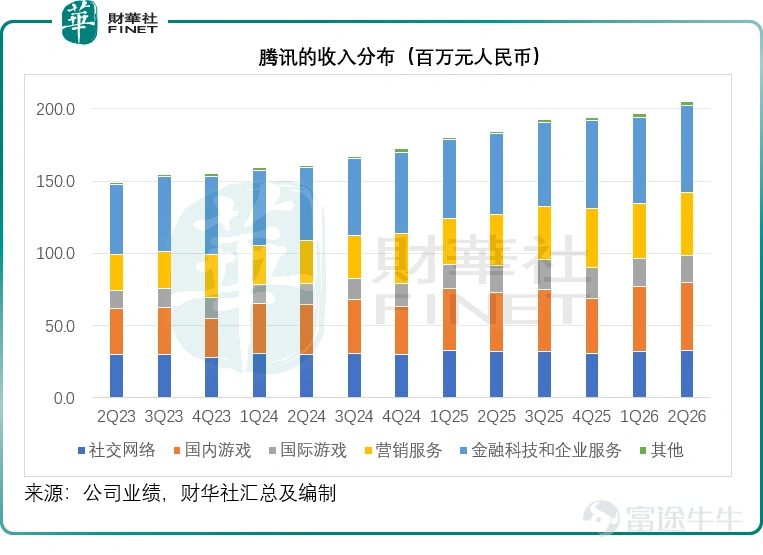
Tencent's core operating businesses—gaming, advertising, and fintech—continue to generate strong cash inflows. As shown in the chart below, segments including social networks, domestic games, marketing services, fintech, and enterprise services all maintained revenue growth in Q2 2026. In other words, Tencent's core business remains robust; it has simply chosen to actively channel significant cash into AI infrastructure construction.
During the earnings presentation, Martin Lau categorized capital expenditures into two parts: one related to existing core businesses, which continues to generate ample cash flow; and another related to new AI-native businesses, considered a 'one-off' start-up investment. He further emphasized that spending on computing power for model training is more akin to fixed costs rather than recurring expenses requiring equal annual additions.
This distinction is crucial for understanding Tencent's financial logic. If the market simply annualizes the quarterly capital expenditure of CNY 52.8 billion to over CNY 200 billion and assumes this level will persist indefinitely, the impact on valuation would be disastrous. However, management's guidance suggests that capital expenditures are expected to decline from current peaks once the training of Hunyuan 4 is completed and sufficient inference computing power reserves are established—although the specific timing and magnitude of this decline remain undetermined.
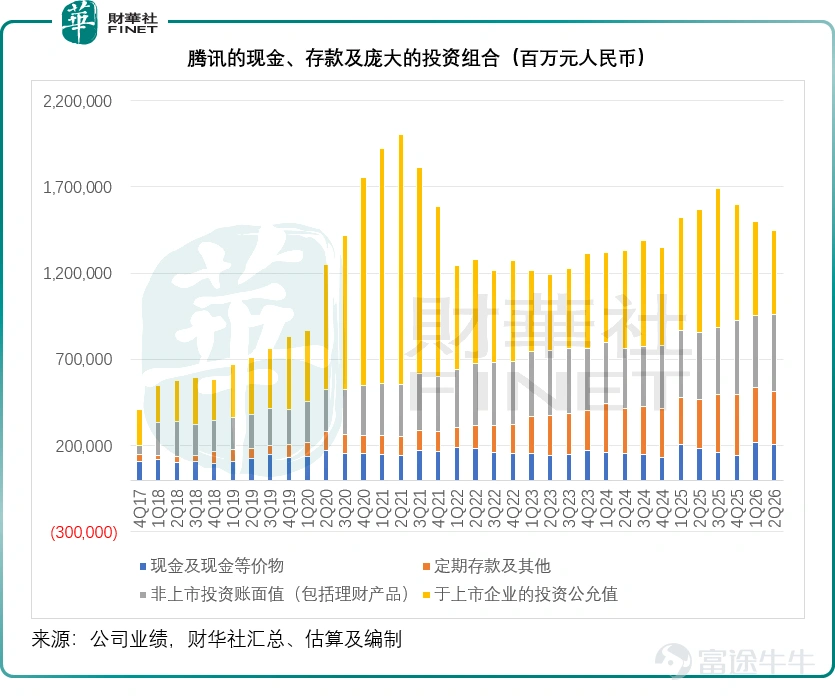
However, even after the aforementioned adjustments, the fact that free cash flow remains negative is still a strong warning signal. It indicates that, at this juncture, Tencent's cash outflows from investing activities have exceeded its cash inflows from operating activities. For a mature internet giant, this is by no means a situation to be taken lightly. Tencent’s ability to sustain this stance is built on its net cash position of over RMB 58 billion and its substantial portfolio of liquid investments—but having deep pockets does not justify unchecked cash burn.
Wall Street’s "Depreciation Anxiety": Revaluing NVIDIA and the Entire AI Ecosystem
Tencent’s stock price correction is not an isolated incident. It gains deeper significance when viewed against the backdrop of a global restructuring of tech stock valuations. At the eye of this restructuring storm stands the former "King of AI."NVIDIA (NVDA.US)。
Although NVIDIA’s stock has soared since 2023, with its current market capitalization exceeding $5.4 trillion, it is worth noting that its share price momentum has slowed significantly since 2026. The cumulative gain year-to-date stands at 20.30%, while the Philadelphia Semiconductor Index, which reflects the AI chip supply chain, has risen by over 75%. NVIDIA’s stock performance has clearly lagged behind peers such as Intel (INTC.US) and AMD (AMD.US), as well as upstream suppliers. Wall Street’s calculation is precise: the focus of AI trades is shifting from downstream to upstream, as massive capital expenditures downstream allow upstream suppliers to reap profits first.
NVIDIA and six major financial institutions plan to leverage $500 billion to deploy AI infrastructure. Following the announcement, the stock price fell instead of rising, marking a symbolic event in the shift of global tech valuations. Beyond concerns that this model might constitute a "self-reinforcing loop" artificially boosting demand and valuations for NVIDIA’s products, it may also reveal latent asset risks across the entire computing power industry chain.
A large number of AI computing projects rely on credit expansion from financial institutions, with many loans directly collateralized by hardware such as GPUs and servers. As global computing capacity continues to be released and Chinese domestic computing hardware accelerates its market entry, low-priced hardware is continuously impacting the global computing market. A sustained decline in hardware prices could trigger a chain reaction: shrinking collateral values leading to tighter risk controls by financial institutions; impairment pressure on the book value of equipment for tech giants that have heavily invested in hardware procurement; and, compounded by the rapid iteration of large language models, new chips continuously compressing the utility value of older computing resources. The actual usable life of hardware may be shorter than its accounting depreciation period, exposing companies to risks of accelerated depreciation and hidden impairments coming to light in the future.
Prominent investor Michael Burry previously warned that the AI industry普遍 underestimates depreciation issues, with many tech companies using extended depreciation periods for computing assets. If hardware obsolescence occurs faster than expected, industry profits face systematic downward revisions in the coming years. In the past, the market was accustomed to optimistically assuming long-term shortages in computing supply, rarely seriously calculating hardware depreciation risks. Now, with changes in the global computing supply landscape, investors are beginning to incorporate depreciation risk into their valuation models.
Impact on Tencent
For Tencent, risks are differentiated but cannot be completely insulated.
Tencent has procured large volumes of domestic and international computing hardware and built its own computing clusters, meaning it will continue to bear hardware depreciation costs in the future. Competition in the domestic computing market is intensifying, and the shadow of cloud service price wars has not fully dissipated. Although Tencent Cloud raised public pricing and reduced discounts in May to improve profitability, if computing supply remains excessively abundant in the future, the pricing ceiling for computing rentals and model services will be suppressed, putting downward pressure on the return on investment per unit of computing power.
During the earnings call, management noted that domestic token production costs are significantly lower than external market estimates. The gross margins for paid users of WorkBuddy and MaaS businesses have approached the overall level of Tencent Cloud. However, substantial subsidies for free users are currently dragging down overall profitability. To achieve profitable scale, the company relies on two pillars: continuously improving paid user conversion rates, and optimizing models to reduce inference costs. Significant volatility in computing hardware prices would impact the long-term cost curve.
Thirdly, Tencent has chosen to prioritize internal use of computing power for AI application development rather than leasing it out externally. This strategy avoids short-term price wars in the computing lease market, but it means the return on computing assets is heavily tied to the commercialization progress of AI products such as the Hunyuan model, WorkBuddy, and WeChat Mini Programs. If AI application adoption lags behind expectations, a large amount of idle computing power will continue to incur depreciation burdens, leading to declining asset utilization and an extended investment payback period.
Of course, Tencent possesses buffer advantages not available to overseas giants. Its stable cash flow foundation, comprised of WeChat, WeCom, and gaming businesses, means it may not need to rely on large-scale external credit to purchase computing power. Furthermore, given that current domestic financing costs are relatively low, its debt risk exposure should be lighter compared to overseas competitors.
However, from a valuation perspective, global capital assessment criteria are converging. In the past, investors were willing to award a growth premium to companies with stable cash flows, but now they impose multiple constraints: return on capital expenditure, computing asset utilization, depreciation pressure, and the pace of AI commercialization realization. As soon as global investors begin to普遍 (universally) price in the potential risks of computing assets, it will be difficult for Tencent's valuation core to rise independently of the broader market environment.
Tencent's AI Strategy: The Application Ecosystem is Key to Breaking Through, but Multiple Challenges Remain to Be Verified
Facing changes in the external valuation environment and pressure to catch up with competing models, Tencent's response strategy appears to focus on developing synergies among models, applications, and infrastructure. Martin Lau confirmed during the earnings call that a larger-parameter version of Hunyuan 4 is currently in training, with a launch expected within 2026, aiming to join the top tier of global foundational models. However, it is worth noting that Hunyuan 3 remains a 'cost-efficiency first' model, with a clear gap in raw capabilities compared to leading models. Whether Hunyuan 4 can truly achieve 'State-of-the-Art' (SOTA) status remains to be verified after its release later this year.
Tencent's insistence on self-developing foundational models is based on the core logic of synergistic advantages: deep integration of self-developed models, terminal applications, and computing infrastructure allows for better unit economics in the early stages of AI development and unlocks the value of the intelligent ecosystem. However, the validity of this logic presupposes that the model's capabilities do not lag behind those of competitors.
Tencent's current layout on the application side can be divided into two main lines: B-end productivity tools and C-end native WeChat AI.
In the B-end sector, WorkBuddy and CodeBuddy currently rank among the top AI office productivity products in China, based on monthly interaction metrics. However, this metric primarily reflects user activity rather than monetization capability.
WorkBuddy is positioned as a one-stop intelligent workspace capable of orchestrating multiple AI agents to handle complex tasks. It integrates entry points for WeChat, WeCom, and remote control, and accesses over 70,000 skills via Tencent Cloud SkillHub. The product has established a developer revenue-sharing mechanism: users pay for skill usage, and developers receive a share, intending to drive the self-expansion of the developer ecosystem. Leveraging the corporate client base accumulated through WeCom, WorkBuddy should have a natural advantage in customer acquisition. However, it should be noted that this closed-loop system is still in an early cultivation stage. Management has stated that the current focus is on market education and expanding the user base. Consequently, the overall gross margin is depressed due to subsidies for free users. While paid users exhibit healthy gross margins, the timing and magnitude of profit elasticity remain unknown, as the scale and proportion of paid users have not been disclosed.
The most noteworthy aspect of the consumer-side strategy is the AI agent "Xiao Wei," embedded within the WeChat ecosystem. Built on WeChat's custom WeLM model, Xiao Wei deeply integrates WeChat's social graph, Mini Program ecosystem, and payment system to assist users with information retrieval, product selection, and even order execution.
In theory, Xiao Wei represents a key attempt by WeChat to evolve from a "connector" to an "executor" in the AI era. However, this vision remains in the early validation stage. Management has explicitly stated that Xiao Wei is currently only a prototype being rolled out in phases. Due to security considerations, it mandates user intervention and multiple confirmations, leaving it far from becoming a truly autonomous agent.
A more concerning risk is that if Xiao Wei successfully simplifies the user journey from demand to transaction, reliance on traditional ad displays and store browsing may decline—potentially disrupting WeChat's existing advertising monetization model. While Xiao Wei's strategic significance is undeniable as an AI-native transformation of the billion-user WeChat ecosystem, critical questions remain unresolved: whether the model can achieve sustainable operations, and the magnitude of its impact on existing business models once established.
Yuanbao, the general-purpose large language model for consumers, is positioned more as an "AI capability testing ground." Through continuous iteration of features such as dialogue, search, and multimodal interactions, it collects user feedback to improve the Hunyuan model and accumulates reusable atomic capabilities, thereby empowering products like WorkBuddy, WeChat, and QQ Browser. While this synergistic design logic is coherent, Yuanbao faces significant competitive pressure from ByteDance's Doubao in China's consumer AI application market.
This strategic blueprint is sufficiently comprehensive, but it may face immediate real-world challenges:
First, AI products are still in the investment phase. Ongoing non-recurring expenditures continue to erode profits. The market needs to see sustained growth in paid user scale to prove that subsidy investments can be converted into stable revenue.
Second, competition in the domestic AI application sector has become intense. Internet giants such as ByteDance, Alibaba, and Baidu$BIDU-W (09888.HK)$are simultaneously ramping up efforts in office AI and consumer intelligent assistants. With fierce competition for users, there is an upward risk to customer acquisition costs. Although Tencent has a client base in the enterprise sector through WeCom and traffic entry points in the consumer sector via WeChat, entry advantages do not necessarily translate into conversion advantages. If AI capabilities are not significantly superior to competitors, the efficiency of converting traffic advantages remains questionable.
Third, there is uncertainty regarding the realization speed of the synergy flywheel. Base model iteration, computing power infrastructure, and application promotion must advance synchronously; delays in any single link will drag down overall return on investment.
Fourth, the depreciation risk of hardware assets is underestimated. Capital expenditures exceeding RMB 50 billion in Q2 2026 are primarily directed toward high-tech iterative hardware such as GPU servers. If the training progress of Hunyuan 4 or external leasing demand falls short of expectations, the utilization rate and economic value of these hardware assets will be directly impacted. Coupled with the potential for downward price pressure due to future hardware oversupply, the risk of hardware asset devaluation facing Tencent cannot be ignored.
Management's strategic trade-off is clear: voluntarily forgo the certain short-term revenue from leasing computing power to prioritize the incubation of proprietary AI applications. The rationale behind this decision is that controlling end-user AI scenarios captures the highest value-added segment of the industry chain. James Mitchell explicitly outlined this priority during the earnings call, noting that compared to bare-metal GPU leasing and Model-as-a-Service (MaaS), token generation from WorkBuddy offers the most durable economic value. The validity of this judgment hinges on whether WorkBuddy's paid ecosystem can mature as scheduled. If incubation lags behind expectations, Tencent will not only miss out on short-term leasing income but also bear the double burden of hardware depreciation and opportunity costs. At a time when global markets are increasingly wary of risks associated with computing assets, investors require a longer timeframe to validate the outcome of this strategy—and time, precisely, is the cost of patience.
Valuation at a Crossroads: Can Tencent Decouple and Forge Its Own Path?
The turn to negative free cash flow signifies a major test for Tencent's traditional "cash cow" valuation narrative, which has been supported by substantial share buybacks and dividends. Sustained capital expenditure aimed at boosting AI computing capacity is forcing the market to reassess the long-term value proposition of this internet giant.
Stable legacy businesses provide a safety cushion for Tencent's participation in the AI race, but whether massive investments in computing power can be converted into a practical, sustainably profitable AI ecosystem remains the biggest question mark. Short-term cash flow pressure is now an established fact, and stock price volatility is likely to persist.
Ultimately, the core of this AI contest lies not in the scale of computing procurement, but in whether Tencent can leverage the advantages of its WeChat ecosystem to transform models and computing power into commercially viable AI products. Short-term cash flow pain is the cost of transformation, while the future trajectory of valuation will be determined by the progress of AI commercialization.
Amidst the valuation storm triggered by AI and the reshaping of the global tech landscape, we see both the growing pains of change and the gestation of new value. How do we cut through the fog and identify long-term value that can truly withstand scrutiny? The 13th "Top 100 Hong Kong Stocks" selection is about to launch. With its consistent professional perspective and rigorous evaluation framework, it will decode the wealth secrets of the Hong Kong stock market amidst epochal changes—helping investors find certainty and confidence to navigate cycles by identifying companies that have truly built moats in the AI wave.
Risk Disclaimer: The above content only represents the author's view. It does not represent any position or investment advice of Futu. Futu makes no representation or warranty.Read more
Comments
to post a comment