Options Hub: Oil prices break $100, PPI beats expectations! How to position with options for tonight

CPI Holds Steady at 3.4%; Why Is the AI Hardware Supply Chain Reactivating? [Huiju AI · Issue 3]
The US July CPI data was officially released last night. The data shows that in July, the USCPI rose 3.4% year-on-year, further declining from the previous value of 3.5%; core CPI rose 2.5% year-on-year, also in line with market expectations. After the data release,market expectations for a further rate hike in September cooled down, with the three major US stock indices performing broadly steadily. Among them, the S&P 500 Index $Stellar AfricaGold Inc (SPX.CA)$ rose 0.26%, the Nasdaq Index $Nasdaq Composite Index (.IXIC.US)$ rose 0.54%, and the Dow Jones Industrial Average $Dow Jones Industrial Average (.DJI.US)$ edged down 0.04%. Notably, against the backdrop of limited index volatility,AI-related sectors showed relatively strong activity, driving continued market attention toward the technology sector.
Over the past two years, inflation and interest rates have been the core macroeconomic variables in global markets. With each CPI release, the market reassesses the Federal Reserve's policy path, as changes in monetary policy not only affect financing costs but also valuation levels for growth industries. However, as U.S. inflation continues to decline, the focus of market discussion is shifting.Rather than focusing solely on the pace of rate hikes, investors are paying closer attention to whether industries can sustain demand creation and whether corporate capital expenditure can translate into real growth.Against this backdrop, the AI supply chain has once again become a key area of market focus.
1. After the CPI cooldown, the market begins to re-examine the fundamentals of the AI industry
Judging from the latest CPI data, there is no new upward pressure on inflation, which has somewhat alleviated market concerns about further short-term policy tightening. Meanwhile, U.S. long-term interest rates remain near relatively high levels, with the yield on recent 10-year U.S. Treasury issuances $U.S. 10-Year Treasury Notes Yield (US10Y.BD)$ even hitting new highs not seen since the financial crisis. The market is gradually realizing that even if short-term rate-hike pressures ease, the high-interest-rate environment may persist for some time.
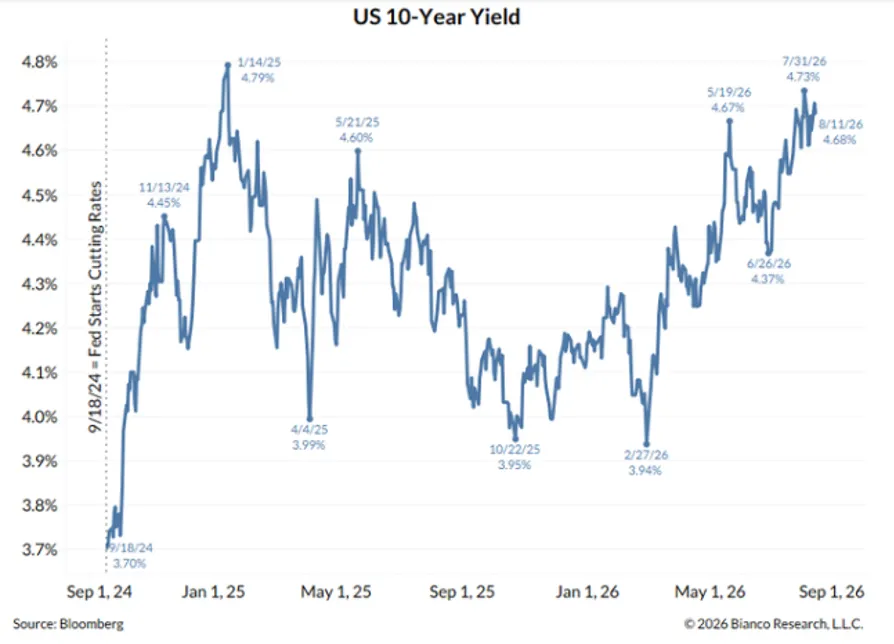
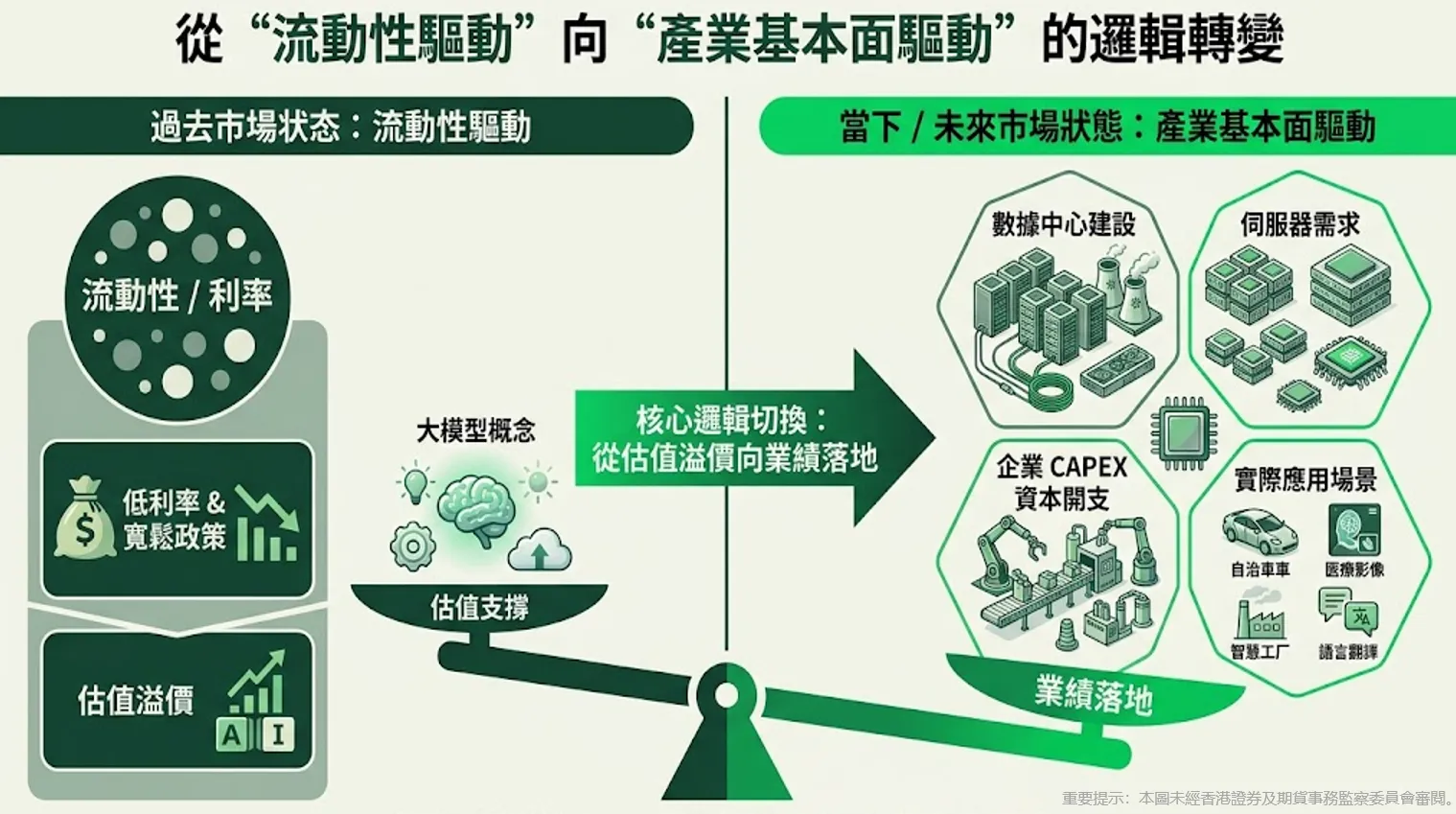
This implies that the logic of relying solely on liquidity to drive valuation gains is weakening, while the importance of industrial fundamentals is rising. For the AI industry, market focus is also evolving. Previously, discussions centered on the scale of large language models and the speed of technological progress; now, the market is paying closer attention to whether data center construction is continuing, whether server demand is growing, whether corporate capital expenditure is expanding, and whether AI technology can gradually develop broader commercial applications.
Judging from recent market performance,AI remains one of the most discussed topics in the global technology sector.However, unlike in the past when the focus was largely on conceptual narratives, the market is now shifting its attention to more specific segments of the industry chain.
2. Strength in the memory chip segment reflects growing market focus on computing infrastructure.
In Asian markets today, South Korea's KOSPI index rose more than 4% at one point during intraday trading, marking a cumulative rebound of approximately 23% from its late-July lows. Among them, Samsung Electronics $Samsung Electronics (005930.KR)$ rose more than 4%, while SK Hynix $SK Hynix (000660.KR)$ surged more than 7%, serving as a key driver behind the index's gains.
From an industry chain perspective, the importance of Samsung Electronics and SK Hynix extends beyond the South Korean market. As major players in the global memory chip industry, both companies hold significant positions in key areas such as HBM (High Bandwidth Memory). As the scale of AI model training continues to expand and data centers demand greater computing and storage capabilities, the importance of high-performance memory remains a focal point for investors.
In recent years, the market has generally viewed GPUs as the core component of AI infrastructure. However, storage systems are equally critical in determining computing efficiency. The growth in model parameter sizes, increased data processing demands, and the expansion of inference tasks all require synchronous upgrades in storage capacity. Therefore, when memory chip companies show strong performance, the market often interprets this as a signal related to AI infrastructure build-out, data center expansion, and corporate investment in computing power.
It is worth noting that, according to public market information, the memory chip sector was previously one of the more volatile sub-sectors during the tech correction, but its relative performance has improved recently.While this shift may not necessarily predict future trends, it reflects growing market attention on issues related to AI infrastructure.
3. From Taiwan Semiconductor to Apple: The AI hardware supply chain is offering a new perspective for observation
Viewing memory chips within the broader framework of the industrial chain reveals that the scope of market discussion is continuously expanding.
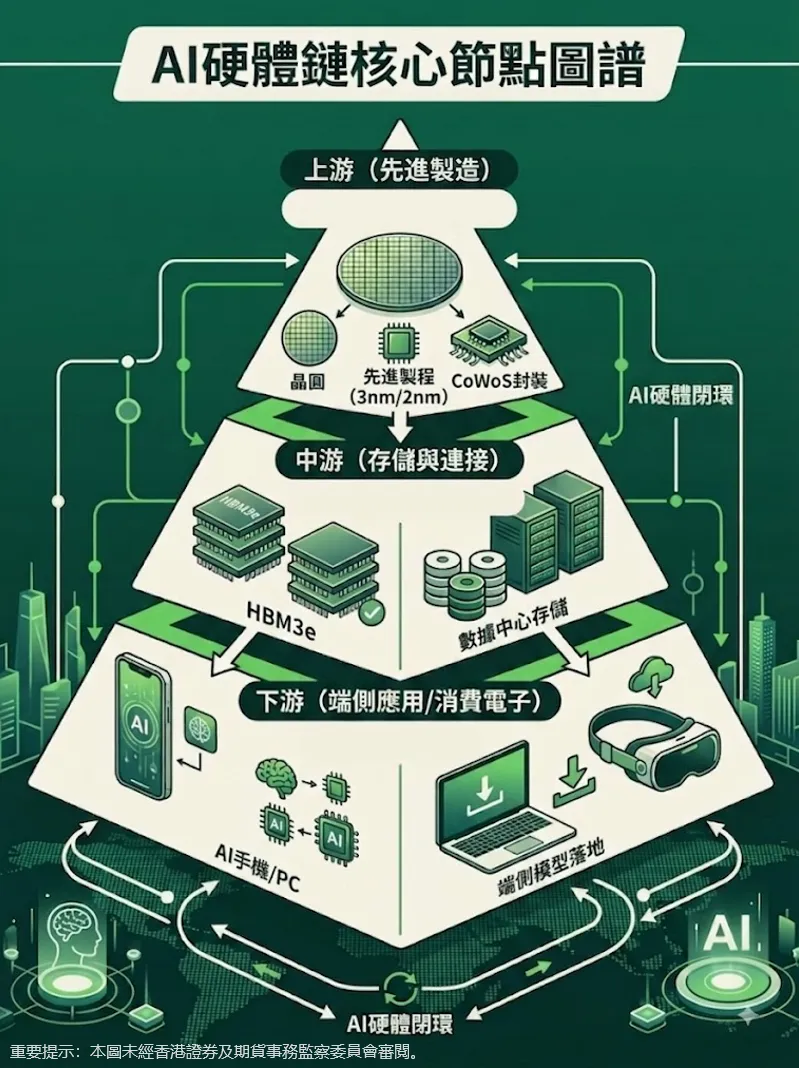
At the upstream end of the supply chain,Taiwan Semiconductor $Taiwan Semiconductor (TSM.US)$ represents advanced process manufacturing capabilities. As the complexity of AI chips continues to rise, the importance of advanced process technology, advanced packaging, and manufacturing efficiency is steadily increasing. Whether for training or inference, changes in demand for high-performance chips rely on the support of advanced manufacturing capabilities.
In the midstream segment,the memory sector, where Samsung Electronics and SK Hynix operate, plays a crucial role in connecting computing power with data. As the scale of data center construction expands, high-performance memory has become a vital component of AI infrastructure, and changes in its demand have become one of the key indicators for observing industry development.
At the downstream end,Apple $Apple (AAPL.US)$ This offers another perspective. Over the past two years, the development of the AI industry has largely revolved around cloud computing power. However, as generative AI gradually makes its way into consumer electronics terminals such as smartphones and PCs, the market is also focusing on how AI capabilities are extending from data centers to edge devices. From a supply chain perspective, this means that the narrative of AI development is no longer just about servers and computing power, but is beginning to extend into broader application scenarios.
Therefore, one phenomenon worth noting is thatrecent market discussions have moved beyond any single AI product or technological breakthrough, gradually expanding to cover multiple segments including advanced manufacturing, memory storage, and terminal applications.Whether it is Taiwan Semiconductor, Samsung Electronics, SK Hynix, or Apple, although they occupy different positions, all are key nodes in the global AI supply chain.
Conclusion
By combining last night's CPI data with today's market performance, it becomes evident that the market's focus is shifting.The CPI data has alleviated some short-term policy uncertainty, with subsequent attention turning more toward segments related to the AI supply chain.From the advanced manufacturing capabilities represented by Taiwan Semiconductor, to the memory sector where Samsung Electronics and SK Hynix operate, and finally to the terminal application scenarios dominated by Apple,market discussions are gradually shifting from macro interest rates to more specific dimensions such as supply chain demand, capital expenditure, and technology implementation.
How these trends will evolve in the future remains to be further verified by additional public data and corporate operational information. However, based on recent market performance, the AI hardware supply chain is re-emerging as a critical entry point for observing the global technology industry.
Data source
U.S. Bureau of Labor Statistics (BLS) July Consumer Price Index (CPI) data; CME FedWatch tool for interest rate expectations; public market information from CNBC, Barron's, etc.; public data from the Korea Exchange (KRX) and Wind; public views from Fundstrat Global Advisors; publicly disclosed materials from relevant listed companies and other public market information.
Disclaimer
· The above content is provided for reference purposes only and does not constitute, nor should it be construed as, an offer, solicitation, or recommendation to buy or sell any securities, investment products, or funds. This content is intended solely for viewing by persons in any jurisdiction where the distribution or provision of such content is lawful. By accessing this content, you represent and warrant that the laws and regulations applicable in your jurisdiction permit you to access such content.
· Investing involves risk. Past performance is not indicative of future results. The price of fund units/shares may rise or fall, and historical fund performance does not guarantee future returns. Investors should refer to the relevant fund prospectus for details and risk factors. Investors may not recover their full principal investment. The value of investments and any income derived therefrom (if any) may be volatile and subject to significant fluctuations over short periods.
· The data and information used to prepare the above content were obtained by Value Partners Asset Management Hong Kong Limited ('Value Partners') from sources believed to be reliable. However, no representation or warranty is made regarding the accuracy or completeness of data sourced from third parties. Any forecasts or other forward-looking statements concerning future events or performance of countries, markets, or companies are not necessarily indicative and may differ materially from actual events or outcomes. Value Partners assumes no liability for any losses incurred by any person acting on the data contained herein.
· No person may reproduce or use the above content—including but not limited to text, images, audio, and video—for any public or commercial purpose without the prior permission of Value Partners. Any modification or use of the above content may infringe upon copyrights and/or intellectual property rights held by Value Partners (where applicable).
· Publisher: Value Partners Asset Management Hong Kong Limited. This content has not been reviewed by the Securities and Futures Commission.
$Dow Jones Industrial Average (.DJI.US)$ $Nasdaq Composite Index (.IXIC.US)$$S&P 500 Index (.SPX.US)$$Hang Seng Index (800000.HK)$$Hang Seng TECH Index (800700.HK)$$Hang Seng China Enterprises Index (800100.HK)$$NASDAQ 100 Index (.NDX.US)$$Russell 2000 Index (.RUT.US)$$HKEX Tech 100 Index (800666.HK)$$PHLX Semiconductor Index (.SOX.US)$$Value Partners HK-US Dividend Low Volatility ETF (03488.HK)$$Value Partners Asian Income Fund MDis (HK0000352291.MF)$
Content Disclosure: Personal opinion
Risk Disclaimer: The above content only represents the author's view. It does not represent any position or investment advice of Futu. Futu makes no representation or warranty.Read more


Comments
to post a comment
6