
iOS 27 leak reveals Apple AI pricing: Want a smarter iPhone? You'll have to pay extra.
Author and source: ifanr
Users in mainland China have waited two years for Apple Intelligence. In July this year, "Apple Intelligence" completed the regulatory filing for its on-device generative AI services in China, bringing the local version one step closer to an official launch.
Although it hasn't officially launched yet, news about the pricing has already surfaced.
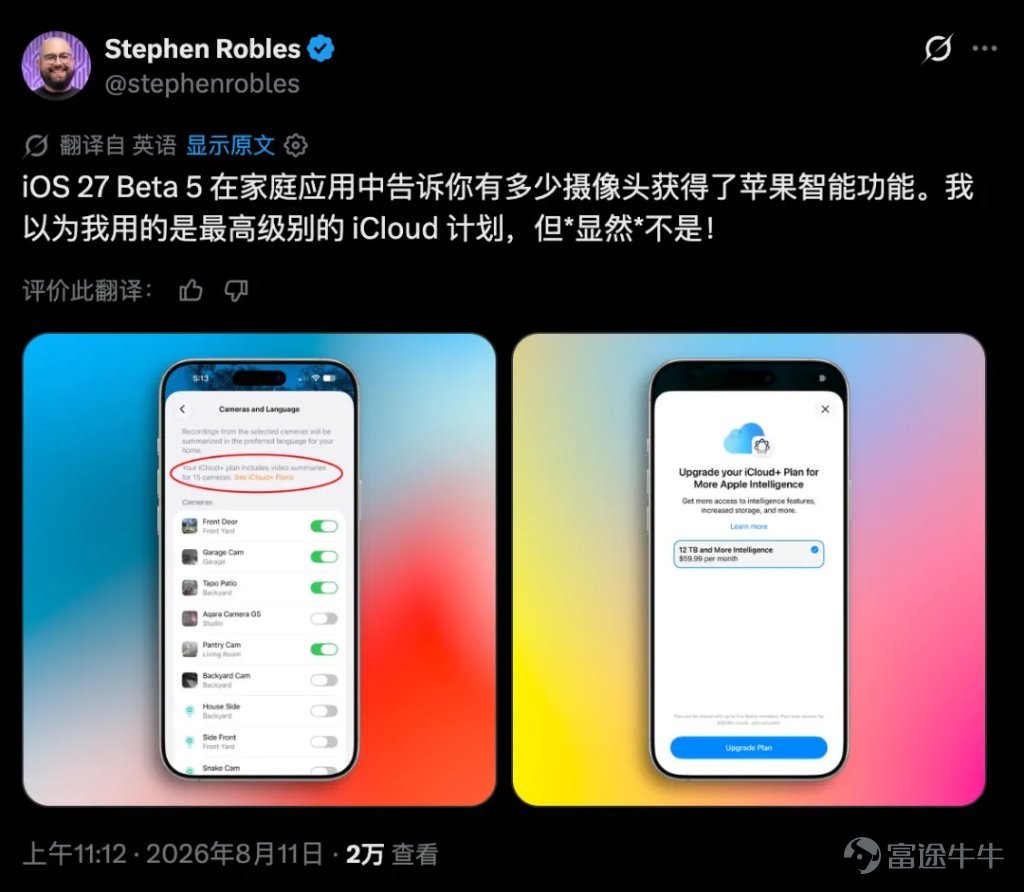
Stephen Robles, a content creator who has long followed the Apple ecosystem, discovered that iOS 27 beta 5 added an Apple Intelligence page to the Home app, which already displays AI usage limits linked to iCloud+ plans.

In the current beta version, the 2TB iCloud+ plan supports AI summaries for five cameras, while the 12TB tier increases this limit to 15. There is also an upgrade option at the bottom of the page stating, "Upgrade iCloud+ to get more Apple Intelligence usage."
In fact, the 2TB iCloud+ plan has long supported an unlimited number of HomeKit Secure Video cameras, with surveillance footage not consuming iCloud storage space. Under the same 2TB plan, you can connect a large number of cameras, but only five can utilize AI summaries.
To put it plainly, Apple’s message is clear: you need to pay more.
When Apple introduced the new generation of Apple Intelligence at WWDC this June, it confirmed that certain features relying on server-side models, including image generation, would have daily usage caps, and upgrading the iCloud+ plan would grant higher usage limits.
Beta 5 takes this a step further by differentiating AI usage based on specific iCloud+ tiers. At least for home security cameras, the number of cameras eligible for AI summaries now differs between 2TB and 12TB users. Whether other features, such as image generation, will adopt a similar tiered approach remains to be seen in future versions.
Discussions about pricing emerged as early as the initial release of Apple Intelligence in 2024. At the time, Bloomberg journalist Mark Gurman reported that Apple might launch an "Apple Intelligence+" service, keeping basic AI features free while offering enhanced capabilities through a premium subscription.
Two years later, Apple appears to have abandoned plans for a standalone "Apple Intelligence+" product, opting instead to integrate these changes directly into the existing iCloud+ offerings.
Currently, the most prominent figures on the iCloud+ plan page remain 50GB, 200GB, 2TB, 6TB, and 12TB. Historically, the rationale for upgrading iCloud+ was straightforward: as photos accumulated and device backups grew larger, users would simply move up to the next tier when their existing storage became insufficient.
Apple has since added features to iCloud+, such as Hide My Email, Private Relay, and HomeKit Secure Video. However, for most users, the relationship between price and storage space remained intuitive. With AI, however, it is difficult to find an equally straightforward metric like "GB" to measure value.

Generating an image, summarizing hours of surveillance footage, or having Siri complete a more complex task primarily consumes model resources and computing power. Average users have no need to know how many tokens a request uses, nor are they likely to decide whether to ask Siri a few extra questions today based on a price list of “cost per million tokens,” as API developers might.
Apple’s smart move with iCloud+ lies precisely here. It is difficult to explain AI costs directly to average users, but everyone is already familiar with the various tiers of iCloud+ plans. In the past, choosing a tier depended mainly on storage needs; in the future, there may be an additional reason to upgrade:To use more AI features。
Last month, Tim Cook publicly addressed this during the earnings call. He mentioned that some users may heavily utilize these AI capabilities in the future, and if they need higher usage limits, they can “buy up the stack” through iCloud+.
Within less than two weeks, this concept began to take shape in iOS 27 Beta 5.
This way, Apple does not need to reteach users how to pay for AI. Previously, when photos accumulated, the iPhone would prompt users to upgrade their iCloud storage. In the future, if users generate too many images or have too many home cameras requiring AI summaries, the same upgrade screen will likely appear.
If iCloud+ indeed starts selling additional AI usage capacity in the future, the impact could extend far beyond just the iPhone.
Rumors suggest that Apple is preparing a new lineup of hardware that relies more heavily on AI. In addition to Apple TV, HomePod mini, and a home hub with a display, Bloomberg reported earlier this year on smart glasses, AirPods with cameras, and an AI device that can be clipped to clothing or worn around the neck. Home security cameras are also part of Apple’s development roadmap.

Cameras need to interpret video footage, while glasses and earphones must understand what is happening in front of the user. The home hub also needs to pull up the corresponding calendar, reminders, and photos based on who is standing in front of the screen. These tasks cannot be handled entirely by the devices themselves.
In recent years, Apple has consistently emphasized the on-device capabilities of Apple Intelligence, enabling many tasks to be processed directly on iPhones, iPads, and Macs. However, computational workloads that exceed device capacity are offloaded to Private Cloud Compute.
Consider a more intuitive example: when you purchase a 256GB iPhone, its storage capacity is 'fixed' at 256GB. While this may be sufficient initially, as photos accumulate and file sizes grow over time, local storage eventually becomes insufficient. The most convenient solution is to subscribe to iCloud+.
The same logic applies to AI: the device provides a certain amount of 'fixed' computational power first, and once tasks exceed its capacity, Apple's servers take over.
For upcoming devices such as smart glasses, camera-equipped AirPods, and home hubs, the available onboard computational resources will be even more limited.

To continuously interpret ambient sounds, visuals, and user commands, these devices will naturally need to leverage the iPhone for more complex tasks, and potentially further tap into Apple's cloud computing power.
Apple is only now beginning to figure out how to monetize AI, which is arguably late to the game.
ChatGPT, Claude, and Gemini have long included more powerful models and higher usage limits in their paid tiers. This year, several major AI products in China with the largest user bases are also following suit.
Doubao began testing paid subscriptions in May and officially launched tiered services in June, with complex tasks such as PowerPoint creation, data analysis, and video production becoming the primary paid offerings. Basic chat remains free, but if you truly use Doubao as a productivity tool for heavy daily workloads, payment is required.
Qianwen also started charging professional users this week. Usage limits for its office assistant increase with different subscription plans, while AI video generation requires separate quota purchases. You can still chat with it for free, but as you move from casual conversation to more compute-intensive scenarios like office work and video creation, the free allowance will not last as long.

Over the past two years, the industry was more focused on cultivating user habits. Chat, search, and image generation were offered for free, with increasingly powerful models continuously added to the free tier. However, as AI begins to permeate office workflows, video processing, deep reasoning, and autonomous agents, the token consumption per task has risen significantly, making it financially unsustainable to offer unlimited access to all users.
Consequently, the current pricing strategies largely follow a consistent logic: keep daily basic needs free, while charging for features that heavily consume computing resources based on membership tiers or usage volume.
Apple’s approach likely differs only in that it will not feature a prominent 'Buy 1,000 AI Credits' button within the iPhone interface.
Interestingly, on the same day Apple's AI subscription plans were discovered in iOS 27 beta 5, there was new progress in Apple's long-standing App Store lawsuit against Epic Games. A U.S. federal judge refused to halt proceedings regarding commissions on external link transactions in the App Store. Apple is now required to provide specific commission rates, calculation methods, and evidence to justify the exact amount of these commissions.

The rationale behind the 30% commission in the app store era, and the previously proposed 27% fee for external link transactions, has been a subject of intense debate among various parties for many years.
In the AI era, this calculation becomes much more straightforward: higher usage directly correlates with greater consumption of computing resources.
This also makes iCloud+ a logical vehicle for monetization. Users do not need to worry about technical details such as tokens or model sizes; they simply need to assess whether their current subscription plan meets their needs.
Two years ago, when Apple Intelligence was announced, we posed a question to our readers: 'Would you be willing to pay to make your iPhone smarter?'
At that time, users in China did not even have the opportunity to respond. After a two-year wait, Apple Intelligence is finally arriving, and today we once again face that 'soul-searching question'—
Would you be willing to pay to make your iPhone smarter?
Risk Disclaimer: The above content only represents the author's view. It does not represent any position or investment advice of Futu. Futu makes no representation or warranty.Read more

Comment (1)
to post a comment
2