Is the food delivery war coming to an end? Meituan's Q2 profits exceed expectations

Tencent conference call: Returns on AI investments are beginning to materialize, WorkBuddy's gross margin has improved significantly, and compute power leasing serves as a "safety cushion"
Source: Wall Street News
Tencent is entering a critical phase where AI investment and commercialization are advancing in parallel: core businesses continue to contribute profits, providing financial support for high-intensity investments in AI infrastructure and native applications.
On August 12, during Tencent's Q2 2026 earnings conference call, Tencent President Martin Lau stated,The company is making substantial investments in AI computing power and has already seen clear upside potential in returns.On one hand, several AI-native applications are performing well; on the other, leasing computing power on the cloud is expected to generate substantial revenue and improve returns on capital expenditure. For some previously placed computing power orders, if sold, the selling price could be more than 30% higher than the purchase price from a few months ago.
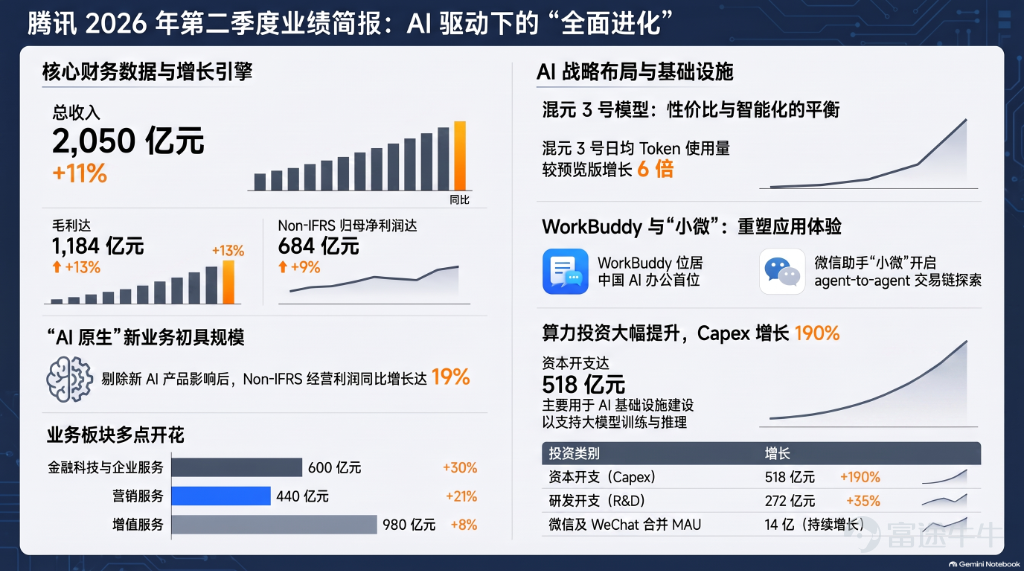
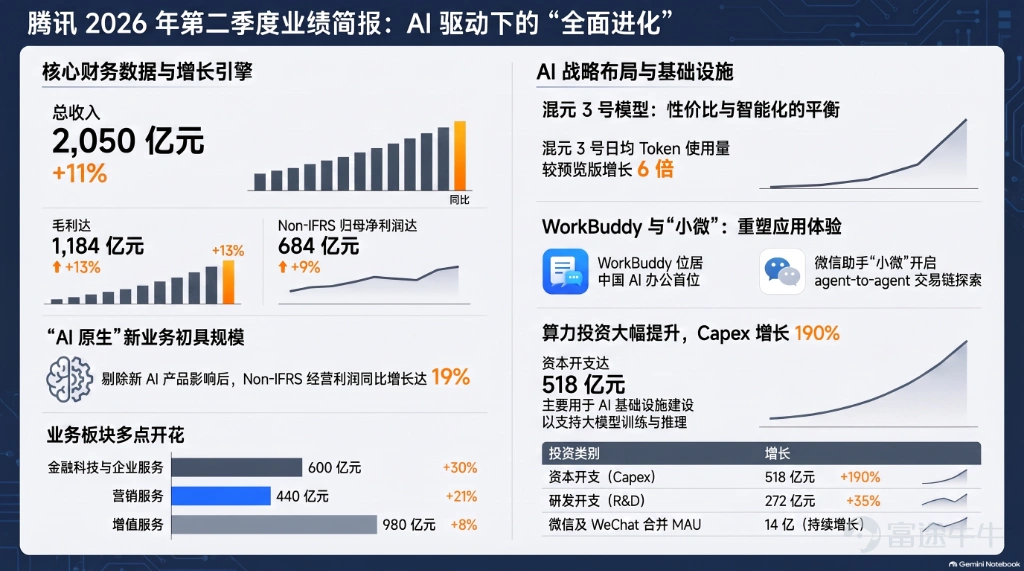
Tencent is building AI infrastructure with unprecedented intensity. Capital expenditure in the second quarter rose to RMB 52.8 billion, far exceeding the expected RMB 32.1 billion and nearly tripling compared to RMB 19.1 billion in the same period last year; free cash flow was negative RMB 13.8 billion. The company stated that excluding prepayments for AI computing power procurement, free cash flow would still be RMB 37.6 billion. In other words,the current pressure on cash flow mainly stems from upfront investments in AI infrastructure, rather than a deterioration in traditional business operations.
This round of investment is primarily used for upgrading the Hunyuan model, meeting the inference demands of Work Buddy and CodeBuddy, advancing WeChat's AI layout, and satisfying the growing cloud service demands from external clients. From management's perspective,AI infrastructure represents an upfront investment for future business growth: first establishing intelligent capabilities through top-tier models, then converting model capabilities into user demand via AI applications, ultimately generating commercial returns.
Regarding the pace of AI investment, Martin Lau stated that the current situation remains highly dynamic. Tencent will remain relatively cautious until it sees genuine breakout opportunities; once opportunities are identified, it will increase investment, such as in WorkBuddy, with an overall focus on long-term returns. Over time, the economic benefits of the AI business will gradually materialize and eventually achieve profitability.
In terms of commercialization, Tencent is exploring monetization methods such as selling tokens through AI applications, while keeping compute leasing as a 'backup option.' Martin Lau stated,if Tencent were to directly adjust its business model to leasing computing power, it would not only avoid losses but also generate profits. Tencent always has this backup option, which gives the company 'considerable confidence.'
At the AI application level, management highlighted Work Buddy.Its positioning is not that of a single model, but rather an AI "orchestrator" capable of integrating diverse models and skills. It selects the optimal solution based on user tasks, balancing task quality with cost efficiency.
Hunyuan will serve as one of the models supporting Work Buddy, though not the exclusive option. If Hunyuan demonstrates leading performance and ratings in practical applications, it is poised to become the mainstream model on the platform. Meanwhile, additional models and skills from various developers will be integrated in the future to cater to diverse user needs.
This indicates that Tencent is not attempting to rely on a single model to dominate the market. Instead, it aims to enhance the overall efficiency of its AI services through a combination of models, skills, and applications.
In terms of profitability, Work Buddy has shown promising signs of commercial viability. James Mitchell, Tencent's Chief Strategy Officer, stated that the gross margin from Work Buddy's paying users is already comparable to the overall gross margin of Tencent Cloud.The overall gross margin for Work Buddy is slightly lower, primarily due to the inclusion of free users, as Tencent continues to subsidize growth to expand market share. However, the paid segment has already generated a "quite respectable" gross margin.
Regarding models, management revealed that Hunyuan 4 has reached a phased milestone. It will subsequently be upgraded to Hunyuan 5, continuing to close the gap with the industry's State-of-the-Art (SOTA) standards.
Management stated,Once SOTA status is achieved, Tencent will establish a matrix of models covering various scales, meeting diverse user needs across different cost and performance levels.Rather than solely pursuing "large models," this strategy emphasizes aligning models of different sizes with specific application scenarios.
Meanwhile, Tencent is promoting the co-design of models and products. As Hunyuan 4 and Hunyuan 5 continue to iterate, the capabilities, feature richness, and execution speed of related products will improve in tandem. For Tencent, the deep integration of model capabilities with application experience will be a key link in transitioning its AI business from technological investment to commercial returns.
Regarding Xiao Wei, the WeChat AI assistant currently in internal beta testing, LiuChiping positions it as a key vehicle for the WeChat ecosystem's entry into the "AI Era," analogizing the potential of this leap to the "10x value amplification" of WeChat relative to QQ.
In the longer term, Tencent aims for users to simply issue natural language commands, allowing Xiao Wei to execute transactions and operations on their behalf. Meanwhile, merchants and mini-programs within the WeChat ecosystem will also deploy their own agents in the future, enabling automated interactions between user agents and merchant agents.
Regarding cost control, Liu Chiping stated that the ongoing inference costs for Xiao Wei will be lower than Tencent's previous investments in Yuanbao. He emphasized that the design intent of its VLM (Vision-Language Model) is to balance privacy protection and cost efficiency within the WeChat environment.
Addressing concerns that "agent-based transactions might erode ad inventory," he believes that the AI transformation of WeChat will bring incremental value rather than simply replacing existing business models.
The commercialization of Yuanbao is also beginning to show a clearer economic model. Tencent's management disclosed that the current gross margin for Yuanbao's paying users is already comparable to the overall gross margin level of Tencent Cloud.
Management also pointed out that due to revenue recognition mechanisms similar to those in the gaming business for subscription models, there is a time lag between current cash inflows and revenue recognition in financial statements. Therefore, the growth in cash income seen currently will gradually translate into reported revenue growth for Tencent Cloud within the year.
Among three cloud business opportunities—GPU bare-metal leasing, Model-as-a-Service (MaaS), and Yuanbao Token generation—management believes that Token generation offers more durable economic value and is therefore the highest priority. For free users, the company continues to expand market share through subsidies, while paid users already demonstrate a healthy gross profit margin base.
Facing a significant surge in AI capital expenditure, Tencent does not view share buybacks and AI investment as a fixed either-or choice. Instead, it emphasizes that capital allocation will be dynamically adjusted based on returns.
Management stated that if AI capital expenditure can demonstrate returns significantly superior to share buybacks, the company will correspondingly increase its capex investment.
Martin Lau emphasized that investment in AI infrastructure is essentially a finite 'lump-sum start-up investment,' rather than growing linearly each year.Therefore, evaluating this expenditure should not rely solely on current free cash flow, but must comprehensively consider cash on hand, portfolio value, operating cash flow, and reasonable debt capacity.
For Tencent, the core logic of current AI investment is shifting from 'how much to invest' to 'how to generate returns.' As compute leasing, Token production, and AI-native applications gradually commercialize, Tencent aims to ultimately transform early-stage infrastructure investments into new growth curves.
Good afternoon and good evening. Thank you for your patience. Welcome to Tencent Holdings Limited's webinar for the second quarter of 2026 earnings announcement. I am Huang Wendi from Tencent's Investor Relations team. At this time, all participants are in listen-only mode. Following management's presentation, we will hold a Q&A session for participants dialing in by phone. If you wish to ask a question, please press 5 on your phone to raise your hand. If you are joining via Tencent Meeting or the Room app, please click the 'Raise Hand' button in the lower-left corner. Please note that today's webinar is being recorded.
Before we begin the presentation, we would like to remind you that it contains forward-looking statements, which are subject to various risks and uncertainties and may not materialize in the future. Information regarding general market conditions is derived from various external sources outside of Tencent. This presentation also includes certain unaudited non-IFRS financial measures, which should be considered supplemental to, but not a substitute for, the group's financial performance measures prepared in accordance with International Financial Reporting Standards (IFRS).
For a detailed discussion of risk factors and non-IFRS measures, please refer to the disclosure documents in the Investor Relations section of our website. Now, let me introduce the management team for this webinar. Tonight, our Chairman and CEO, Mr. Ma Huateng, will begin with a brief overview. President Mr. Lau Chi Ping will provide a strategic review, Chief Strategy Officer Mr. James Mitchell will present a business review, and Chief Financial Officer Mr. Loh Soh Han will conclude with a financial discussion. Before we move to the Q&A session, I would like to invite Mr. Ma Huateng to speak.
Ma Huateng, Co-founder, Chairman of the Board, and Chief Executive Officer:
Thank you, Wendy. Good evening, everyone. Thank you all for joining us. As we enter the third quarter of this year, we have made significant progress in building a new AI-powered Tencent across intelligence, applications, and infrastructure layers. On the intelligence front, the production version of Hunyuan 3 provides users with a powerful and cost-effective widely used model, laying the foundation for the Hunyuan model series to achieve state-of-the-art capabilities in the future. On the application front, our WorkBuddy AI office productivity service and CodeBuddy AI coding tool are achieving breakthrough user growth, currently establishing ourselves as clear leaders in this sector in China. On the infrastructure front, we have significantly increased the procurement of computing resources, which will enable us to convert application and model usage into future revenue. Meanwhile, we continue to strengthen our existing services through steady growth in marketing service revenue, several recently successful game launches, and the rapidly growing video views on WeChat Channels. Looking at our financial results for the second quarter, total revenue was RMB 205 billion, an 11% year-on-year increase. Gross profit was RMB 118 billion, up 13% year-on-year. Non-IFRS operating profit was RMB 76 billion, up 9% year-on-year. Excluding new AI products, non-IFRS operating profit was RMB 86 billion, up 19% year-on-year. Non-IFRS net profit attributable to equity holders was RMB 68 billion, up 9% year-on-year. Turning to our key services, the combined monthly active accounts for Weixin and WeChat in communications and social networking grew both year-on-year and quarter-on-quarter, reaching 1.4 billion. In digital content, Tencent Music Entertainment Group's acquisition of Ximalaya has strengthened our audio content and unlocked new synergies with ecosystem IP (including China Literature). In gaming, the new title "Roco Kingdom: World" ranked first among all new games launched in China this year in terms of both average daily active users and total revenue. In cloud services, WorkBuddy recently ranked first in China's AI productivity services based on monthly interaction volume. Now, I will hand over to Martin for the strategic review.
Lau Chi Ping, President:
Thank you, Pony. Good evening and good morning, everyone. Today, we would like to update you on the latest progress of our overall AI strategy. Tencent's existing businesses are growing steadily due to intrinsic moats and AI empowerment. As discussed earlier this year, our moats stem from factors such as network effects, supply chain depth and value-add, IP, low churn rates, regulatory requirements, and proprietary data. Beyond these moats, we are further deploying AI to improve returns in businesses including gaming and advertising. Consequently, our existing businesses provide very strong financial support for our new AI initiatives. Regarding our new AI initiatives, we have made significant progress in building a solid foundation, including the substantially improved Hunyuan 3 base model with leading cost-performance ratio, WorkBuddy and CodeBuddy which lead the market in AI productivity usage in China, and Yuanbao and Xiaowei as portals driving broader consumer adoption of AI.
We see increasing potential for generating attractive financial returns from franchise products with differentiated advantages, including Hunyuan, WorkBuddy, and Xiaowei. Over time, we are confident in making large-scale AI investments because there is not only significant upside potential but also clear downside protection. Our AI investments are primarily in AI infrastructure; in a worst-case scenario (which we do not believe will occur), we could choose to rent out this infrastructure via Tencent Cloud at cost-recovery prices or better if needed. Now, let us continue to discuss the different components. First, regarding the Hunyuan base model, the launch of the full production version of Hunyuan 3 has been very successful, achieving significant performance improvements compared to the Hunyuan 3 preview version. By leveraging feedback loops from product teams to improve the quality and diversity of data used for post-training, and by scaling up reinforcement learning, Hunyuan 3 has achieved significant improvements in task completion rates and meaningful reductions in hallucinations and error rates.
The enhancement of Hunyuan 3's capabilities is most evident in its agent capabilities and product experience. The model's leap in performance on reasoning, agent, and long-context tasks brings obvious advantages to use cases such as coding, office work, financial modeling, and front-end design. These performance improvements have driven accelerated user adoption and growth in external customer demand, validating its practicality in real-world applications, as reflected by the approximately sixfold increase in omnichannel daily average token usage of Hunyuan 3 during the paid period compared to the preview version. Furthermore, according to OpenRouter's token usage rankings, Hunyuan 3 has consistently remained among the top three globally. The production version of Hunyuan 3 is performing well, laying the cornerstone for the Hunyuan model series to achieve state-of-the-art capabilities in the future, while providing users with the cost-efficiency they need today.
We have been integrating Hunyuan into our products, which has had a huge impact on WorkBuddy. Hunyuan can facilitate complex agent workflows, improving task success rates and shortening completion times. For Yuanbao, Hunyuan provides leading execution quality in information retrieval, data processing, document workflows, and daily decision-making. In gaming, we are leveraging Hunyuan to create AI teammates and conduct code reviews, including in our flagship game "Game for Peace."
We have deployed Hunyuan to support AI assistants for Official Accounts and developer tools for Mini Programs. Meanwhile, product integration makes Hunyuan better by continuously feeding real-world product usage and domain feedback into model training. Our model-product co-design approach allows Hunyuan to validate model accuracy, identify and handle edge cases, thereby enabling faster model iteration and continuous performance improvement. Having established a new rapid model iteration system and validated it with Hunyuan 3, we are accelerating model improvements. We are expanding more robust reinforcement learning to significantly upgrade models after pre-training is complete, and we are upgrading multimodal capabilities.
More importantly, we are training a larger-parameter model, Hunyuan 4, which is expected to be released later this year. By accelerating technological iteration and breaking through the boundaries of model intelligence, we believe Hunyuan's capabilities will reach state-of-the-art levels. We believe that building a large and valuable AI-native new business for Tencent will generate significant returns. The reason for investing in our own base models is that through co-design across our applications, our models, and our computing infrastructure, we can achieve better unit economics, more innovative features, and greater access to intelligent value.
In the early stages of AI diffusion, as we continue to discuss application layers, our AI office productivity workspace WorkBuddy and coding tool CodeBuddy are achieving breakthrough success in both capabilities and user growth. They are China's leading office productivity services based on monthly interaction volume. WorkBuddy, as a one-stop workspace, orchestrates multiple agents to handle complex tasks end-to-end.
Users can remotely control WorkBuddy via WeChat, WeCom, and VPC, and access over 70,000 skills from the Tencent Cloud Skill Center. Beyond rapid user adoption, WorkBuddy has achieved high retention rates and strong willingness to pay, as it directly enhances user productivity. It also attracts a growing and more vibrant developer community by embedding skill payments and pro-rata compensation into task flows, rewarding developers when their skills are invoked. This progress supports our view that significant opportunities remain untapped in the productivity market, including coding and existing office scenarios. We are currently focused on investing in market education and expanding our market leadership. Over time, product economics will become attractive as enhanced premium benefits accelerate paid user growth, while we reduce token costs through agent efficiency, inference efficiency, and model optimization.
Given that Tencent applications such as WeChat, WeCom, and Tencent Meeting are widely adopted by enterprises, WorkBuddy offers us a new way to monetize through enterprise relationships. On the consumer side, we recently released a prototype of Xiao Wei, which provides an embedded, context-aware agent AI experience within WeChat, leveraging WeChat's social graph, knowledge graph, rich merchant information, and payment capabilities. Xiao Wei is powered by a WeChat-customized VLM model, focusing on user privacy, WeChat-specific use cases, and cost efficiency. Xiao Wei helps users navigate and derive insights from WeChat's diverse content universe in a personalized and efficient manner. It also leverages WeChat's unique Mini Program ecosystem to help users discover products, make purchase decisions, and place orders, laying the foundation for an agent-to-agent transaction loop. Although the prototype is technically capable of handling advanced agent workflows, as a safety measure, we currently configure Xiao Wei to require user intervention and multi-step confirmation. Xiao Wei will be rolled out to a broader user base in phases as we advance several core initiatives to enhance the user experience.
These initiatives include upgrading Xiao Wei's conversational, memory, and recommendation capabilities, expanding service and content integration, scaling our AI infrastructure, and upgrading our systems to support a significantly larger user base. As we upgrade WeChat for the AI era, we can do so in a cost-effective manner, and we believe AI will accelerate the growth of the entire WeChat ecosystem over time, thereby accelerating its monetization and delivering attractive returns for us. Turning to Yuanbao, we are focusing on enhancing its capabilities and user experience, particularly in search, speech recognition, and text-to-speech functions. We are also improving its ability to meet consumers' broader long-tail AI needs, including multimodal generation. Yuanbao plays a crucial role in the collaborative design of Hunyuan, as its conversational use cases generate valuable feedback that helps improve our Hunyuan model series. Over time, features developed and refined by Yuanbao can become atomic capabilities for other Tencent products, such as WorkBuddy, CodeBuddy, WeChat, and QQ Browser. Now, please welcome James.
James Mitchell, Chief Strategy Officer and Senior Executive Vice President:
Thank you, Martin. This quarter, total revenue grew by 11%, with contributions from Social Networks at 16%, Domestic Games at 23%, International Games at 9%, Marketing Services at 21%, and FinTech and Business Services at 30%. Gross profit increased by 13%, with Value-Added Services gross profit up 14%, Marketing Services up 21%, and FinTech and Business Services up 9%. Revenue from Value-Added Services was RMB 98 billion, an 8% year-on-year increase. Within this, Social Networks revenue rose 1% year-on-year to RMB 32 billion, primarily driven by increased sales of in-game items for mobile games, partially offset by a 6% year-on-year decline in long-form video subscription revenue.
However, our exclusive series 'The Lead' was the most-watched series across all video platforms in China. In the second quarter, audio subscription revenue grew by 8%, driven by higher ARPU for music and richer content. By integrating Ximalaya, we enabled users to access QQ Music with one click from Video Accounts, facilitating music discovery. In May, we completed the acquisition of Ximalaya. By bringing Ximalaya into the Tencent group, we can enhance the resilience of Tencent Music Entertainment Group, deepen the content supply relationship between China Literature and Ximalaya, and provide users with new content formats including audiobooks and podcasts. Domestic Games revenue grew by 17%, primarily driven by 'Delta Force', 'Valorant' PC, 'Valorant' Mobile, and 'Roco Kingdom: World'. International Games revenue declined by 1%, but grew by 4% at constant exchange rates, as revenue growth from 'Wuthering Waves' and 'Valorant' PC was offset by declines in revenue from two Supercell titles. In Communications and Social Networks, total viewing time on Channels grew by over 20% in the second quarter, benefiting from richer content supply, upgraded interactivity, and the introduction of a new multi-variable content ranking system.
We increased content appealing to younger users through IP collaborations with game studios, music labels, and TV programs, and provided creators with new revenue-sharing opportunities, expanding the base of creators earning income directly from Video Accounts. GMV for Mini Store merchandise grew, with significant growth in GMV from WeChat's centralized e-commerce gateway pages. For Mini Store merchants, we launched marketing tools such as lucky draws to help them boost brand awareness and drive product discovery; for Mini Store consumers, we enhanced rewards for repeat customers to increase customer lifespan, thereby raising the lifetime value of merchant clients.
In Domestic Games, 'Delta Force' achieved its highest-ever average daily active users (DAU) in the second quarter, thanks to the Burst Fest event, the game's first professional esports grand finals, and a global 20v20 tournament. In production, the 'Delta Force' team has integrated AI into multiple workflows, including using data agents for performance analysis and Hunyuan 3D models for asset generation. 'Valorant' PC also reached its highest-ever average DAU in the second quarter, benefiting from the Skirmish Ascension mode with rotating progressive weapons and the Summit map with destructible walls. The game expanded its reach through influencer collaborations during the Ground City event and promotions in over 10,000 internet cafes. Among new games, 'Roco Kingdom: World' ranked 5th by average DAU and 8th by total revenue among all mobile games launched in China's industry in the second quarter, making it the highest-ranked new game launched year-to-date. The game has maintained a rapid pace of content delivery since its launch, adding 100 creatures and expanding the map with seven new regions. On July 9, we released 'Runaway Evolution'. Adapted from the PC survival open-world crafting game 'Rust', which has consistently ranked among the top 20 Steam concurrent user counts over the past eight years due to its unique high-risk, high-reward gameplay (where players compete to survive until the end in week-long matches), 'Runaway Evolution' aims to tailor this gameplay to Chinese market preferences by offering mobile and PC devices and providing sandbox safe zones for new players.
In our International Games, 'League of Legends' DAU grew year-on-year in the second quarter, primarily driven by the ARAM Mayhem mode. We launched League Classic, a nostalgia mode designed to re-engage old fans by recreating early gameplay, including pre-rework champions, classic runes, and the original Summoner's Rift map layout. 'Warframe' DAU increased year-on-year, and total revenue reached a record high this quarter, benefiting from the new wolf-themed Prime Warframe and the new storyline 'Jade Shadow's Constellations'. 'Arrow's Puzzle Escape', a maze-clearing game developed by Lessmore, a Miniclip subsidiary, was the most-downloaded mobile game globally in the second quarter. The success of 'Arrow' demonstrates that the Miniclip studio family, supported by Miniclip's publishing expertise, possesses the innovative capability to jointly pioneer and lead the development of new casual game genres. 'Arrow' is monetized through in-app advertising, so we report its revenue in the Marketing Services segment rather than the International Games sub-segment. Adjusting for the inclusion of revenue from 'Arrow' and other in-app advertising games, our International Games year-on-year revenue growth rate would be 4 percentage points faster than the disclosed figure. In Marketing Services, revenue increased by 22% year-on-year to RMB 44 billion, driven by higher CPMs and impression volumes. Most major categories increased their marketing spend on our platforms, including e-commerce, internet services, and local services. We upgraded the end-to-end execution capabilities of AI Marketing+ to better support closed-loop Mini Store and mini-drama advertisers.
For example, AI Marketing+ now enables mini-store owners to automatically select products for promotion, generate product-related ad creatives, and then run smart bidding to purchase inventory for these creatives. We have significantly expanded the parameters of our advertising AI recommendation system to capture user interests more granularly, thereby improving ad conversion rates. Video Account ad impressions grew rapidly year-over-year, driven by higher video views and ad load rates, although the ad load rate remains well below the industry average for short videos. Mini Programs attracted increasing marketing spend from mini-drama and mini-game studios. Revenue from the FinTech and Business Services segment was RMB 60 billion, up 9%. FinTech services revenue increased year-over-year, driven by growth in commercial payments, wealth management, and consumer loan services. In commercial payments, transaction volume grew year-over-year, while the decline in value per transaction narrowed. In wealth management, total client assets increased year-over-year, benefiting from the popularity of automated investment strategies and thematic index funds.
In terms of Business Services, although we are still addressing capacity constraints, our cloud revenue growth rate accelerated from a high-teens percentage year-over-year in the first quarter to the low-twenties percentage in the second quarter, benefiting from AI-related demand, international expansion, and increased usage and pricing of general-purpose cloud services. AI-related demand translated into revenue growth from GPU rentals, Model-as-a-Service, and the usage of WorkBuddy and CodeBuddy tokens. Our international cloud business expanded rapidly; skills developed using CodeBuddy enabled us to migrate customers to the cloud faster than before, such as serving a leading telecommunications company in Indonesia. Now, please welcome John.
Luo Shuohan, Chief Financial Officer and Senior Vice President:
Thank you, James. In the second quarter of 2026, total revenue was RMB 204.8 billion, up 11% year-over-year. Gross profit was RMB 118.4 billion, up 13% year-over-year. Operating profit was RMB 67.3 billion, up 12% year-over-year. Interest income was RMB 4.2 billion, up 2% year-over-year. Finance costs were RMB 3.0 billion, compared to RMB 3.9 billion in the same period last year, reflecting favorable foreign exchange movements and reduced interest expenses due to lower average interest rates.
Our share of losses from associates and joint ventures in the second quarter of 2026 was RMB 10.0 billion, primarily reflecting an adjustment recognized for our share of an unlisted investee’s fair value remeasurement of its convertible redeemable preferred shares, which stemmed from an increase in the investee’s valuation. This item has been excluded from our Non-IFRS profit. On a Non-IFRS basis, our share of profits from associates and joint ventures this quarter was RMB 6.4 billion, compared to a share of profits of RMB 6.3 billion in the same period last year. Income tax expense increased by 3% year-over-year to RMB 11.7 billion. Based on Non-IFRS financial data, operating profit was RMB 75.6 billion, up 9% year-over-year. Excluding new AI products, operating profit was RMB 86.1 billion, up 19% year-over-year. Net profit attributable to equity holders was RMB 68.4 billion, up 9% year-over-year. Diluted earnings per share were RMB 7.433, up 9% year-over-year.
Turning to gross margin, the overall gross margin for the second quarter was 58%, up 1 percentage point year-over-year. By segment, the gross margin for Value-Added Services rose by 4 percentage points year-over-year to 64%, driven by a shift in the revenue mix toward higher-margin in-house developed games. The gross margin for Marketing Services was 57%, down 0.3 percentage points year-over-year, as revenue growth supported by our AI-driven marketing capabilities was largely offset by increased depreciation and operating costs associated with expanding AI infrastructure to improve ad and content recommendations. The gross margin for FinTech and Business Services was 52%, roughly stable year-over-year. Regarding operating expenses, selling and marketing expenses were RMB 11.9 billion, up 26% year-over-year, due to increased marketing spend to support our gaming business and drive the adoption of AI-native products. R&D expenses increased by 35% year-over-year to RMB 27.2 billion, primarily reflecting increased R&D spending to support model enhancements throughout the year, the WeChat AI initiative, and the development of AI capabilities across products and services.
General and administrative expenses, excluding R&D expenses, decreased by 1% year-over-year to RMB 11.5 billion. At the end of the quarter, we had approximately 116,000 employees, up 4% year-over-year and 1% quarter-over-quarter, mainly driven by headcount increases in gaming and technology platforms (including AI-related roles). Our Non-IFRS operating margin for the second quarter was 36.9%, down 0.6 percentage points year-over-year. The Non-IFRS operating margin excluding AI products was 42%, up 2.8 percentage points year-over-year. In conclusion, I will highlight some key cash flow and balance sheet metrics.
Operating capital expenditures were RMB 51.8 billion, up 190% year-over-year and 66% quarter-over-quarter, as we accelerated investment in AI infrastructure to support model enhancements throughout the year, inference demands for WorkBuddy and CodeBuddy, the WeChat AI initiative, and the development of AI capabilities across products and services, as well as to meet growing external demand for our cloud services. Non-operating capital expenditures were RMB 1.0 billion. Free cash flow was negative RMB 13.8 billion, reflecting substantial AI infrastructure investments and AI-related prepayments, as well as seasonally lower total gaming revenue. Excluding prepayments for computing resource procurement, free cash flow would have been RMB 37.6 billion. The net cash position was RMB 58.2 billion, compared to RMB 146.9 billion as of March 31, 2026, reflecting capital expenditure payments of RMB 59.3 billion and dividend payments for 2025 of RMB 41.6 billion made during the quarter. Thank you.
Huang Wendi, Director of Investor Relations:
Thank you, John. We will now begin the Q&A session. (Operator instructions) The first question comes from Robin Zhu at Bernstein. Robin, your line is open.
Robin Zhu, Analyst:
Thank you, Wendy. I appreciate management giving me the opportunity to ask a question. I would like to ask about your capital expenditures of RMB 53 billion in the most recent quarter, which represents an increase from the previous quarter and annualizes to over RMB 200 billion. If we simply multiply this by four, how should we view the resulting depreciation and amortization costs? To what extent do you believe this will be covered by incremental revenue from AI investments? Or will this erode profits in the coming quarters? It would be very helpful to hear your views on the payback period, particularly including the associated R&D costs. Thank you.
Tencent Management:
Thank you for your question, Robin. Given the surge in computing demand and the subsequent rise in leasing prices, we could almost immediately recover depreciation costs by leasing computing resources to third parties, as many new cloud businesses do, yielding substantial returns in a short time. However, in reality, we are playing a different game or executing a broader strategy: we are allocating a significant portion of our new computing resources to building our own models to achieve state-of-the-art capabilities, and deploying and promoting our own AI applications to establish leadership in the Chinese market. We believe that by providing superior intelligence enabled by our state-of-the-art models and leading-market AI applications, we can translate this superior intelligence into superior economic returns over time, such as through token sales via the WorkBuddy application. This is the path we have chosen. To elaborate further, I think you can currently view Tencent's business as consisting of two parts: one is the existing or franchise businesses, which are achieving robust growth with a certain degree of operating leverage. This is the high-quality growth trajectory we have been building, and we will continue along this path; the other part is the new AI-native business we are constructing. This new AI-native business will involve, as James mentioned, our own models, the new applications we are building, and the corresponding computing infrastructure. From a financial perspective, you should look at the revenue and profit of our core existing businesses, while we indeed disclose investments in AI-native businesses separately as an operational item. Then, when you look at capital expenditures, I believe CapEx will also be divided into two parts, correct? One part is indeed related to our existing businesses; in the past, we could simply say this was the operating cash flow generated and the associated capital expenditures. This segment continues to have strong cash flow generation capabilities; the other part of capital expenditures relates to the new AI-native business, which is essentially the one-time investment required to acquire computing resources for model training, prepare for inference demands, and order additional resources to build our AI computing and AI cloud businesses.
Unidentified Speaker:
So that is basically how it is structured. The reason we are investing in all these computing resources is that we need them to launch the business. At the same time, as we invest, we see clear upside potential because our models are performing well, our new applications are performing well, and there is substantial demand for computing resources today. If we were to allocate these computing resources for leasing through Tencent Cloud, it would actually generate more revenue and produce significant returns from capital expenditures. In fact, for some prepayments and computing orders we made a few months ago, we are today selling them at a margin more than 30% higher than the price paid a few months ago. But we believe that if we use these computing resources to build our own models and applications, and allocate computing resources for leasing in that sequence, over time we will build a very significant AI-native business that will bring huge profits as well as high cash flows and returns to Tencent. So this is how we are currently thinking about the business.
Robin Zhu, Analyst:
Understood. Thank you. If I may ask a follow-up question regarding WorkBuddy, I would like to hear your views. You know, every AI lab essentially has the incentive to develop its own type of application. What is your view on how the market will divide between first-party and third-party applications? How do you plan to position WorkBuddy to compete with these first-party applications? And do you see WorkBuddy as an enterprise software product alongside Tencent Meeting and Docs, or as a new platform-level product that will essentially define the future AI market? Thank you.
Unidentified Speaker:
I believe it is indeed a new platform, a very flexible foundation for agent-based AI work. Its core objective is to address all productivity needs for office workers as well as various individuals running their own businesses, such as sole proprietorships. Underneath this will be a platform that helps users leverage the capabilities of different models to solve their agent-related problems. Over time, many models will serve users through WorkBuddy. Many skills will be developed by various developers over time, with the aim of solving productivity problems. The platform itself will utilize various tools and models to achieve this. Of course, we act as the orchestrator, so we can select the appropriate models and skills to help users solve problems, ensuring the work is completed perfectly. At the same time, it will be done in a very cost-effective manner. Hunyuan will be one of the models provided by WorkBuddy. But meanwhile, if you can truly solve many user problems with excellent results, Hunyuan will become one of the primary models within WorkBuddy, but not the only one.
Robin Zhu, Analyst:
Thank you very much.
Huang Wendi, Director of Investor Relations:
Thank you, Robin. We will now take the next question from Kenneth Fong at UBS Group.
Kenneth Fong, Analyst:
Hello, good evening to the management team. Thank you for taking my question. I have a question regarding the development of Xiao Wei (Mini Agent). Could management share any preliminary feedback or challenges from the testing phase of Xiao Wei? From a commercial perspective, how should we assess its net monetization potential? Specifically, as agents simplify transaction pathways, we are concerned that this may merely shift existing trading volume from users' traditional self-executed Mini Program transactions to the agent, which incurs higher computational costs without significantly increasing new net Gross Merchandise Value (GMV). Furthermore, the shortened user transaction journey facilitated by Xiao Wei may also reduce the inventory risk for high-margin ad impressions. Thank you very much.
Unidentified Speaker:
Well, I believe all the risks you mentioned are not relevant because we believe that as AI makes the WeChat ecosystem smarter—helping users execute transactions, explore content, and manage daily life through extensive AI capabilities—the already rich and powerful WeChat ecosystem will become even more useful to users. So, if you imagine QQ as a communication and social tool in the PC era, then when we entered the mobile era, WeChat emerged. WeChat essentially amplified QQ's value by more than tenfold because it was empowered in the mobile era and became mobile-first. Therefore, when we look at AI, we believe the WeChat ecosystem has another huge opportunity, first empowered by AI, and over time becoming an AI-first application and ecosystem. When this happens, users will have many wonderful experiences. Just like now, you have to type and navigate through clicks. In the future, if you simply give a command to Xiao Wei, it can help you execute transactions and carry out your instructions, which will be an incredible experience for users. This will also be an incredible empowerment for the entire ecosystem. Therefore, we believe that if we can provide this experience, and if we can control the cost of delivery—and if you look at the design of VLM (Vision-Language Model), it is built for privacy, cost efficiency, and ensuring it can fulfill all user needs within the WeChat environment—if we can achieve this, then we can truly empower WeChat for the AI era at controllable costs. When this happens, the WeChat ecosystem will expand, which will translate into significant value based on the current monetization mechanisms within WeChat. I think this is the future we see, and with the rollout of prototypes, we are increasingly confident that this will happen.
Kenneth Fong, Analyst:
Thank you, Martin. I have a follow-up question regarding AI Cloud. In terms of domestic API token pricing, there is a preference for rapid commoditization, and the Chinese cloud market is structurally price-sensitive. So, how should we view Tencent's current AI Cloud margin profile, say compared to PaaS products in the industry? As AI adoption scales up and expands gradually, how should we view future margin trends? Thank you.
Unidentified Speaker:
Indeed, domestic token prices are very low, but the cost of producing these tokens domestically is also extremely low, far below general perception or external estimates. Therefore, even at these low token prices, the token business can achieve positive gross margins due to the low costs. If you look at the gross margin for paying users (WorkBuddy), or our Model-as-a-Service gross margin, today's figures are already comparable to Tencent Cloud's overall gross margin. Of course, WorkBuddy's overall gross margin is lower because we are subsidizing a portion of free users to drive market share and growth. However, among paying users, we are now generating quite respectable gross margins. Regarding your broader concerns, it is true that competition in China's cloud market is intense, but this environment has changed significantly over the past few months as input costs (particularly memory costs) have risen. Consequently, we have been raising our pricing for customers. We implemented a comprehensive price increase for Tencent Cloud in May. In addition to these headline price hikes, we have also reduced discounts more substantially. As a result, the overall pricing environment in China's cloud market is not as challenging as it used to be. Thank you.
Wendy Huang, Director of Investor Relations:
Thank you, Kenneth. We will now take the next question from Ronald Keung of Goldman Sachs.
Ronald Keung, Analyst:
Thank you, Pony, Martin, James, John, and Wendy. I have two questions. First, regarding the Hunyuan model: following the progress made with Hunyuan 3, which has demonstrated excellent cost efficiency and strong performance in agents, how will Hunyuan 4 differentiate itself? Given that the space around the 3-trillion-parameter scale may become more crowded in the coming months, what category, segment, or direction of differentiation do you envision for Hunyuan 4? Second, regarding capital expenditure and our focus on AI initiatives. Looking at some of our peers who have shifted their strategy toward hyperscale cloud businesses, I would like to hear at what stage or timeline we might prioritize cloud business as a potential high-ROI area worthy of increased capital expenditure. I am also interested in the similarities and differences between Tencent Cloud and its US counterparts, particularly as some peers have shifted their focus from applications to cloud infrastructure. Thank you.
Unidentified Speaker:
If you look at Hunyuan 3, it is actually a very small model by today's standards, yet it is widely adopted. I believe Hunyuan 3 has several key characteristics. First, it has the capability to match or even outperform larger models. Second, it focuses on real-world use cases rather than just benchmarks. As a result, it proves much more useful in practical applications than many models of similar or even larger sizes. We believe these are the same principles we will apply to Hunyuan 4. When Hunyuan 4 is launched, it will be a larger model capable of outperforming even bigger models, and it will be more useful than Hunyuan 3. We believe this will truly propel us into the next phase, providing better intelligence for many of our users. Keep in mind that we also have products co-designed with our models. Therefore, when Hunyuan 4 arrives, products powered by it will become more powerful and useful than they are today, bringing significant enhancements to the offerings it drives. So, I see this as the path forward: Hunyuan 4 is just another milestone, after which we will upgrade to Hunyuan 5. As we continue to advance, we will approach State-of-the-Art (SOTA) performance and will certainly achieve it at some point. Once we reach SOTA, we will also have models of various sizes to address different user problems at different model tiers and cost efficiencies. Meanwhile, having multiple models allows for co-design with different products. This will help enrich product features, strengthen both models and products, and ensure fast execution speeds. That is our vision for Hunyuan 4 and the subsequent Hunyuan 5. Regarding your second question on allocating capital expenditure across different use cases, including Tencent Cloud: The most direct primary use case for capex in the coming months is training larger and better Hunyuan models, as discussed by Martin. An important secondary use case is providing inference services for the Hunyuan models behind WorkBuddy, as well as for Deep Seq and other models. The main intent of this initiative is to drive adoption of applications we consider strategically important and to provide critical feedback loops for our models and the broader ecosystem. It also has the beneficial effect of generating upfront revenue. From an accounting perspective, most user spending on WorkBuddy comes in the form of subscription fees. Similar to gaming and some of our other businesses, there is a significant time lag between receiving cash from users and recognizing it as reported revenue. However, we are seeing substantial growth in cash receipts today, which will translate into reported revenue growth for Tencent Cloud for the remainder of this year. By year-end and into next year, we will also have sufficient GPU/ASIC capacity to strengthen Tencent Cloud's offerings for bare-metal GPU leasing or Model-as-a-Service. Among these opportunities—leasing GPUs, Model-as-a-Service, and producing tokens for WorkBuddy—we believe that producing tokens for WorkBuddy holds the most enduring economic value for us, which is why we are prioritizing it today. Thank you.
Ronald Keung, Analyst:
Thank you, Martin and James.
Operator:
Thank you. We will now take the next question from Alicia Yap of Citigroup.
Alicia Yap, Analyst:
Hello, good evening to the management team. Thank you for taking my question. Congratulations on the solid performance. My first question is about Xiao Wei (WeChat's AI assistant). Could management elaborate on your comments regarding the agent-to-agent transaction loop? Does this concept point toward a long-term vision of a fully autonomous agent ecosystem within WeChat? Management also emphasized that you will explore on-device inference for Xiao Wei. What are the challenges and benefits of this approach? Is on-device inference another reason why your proprietary VLM models are better suited to empower Xiao Wei compared to external models? Then, a quick follow-up on your marketing services revenue. The growth rate accelerated to 22% this quarter. Should we expect that the continuous upgrades and automation activities in AI advertising technology will further support this growth momentum? Also, do you anticipate any further future benefits from deeper integration with the Hunyuan 3D model? Thank you.
Unidentified Speaker:
Yes. Regarding agent-to-agent transactions, I believe we envision a future where many users will execute their instructions and conduct transactions through Xiao Wei and agents over time. In the past, the WeChat ecosystem was about users interacting with content and with Mini Programs themselves. In the future, if they can send complex instructions to an agent, that agent can begin helping users execute transactions. Many Mini Programs and merchants will also have their own agents, which can interact with users' agents over time. In the long run, even each user may have their own agent, and these agents can interact with each other to execute transactions. So I think this is basically what could happen in the future, and we are building the architecture to achieve this goal step by step. Regarding on-device inference, I think, first, it will likely happen gradually, and only in the long term will the majority of inference occur on devices, right? But at some point, it is not hard to imagine that some inference will actually take place on devices, while some will remain in the cloud. Over time, as on-device computing becomes more powerful and models become more efficient, more inference will occur on people's devices. I think this will return to the normal state of the computer industry. If you think about the computer and smartphone industries, most computation, i.e., CPU processing, actually happens on devices, while the cloud handles only a small portion. However, in this initial stage of AI infrastructure, most computation happens in the cloud because it requires immense power, and the issues of providing devices with sufficient computing power at a low enough cost and with adequate energy efficiency have not yet been resolved. That is why everything currently happens in the cloud. But there will come a time when more GPU capacity will be embedded in everyone's phones and computers. When that happens, more inference will occur on devices, returning us to an era where software and models become more important, and the returns on running models and applications will be higher because computer capital expenditure will be borne not just by model companies but by the entire ecosystem. I believe this will definitely happen at some point, and we are preparing for it. Regarding your question on marketing services, our advertising revenue growth has fluctuated in the past and will continue to do so in the future. I would not simply linearly extrapolate anything. Yes, there are several reasons. One is the flip side of my earlier comment about in-app advertising games dragging down international gaming segment revenue growth (relative to what it would have been); this quarter, they contributed about 2 percentage points to advertising segment revenue growth. In-app advertising games are a new business for Tencent and, to some extent, a new product globally, so we do not have the same clarity on the growth trajectory of contributions from in-app advertising games as we do for regular marketing services revenue. Furthermore, Chinese consumers and the advertising market remain volatile, with certain economic or consumption headwinds potentially affecting advertising trends. That said, we have consistently outperformed the overall Chinese advertising market, and we are confident we will continue to maintain a significant lead. Given the upside potential from our deployment of AI ad targeting, given that engagement (especially in our key Video Accounts inventory) is growing at a healthy pace, and given that we are still in the early stages of evolving toward closed-loop advertising, which will drive higher ad pricing. Thank you.
Operator:
Thank you. We will take the next question from Alex Liu of Bank of America Merrill Lynch.
Alex Liu:
Thank you for taking my question. I have just one question. We noticed that Tencent recently increased its share buybacks. Buyback activity started in May, while capital expenditure also accelerated significantly. So we understand that we are still in the relatively early stage of the AI investment cycle. But considering this, how should investors view Tencent's capital allocation priorities over the next 12 to 24 months? Thank you.
Unidentified Speaker:
I think, or rather I know, that capital allocation will be dynamic and reflect the environment we see. Therefore, if we identify superior returns from capital expenditure—i.e., increasing our compute resources, leveraging these resources to build models, leasing these compute resources via WorkBuddy tokens, and leasing them via Model-as-a-Service—then we will direct more cash toward capital expenditure than in the past, thus potentially reducing the cash used for buybacks. But this will be a dynamic situation.
Unidentified Participant:
Thank you, Alex.
Unidentified Speaker:
Additionally, I would like to emphasize that when we look at the capital expenditure allocated for building AI-native businesses, it is more akin to a total investment amount for this year and next. I believe people should not assume that this level of spending will recur annually, as the model-building component involves largely fixed costs. You need to secure sufficient compute resources, but you won't necessarily need to invest more every year. Regarding inference compute, yes, we need adequate resources to generate tokens and build our compute business. However, we will continue to invest only if we see substantial returns. If not, this essentially represents the total amount we intend to invest, and any additional capex will be tied to the returns generated from that business. To fund this total amount, we should not measure our capacity solely based on operating cash flow, but rather consider the cash on our balance sheet, our investment portfolio, operating cash flow, and prudent debt capacity. All these resources will be utilized to cover the initial phase of compute investment.
Wendi Huang, Director of Investor Relations:
Thank you, Martin, for your additional comments on capital expenditure and return considerations. We will now move on to the next question from Alex Yao of JPMorgan.
Alex Yao, Analyst:
Thank you, management, for taking my questions. My first question concerns the Hunyuan flagship strategy. Hunyuan 3 competes on cost efficiency rather than raw capability. If you successfully build a truly frontier-level model, which would likely be larger and have higher operating costs, what specific commercial value would this create compared to what the current Hunyuan 3 cannot deliver? Whether it involves more capable WeChat agents, stronger ad performance, or enterprise clients, how does this opportunity justify a significant increase in training spend over the next 12 months?
Management:
Let us be very clear. The WeChat model, strategy, and positioning are quite different, correct? WeChat's agents do not truly require or depend on Hunyuan achieving new richness or state-of-the-art (SOTA) status. As we have stated multiple times, WeChat is designed with user privacy at its core, focusing on resolving all necessary interactions and agent technologies within the WeChat environment while pursuing cost efficiency. That is its positioning. Now, achieving SOTA status will enable us to build a significantly large token business, while also allowing WorkBuddy to perform more challenging and higher-value services and operations for users. One of our key focuses with WorkBuddy is not just treating it as enterprise software that replicates what people can already do today. Instead, we are constantly seeking value-added use cases to provide users with additional value and returns, and in some cases, even help them earn more money. If we can achieve this, we can unlock many business models. Therefore, I believe this is what we can achieve through SOTA models. Furthermore, once we reach SOTA, we can begin creating many other models tailored to perform specific tasks for users across different cost-efficiency curves (while still remaining on the frontier curve). This will help us meet the diverse intelligence needs of users. Although costs will vary at each level, we will be able to generate profits because we control the models, inference costs, and compute. I believe this outlines our vision for what future generations of models can achieve.
Alex Yao, Analyst:
Thank you, Martin. My follow-up question is regarding the economic benefits of AI products. The drag from new AI products increased from approximately RMB 8.8 billion in the first quarter to about RMB 10.5 billion this quarter. Could you explain how you are managing these investments? Are you basing this on spending limits,
Risk Disclaimer: The above content only represents the author's view. It does not represent any position or investment advice of Futu. Futu makes no representation or warranty.Read more

Comments
to post a comment
2
2