
Tencent Q2 Earnings: AI Breakthroughs Continue, Core Business Grows, Operating Profit Rises Steadily by 19%
On August 12, Tencent (00700.HK) released its second-quarter financial report, with AI serving as the core theme throughout the quarter. From completing reconstruction and launching the Hy3 preview in under three months, to rapidly iterating to the official Hy3 release, and with the larger-scale Hy4 model scheduled for imminent launch, Hunyuan is developing stable and systematic model R&D capabilities. Tencent has established an initial advantage in the office AI agent sector, with multiple products gaining momentum simultaneously. The WeChat AI assistant "Xiao Wei" launched in June and continues to expand its limited beta testing scope.
Tencent's fundamentals remained robust this quarter: Revenue reached RMB 204.79 billion, up 11% year-on-year; Non-IFRS operating profit was RMB 75.64 billion, up 9% year-on-year. Excluding the impact of revenue, costs, and expenses from new AI products (primarily Hunyuan, Yuanbao, CodeBuddy, WorkBuddy, and Xiao Wei), Non-IFRS operating profit increased 19% year-on-year to RMB 86.1 billion.
A sound business model and strong fundamentals support more substantial AI investment: R&D expenditure for the quarter was RMB 27.28 billion, up 35% year-on-year; capital expenditure was RMB 52.78 billion, up 176% year-on-year and 65% quarter-on-quarter. Excluding prepayments for computing power procurement, free cash flow stood at RMB 37.6 billion. As AI contributes more incremental growth to core businesses, the positive cycle between investment, implementation, and business returns is gradually strengthening.
Ma Huateng, Chairman and CEO of Tencent, stated: "Entering the third quarter of this year, we are building a new, AI-enabled Tencent across intelligence, applications, and infrastructure, and have made significant progress. At the intelligence layer, the official release of Hy3 provides users with a widely accessible and cost-effective model, laying the foundation for the Hy series models to reach top-tier industry standards in the future. At the application layer, our AI office productivity service WorkBuddy and AI coding tool CodeBuddy have achieved breakthrough user growth, leading their respective fields in China. At the infrastructure layer, we have significantly increased computing power procurement, which will help us convert application and model usage into revenue. Meanwhile, we continue to refine our existing businesses, with marketing service revenue growing steadily, several new games performing well, and WeChat Channels' video views rising rapidly."
Hy3 sees simultaneous growth in performance and usage; Hy4 is set to take the baton, while the model foundation continues to be strengthened.
Following a comprehensive overhaul of infrastructure ranging from pre-training to reinforcement learning, Hunyuan rapidly iterated Hy3 from preview to official release this quarter. The upcoming Hy4, scheduled for launch soon, will further enhance model performance and multimodal capabilities.
As a core achievement of this iteration, Hy3 demonstrates higher "intelligence density," achieving intelligence levels comparable to domestic and international flagship models with 2–5 times larger parameter scales, despite its relatively smaller size.
Co-design between models and AI products has become a key pathway for Hunyuan's iterative upgrades. Hy3 has already been rapidly integrated into products such as WorkBuddy, CodeBuddy, Yuanbao, ima, and Marvis, delivering significant improvements in user experience. Notably, WorkBuddy's task resolution rate increased from 72% to 90%.
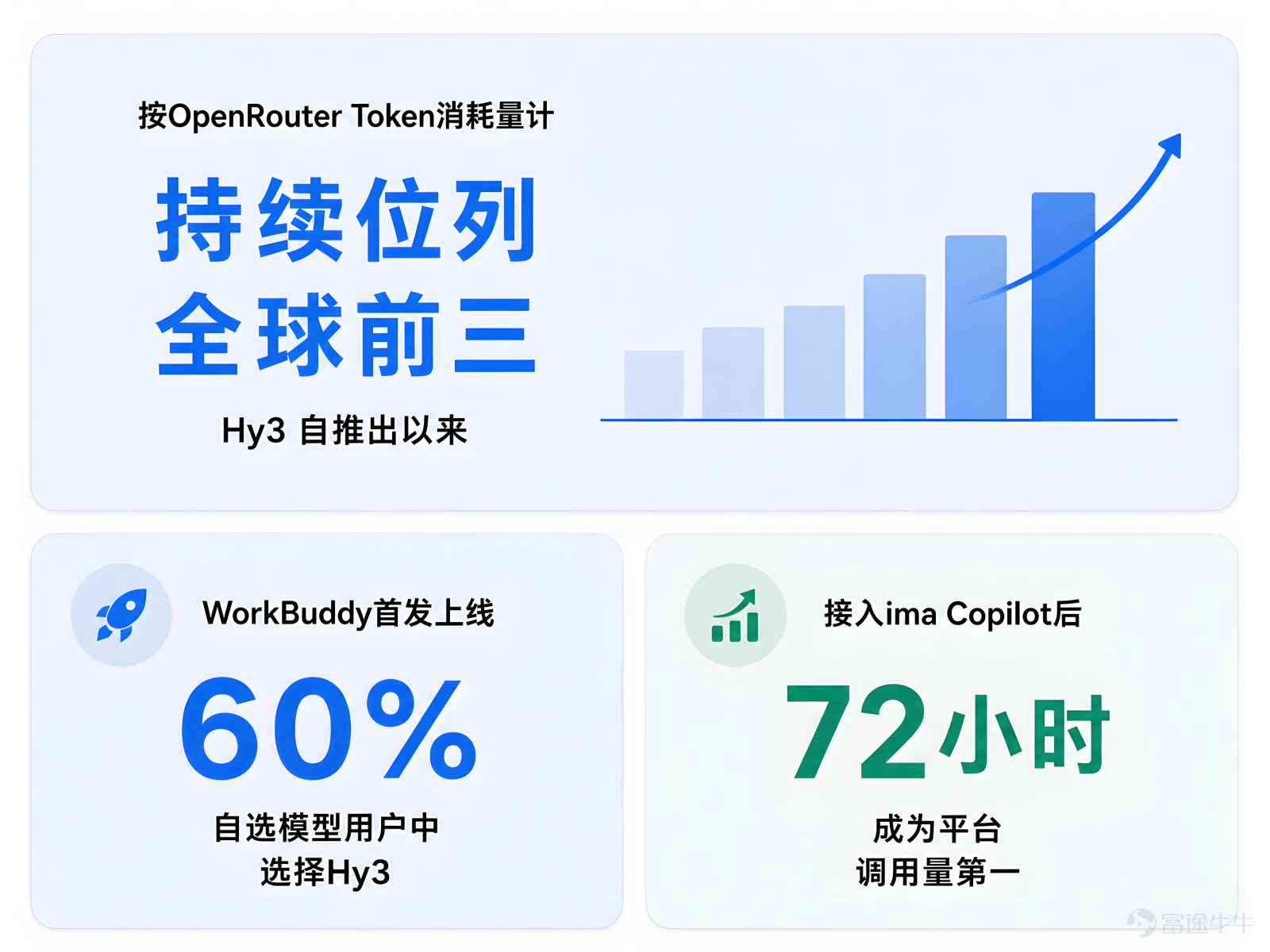
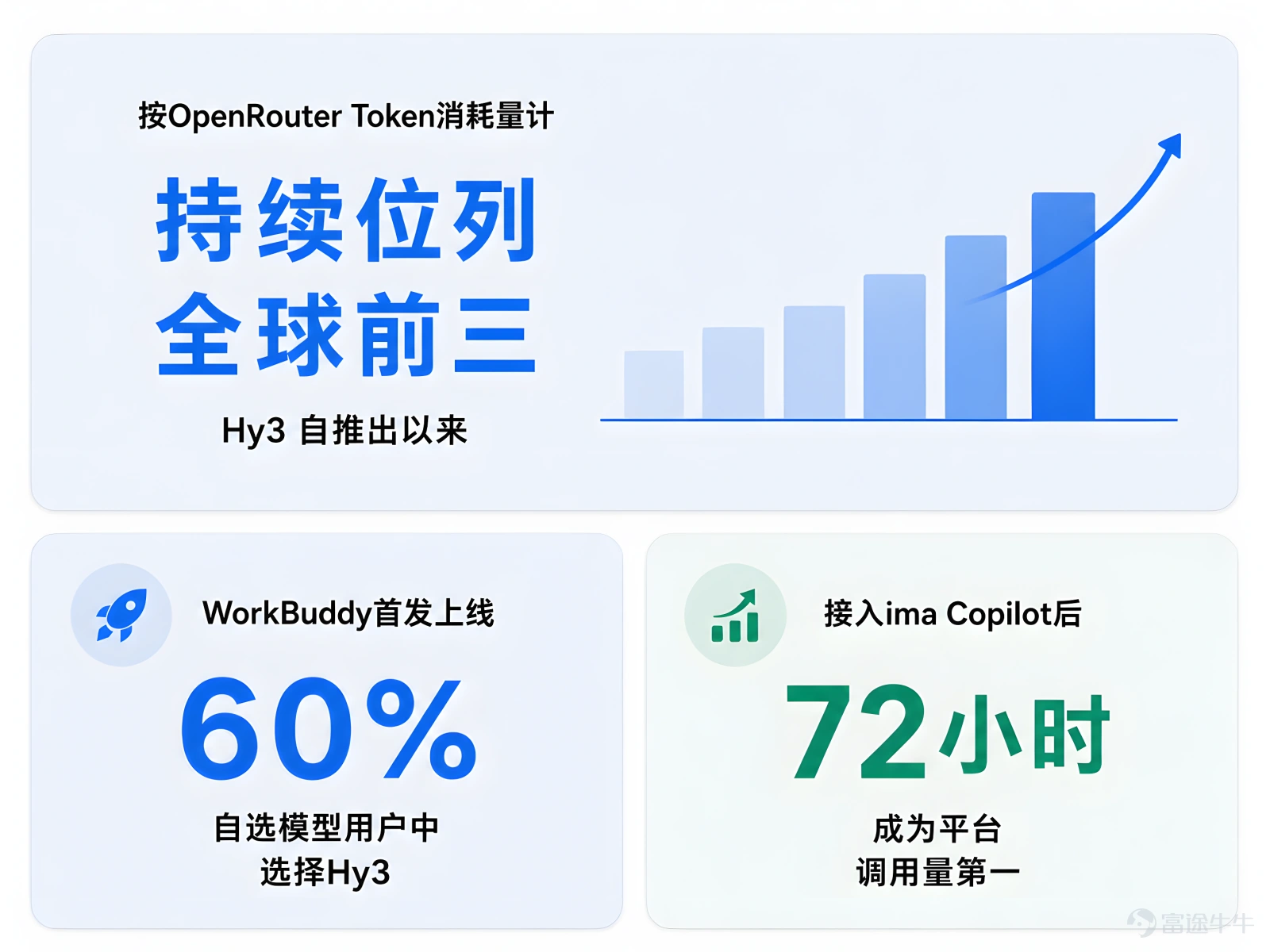
Enhanced model capabilities have driven a rapid surge in usage volume. Measured by token consumption on OpenRouter, Hy3 has consistently ranked among the top three globally since its launch. Furthermore, Hy3's daily average token usage is seven times that of its preview version, reflecting accelerated user adoption and rising demand for paid services.
User choices provide direct feedback. Among WorkBuddy users who select their own models, 60% chose Hy3. After integration with ima Copilot, Hy3 became the most-called model on the platform within just 72 hours.
WorkBuddy continues to lead, scaled-up beta testing for Xiaowei is underway, and AI products are achieving large-scale deployment.
As model iterations accelerate, Tencent's AI products are transitioning from isolated breakthroughs to scaled growth: Office agents like WorkBuddy and CodeBuddy are showing strong momentum; the WeCom AI assistant "Dayuan" has launched; the native WeChat AI assistant "Xiaowei" is expanding its beta testing; and Miora, a creative agent sharing the same architecture as WorkBuddy, has been fully rolled out.
Office agents are establishing a matrix advantage first. WorkBuddy has achieved rapid user growth and healthy retention rates, with users showing strong willingness to pay via subscriptions and token top-ups. Leveraging robust harness engineering capabilities, a diverse range of model options, and an industry-leading skill library, WorkBuddy has become a leading AI-native office agent in China.
According to Analysys' "Market Insights Report on China's Office Agent Platform Market in Q2 2026," WorkBuddy's PC traffic reached 20.97 million visits in June, ranking first among domestic peers and exceeding the combined traffic of the second and third place competitors. Among the top ten platforms by monthly traffic, Tencent holds four spots, with WorkBuddy, CodeBuddy, QClaw, and Marvis all making the list.
Leveraging its ecosystem advantages, Tencent is amplifying the differentiated competitiveness of its office AI agents. WorkBuddy integrates with WeChat and WeCom to embed itself deeply into real-world work scenarios. Recently, it has connected with documents and knowledge bases, and launched a "human-AI co-writing" feature, exploring new forms of office software in the AI era.
Beyond personal productivity, the application boundaries of Tencent's office AI agents are extending to enterprises and industries. Currently, WorkBuddy has been deployed in over 50 industries, covering government services, manufacturing, and lifestyle services, with implementations in scenarios such as Guangdong government affairs and the Port of Shenzhen. The enterprise version of WorkBuddy has been officially released, with commercialization and ecosystem partnerships advancing simultaneously.
AI deployment on the enterprise side continues to deepen within existing collaboration interfaces. In the second quarter, WeCom rolled out multiple AI features, including face-to-face meeting records and smart documents, and launched the intelligent assistant "Da Yuan." Directly embedded into workflows, it covers scenarios such as group chats, to-do lists, and emails, performing tasks like chat summarization, document and spreadsheet processing, and project progress aggregation. It also connects with external WeChat group chats, integrating more naturally into enterprise collaboration processes.
Beyond office and enterprise scenarios, Tencent's AI products are accelerating their entry into personal life contexts. The native WeChat AI assistant "Xiao Wei," launched in June, is continuously expanding its beta testing. Its access points have extended from the main slide-out menu on the WeChat home page to Moments, Official Accounts, and Channels. Built on the WeLM model developed in-house by the WeChat team, Xiao Wei prioritizes user privacy, scenario adaptation, and inference efficiency, while leveraging Official Accounts and Channels to enhance personalized AI experiences.
Yuanbao continues to strengthen core experiences such as search and speech recognition, and repurposes its accumulated atomic AI capabilities across Tencent products including WeChat, WorkBuddy, and QQ Browser.
AI is driving cloud service growth, while gaming and advertising maintain their upward momentum, with several evergreen games hitting record highs in daily active users.
In the second quarter, all three of Tencent's major business segments achieved growth, with the contribution from core AI businesses deepening. Notably, revenue from FinTech and Business Services rose 9% year-over-year to RMB 60.29 billion, with cloud business becoming the most direct contributor to AI-driven incremental growth.
Specifically, growing demand for model inference, agent operations, and AI-native applications has driven increased demand for computing power, MaaS, and API calls. AI products and services such as WorkBuddy and CodeBuddy have also contributed to new revenue. Tencent Cloud's overseas business continues to expand rapidly; this quarter, it supported Indonesia's leading operator, XL SMART, in completing a large-scale public cloud migration, applying AI capabilities like WorkBuddy and CodeBuddy to the migration process. Demand for general cloud services also remains robust.
In the gaming sector, AI has become a significant driver of business growth, deeply integrating into the entire value chain, including player experience, R&D production, and operational services. For instance, Delta Force uses AI agents to improve operational efficiency and leverages Hy3D capabilities to streamline the integrated production pipeline for scenes and handheld devices.
Meanwhile, exploration of the integration between AI and gameplay continues. The AI NPC feature in Game for Peace has reached a cumulative user base of 167 million, with peak daily active users hitting 17.7 million. The new title Roco Kingdom: World introduced "Scarlett," a game-native Coach Agent designed for complex gameplay decision-making. Since its launch, it has effectively facilitated PVP engagement and activity, resulting in a 20% increase in PVP activation rates. Users who utilized the feature after breaking the ice also saw a substantial improvement in win rates, enhancing the overall gameplay experience.
In terms of business performance, game revenue for the quarter reached RMB 65.9 billion, up 11% year-over-year, marking a return to double-digit growth overall. Domestic market revenue stood at RMB 47.3 billion, rising 17% year-over-year. Growth was primarily driven by four core titles: Delta Force, VALORANT, VALORANT: Source Energy Action, and Roco Kingdom: World. Notably, both Delta Force and VALORANT achieved record-high daily active users this quarter, reinforcing Tencent's leading position in the shooter and competitive gaming segments.
International game market revenue amounted to RMB 18.6 billion, representing a 4% year-over-year increase on a constant currency basis, mainly driven by Wuthering Waves and VALORANT. Meanwhile, Tencent’s Miniclip achieved breakthrough success in international markets, with its title Arrows - Puzzle Escape becoming the most downloaded mobile game globally in Q2.
In marketing services, AI continues to drive improvements in advertising delivery efficiency. Marketing services revenue for the quarter totaled RMB 43.57 billion, up 22% year-over-year, sustaining a growth momentum that outpaces the industry. The client coverage rate for the intelligent advertising product matrix "Tencent Marketing AIM+" remained stable at over 80%, while AI-powered creative capabilities boosted material production efficiency by nearly 80%.
The ad recommendation model underwent a Scaling Up upgrade, establishing a next-generation infrastructure foundation for ad training and inference. Taking WeChat Channels ad recommendations as an example, the scale of the ultra-large-scale ranking model increased by 30 times, and computational volume rose by 24 times. These capabilities have been extended to more WeChat scenarios, including Official Accounts and Mini Programs.
AI is also accelerating its integration into existing WeChat products and ecosystems. In addition to launching the AI assistant Xiao Wei, the Mini Program ecosystem continues to attract developers, with AI-native applications emerging rapidly; AI-focused Mini Programs grew by nearly 40% in six months. The "WeChat Mini Program Growth Plan" has increased the large language model token quota to 1 billion, attracting 63,000 participating Mini Programs, over 60% of which are from individual developers. Official Accounts have introduced one-click AI formatting and are conducting gray-box testing of AI avatars to enhance content creation and user service efficiency. WeChat Pay launched the "AI Exclusive Card" for AI agents, initially integrating WorkBuddy, allowing users to express consumption needs to agents and experience an automated consumption loop from smart recommendations to ordering and payment.
Rich AI capabilities continue to energize the WeChat ecosystem. This quarter, the combined monthly active accounts for Weixin and WeChat reached 1.439 billion. Total user time spent on WeChat Channels grew by over 20% year-over-year, thanks to increasingly diverse content targeting younger users, upgraded interactive features, and a new content mixing system. During this year's "618" shopping festival, transaction volume in the WeChat Stores and Cards & Offers scenarios surged 537% year-over-year, establishing them as new hubs for merchant development. The number of brands with transactions exceeding RMB 10 million rose by over 200% year-over-year, while the number of merchants with transactions exceeding RMB 1 million increased by 564% year-over-year. Overseas services via Mini Programs further expanded, with monthly transaction volumes in Southeast Asia growing 160% year-over-year.
Risk Disclaimer: The above content only represents the author's view. It does not represent any position or investment advice of Futu. Futu makes no representation or warranty.Read more


Comment (1)
to post a comment
13
4