Options Hub: Oil prices break $100, PPI beats expectations! How to position with options for tonight

Options Mini-Class 05 | Expecting a pullback? Buy a Long Put to short and hedge with "small change"
Every Wednesday, the 'Bai Dao Mini-Class' starts right on time. We begin with the basics and focus on just one concept per session. Fellow investors, follow along week by week—options aren’t as hard as they seem.
In addition to the Wednesday mini-class, we also have 'Opportunity Pool' on Mondays to discuss potential trade ideas, and 'Weekly Recap' on Fridays to break down cases from the week—each of these three segments has its own focus, and they work even better when consumed together.Follow NiuNiu’s official account 'BaiDao Plays Options' so you never miss an update~
Want to go short, but find short selling too expensive and scary?
Do fellow investors ever feel this way—you see a stock that seems overvalued, or expect it to pull back soon, and you’re itching to "profit from the drop." But when you look into how to do it, you realize it involves "short selling": borrowing shares to sell, posting a large margin deposit, and worrying about unlimited losses if the stock skyrockets... Just thinking about it is enough to deter you.
Actually, there is a much lower-barrier way to go short—Buy a Put (Long Put). With a small amount of capital, you can bet on the stock’s decline, and your maximum loss is limited to that initial cost. Today, we’ll use $Tesla (TSLA.US)$ to thoroughly explain this strategy (no bearish intent toward Tesla; it’s just used as an example).
A put option is essentially "the right to sell at an agreed-upon price."
Let’s clarify the concept first. A put option gives youThe right to "sell" stocks at an agreed-upon price before expiration。
To use an analogy: imagine you hold a "price protection policy" that states, "No matter how low the market price falls, I can sell my shares at $300." If the stock price indeed drops to $270, doesn't this "right to sell at $300" become valuable? The sharper the decline, the more valuable it becomes.
Therefore, buy put options when you are bearish. As the stock price falls, the value of your option increases—this is the logic behind profiting from a downturn.
Moreover, you are simply "buying a right," not actually borrowing shares to sell short, so:You don't need to post tens of thousands of dollars in margin; your initial investment is just the option premium. Even if your prediction is wrong and the stock rises instead, the most that can happen is that the option expires worthless. Your losses are capped, giving you peace of mind.。
Let's run the numbers using Tesla
TSLA's current price is approximately $333. It has seen significant volatility this year, with a sharp pullback during one week in July. Fellow investors should be familiar with its wild ups and downs.
Assuming you believe Tesla will continue to trend downward, let's construct a put option strategy:
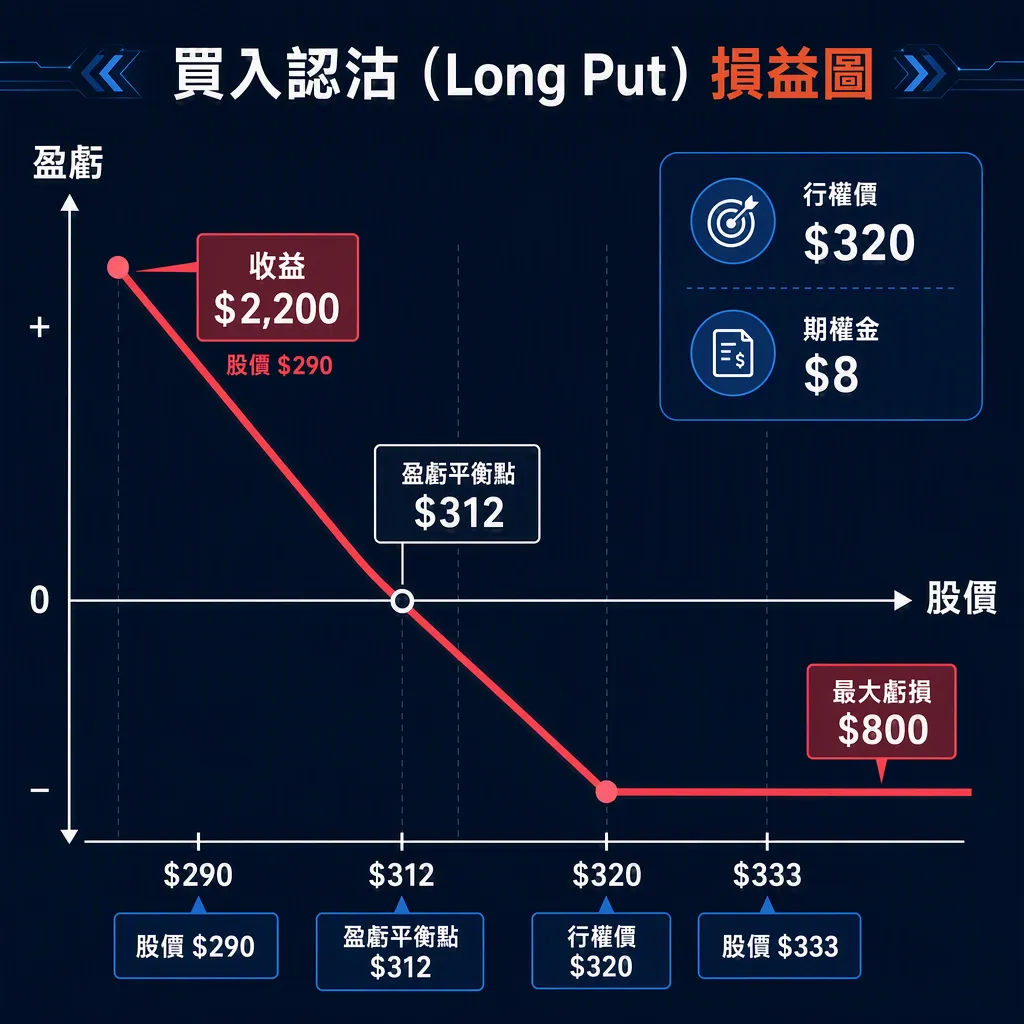
Select oneStrike price: $320(one tick below the current price), put options expiring next month
Assuming the option premium is $8 per share,with one contract covering 100 shares, the total cost would be $800(To make it easier for fellow investors to understand, we are not using real-world option chains and are demonstrating with rounded premium figures. For actual trading, please refer to the real-time quotes on the option chain.)
A quick note here:Option premiums are not always as cheap as "the cost of a meal." For stocks with higher prices and greater volatility, contracts that are closer to the current price and have longer expiration dates often command higher premiums, potentially reaching hundreds or even thousands of dollars per contract. To truly keep costs down to tens or hundreds of dollars, you typically need to choose underlying assets with lower prices, or select contracts that are further out-of-the-money and closer to expiration—but this also means the stock needs to drop significantly more for you to profit. Therefore, while "spending little" represents a lower barrier to entry compared to short selling, the exact amount depends entirely on which specific contract you choose.
At expiration, consider two possible outcomes:
① If your bearish view is correct and the price drops to $290:
The intrinsic value of your "sell at $320" put option is $320 − $290 = $30 per share.
Profit = ($320 − $290 − $8) × 100 = $2,200。
Spending $800 to earn $2,200—this isleveraging a small capital for significant gains。
② If your view is wrong, and the stock price doesn't fall or only dips slightly, ending up above $320 at expiration:
The option expires worthless,and you lose exactly the $800 premium paid, nothing more.
Compare this to short selling: to short 100 shares of Tesla with the same bearish outlook, you would need to post thousands of dollars in margin and worry about unlimited losses if the stock surges.Buying a put option caps your maximum loss at a few hundred dollars while preserving substantial upside potential if the stock plunges. This is precisely what makes it so appealing.
Don't overlook the "breakeven point" and "time".
Buying puts isn't just "making money as long as the stock drops"; it has to fall past a hurdle—the breakeven point.。
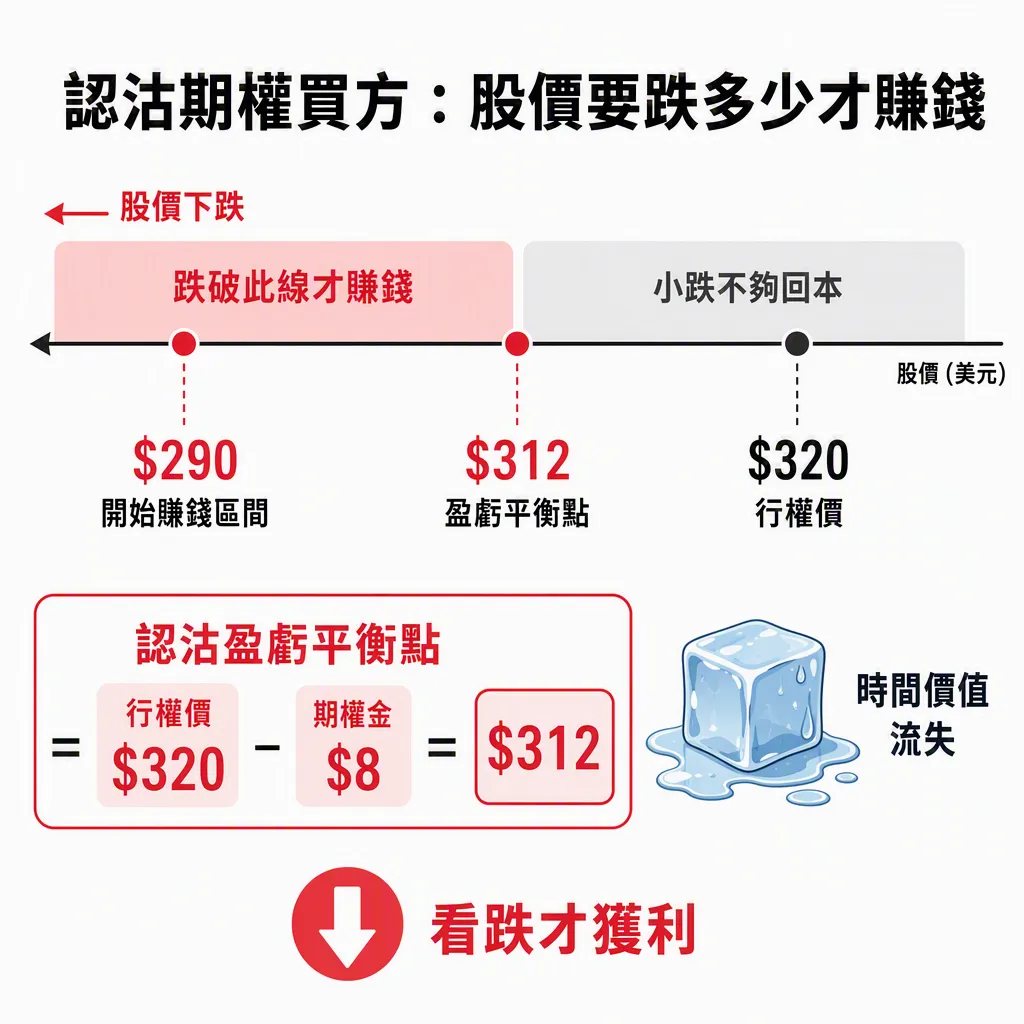
In the example above: with a strike price of $320 and an option premium of $8, the stock price needs to drop to $320 − $8 = $312 $312 for you to break even, and only starts generating profit if it falls below $312.So when buying puts, it's not just about getting the direction right, but also the "magnitude of the drop"—a small decline might not even cover your costs.
Another point often overlooked by beginners: options have an "expiration date."As the expiration date approaches, if the stock price remains stagnant, the option premium will slowly melt away like ice (due to time decay). Therefore, don't hold puts for too long, and don't buy them too close to expiration. Allowing enough time for the trend to play out is a crucial lesson.
Key takeaway
Long Put = Buying the right to "sell at an agreed price," which appreciates in value when you are bearish.It is a powerful tool for shorting or hedging with small capital.
Maximum loss = Premium paid, capped and controllable; unlike short selling, it doesn't require tying up large amounts of margin or worrying about unlimited losses.
Whether the option premium is expensive depends on the specific contract.Don't assume it's "always cheap"; be mindful when selecting the underlying asset and expiration date.
To make a profit, the price must fall belowthe breakeven point.(Strike Price − Premium). Just getting the direction right isn't enough; the magnitude of the move must also be sufficient. Options also have an "expiration date," and when the stock price remains stagnant,time value will gradually erode.。
Fellow investors can open Futubull → go to the "TSLA" stock page → select "Options" → enter the option chain, find a put option one or two strikes below the current price, and check its quote, expiration date, and break-even point. Also, compare the premium differences across different contracts to get a feel for "how it moves when the price drops."
If you're not ready to commit real capital just yet, we strongly recommend practicing with Futubull's "Paper Trading" feature first. Use virtual funds to go through the entire process of placing orders, holding positions, and managing expirations. Once you're comfortable with the rhythm, consider testing the waters with a small live trading position.Options amplify both returns and risks. Buying put options can also result in the total loss of your premium, so be sure to start with an amount you can afford to lose.
Finally, we’ve got a little perk for our fellow investors—feel free to claim it!Options Starter Pack~
*This promotion is exclusively available to invited Hong Kong users. Click to learn more.Detailed terms and conditions of the promotion >>

Disclaimer
This content does not constitute an offer, solicitation, recommendation, advice, opinion, or any form of guarantee regarding any securities, financial products, or instruments. Trading options carries substantial risk of loss. In certain scenarios, your losses may exceed the initial margin deposit. Even if you set contingency instructions such as 'stop-loss' or 'limit orders,' these may not necessarily prevent losses, as market conditions could render such instructions unexecutable. You may be required to deposit additional margin on short notice. If you fail to meet the margin call within the specified timeframe, your open positions may be liquidated. Nevertheless, you remain fully liable for any resulting deficit in your account. Therefore, prior to trading options, you should thoroughly study and understand options trading and carefully consider whether such trading aligns with your financial situation and investment objectives. If you do trade options, you must become familiar with the procedures, rights, and obligations associated with exercising options and their expiration.
Risk Disclaimer: The above content only represents the author's view. It does not represent any position or investment advice of Futu. Futu makes no representation or warranty.Read more

Comments
to post a comment
12
26