NEBIUS and CoreWeave raise prices: Is the surge in AI computing demand here to stay?

Anthropic signs 20-year compute capacity deal with Riot; CoreWeave’s backlog exceeds $100 billion! Why are AI giants collectively betting on Neocloud?
The battle for AI computing power is showing two defining signals.
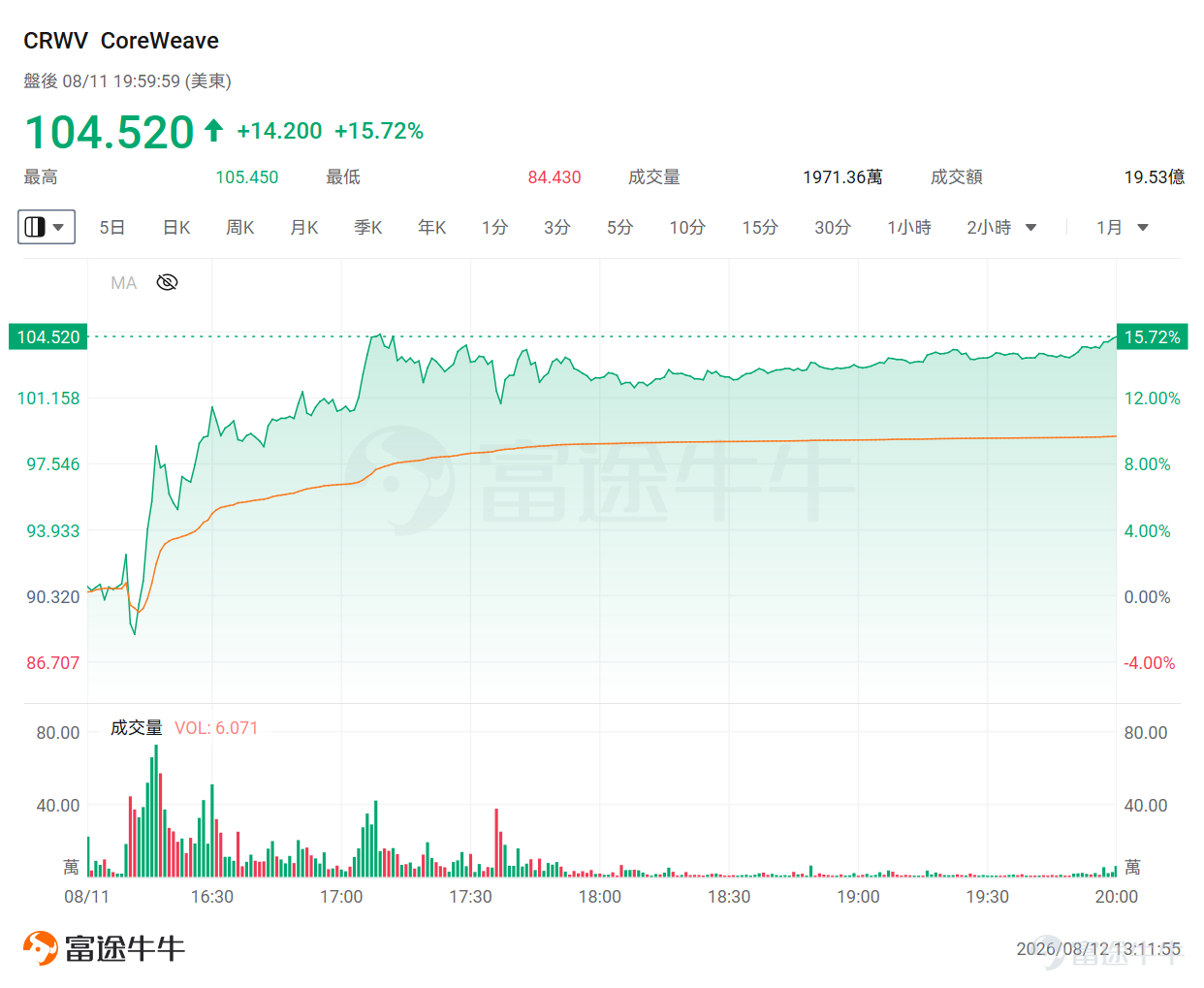
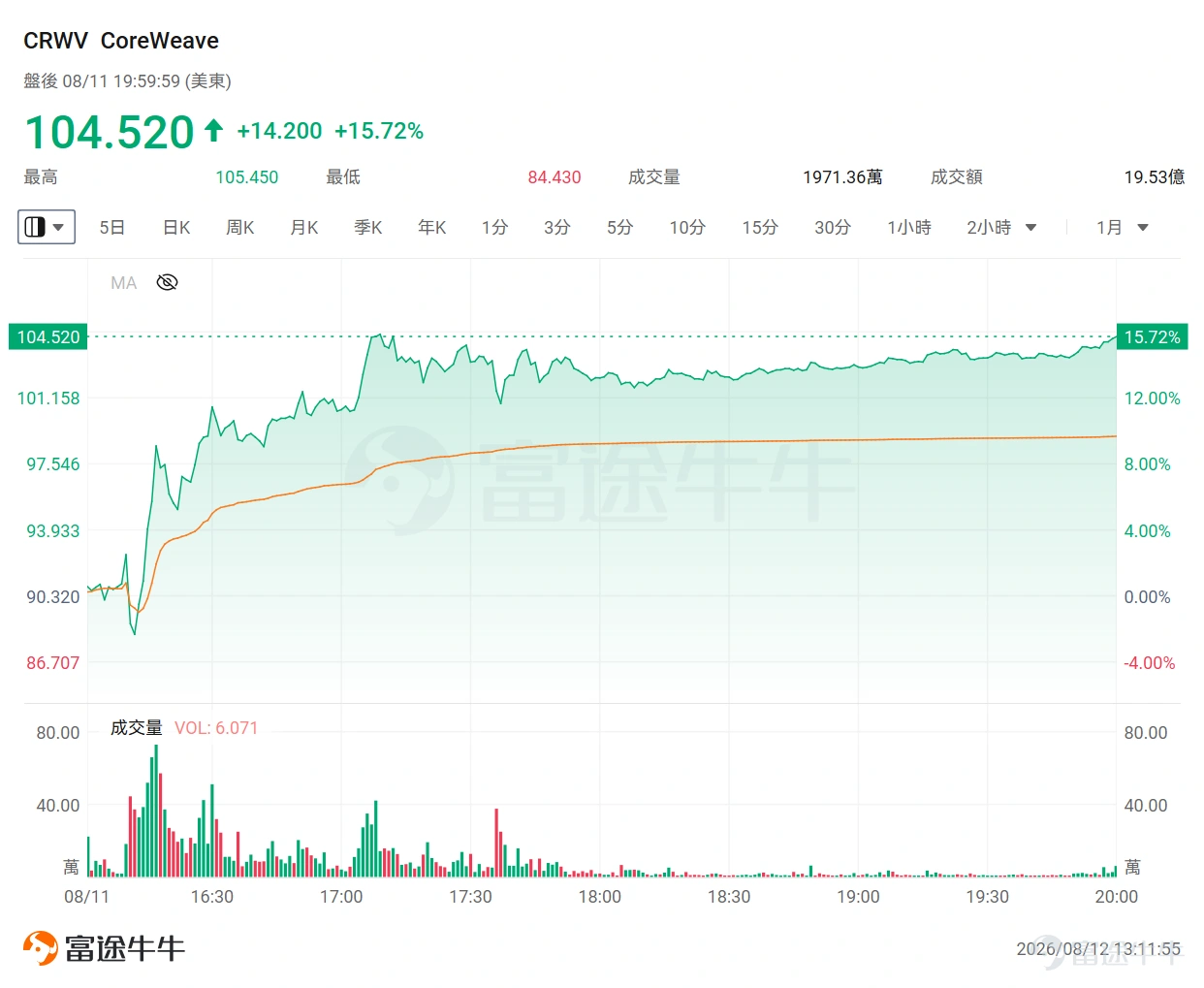
On one side, Anthropic continues to lock in future computing capacity with a $9.1 billion contract spanning up to 20 years; on the other, AI cloud providers $CoreWeave (CRWV.US)$ doubled revenue in Q2, with backlog orders exceeding $100 billion, and secured over $25 billion in new customer commitments early in Q3. Following the earnings release, CoreWeave surged more than 15% in after-hours trading.
--
--
--
On the surface, these appear to be two separate news items; in reality, together they form a complete closed loop of AI infrastructure expansion:AI companies secure long-term contracts for power and computing capacity, while Neocloud relies on these orders to finance, procure chips, and build data centers.
Anthropic starts racing to secure computing power on a '20-year' horizon
According to media reports, Anthropic has signed a 20-year, $9.1 billion computing power agreement with Bitcoin mining company $Riot Platforms (RIOT.US)$ Riot.
Riot will provide Anthropic with 191 megawatts of computing power from its data center campus in Rockdale, Texas, to be delivered in phases by 2028. The base contract is valued at approximately $9.1 billion; if Anthropic exercises two five-year extension options, the nominal total value could reach up to $16.1 billion. Following the announcement, Riot’s stock surged more than 15% intraday but ultimately closed up just 4%.
This is not the first time Anthropic has signed an ultra-long-term contract with a mining company. In July this year, Anthropic just entered into a 20-year lease agreement with TeraWulf, securing approximately 401 megawatts of capacity at its Kentucky data center, with a base contract value of about $19 billion, potentially rising to $33 billion if extension options are exercised.
Additionally, Anthropic also signed a roughly $10 billion, six-year computing power agreement with Volta Infra, a company founded only a few months ago; and it procured Colossus computing capacity from Elon Musk’s SpaceX AI. Based on a monthly rate of $1.25 billion through May 2029, the nominal total commitment amounts to nearly $45 billion. However, the SpaceX AI agreement includes early termination clauses, so it cannot be fully equated with rigidly locked-in revenue.
This reflects that Anthropic’s most critical current growth bottleneck is no longer merely whether it can acquire GPUs, but whether it can secure sufficient power, land, data center capacity, and financing resources well in advance.
CoreWeave’s $100 Billion Backlog Confirms: AI Computing Demand Remains Red-Hot
If Anthropic’s flurry of contracts represents demand-side players aggressively locking in resources, then $CoreWeave (CRWV.US)$ the latest results confirm—from the supply side—that this demand continues to materialize.
CoreWeave reported second-quarter revenue of $2.575 billion, up 112% year-over-year; net loss stood at $626 million, or $1.14 per share.
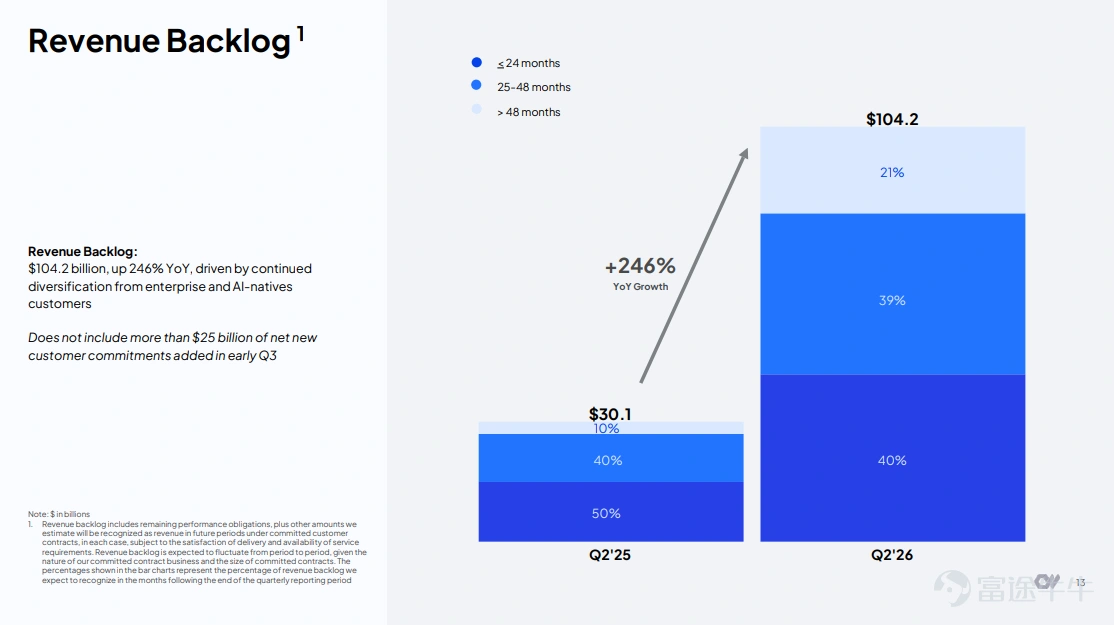
More notably,as of the end of Q2, the company’s backlog reached approximately $104.2 billion, up 246% year-over-year,higher than the $99.4 billion reported at the end of Q1.At the beginning of the third quarter, the company secured over $25 billion in new customer commitments,not yet included in the aforementioned backlog.
Meanwhile, the company added nearly 500 megawatts (MW) of active power capacity in Q2, bringing total active capacity to 1.5 gigawatts (GW). Signed power capacity reached approximately 3.7 GW by the end of Q2 and further increased to around 4.2 GW as of August 11.
CoreWeave also expanded its number of active data centers to 51 and completed the industry’s first deployment validation of NVIDIA’s Vera Rubin NVL72 systems. Management stated that the expected margin on new contracts signed in Q2 was 5 to 10 percentage points higher than that of contracts added in recent quarters.
This indicates a shift in CoreWeave’s growth narrative: previously, the market focused on whether it could secure orders; now, the more critical question is whether those orders can be converted into revenue and cash flow at higher margins.
Why are tech giants all betting on Neocloud?
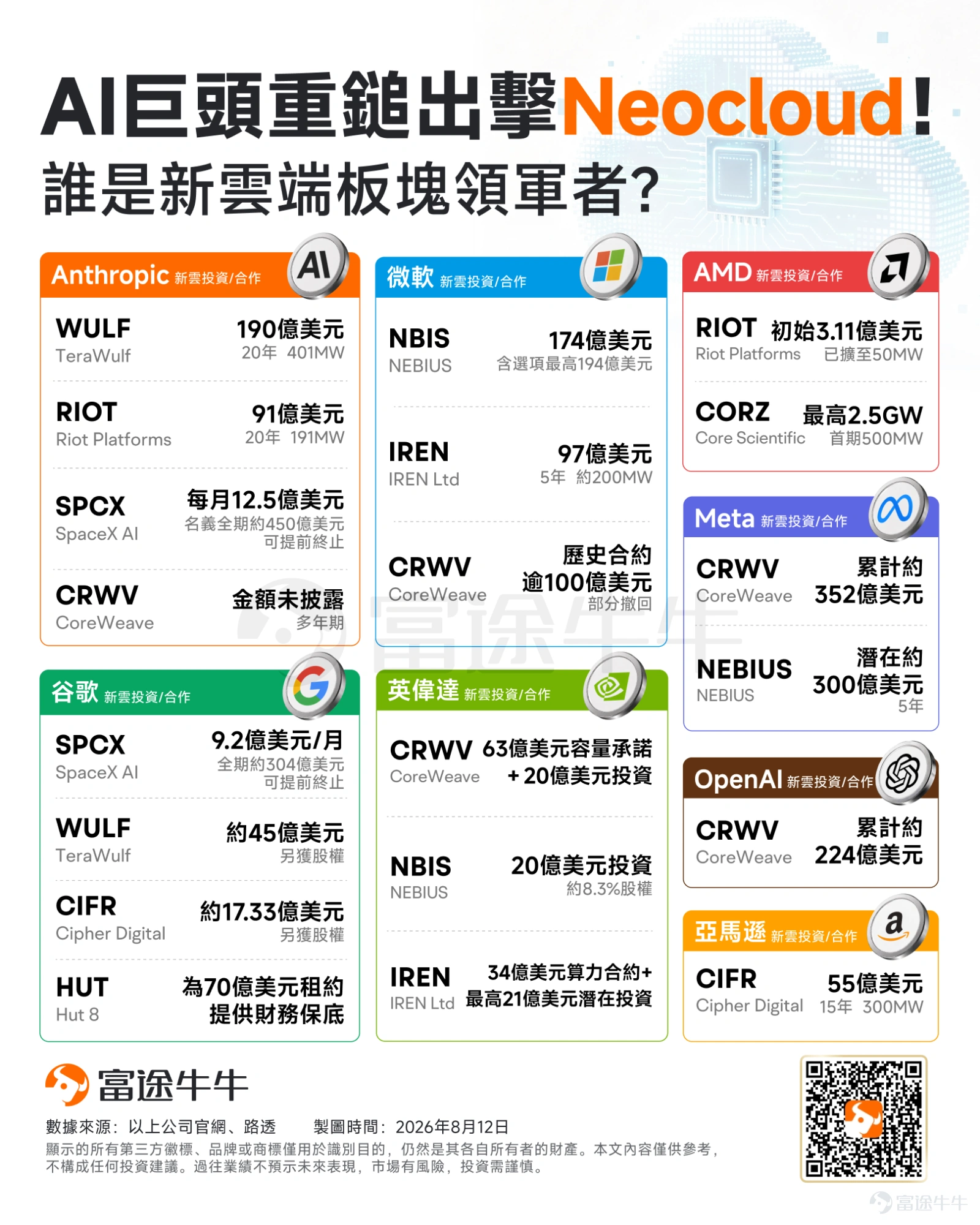
As shown in the chart below, besides Anthropic, companies such as Microsoft, Meta, and OpenAI are also heavily increasing their bets on the Neocloud space.
--
--
--
The underlying reason is that these giants are leveraging third-party platforms to address gaps in their own expansion speed, power resources, and capital efficiency.
First, self-built infrastructure cannot keep up with demand.Large-scale data centers typically take years—from securing land and power to completing construction and GPU deployment—whereas Neocloud has already secured portions of power, land, and grid interconnection resources in advance, enabling faster compute delivery.
Second, Neocloud enhances capital flexibility.Tech giants can avoid bearing the full construction cost upfront and reduce depreciation and obsolescence risks associated with rapid GPU iteration.
Finally, it diversifies supply chain risk. $Microsoft (MSFT.US)$ while partnering with $CoreWeave (CRWV.US)$ 、 $NEBIUS (NBIS.US)$ and $IREN Ltd (IREN.US)$ to collaborate, $Meta Platforms (META.US)$ while simultaneously betting on $CoreWeave (CRWV.US)$ and $NEBIUS (NBIS.US)$ to avoid over-reliance on a single cloud provider, data center, or chip architecture.
Different tech giants also have distinct motivations: Microsoft and Meta primarily view Neocloud as a 'flexible expansion pool' beyond their own in-house computing capacity; OpenAI and Anthropic, lacking proprietary data centers, need long-term contracts to secure core capacity in advance; Google and Amazon use lease guarantees, project financing, and equity arrangements to indirectly control scarce power resources; $NVIDIA (NVDA.US)$ and $Advanced Micro Devices (AMD.US)$ Investing in Neocloud not only expands AI cloud supply but also creates stable demand for their own chips.
Therefore, tech giants’ bets on Neocloud are not fundamentally an 'either-or' choice between building in-house or outsourcing, but rather using self-built data centers as a foundation while leveraging Neocloud to accelerate deployment, fill capacity gaps, and mitigate risks.
In the race among Neocloud contenders, who holds a stronger competitive edge?
Currently, companies related to Neocloud can generally be divided into three categories.
The first category includes $CoreWeave (CRWV.US)$ full-stack AI cloud platforms.Their advantages include high-quality clients, large order sizes, and comprehensive technology platforms, resulting in relatively strong predictability; however, risks include high debt and capital expenditures, along with continued reliance on a few major clients.
The second category includes $NEBIUS (NBIS.US)$ and $IREN Ltd (IREN.US)$ high-growth challengers.Both companies have secured large contracts from tech giants and support from NVIDIA, offering greater revenue elasticity, but it remains to be seen whether their data centers can be delivered on schedule and whether rapid expansion can translate into cash flow.
The third category includes $Riot Platforms (RIOT.US)$ 、 $TeraWulf (WULF.US)$ 、 $Cipher Digital (CIFR.US)$ 、 $Hut 8 (HUT.US)$ and $Core Scientific (CORZ.US)$ mining companies transitioning into this space.Their biggest assets are power, land, and grid interconnection resources; once they secure long-term contracts, their valuation could shift from 'Bitcoin miners' to 'AI data center landlords'—though they also face the highest construction, financing, and transformation risks.
If you’re bullish on the entire Neocloud sector but don’t want to bet on a single company, you could also consider $Roundhill Neocloud ETF (NCLD.US)$ . This ETF launched on August 6, 2026, with its top five holdings including $NEBIUS (NBIS.US)$ 、 $CoreWeave (CRWV.US)$ 、 $IREN Ltd (IREN.US)$ 、 $Hut 8 (HUT.US)$ and $TeraWulf (WULF.US)$ , covering three main themes: AI cloud platforms, growth-stage Neocloud companies, and miners transitioning into AI infrastructure.
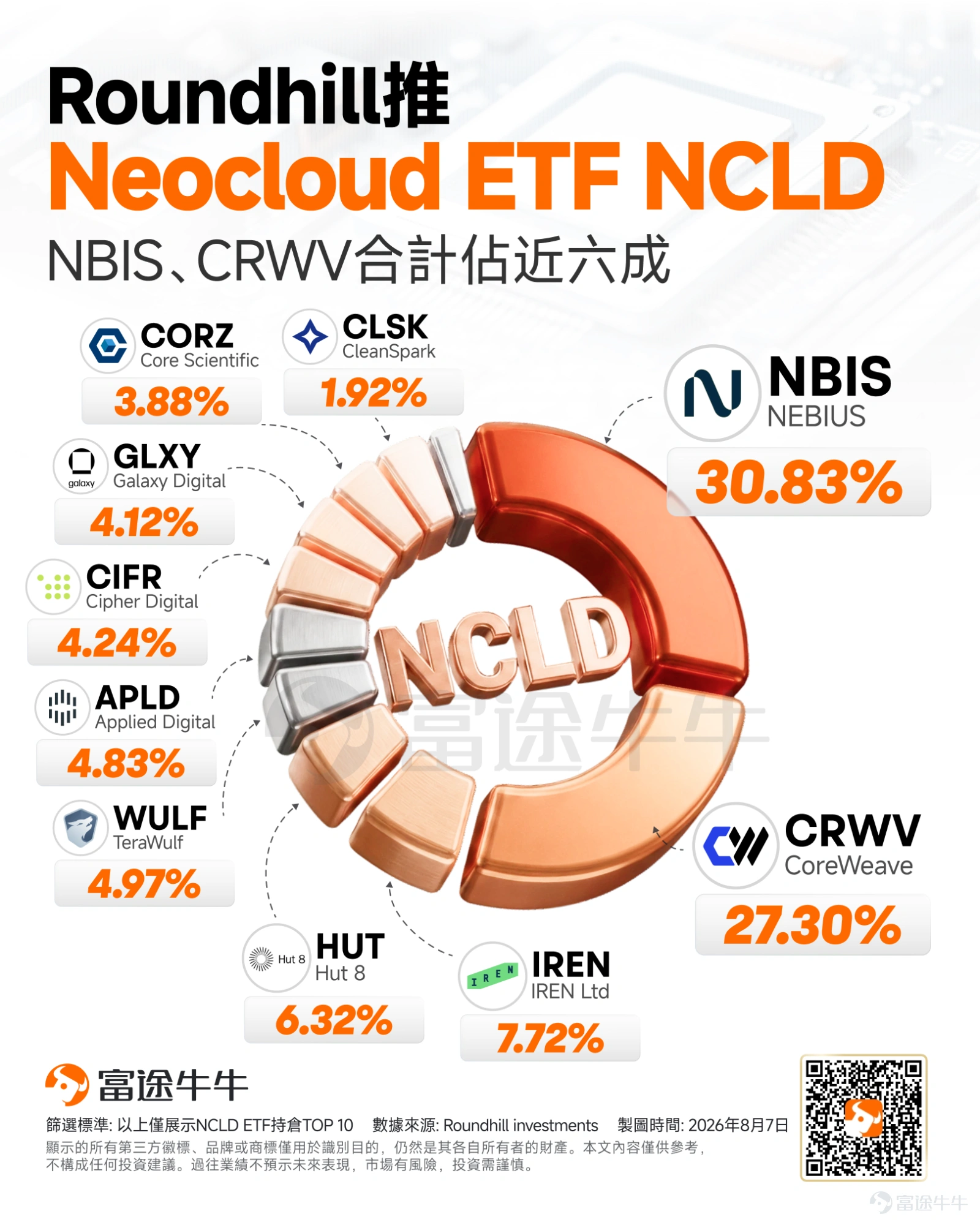
Overall,investors prioritizing order visibility and platform certainty should closely track CoreWeave; those seeking higher growth elasticity may focus on NEBIUS and IREN; and those favoring event-driven or high-volatility opportunities should watch Bitcoin miners that hold long-term contracts and have deliverable power capacity.
However, regardless of which category you choose, you shouldn’t look only at total contract value—you should also monitor three key metrics:delivered power capacity, cost of financing, and the speed at which orders convert into cash flow.
Anthropic’s aggressive scramble for computing power and CoreWeave’s order book surpassing $100 billion indicate that the AI infrastructure cycle has not yet cooled down. But in the next phase, the ultimate winners may not be the companies with the largest orders—they’ll be the ones that can secure cheaper financing, deliver computing power on schedule, and ultimately achieve profitability.
Risk Disclaimer: The above content only represents the author's view. It does not represent any position or investment advice of Futu. Futu makes no representation or warranty.Read more


Comments (4)
to post a comment
75
243