Hong Kong stocks are rebounding—what sectors deserve attention?

The Four Sisters of New Consumption This Year
(This article was written by Zhaibo and published by TMTPost with authorization)
By Narrowcast, Author: Lin Zhi (Hong Kong), Supervising Editor: Shao Lele (Shanghai)
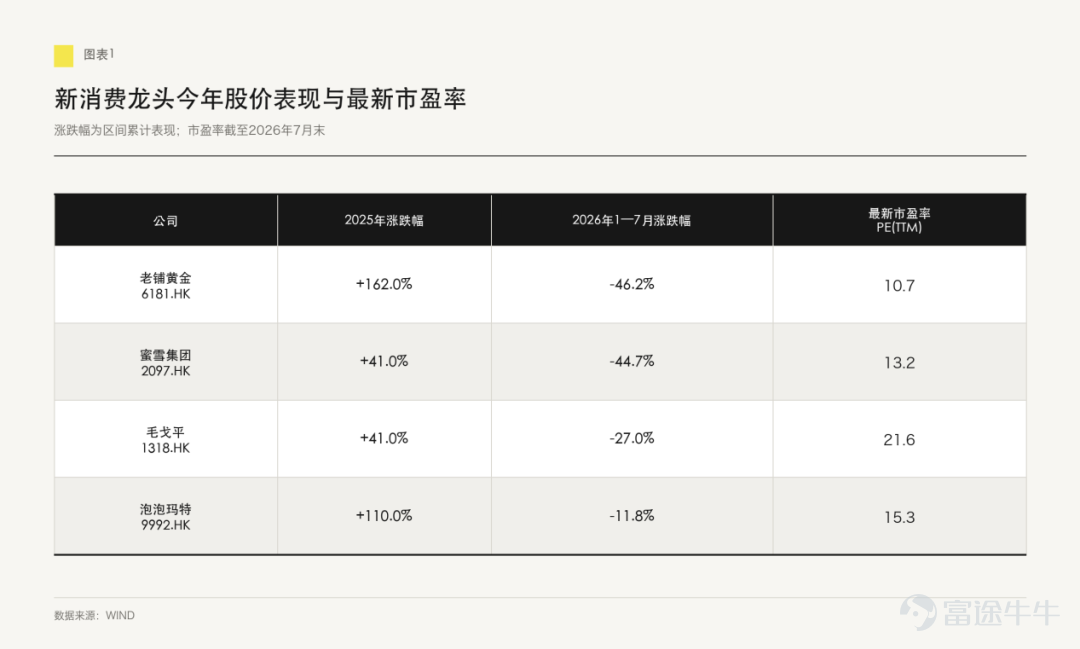
The Hong Kong-listed 'Four Sisters of New Consumption,' which were still favored by capital markets last year, have collectively entered a valuation adjustment phase this year. From January to July 2026, Laopu Gold and Mixue Group saw their share prices decline by 46.2% and 44.7%, respectively, while Mao Geping and Pop Mart fell by 27% and 11.8%. Compared to their strong rallies in 2025—some even doubling in value—the market’s pricing logic for these companies is shifting.

Amid the stock price adjustments,the earnings growth rates of these four companies are also normalizing from high bases. Laopu Gold was the first to issue a profit guidance: for the first half of 2026, revenue is expected to increase by 60%–66% year-over-year, and net profit is projected to rise by 83%–85%. While this growth remains impressive, it marks a slowdown compared to the high-growth phase in 2025, when revenue surged by 221% and net profit jumped by 230.5%.
This does not mean that the businesses of these new consumption companies have suddenly lost momentum.Although the 'Four Sisters of New Consumption' have clearly stepped down from their historical performance peaks this year, their operational results remain stronger than those of most peers when viewed on a cross-sectional basis.
Corporate operations still show resilience, but stock prices have already adjusted. The reason is straightforward: last year, the market priced in high growth expectations, and this year it is assessing whether actual results can keep pace. The long-term potential remains, but new operational data is needed to support it.
The high valuations in 2025 stemmed both from rapid growth at the time and from market expectations regarding brand strength, overseas expansion, and long-term growth. These factors haven’t disappeared this year, but the market is no longer assigning such lofty valuations in advance as it did last year. Coupled with capital rotating more heavily into sectors like AI, several companies’ share prices have entered an adjustment phase.
On the macro front, in the first half of 2026, global capital clearly rotated toward hard-tech AI assets, putting broad pressure on Hong Kong-listed growth sectors that had previously traded at high valuations. Both the Wind Hong Kong Consumer Discretionary Index and Consumer Staples Index fell by 19% in the first half of the year. This shift in market style amplified the correction in the new consumer segment.
The share price trajectories of the four companies also reflectthe cooling of their respective growth narratives after an initial period of enthusiasm.
Over a longer timeframe, all four companies reached阶段性 peaks in share price and valuation in 2025, followed by broad-based pullbacks starting in the second half of that year. Behind these similar curves lies a pattern where capital markets first aggressively priced in growth expectations and then waited for operational results to validate them.

Specifically, Laopu Gold rose steadily after its June 2024 listing, peaking at HK$1,065 in July 2025—more than 25 times its IPO price of HK$40.5—and reached a peak price-to-earnings (P/E) ratio of 140x. Since then, its share price has declined continuously, falling over 70% from its peak. From January to July 2026, it dropped 46.2%, with its P/E ratio retreating to 10.7x.
Pop Mart saw strong momentum in 2025 from the LABUBU launch and overseas growth, pushing its share price close to HK$340 with a P/E ratio exceeding 105x, resulting in a 110% gain for the year. However, its stock began declining after August 2025 and is now down more than 50% from its peak. From January to July 2026, it fell 11.8%, with a current P/E ratio of 15.3x.
Mixue Group attracted strong investor interest shortly after its March 2025 listing, with its P/E ratio briefly exceeding 45x. After peaking around mid-2025, its share price has steadily declined, falling 44.7% from January to July 2026, and its P/E ratio has since dropped to 13.2x.

Mao Geping also experienced a post-listing surge followed by a pullback. The market had previously been optimistic about the growth potential of premium domestic cosmetics, driving its price-to-earnings (P/E) ratio to as high as 60x. From January to July 2026, its share price fell by 27%, and by the end of July, its P/E ratio stood at 21.6x—still relatively high compared to the other three companies.
The elevated valuations of these four companies are primarily supported by three layers of premium.
The first layer is earnings growth: in 2025, Laopu Gold’s revenue and net profit grew by 221% and 230.5%, respectively, while Pop Mart saw growth of 184.7% and 308.8%, respectively.
The second layer stems from temporary tailwinds: Laopu Gold benefited to some extent from rising gold prices; Pop Mart gained from the global popularity of LABUBU and low-base overseas growth; Mixue Group leveraged IPO sentiment premium, rapid expansion of its store network, and market expectations for international expansion to unlock valuation upside.
The third layer lies in longer-term narratives—China’s homegrown luxury brand (Laopu Gold), a brand group capable of creating globally resonant cultural icons (Pop Mart), or premiumization of domestic brands (Mao Geping). Overall, the first two layers provide a tangible foundation, while the third further elevates investors’ imagination of these companies’ future potential.
In 2026, the conditions underpinning these high valuations began to shift. Corporate earnings reverted from the previous two years’ explosive growth to a more moderate pace, and the additional boosts from gold prices, viral hits, and IPO hype became less pronounced than before. As a result, the market started reassessing how much these companies are truly worth.
External factors first shifted capital allocation priorities. Geopolitical tensions and changes in overseas monetary policy heightened investor preference for certainty. Meanwhile, global capital flowed increasingly into the AI supply chain, and within the Hong Kong market, hard-tech sectors outperformed, while previously high-valued segments such as discretionary consumption, software services, and biopharma entered a phase of valuation digestion.
Investors in the Hong Kong stock market now have more options to choose from. According to Wind data, new listings on the Hong Kong Stock Exchange raised over HK$208 billion in the first half of 2026, while lock-up expirations amounted to over HK$390 billion; the scale of expirations in the second half is expected to exceed HK$1 trillion. With the influx of new shares and unlocked stakes, capital is spread across a broader set of companies. For consumer firms trading at high valuations, the market is placing greater emphasis on whether earnings can be genuinely delivered and whether growth is underpinned by solid fundamentals.
Consumer fundamentals show a modest and divergent recovery pattern. In the first and second quarters of 2026, total retail sales of consumer goods rose year-on-year by 2.4% and 0.2%, respectively. Against this backdrop, demand for non-essential categories—such as premium gold jewelry, IP-driven collectible toys, and high-end cosmetics—depends more on sub-category momentum, brand appeal, and new product pipelines than on overall consumption trends.
More important than macroeconomic shifts is whether the company itself can continue to grow.The high growth seen in 2024–2025 will be difficult to replicate year after year. As the base expands and competition intensifies, companies must rely less on gold prices, hit products, or IPO-driven hype, and more on product strength, brand equity, and operational efficiency to sustain growth.
The most immediate change is a return of earnings growth to more normal levels. Take Pop Mart as an example: according to Wind’s consensus earnings forecasts, its revenue and net profit are expected to grow by approximately 21% and 17% respectively in 2026—marking a significant deceleration from the 184.7% and 308.8% growth projected for 2025, and bringing it back into a more typical growth range. Growth persists, but capital markets now need to reassess what level of growth can justify the previous valuation.
At the same time, the stage-specific variables facing each company are also shifting. Fluctuations in gold prices have altered consumer spending patterns in the gold sector; meanwhile, trendy toys, tea beverages, and cosmetics have entered a phase of more intense competition. Whether hit products can maintain momentum and whether offerings can be continuously iterated have become new challenges. This round of valuation adjustments does not imply that underlying businesses have weakened—it reflects the market’s growing emphasis on aligning long-term potential with near-term execution.
Overall, share price movements among Hong Kong-listed new consumer companies are driven not only by their operational performance but also by broader capital flows.Global capital is increasingly flowing toward sectors like AI, and the pool of investable assets in the Hong Kong market is expanding. At the same time, these brands were previously valued at relatively high levels, their industries have entered a new phase, and the tailwinds from rising gold prices, viral hits, and IPO momentum are no longer as pronounced as they were over the past two years.

It is clear that the core supply chains, distribution channels, and overseas expansion strategies of these new consumer companies have not suddenly lost effectiveness; all four companies are still expected to deliver positive growth in 2026.
This correction resembles more of a valuation reset: the market is beginning to separate temporary tailwinds from sustainable capabilities, requiring each company to validate its growth story with fresh operational data.
The divergence in broker opinions stems precisely from this same tension: cautious analysts highlight near-term growth pressures, while optimists remain confident in the durable competitive advantages of leading players.
What will truly determine the next phase of valuation is no longer the shared label of 'new consumption,' but whether each company can convert past windfall gains into sustainable capabilities.
The real divergence on Pop Mart isn't about 'how long Labubu will remain popular,' but whether it is merely an IP-driven company constrained by hit-driven cycles or has already evolved into a brand group capable of consistently creating global cultural icons.In the past, the market once envisioned it as a global streetwear brand akin to Supreme—one with high pricing power, strong cultural identity, and the ability to define generational trends.

Labubu at this year's World Cup venue
Cautious institutions acknowledge that Pop Mart has become China’s leading IP operator but believe it still needs to prove its resilience against single-IP cycles and its ability to successfully launch new products. A late-May research report from China Merchants Securities noted that the company’s sales in the Asia-Pacific region have been relatively weak, with Thailand facing high-base pressures; overseas store openings have lagged behind market expectations, and rising costs, high fixed expenses, and shifts in channel mix could weigh on profitability in the near term.
Optimistic institutions place greater emphasis on its globalization and continuous IP incubation capabilities. CICC maintained a positive outlook in June on Pop Mart’s medium- to long-term growth, noting that the company’s current valuation is not high and that recent developments could re-attract market attention, with room for improvement in interim earnings. This view hinges on the sustainability of overseas growth, the efficiency of new IP incubation, and further diversification of product categories and sales channels.
Laopu Gold faces a different set of identity questions: Is it merely a standout player in the gold and jewelry sector with superior products, design, channels, and branding—or has it already transcended its category to become a Chinese luxury brand comparable to international high-end houses?

Laopu Gold defines itself this way across its official accounts
Cautious institutions are concerned about the tension among gold prices, foot traffic, and high gross margins. A late-July report from China Merchants Securities (Hong Kong) argued that as speculative and arbitrage demand driven by rising gold prices fades, the company faces a dilemma: maintaining its luxury positioning with high margins and limited discounts may further pressure store traffic, while discounting to boost traffic would erode profits and potentially damage brand equity.
Optimistic institutions believe Laopu Gold has already built hard-to-replicate moats through its prime store locations, product design, high-net-worth clientele, and brand culture. Guojin Securities remains positive on the company’s ability to drive same-store sales growth via store optimization and refined operations targeting high-net-worth clients, viewing it as a rare domestic high-end gold play. The key validation points going forward are whether same-store sales, foot traffic, and gross margins can remain balanced in a declining gold price environment, and whether the brand can truly transcend the cyclical nature of the gold category.
Mixue Group needs to answer whether its scale advantage can continue to translate into growth.The market does not dispute its competitive moats in lower-tier markets, supply chain, and franchise systems; the disagreement lies in whether per-store efficiency can be maintained as store count continues to expand and whether overseas operations can truly contribute profits.
Cautious institutions are focused on whether Mixue’s growth shift will remain confined to short-term base effects or extend into longer-term operational efficiency. China Renaissance Securities believes the company currently lacks any clear new drivers that could significantly boost growth in the near term, so attention should center on second-half performance—particularly whether fourth-quarter results can return to flat or positive growth against last year’s low base. If performance still hasn’t recovered by then, store density and brand efficiency will need to be reassessed.
Optimistic institutions place greater emphasis on Mixue’s integrated advantages in lower-tier markets, supply chain, franchisee ecosystem, and international expansion. Bank of China Securities argues that even as the ready-to-drink tea industry enters a later stage of growth, Mixue can still leverage these moats to capture opportunities in lower-tier markets and overseas expansion. The next key validation points will be per-store operating efficiency, franchisee returns, and whether overseas expansion can translate into stable profits.
Overall, leading new consumer companies still have a foundation for earning a growth premium, but the market has shifted from trading on shared narratives to verifying operational capabilities one by one. For Pop Mart, the key is continuous IP incubation and global expansion; for Laopu Gold, it’s ensuring its premium brand strength endures through gold price cycles; and for Mixue Group, it’s about continuing to generate profits from scale, supply chain, and overseas expansion.
Whether operational execution can gradually align with long-term narratives will determine their next round of valuation upside.
Risk Disclaimer: The above content only represents the author's view. It does not represent any position or investment advice of Futu. Futu makes no representation or warranty.Read more

Comments
to post a comment
1
1