Gold prices break above USD 4,400—can the precious metals rally accelerate?

Non-farm payroll data weakened significantly, renewing attention on diversified allocation opportunities
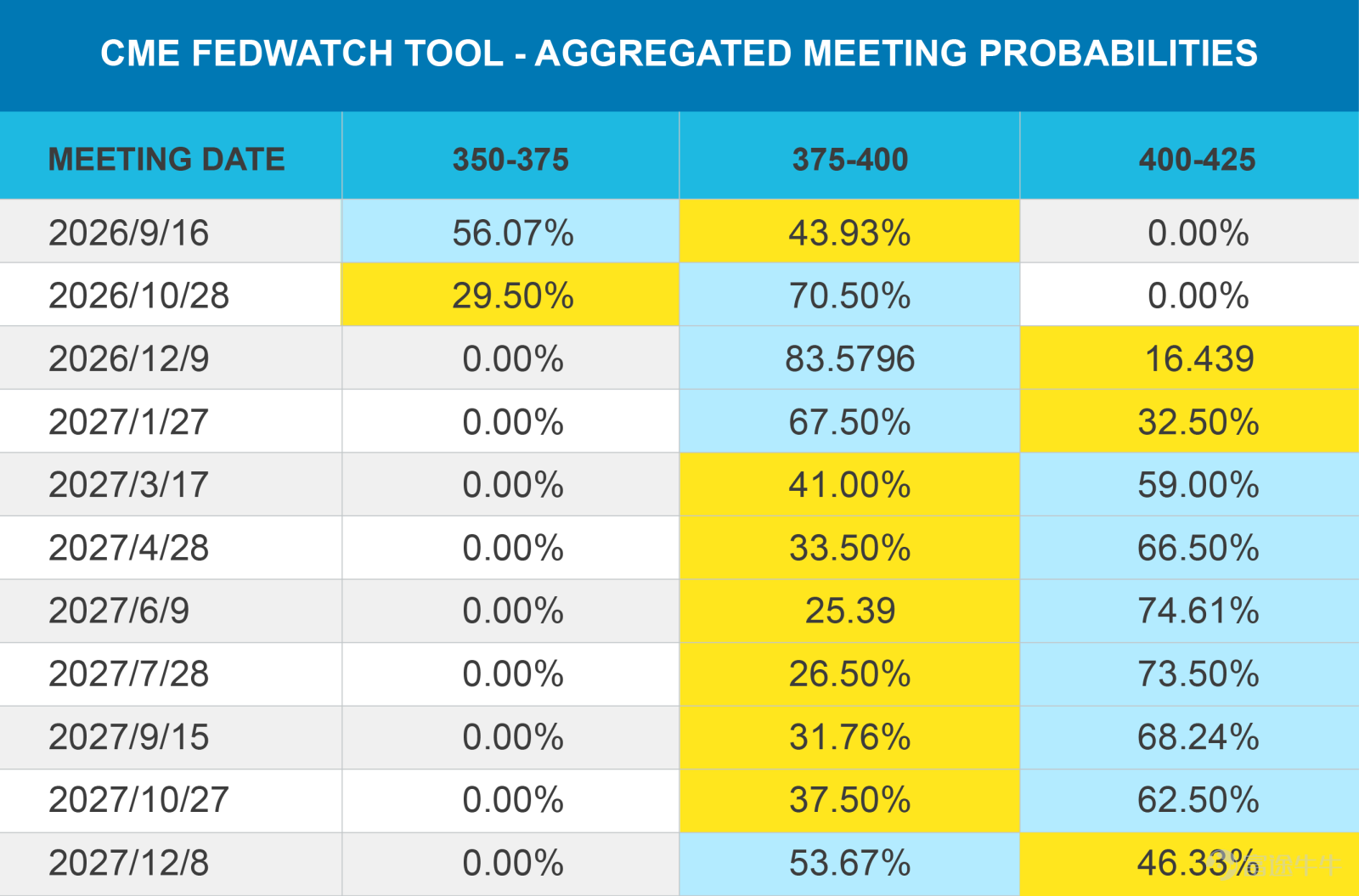
The U.S. nonfarm payroll data for July, released by the U.S. Department of Labor on August 7, came in significantly below market expectations, becoming a recent market focal point. Although nonfarm payrolls declined by 23,000 in the month—far worse than the expected gain of 80,000—data for May and June were also revised down by a combined 103,000. Following the release, both the U.S. dollar and Treasury yields weakened, and market expectations for a rate hike in September cooled noticeably. As of August 10, 2026, the CME FedWatch Tool indicated that traders in fed funds futures now see approximately a 44% probability of a rate hike on September 16; the three major U.S. equity indices $S&P 500 Index (.SPX.US)$ 、 $Dow Jones Industrial Average (.DJI.US)$ and $NASDAQ 100 Index (.NDX.US)$ all showed signs of stabilization.

(Source: CME FedWatch, as of August 10)
Underlying Signals from the Employment Data: Signs of Weakening Are Emerging
A negative nonfarm payroll reading is a relatively rare signal of labor market weakness in recent times. Combined with the substantial downward revisions to the prior two months’ data, a coherent body of evidence pointing to a cooling labor market is gradually forming. Although the unemployment rate edged down slightly to 4.1%, this improvement was primarily driven by a decline in labor force participation—as some workers exited the labor force—rather than genuine job creation. In other words, the seemingly favorable unemployment rate masks the underlying slowdown in the job market.

(Source: U.S. Department of Labor, as of August 7)
Although the nonfarm payroll figure fell far short of expectations, it did not cause significant market disruption, due to two noteworthy structural details. The government sector saw the largest job losses, shedding around 53,000 positions in the month, mostly within local government education departments. This was largely driven by seasonal factors—U.S. public schools typically reduce temporary teaching staff after summer break—and this year’s seasonal adjustment further amplified the decline, rather than reflecting large-scale structural layoffs.
Secondly, the leisure and hospitality sector was the second-largest source of job losses, shedding about 40,000 positions, partly reflecting the post-World Cup pullback in temporary employment and consumer activity. Taken together, adjustments in these two sectors appear largely temporary or technical in nature. Excluding this noise, private-sector employment still recorded modest growth, indicating that while the labor market is showing signs of cooling, it has not yet entered a broad-based collapse.
It should be noted that although short-end rate expectations have turned dovish, long-end bond yields $U.S. 10-Year Treasury Notes Yield (US10Y.BD)$ remain elevated, reflecting persistent market concerns that inflationary pressures have not fully subsided. Precisely because inflation stickiness has not been entirely eliminated, the Federal Reserve's room to further raise rates is constrained—this, in turn, highlights gold’s appeal as a traditional inflation hedge and serves as one of the key supports behind its recent strong performance.
Central Bank Gold Purchases: A Long-Term Force Building a Floor

(Source: State Administration of Foreign Exchange, as of August 7, 2026)
Reinforcing the non-farm payroll data is the People’s Bank of China’s continued gold buying. China’s gold reserves increased to 76.08 million ounces by the end of July, adding 640,000 ounces (approximately 19.9 tonnes) in the month,marking the largest monthly increase in this cycle and extending its streak of consecutive monthly purchases to 21 months.Notably, this accelerated buying occurred during a period of gold price consolidation, indicating that central banks—as price-insensitive, long-term buyers—remain firmly committed to diversifying reserves and advancing de-dollarization strategies.
Against a backdrop of recurring geopolitical tensions and lingering long-term concerns about the U.S. dollar’s credibility, the fundamental rationale for central banks’ gold purchases remains intact—and has even strengthened. Sustained official demand provides solid underlying support for gold prices and significantly increases downside resistance.
Outlook and Allocation Strategy
The core drivers of current gold prices—‘shifting rate expectations toward easing + sustained central bank buying’—are reinforcing each other simultaneously. The unexpectedly weak non-farm payroll data has opened a window for a rebound, $Gold Futures (DEC6) (GCmain.US)$$XAU/USD (XAUUSD.CFD)$ After breaking above $4,300, whether gold can further extend its upside will still hinge on whether the upcoming CPI data can resonate with labor market trends.
If subsequent inflation data continues to ease and aligns with a weakening labor market—forming an ideal combination of 'weak employment + falling inflation'—it would further solidify market expectations for monetary easing, opening up greater upside potential for gold prices. Conversely, if inflation shows strong stickiness, it could limit gold’s upward elasticity; however, under an environment of elevated long-end yields, gold’s role as an inflation hedge remains fundamentally sound.
For Hong Kong investors, amid the interplay of interest rate dynamics and geopolitical risks, allocations to gold-related assets remain worth considering. Notably, when gold prices rise, gold mining stocks often exhibit stronger price elasticity,and gold-mining ETFs can serve as one tool to capture this upside potential.Meanwhile,investors may also moderately consider high-dividend assets as a source of supplementary income, along with growth opportunities offered by AI-themed products, to achieve a balance between risk diversification and returns.。
Gold Investment Theme
According to Bloomberg data as of August 10, the Solactive Global Select Gold Mining Index currently trades at a forward P/E ratio of just 16.4x, with projected P/E ratios declining further to 11.9x in 2026 and 9.9x in 2027. Benefiting from the upward trend in gold prices, Bloomberg expects the index’s profit margin to rise from the current 18.8% to 22.5% by 2027. Based on this data,the index’s current PEG ratio stands at approximately 0.6x, indicating significant valuation upside elasticity as gold prices climb.。
E Fund Gold Miners ETF (2824)The investment objective is to closely track the performance of the Solactive Global Gold Miners Select Index, focusing on leading global gold mining companies across 30 miners from four major producing regions: China, Canada, the U.S., and Australia. During upward gold price cycles, gold mining stocks typically exhibit higher earnings elasticity than physical gold, making them a potential tool for capturing opportunities in the gold sector. However, note that the index’s volatility is generally higher than that of physical gold, and it may experience significant drawdowns when gold prices decline.
High dividend yield investment concept
Against the backdrop of non-farm payroll data showing signs of cooling in the labor market and interest rate expectations gradually shifting toward easing, the allocation value of high-dividend assets also deserves attention. Such assets typically offer income through dividends, providing a degree of yield cushion during periods of heightened market volatility and reducing overall portfolio volatility. Moreover, in an environment where inflation remains sticky and long-term bond yields stay elevated, companies with sustainable high dividend payouts often demonstrate stronger resilience to market fluctuations.helping investors balance the pursuit of income with the need for capital preservation。
iShares High Dividend Yield ETF (3483)Tracks the MSCI Asia Pacific Select High Dividend Yield Index, covering markets such as Hong Kong, Japan, and Australia, with holdings concentrated in high-dividend sectors like energy, resources, and banking. It may benefit from strong earnings supported by elevated energy prices and is suitable as a cross-regional income-oriented core holding amid concurrent geopolitical disruptions and valuation adjustments in AI-related stocks.
Hong Kong equities investment concept
Following the release of non-farm payroll data, both the U.S. dollar and Treasury yields weakened simultaneously, with interest rate expectations turning dovish—providing positive support for HKD-denominated assets. Hong Kong tech stocks currently trade at relatively low valuations, and as the market increasingly focuses in the second half of the year on the real-world implementation of AI and related supply chain opportunities, this could create room for valuation recovery and renewed investor interest in Hong Kong tech names.
iShares Hang Seng Tech Index ETF (3456)Closely tracks the Hong Kong Exchange Tech 100 Index, rapidly incorporating constituents to capture investment opportunities in six thematic areas: artificial intelligence, internet, information technology, electric vehicles and smart driving, biotech and pharmaceuticals, and robotics—focusing on leading Hong Kong-listed tech companies in these fields.
According to Bloomberg data as of August 10,the index’s primary upside drivers over the past month and past year have come from its biotechnology sector constituents, including leading companies such as $WUXI APPTEC (02359.HK)$ 、 $WUXI BIO (02269.HK)$ and $INNOVENT BIO (01801.HK)$ among others, benefiting from the rapid growth of China’s biopharmaceutical industry and the optimistic profit outlook for CRO and CXO businesses.
$HKEX Tech 100 Index (800666.HK)$$Hang Seng Index (800000.HK)$$Hang Seng TECH Index (800700.HK)$$Hang Seng Biotech Index (800805.HK)$$TENCENT (00700.HK)$$BABA-W (09988.HK)$$MEITUAN-W (03690.HK)$$XIAOMI-W (01810.HK)$$NTES (09999.HK)$$BYD COMPANY (01211.HK)$$SMIC (00981.HK)$$BEONE MEDICINES (06160.HK)$
Important Notice
This material is issued by E Fund Asset Management (Hong Kong) Company Limited. This material is for reference only and does not constitute an offer or recommendation to invest in fund units. This material is for display purposes only and must not be shown to any person in any jurisdiction where such display would be unlawful. Investing involves risks, and you may lose a substantial portion of your principal. Prior to investing, investors should carefully read the relevant investment risks described in the offering documents (including the 'Risk Factors' section) of the fund. This material has not been reviewed by the Securities and Futures Commission of Hong Kong.
iShares (Hong Kong) Solactive Global Gold Mining Select Index ETF (the “Sub-Fund”) is a sub-fund of iShares ETF Trust. The iShares ETF Trust is an umbrella unit trust established under Hong Kong law. The Sub-Fund is a passively managed ETF as defined under Chapter 8.6 of the Securities and Futures Commission (“SFC”) Code on Unit Trusts and Mutual Funds. Units of the Sub-Fund (“Units”) are traded on The Stock Exchange of Hong Kong Limited (“HKEX”) like stocks. The investment objective is to provide investment returns that closely track the performance of the Solactive Global Gold Mining Select Index (the “Index”) before fees and expenses.
Gold prices may fluctuate significantly due to changes in global supply and demand, geopolitical events, and currency movements. In addition, gold mining companies may face industry-specific risks, such as operational challenges, regulatory changes, and environmental concerns, all of which could affect their profitability regardless of gold price movements.
For detailed important notices and disclaimers regarding the above fund, please visit E Fund (Hong Kong)'s website:
Risk Disclaimer: The above content only represents the author's view. It does not represent any position or investment advice of Futu. Futu makes no representation or warranty.Read more


Comment (1)
to post a comment
10
2