Storage inventory remains tight; how much further can the super cycle go?

Focus on August 13! SanDisk’s Investor Day is here: Can the $100B+ long-term contracts, HBF, and buybacks reverse the downtrend?
At 9:00 a.m. Eastern Time on August 13 (9:00 p.m. Beijing time), $SanDisk (SNDK.US)$ the company will hold its 2026 Investor Day. This will be the most significant strategic communication since SanDisk’s spin-off from Western Digital and a critical opportunity for management to rebuild market confidence following the recent sharp pullback in its share price.
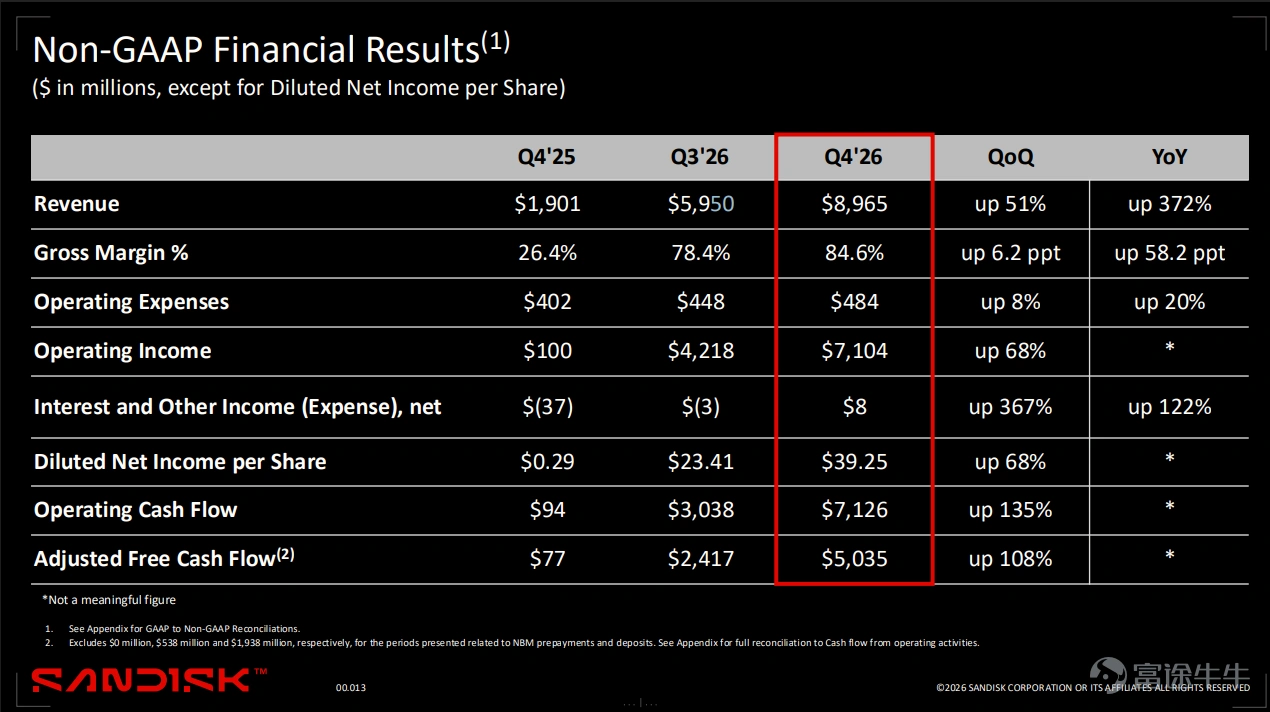
From a fundamentals perspective, SanDisk has just delivered an almost 'off-the-charts' earnings report: Q4 FY2026 revenue reached $8.965 billion, up 372% year-over-year and 51% quarter-over-quarter; non-GAAP gross margin rose to 84.6%, earnings per share (EPS) hit $39.25, and adjusted free cash flow exceeded $5 billion. Notably, data center revenue doubled sequentially to $2.977 billion, and the share of shipped bits attributable to data centers surged from 12% to 38% within just one year.
Source: SanDisk
Yet such strong results have still failed to prevent the stock price from falling. On the first trading day after the earnings release, SanDisk shares dropped as much as 13.3%, closing down more than 5%. This indicates that the market is no longer questioning whether AI memory demand exists, but is instead focused on two more pressing concerns:How long can NAND price increases last, and can SanDisk sustain its current exceptionally high profitability?
Why did the stock price fall despite earnings beating expectations?
SanDisk forecasts Q1 FY2027 revenue of $10.3–10.8 billion, non-GAAP gross margin of 83%–85%, and EPS of $44–46. While these figures remain robust, the midpoint of the gross margin guidance represents a slight decline from the prior quarter’s 84.6%, and the revenue outlook failed to meaningfully surpass the market’s 'implied expectations.'
More importantly, about one-third of SanDisk's sequential revenue growth in the fourth quarter came from higher shipment volumes, while two-thirds stemmed from price increases. In other words, current earnings growth remains heavily dependent on rising NAND prices. Should the market begin to worry about a slowdown in price appreciation, the pace of earnings upgrades could decline accordingly.
Therefore, the real objective of this Investor Day is to demonstrate that SanDisk is not merely a cyclical stock benefiting from NAND price hikes, but rather a company capable of sustaining high profitability and strong cash flow through long-term contracts, AI memory products, and technological iterations.
What are the key highlights of this Investor Day?
Highlight #1: Can nearly $100 billion in long-term contracts truly smooth out the NAND cycle?
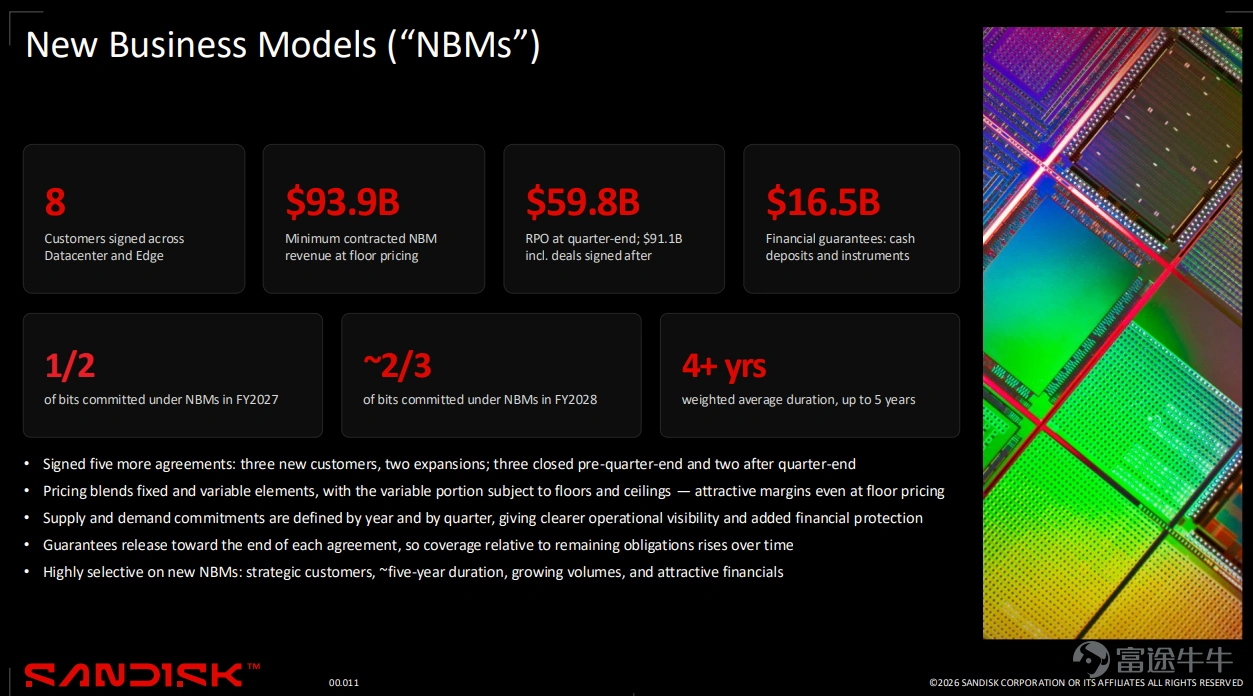
SanDisk has already signed 10 New Business Model (NBM) agreements with eight data center and edge customers, with a weighted average contract duration exceeding four years and extending up to five years.
Based on minimum pricing assumptions, these contracts represent at least $93.9 billion in guaranteed revenue. Including agreements signed after the quarter-end, the remaining performance obligations amount to $91.1 billion, backed by $16.5 billion in combined customer cash deposits and financial guarantees.
Source: SanDisk
By fiscal year 2027, more than half of bit shipments will be covered by NBMs; by fiscal year 2028, this proportion will further increase to approximately two-thirds. Management previously stated that even if these contracts are executed at their price floors, gross margins are expected to remain around 80%.
This is the most noteworthy aspect of the Investor Day.Traditional NAND companies typically enjoy windfall profits at cyclical peaks but see earnings collapse rapidly during periods of oversupply. The essence of the NBM model is trading some upside potential in the spot market for a higher earnings floor and longer-term demand visibility.
Therefore, the market needs further clarification from management on: (1) whether the ~80% gross margin for NBM can be sustained throughout the entire NAND cycle; (2) how the contract’s price caps, floors, and cost-adjustment mechanisms operate; (3) whether customers have provisions allowing them to cancel, delay, or modify purchase volumes; (4) how the minimum contracted revenue of $93.9 billion will be recognized over the coming years; and (5) whether these long-term agreements introduce new customer concentration risks.
If the company can demonstrate that NBM can maintain a gross margin close to 80% even if NAND prices decline in the future,SanDisk’s valuation thesis could shift from a 'low-multiple cyclical stock' to a 'high-cash-flow AI infrastructure company.'
Key focus #2: When will HBF transition from a technology narrative to actual revenue?
Aside from long-term contracts, HBF may be the product line with the greatest upside potential highlighted at this investor day.
HBF, or High Bandwidth Flash, is positioned as a high-capacity near-compute memory solution for the AI inference era. Compared to HBM, HBF places greater emphasis on capacity, non-volatility, and cost efficiency, making it well-suited for inference workloads such as model weights and KV cache that require frequent reads of large datasets.
A more reasonable interpretation is that HBF is not intended to fully replace HBM in the near term, but rather aims to fill the memory hierarchy gap between HBM and traditional enterprise SSDs, thereby reducing memory costs and power consumption for large-model inference.
SanDisk and SK hynix have already released the first HBF technical specification through the Open Compute Project, with Google and Tenstorrent also participating in the standard-setting process.
The biggest unknown remains the commercialization timeline.Management has already indicated that it will discuss HBF further during the investor day. The market should therefore closely monitor key milestones such as sample availability, customer validation, mass production timing, potential revenue scale, and the pricing and gross margin premium of HBF relative to traditional NAND products.
If management can provide a clear roadmap for sample delivery or volume production, HBF could become a valuation catalyst for Western Digital in its next phase; if it remains at the stage of technical concepts and customer discussions, near-term stock price upside may be limited.
Key Focus #3: Can BiCS10 sustain its cost and density advantages?
Another core technological pillar for Western Digital is BiCS.
The company has ramped BiCS8 to account for the majority of bit output and has begun recognizing revenue from its QLC Stargate platform. The newly launched 10th-generation QLC 3D NAND features a 332-layer architecture, delivering up to a 60% increase in bit density compared to the 8th generation—exceeding 37 Gb/mm²—with an interface speed of 4.8 Gb/s.
Higher density means more storage capacity can be produced from the same wafer area, helping reduce per-bit costs; higher bandwidth and improved power efficiency directly address the performance and energy demands of AI data centers.
Key questions for the Investor Day include: When will BiCS10 enter customer qualification and volume production? What are the initial yield rates and cost curves? How quickly will QLC penetrate high-capacity enterprise SSDs? And can the company sustain mid-to-high teens bit growth through process technology upgrades without significantly increasing wafer capacity?
Key Focus #4: Can free cash flow and buybacks provide stock price support?
Western Digital generated over $5 billion in adjusted free cash flow in Q4 and spent $4.5 billion to repurchase approximately 2.84 million shares. Since its spin-off, the company has received approval for $20 billion in share repurchase authorization, of which $15.5 billion remains unused.
Management stated that the company’s capital allocation priority is first to invest in the business, then return excess cash to shareholders, with a current preference for buybacks over dividends.
Investors should watch whether the company announces a more specific buyback cadence and long-term free cash flow targets at Investor Day. If Western Digital can consistently generate substantial free cash flow while maintaining capital expenditures at around 6% of revenue, buybacks could become more than just a short-term floor-support mechanism—they could also serve as a key driver of earnings-per-share growth.
Three possible scenarios for the upcoming Investor Day
Bull case:The company announces clear medium- to long-term targets for revenue, gross margin, and free cash flow, confirms that NBM gross margins can stabilize around 80%, and provides a timeline for HBF sampling or mass production. This would reinforce the narrative of 'structurally improved profitability' and could drive a valuation recovery.
Base-case scenario:Management largely reiterates existing talking points on AI demand, long-term contracts, and the current product roadmap but offers little new quantitative guidance. Fundamentals remain strong, but the Investor Day may provide limited near-term catalysts, potentially leading to continued high-level stock price volatility.
Bear case:The company signals that gross margins will gradually normalize, that NBM contract terms offer less protection than the market expected, that HBF commercialization is still distant, and that capital expenditures and inventory requirements are rising. The market may continue to lower earnings expectations, raising the risk of a second leg down in the stock price.
Conclusion
This Investor Day is not just another ordinary product launch event,but rather more akin to a 'defense session' for SanDisk’s valuation thesis.
The market already understands that AI is driving NAND demand and knows that SanDisk’s current profitability is very strong. What needs to be proven now is:Even if the 84.6% gross margin represents a short-term peak, can the company permanently raise its earnings floor?
For SanDisk, the key may not be pushing gross margins even higher from 84.6%, but rather demonstrating that a contracted gross margin of approximately 80% can be sustained for multiple years. The former reflects a cyclical peak; the latter could signal a structural shift in the business model.
If management can substantiate this with long-term financial targets, detailed NBM contract terms, and an HBF commercialization timeline, the recent pullback could mark the start of a valuation reset. However, if the Investor Day merely repeats the message of 'strong AI demand' without providing sufficient new metrics, market concerns about peak earnings may persist.
Risk Disclaimer: The above content only represents the author's view. It does not represent any position or investment advice of Futu. Futu makes no representation or warranty.Read more


Comments (5)
to post a comment
71
227