English
Back
Open Account
HK Stock Market Barometer | HK stocks continue to fluctuate and pull back! How much room for recover

牛牛課堂
joined discussion · Aug 11 10:11 ·

Saying goodbye to the 'food delivery index'? Hang Seng Tech may undergo its biggest-ever overhaul, with AI and hardware stocks taking center stage?

In recent years, $Hang Seng TECH Index (800700.HK)$ although bearing the name 'tech,' its actual weighting has long been concentrated in internet platforms. As competition intensifies in food delivery, e-commerce, and local services,the index was even jokingly dubbed the 'food delivery index' by investors.
But that label may soon become a thing of the past.
On the evening of August 10, Hang Seng Indexes Company announced it is seeking market feedback on proposed revisions to the Hang Seng Tech Index. The proposed changes include expanding the number of constituent stocks from 30 to 50 and elevating artificial intelligence as an independent theme, while also opening inclusion pathways for emerging tech firms in advanced hardware, robotics, aerospace, quantum computing, and other fields.
If implemented, this would mark the most systematic and structurally significant reform since the launch of the Hang Seng Tech Index. More importantly, as of the end of June this year, global assets under management tracking this index had already reached USD 40.4 billion. Any adjustment to index constituents and weightings will trigger concentrated rebalancing by related passive funds.
Over the past few years, $Hang Seng TECH Index (800700.HK)$ although bearing the name 'tech,' its actual weighting has long been concentrated in internet platforms. As competition intensifies in food delivery, e-commerce, and local services, the index was even jokingly dubbed the 'food delivery index' by investors. But that label may soon become a thing of the past. On the evening of August 10, Hang Seng Indexes Company announced it is seeking market feedback on proposed revisions to the Hang Seng Tech Index. The proposed changes not only aim to expand the number of constituents from 30 to 50 but also elevate artificial intelligence (AI) as an independent theme and open inclusion pathways for emerging tech firms in advanced hardware, robotics, aerospace, and quantum computing. If implemented, this would mark the most comprehensive and structurally significant reform since the index's launch. More importantly, as of the end of June this year, global assets under management in funds tracking this index had already reached USD 40.4 billion. Any adjustment to index constituents or weightings would trigger significant rebalancing by passive funds. Why is Hang Seng Tech undergoing reform? The Hang Seng Tech Index was launched in 2020, originally designed to track the 30 largest tech companies listed in Hong Kong. However, the composition of Hong Kong’s tech sector has changed significantly over the past few years. On one hand, internet platforms still account for a significant weighting, making the index performance heavily influenced by just a few business segments such as e-commerce, food delivery, and gaming; on the other hand, the Hong Kong stock market is welcoming more companies in artificial intelligence, semiconductors, robotics, advanced manufacturing, and...
Why is the Hang Seng Tech Index undergoing reform?
The Hang Seng Tech Index was launched in 2020, originally designed to track the 30 largest tech companies listed in Hong Kong by market capitalization. However, the composition of the tech sector in the Hong Kong market has changed significantly over the past few years.
On one hand, internet platforms still hold substantial weight, causing index performance to be easily dominated by just a few business lines like e-commerce, food delivery, and gaming; on the other hand, the Hong Kong market is seeing an influx of companies in artificial intelligence, semiconductors, robotics, advanced manufacturing, and specialized technology—yet these firms generally have shorter listing histories and relatively smaller market caps, making it difficult for them to enter the index through traditional market-cap-based rankings.
This has led to an increasingly evident issue: while the Hang Seng Tech Index can represent Hong Kong-listed internet giants, it may not fully reflect the latest wave of technological industry trends in the Hong Kong market.
Especially against the backdrop of the rapid expansion of the AI industry chain, if the index continues to select constituents primarily based on market capitalization, high-growth companies that have not yet achieved large market caps risk being excluded. Therefore, the core objective of this reform is to evolve the Hang Seng Tech Index from a basket of 'internet leaders' into a comprehensive tech index covering platforms, AI, hardware, robotics, and frontier technologies.
Over the past few years, $Hang Seng TECH Index (800700.HK)$ although bearing the name 'tech,' its actual weighting has long been concentrated in internet platforms. As competition intensifies in food delivery, e-commerce, and local services, the index was even jokingly dubbed the 'food delivery index' by investors. But that label may soon become a thing of the past. On the evening of August 10, Hang Seng Indexes Company announced it is seeking market feedback on proposed revisions to the Hang Seng Tech Index. The proposed changes not only aim to expand the number of constituents from 30 to 50 but also elevate artificial intelligence (AI) as an independent theme and open inclusion pathways for emerging tech firms in advanced hardware, robotics, aerospace, and quantum computing. If implemented, this would mark the most comprehensive and structurally significant reform since the index's launch. More importantly, as of the end of June this year, global assets under management in funds tracking this index had already reached USD 40.4 billion. Any adjustment to index constituents or weightings would trigger significant rebalancing by passive funds. Why is Hang Seng Tech undergoing reform? The Hang Seng Tech Index was launched in 2020, originally designed to track the 30 largest tech companies listed in Hong Kong. However, the composition of Hong Kong’s tech sector has changed significantly over the past few years. On one hand, internet platforms still account for a significant weighting, making the index performance heavily influenced by just a few business segments such as e-commerce, food delivery, and gaming; on the other hand, the Hong Kong stock market is welcoming more companies in artificial intelligence, semiconductors, robotics, advanced manufacturing, and...
Three major reforms: thematic expansion, constituent count increased to 50, and introduction of a revenue growth criterion
This revision primarily involves three key changes.
First is a comprehensive expansion of eligible tech themes.
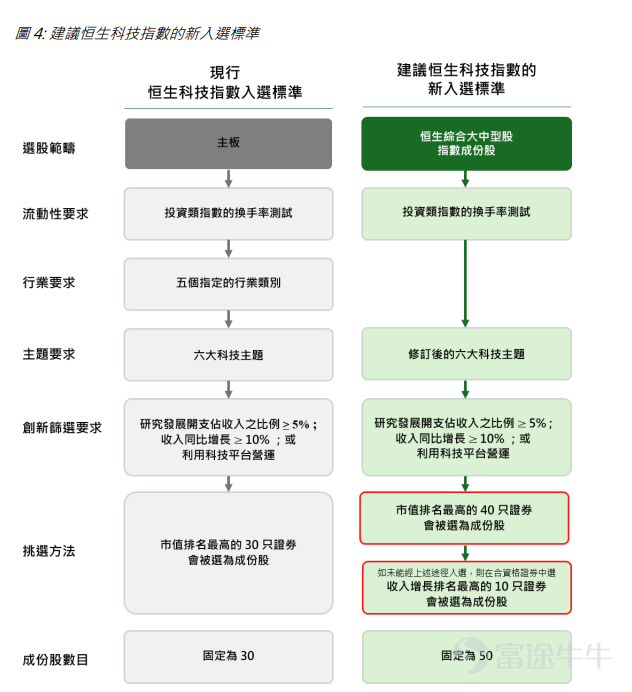
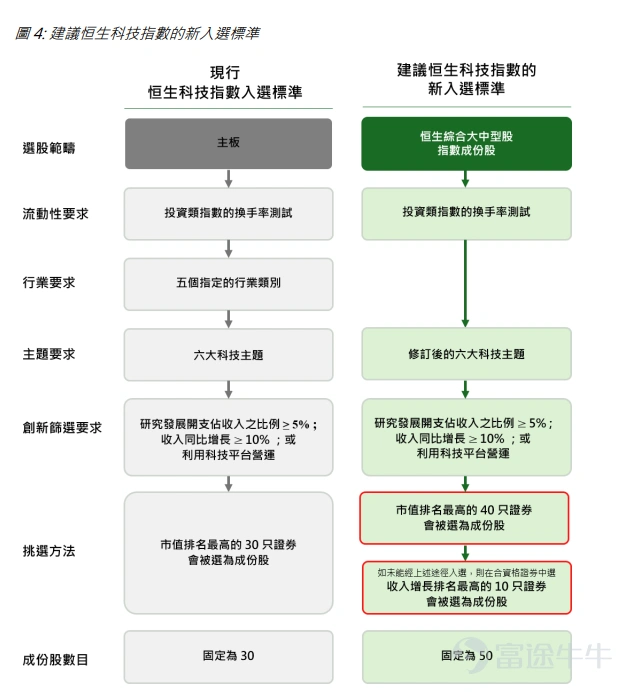
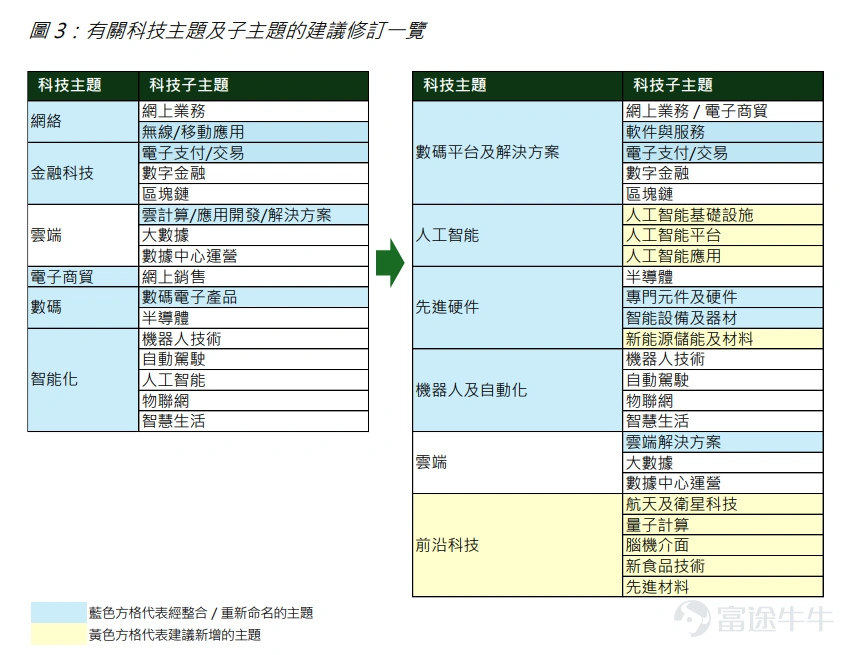
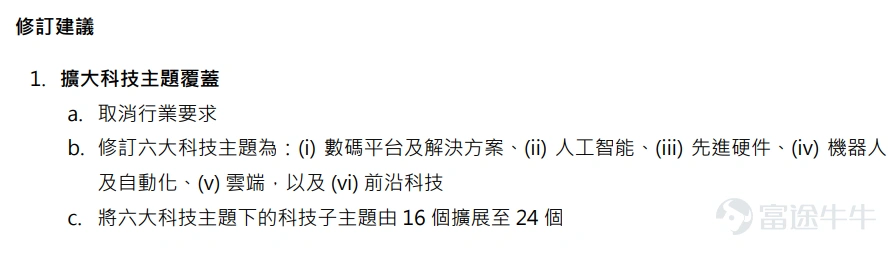
The new proposal recommends removing the previous industry classification restrictions and redefining tech themes into six categories: Digital Platforms & Solutions, Artificial Intelligence, Advanced Hardware, Robotics & Automation, Cloud Computing, and Frontier Technologies.
Among these, Artificial Intelligence will be formally upgraded from a sub-theme to an independent theme, while Frontier Technologies is a newly added category encompassing emerging fields such as aerospace and satellite technology, quantum computing, and brain-computer interfaces. The number of tech sub-themes will also increase from 16 to 24, with new inclusions such as AI infrastructure, new energy storage, and advanced materials.
Over the past few years, $Hang Seng TECH Index (800700.HK)$ although bearing the name 'tech,' its actual weighting has long been concentrated in internet platforms. As competition intensifies in food delivery, e-commerce, and local services, the index was even jokingly dubbed the 'food delivery index' by investors. But that label may soon become a thing of the past. On the evening of August 10, Hang Seng Indexes Company announced it is seeking market feedback on proposed revisions to the Hang Seng Tech Index. The proposed changes not only aim to expand the number of constituents from 30 to 50 but also elevate artificial intelligence (AI) as an independent theme and open inclusion pathways for emerging tech firms in advanced hardware, robotics, aerospace, and quantum computing. If implemented, this would mark the most comprehensive and structurally significant reform since the index's launch. More importantly, as of the end of June this year, global assets under management in funds tracking this index had already reached USD 40.4 billion. Any adjustment to index constituents or weightings would trigger significant rebalancing by passive funds. Why is Hang Seng Tech undergoing reform? The Hang Seng Tech Index was launched in 2020, originally designed to track the 30 largest tech companies listed in Hong Kong. However, the composition of Hong Kong’s tech sector has changed significantly over the past few years. On one hand, internet platforms still account for a significant weighting, making the index performance heavily influenced by just a few business segments such as e-commerce, food delivery, and gaming; on the other hand, the Hong Kong stock market is welcoming more companies in artificial intelligence, semiconductors, robotics, advanced manufacturing, and...
This means the future Hang Seng Tech Index will no longer solely reflect competition among internet platforms but could also capture trends across AI computing power, semiconductor hardware, robotics, commercial spaceflight, and other sectors.
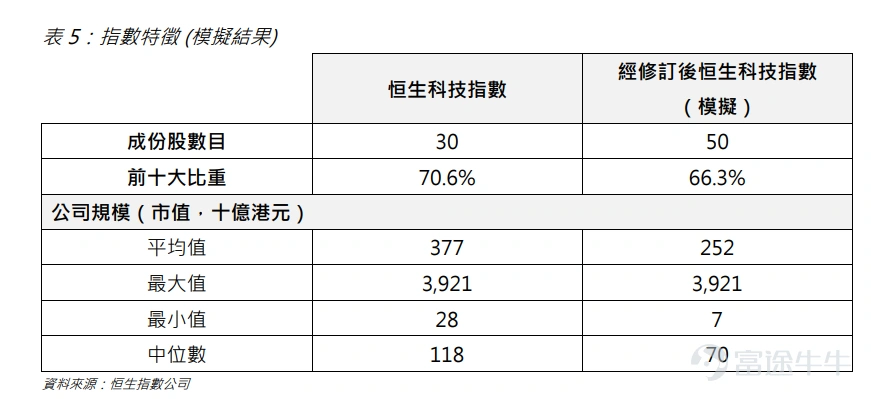
Second, the number of constituents will increase from 30 to 50.
Following this expansion, the index’s reliance on a handful of internet giants is expected to decline. According to simulations by Hang Seng Indexes Company, the combined weighting of the top 10 constituents will decrease from the current 70.6% to 66.3%. While the dominant position of leading companies will remain intact, the index’s sector diversification and individual stock risk exposure will become more balanced.
Over the past few years, $Hang Seng TECH Index (800700.HK)$ although bearing the name 'tech,' its actual weighting has long been concentrated in internet platforms. As competition intensifies in food delivery, e-commerce, and local services, the index was even jokingly dubbed the 'food delivery index' by investors. But that label may soon become a thing of the past. On the evening of August 10, Hang Seng Indexes Company announced it is seeking market feedback on proposed revisions to the Hang Seng Tech Index. The proposed changes not only aim to expand the number of constituents from 30 to 50 but also elevate artificial intelligence (AI) as an independent theme and open inclusion pathways for emerging tech firms in advanced hardware, robotics, aerospace, and quantum computing. If implemented, this would mark the most comprehensive and structurally significant reform since the index's launch. More importantly, as of the end of June this year, global assets under management in funds tracking this index had already reached USD 40.4 billion. Any adjustment to index constituents or weightings would trigger significant rebalancing by passive funds. Why is Hang Seng Tech undergoing reform? The Hang Seng Tech Index was launched in 2020, originally designed to track the 30 largest tech companies listed in Hong Kong. However, the composition of Hong Kong’s tech sector has changed significantly over the past few years. On one hand, internet platforms still account for a significant weighting, making the index performance heavily influenced by just a few business segments such as e-commerce, food delivery, and gaming; on the other hand, the Hong Kong stock market is welcoming more companies in artificial intelligence, semiconductors, robotics, advanced manufacturing, and...
Third, and the most critical reform, is the introduction of a revenue growth metric in addition to market capitalization.
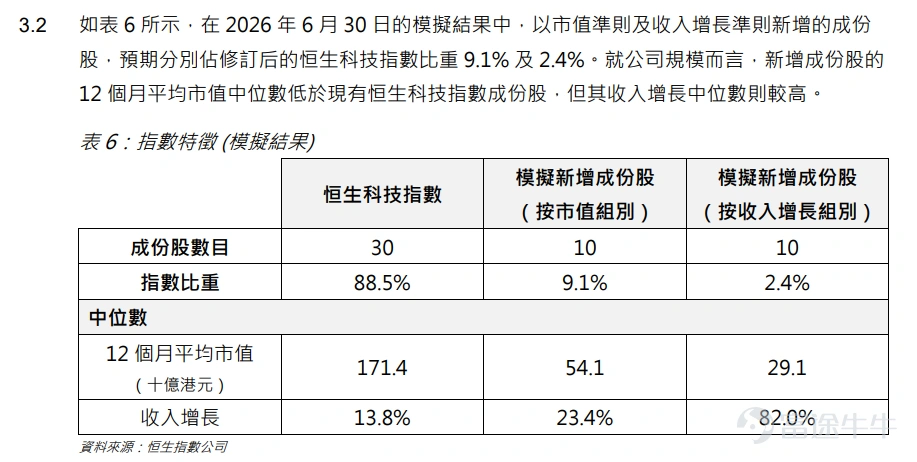
Under the new mechanism, 40 of the 50 constituent stocks will still be selected based on market cap rankings; the remaining 10 slots will be filled by companies that did not qualify via the market cap criterion, ranked instead by their revenue growth over the past 12 months.
Simulation results show that the median revenue growth rate of these 10 'revenue growth group' constituents is as high as 82%, significantly exceeding the 23.4% for newly added market-cap-based constituents and far surpassing the 13.8% of existing index constituents.
Over the past few years, $Hang Seng TECH Index (800700.HK)$ although bearing the name 'tech,' its actual weighting has long been concentrated in internet platforms. As competition intensifies in food delivery, e-commerce, and local services, the index was even jokingly dubbed the 'food delivery index' by investors. But that label may soon become a thing of the past. On the evening of August 10, Hang Seng Indexes Company announced it is seeking market feedback on proposed revisions to the Hang Seng Tech Index. The proposed changes not only aim to expand the number of constituents from 30 to 50 but also elevate artificial intelligence (AI) as an independent theme and open inclusion pathways for emerging tech firms in advanced hardware, robotics, aerospace, and quantum computing. If implemented, this would mark the most comprehensive and structurally significant reform since the index's launch. More importantly, as of the end of June this year, global assets under management in funds tracking this index had already reached USD 40.4 billion. Any adjustment to index constituents or weightings would trigger significant rebalancing by passive funds. Why is Hang Seng Tech undergoing reform? The Hang Seng Tech Index was launched in 2020, originally designed to track the 30 largest tech companies listed in Hong Kong. However, the composition of Hong Kong’s tech sector has changed significantly over the past few years. On one hand, internet platforms still account for a significant weighting, making the index performance heavily influenced by just a few business segments such as e-commerce, food delivery, and gaming; on the other hand, the Hong Kong stock market is welcoming more companies in artificial intelligence, semiconductors, robotics, advanced manufacturing, and...
This effectively creates a fast track for a group of tech companies whose market caps are not yet large enough but whose businesses are expanding rapidly. The Hang Seng Tech Index’s stock selection logic will thus shift from solely rewarding 'large companies' to balancing both 'large market cap' and 'high growth.'
Who benefits the most? Advanced hardware and AI are expected to become the main themes driving index expansion.
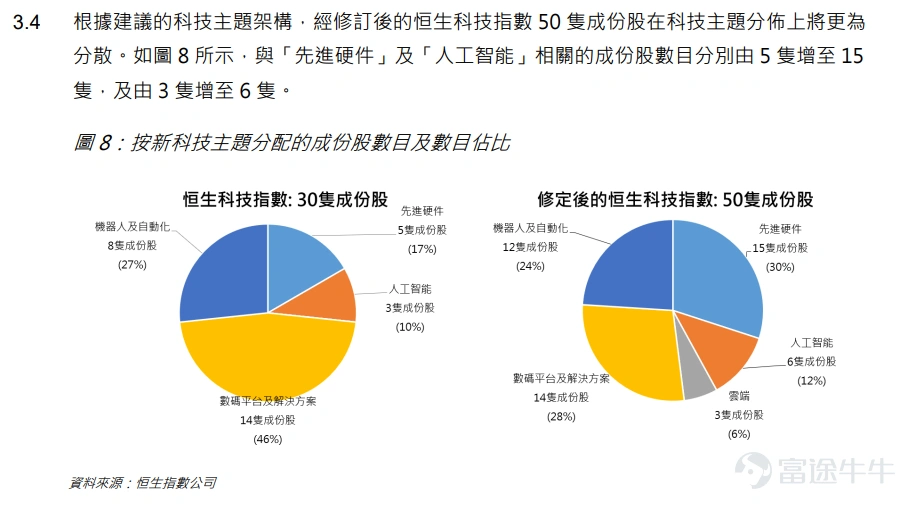
According to simulation results, the most immediate beneficiaries of this reform are not traditional internet platforms, but companies related to advanced hardware and artificial intelligence.
Post-reform, the number of constituents related to advanced hardware is expected to increase from 5 to 15, while AI-related constituents will rise from 3 to 6. Companies in robotics, automation, AI infrastructure, and frontier technologies will also gain greater inclusion potential in the index.
Over the past few years, $Hang Seng TECH Index (800700.HK)$ although bearing the name 'tech,' its actual weighting has long been concentrated in internet platforms. As competition intensifies in food delivery, e-commerce, and local services, the index was even jokingly dubbed the 'food delivery index' by investors. But that label may soon become a thing of the past. On the evening of August 10, Hang Seng Indexes Company announced it is seeking market feedback on proposed revisions to the Hang Seng Tech Index. The proposed changes not only aim to expand the number of constituents from 30 to 50 but also elevate artificial intelligence (AI) as an independent theme and open inclusion pathways for emerging tech firms in advanced hardware, robotics, aerospace, and quantum computing. If implemented, this would mark the most comprehensive and structurally significant reform since the index's launch. More importantly, as of the end of June this year, global assets under management in funds tracking this index had already reached USD 40.4 billion. Any adjustment to index constituents or weightings would trigger significant rebalancing by passive funds. Why is Hang Seng Tech undergoing reform? The Hang Seng Tech Index was launched in 2020, originally designed to track the 30 largest tech companies listed in Hong Kong. However, the composition of Hong Kong’s tech sector has changed significantly over the past few years. On one hand, internet platforms still account for a significant weighting, making the index performance heavily influenced by just a few business segments such as e-commerce, food delivery, and gaming; on the other hand, the Hong Kong stock market is welcoming more companies in artificial intelligence, semiconductors, robotics, advanced manufacturing, and...
Therefore, market focus going forward will not only center on which companies make it into the list of 50 constituents, but also on three potential shifts:
First, high-growth companies already listed but excluded from the Hang Seng Tech Index due to insufficient market cap; second, AI and hardware firms currently assigned low weights but likely to gain higher representation due to thematic expansion; third, existing internet giants whose weights may be passively diluted as the index expands.
However, this does not mean the Hang Seng Tech Index will completely abandon internet giants. Large-cap companies such as Tencent, Alibaba, Xiaomi, and Meituan will remain core holdings of the index.This reform appears to add another layer of exposure to AI, hardware, and cutting-edge technologies beyond internet platforms.
In other words, the Hang Seng Tech Index is not transforming overnight from an 'internet index' into an 'AI index,' but rather evolving from a highly concentrated platform-centric index into a more balanced, diversified technology index.
How will the $40.4 billion in assets be rebalanced?
As of the end of June this year, the global assets under management (AUM) of funds tracking the Hang Seng Tech Index had reached $40.4 billion, a nearly 26-fold increase from the $1.5 billion at its launch in 2020.
There are currently 13 ETFs tracking the Hang Seng Tech Index in the domestic market, with a combined AUM of RMB 163.645 billion. Among them, ChinaAMC Hang Seng Tech ETF holds approximately RMB 43.175 billion, Huatai-Peaceful Hang Seng Tech ETF about RMB 34.52 billion, and related ETFs from E Fund, Da Cheng, Tianhong, and GF Securities each exceed RMB 10 billion.
Once the new methodology is officially implemented, relevant ETFs and index funds will need to adjust their portfolios in line with the new constituents and weightings. Companies newly added with relatively high initial weights may see concentrated passive buying, while those removed or downweighted could face corresponding selling pressure.
However, it should be noted that the $40.4 billion represents the total AUM tracking the index and does not imply that all funds will trade on the rebalancing date. The actual amount rebalanced depends on the final constituent list, changes in individual stock weights, and the replication methodology used by each fund.
Therefore, prior to the official announcement of the new constituents, market trading will likely center on 'inclusion expectations'; after the announcement, focus will shift toward 'scale of passive inflows' and 'trading impact on the rebalancing day.'
According to the current timeline, the revised index composition is expected to be announced at the end of September this year, with changes taking effect on the official index review date in December. Over the coming months, index inclusion trades around potential new members may gradually gain momentum.

Over the past few years, $Hang Seng TECH Index (800700.HK)$ although bearing the name 'tech,' its actual weighting has long been concentrated in internet platforms. As competition intensifies in food delivery, e-commerce, and local services, the index was even jokingly dubbed the 'food delivery index' by investors. But that label may soon become a thing of the past. On the evening of August 10, Hang Seng Indexes Company announced it is seeking market feedback on proposed revisions to the Hang Seng Tech Index. The proposed changes not only aim to expand the number of constituents from 30 to 50 but also elevate artificial intelligence (AI) as an independent theme and open inclusion pathways for emerging tech firms in advanced hardware, robotics, aerospace, and quantum computing. If implemented, this would mark the most comprehensive and structurally significant reform since the index's launch. More importantly, as of the end of June this year, global assets under management in funds tracking this index had already reached USD 40.4 billion. Any adjustment to index constituents or weightings would trigger significant rebalancing by passive funds. Why is Hang Seng Tech undergoing reform? The Hang Seng Tech Index was launched in 2020, originally designed to track the 30 largest tech companies listed in Hong Kong. However, the composition of Hong Kong’s tech sector has changed significantly over the past few years. On one hand, internet platforms still account for a significant weighting, making the index performance heavily influenced by just a few business segments such as e-commerce, food delivery, and gaming; on the other hand, the Hong Kong stock market is welcoming more companies in artificial intelligence, semiconductors, robotics, advanced manufacturing, and...
What the Hang Seng Tech Index is truly moving beyond is not just the 'food delivery index.'
On the surface, this reform involves expanding the index and adjusting stock selection rules, but it reflects a deeper shift in the composition of Hong Kong’s tech assets.
In the past, the core holdings of Hong Kong’s tech sector were primarily internet platforms; going forward, companies in artificial intelligence, advanced hardware, robotics, and frontier technologies are expected to play an increasingly important role. If the Hang Seng Tech Index remains confined to its existing framework, its market representativeness will inevitably decline over time.
Thus, what this reform truly aims to address is not merely shedding the nickname 'takeout index,' but rather answering a more fundamental question: what kind of companies should represent the future of Hong Kong’s tech sector?
Based on the current proposal, the Hang Seng Tech Index is attempting to offer a new answer—retaining the scale advantage of leading internet firms while also making room for AI, hardware, and high-growth companies.
If the reform is ultimately implemented, the trading logic behind the Hang Seng Tech Index could also shift: moving from primarily betting on valuation recovery of internet platforms toward simultaneously trading internet cash flows, AI growth potential, and the cyclical strength of advanced hardware.
This may well be the most profound impact of this historic overhaul on the pricing of Hong Kong’s tech assets.
Risk Disclaimer: The above content only represents the author's view. It does not represent any position or investment advice of Futu. Futu makes no representation or warranty.Read more
Emm
1
Thumbs Up
57
Respect
2
Sob
1
Lol
2
Heart
1
80K Views
Report
Comments (52)
Write a Comment...
52
64
293