Positioning for Global Technology Innovation Opportunities: An In-Depth Analysis of the Nasdaq-100 Index
Throughout the long-term development of global financial markets, technological innovation has consistently remained a focal point for investors. As one of the primary broad-based indices encompassing leading overseas innovative listed companies, the Nasdaq-100 Index has long been a core asset of interest for global investors.
I. Objective Index Construction Methodology
The index was launched on January 31, 1985, and its methodology follows clear and objective market criteria:
• Tracks the 100 largest U.S. and international non-financial companies listed on Nasdaq.
• Constructed using a modified market-capitalization weighting methodology, excluding all financial firms. Index constituents lead in terms of market capitalization and liquidity, and the index features regular rebalancing and dynamic inclusion/exclusion mechanisms.
II. Constituents Concentrated in Core Technology Sectors, Reflecting AI and Digital Transformation Trends
Although the index’s construction rules rely objectively on 'market capitalization and liquidity' for stock selection, decades of rapid global digitalization and technological advancement have led to a pronounced concentration of constituents in technology and innovation-driven industries:
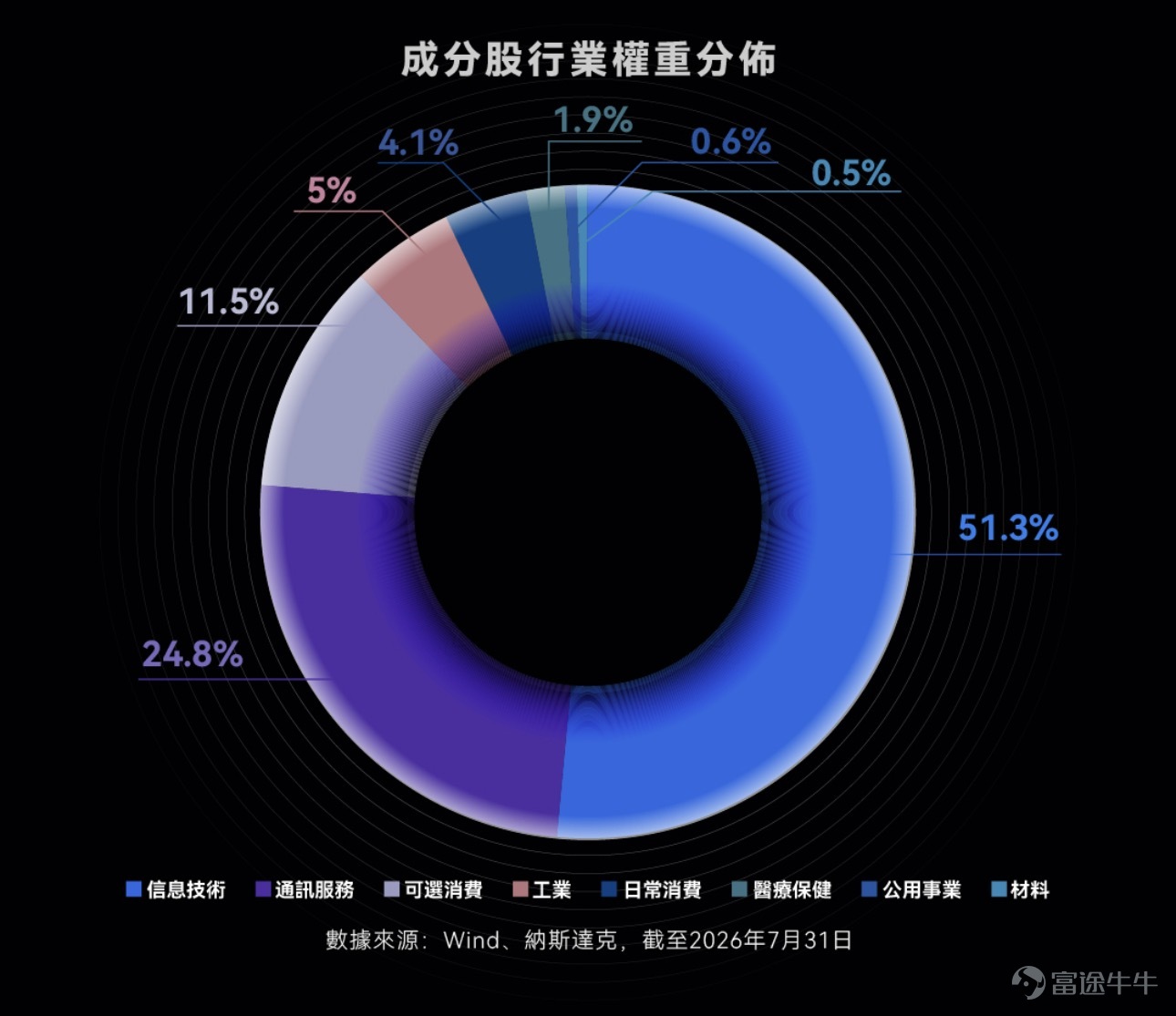
• Relatively concentrated sector allocation: The Nasdaq-100 Index is currently heavily weighted toward information technology, communication services, and consumer discretionary sectors—three areas that together account for 87.6%* of the index’s total weight.

• Bringing together leading global technology companies: From a holdings perspective, the index includes representative global tech giants such as NVIDIA (NVDA), Apple (AAPL), Microsoft (MSFT), Micron Technology (MU), Amazon (AMZN), Advanced Micro Devices (AMD), Alphabet (GOOGL), Meta, and Broadcom (AVGO)*. These companies, backed by deep competitive moats and core technological expertise, serve as key drivers behind the global transformation in artificial intelligence and the digital economy.

*Data sources: Index sector weightings and constituent stock information are sourced from Wind and Nasdaq, as of July 31, 2026. Investing involves risks. Historical data is provided for reference only and may be adjusted in response to market changes.
III. Cross-border asset synergy to optimize portfolio risk-return profile
Long-term historical data shows that the Nasdaq-100 Index has exhibited low correlation with China A-share and Hong Kong equity markets (the rolling 10-year correlation coefficient has consistently remained within the 0.1–0.3 range). By allocating assets across multiple markets, investors can diversify their portfolio structure and reduce exposure to volatility in any single market.

Data source: Wind; data period: January 1, 2010 – May 29, 2026; correlations calculated using a rolling three-year window

👉Bosera Nasdaq-100 Index Fund
✨One-click access to global technology leaders
Important Notices:
• Investing involves risks. Past performance does not guarantee future results.
• The Bosera Nasdaq 100 Index Fund (the “Sub-Fund”) is a sub-fund of Bosera Global Public Fund Open-Ended Fund Company (the “Company”). The Company has been registered with the Securities and Futures Commission (“SFC”) as an open-ended fund company, and both the Company and the Sub-Fund have been authorized by the SFC under Section 104 of the Securities and Futures Ordinance. Such registration or authorization by the SFC does not constitute a recommendation or endorsement of the Company or the Sub-Fund, nor does it guarantee their commercial viability or performance.
• Investors should be aware of investment risks, including but not limited to: investment risk—the value of the Sub-Fund’s portfolio may decline, and there is no assurance that the value of the investment will increase; equity market risk—investments in equity securities are subject to general market risks, and their values may fluctuate due to various factors; geographic concentration risk—the Sub-Fund primarily invests in companies listed in the United States with business operations related to the technology sector, making the Sub-Fund potentially more susceptible to economic, political, policy, foreign exchange, liquidity, tax, legal, or regulatory events in the United States; sector concentration risk; currency risk; RMB currency risk and RMB-denominated share class risk; passive investment risk; tracking error risk; termination risk; risks associated with distributions made from or effectively from capital; and risks related to securities lending transactions.
• The Sub-Fund is exposed to sector concentration risk, as its investments may at times be concentrated in companies within specific sectors. Compared with funds holding more diversified portfolios, the Sub-Fund’s value may exhibit greater volatility. In particular, the index constituents (and thus the Sub-Fund’s investments) are concentrated in technology sector companies, whose price performance tends to be more volatile than that of companies in other economic sectors. Companies in the technology sector generally face intense domestic and international competition, which could adversely affect their profit margins.
• Distributions from the Sub-Fund may be paid out of capital or effectively out of capital, which amounts to investors receiving a return of part of their original investment or a withdrawal of part of their original investment or capital gains attributable thereto. Such distributions may result in an immediate reduction in the net asset value per unit. A positive distribution yield does not imply a positive return.
• The above information is not exhaustive. Investors should not base their investment decisions solely on the information contained herein. Prior to making any investment decision, investors should carefully read the relevant offering memorandum and product highlights sheet for the Sub-Fund (including the product features and risk factors described therein).
Disclaimer:
This document is for reference purposes only and does not constitute investment advice or an offer or solicitation to buy or sell any investment product. Investing involves risks. Past performance is not indicative of future results. The value of investments and the income from them may go up or down, and future performance or capital value is not guaranteed. Bosera Fund Management (International) Limited (“Bosera International”) believes that the data sources used in preparing this document are accurate, complete, and appropriate. However, Bosera International makes no representation or warranty as to the accuracy or completeness of the information contained herein. Bosera International shall not be liable for any legal consequences arising from the use of such data. This document is not intended for distribution or dissemination in any jurisdiction where such action is prohibited. This material has not been reviewed by the Securities and Futures Commission of Hong Kong and is issued and copyrighted by Bosera Fund Management (International) Limited.
Index Provider Disclaimer:
This fund is not sponsored, endorsed, sold, or promoted by Nasdaq, Inc. or its affiliates (collectively, “Nasdaq”). Nasdaq has not passed on the legality or suitability of the fund, nor has it reviewed the accuracy or adequacy of the fund’s description or disclosures. Nasdaq makes no express or implied representations or warranties to fund shareholders or the public regarding the advisability of investing generally in securities or specifically in the fund, or regarding the ability of the index to track the overall stock market. The only relationship between Nasdaq and the fund manager or the issuer is the licensing of certain trademarks and trade names of Nasdaq, including Nasdaq®, and the use of indexes determined, compiled, and calculated by Nasdaq without regard to the licensees or the fund. Nasdaq has no obligation to take into account the needs of the fund manager or the fund’s shareholders in determining, compiling, or calculating the index. Nasdaq has no responsibility for, and does not participate in, determining the timing, price, or quantity of fund issuance, or in establishing or calculating any formula for converting fund units into cash. Nasdaq assumes no responsibility related to the management, marketing, or trading of the fund.
These companies do not guarantee the accuracy and/or uninterrupted calculation of the index or any data contained therein. These companies make no express or implied warranties regarding the results obtained by any licensee, sub-fund holder, or any other person or entity from the use of the index or any data contained therein. These companies disclaim all express or implied warranties, including but not limited to those of merchantability or fitness for a particular purpose or use, with respect to the index or any data contained therein. Without limiting the foregoing, in no event shall these companies be liable for any loss of profits or any special, incidental, punitive, indirect, or consequential damages, even if advised of the possibility of such damages.
$Micron Technology (MU.US)$ $SK hynix (SKHY.US)$ $Dow Jones Industrial Average (.DJI.US)$ $SanDisk (SNDK.US)$ $S&P 500 Index (.SPX.US)$ $NASDAQ 100 Index (.NDX.US)$ $NVIDIA (NVDA.US)$ $Apple (AAPL.US)$ $Alphabet-C (GOOG.US)$ $Alphabet-A (GOOGL.US)$ $Tesla (TSLA.US)$ $Advanced Micro Devices (AMD.US)$ $Microsoft (MSFT.US)$ $Amazon (AMZN.US)$
Risk Disclaimer: The above content only represents the author's view. It does not represent any position or investment advice of Futu. Futu makes no representation or warranty.Read more


Comment (1)
to post a comment
4
4