Technology Research Institute: CPI data is about to be released! What opportunities are there amid t

Daily Options Income Strategy | PC Hardware Leader HP Inc Reclaims $30, Hits Year-to-Date High—How to Capture Volatility Premium?
I. Market Barometer
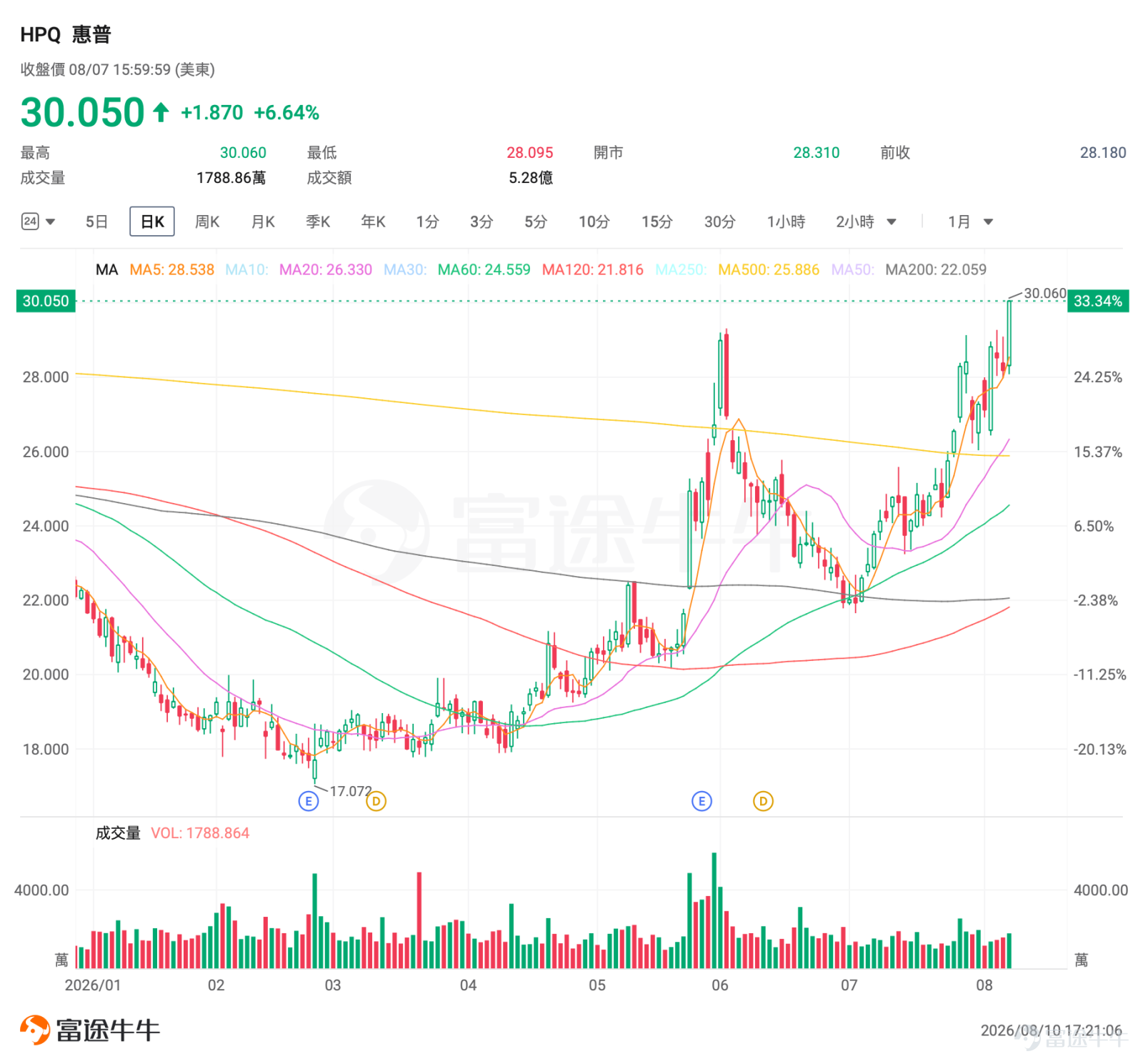
U.S. equity sectors showed clear divergence in the previous trading session, with precious metals and aerospace among the strongest performers. However, rising expectations of higher electronics prices—fueled by an AI-driven device replacement cycle—continued to gain traction, driving capital into leading PC hardware companies, $HP Inc (HPQ.US)$ which rose 6.64% to close above $30. The combination of high volatility and elevated implied volatility (IV) has created a rare premium window for options sellers.
II. Watchlist Highlights
$HP Inc (HPQ.US)$ On the previous trading day (Friday, August 7, 2026), the stock gained 6.64%, closing at $30.05 with a trading volume of $528 million.The company’s share price has rebounded nearly 70% since its low point at the end of February.
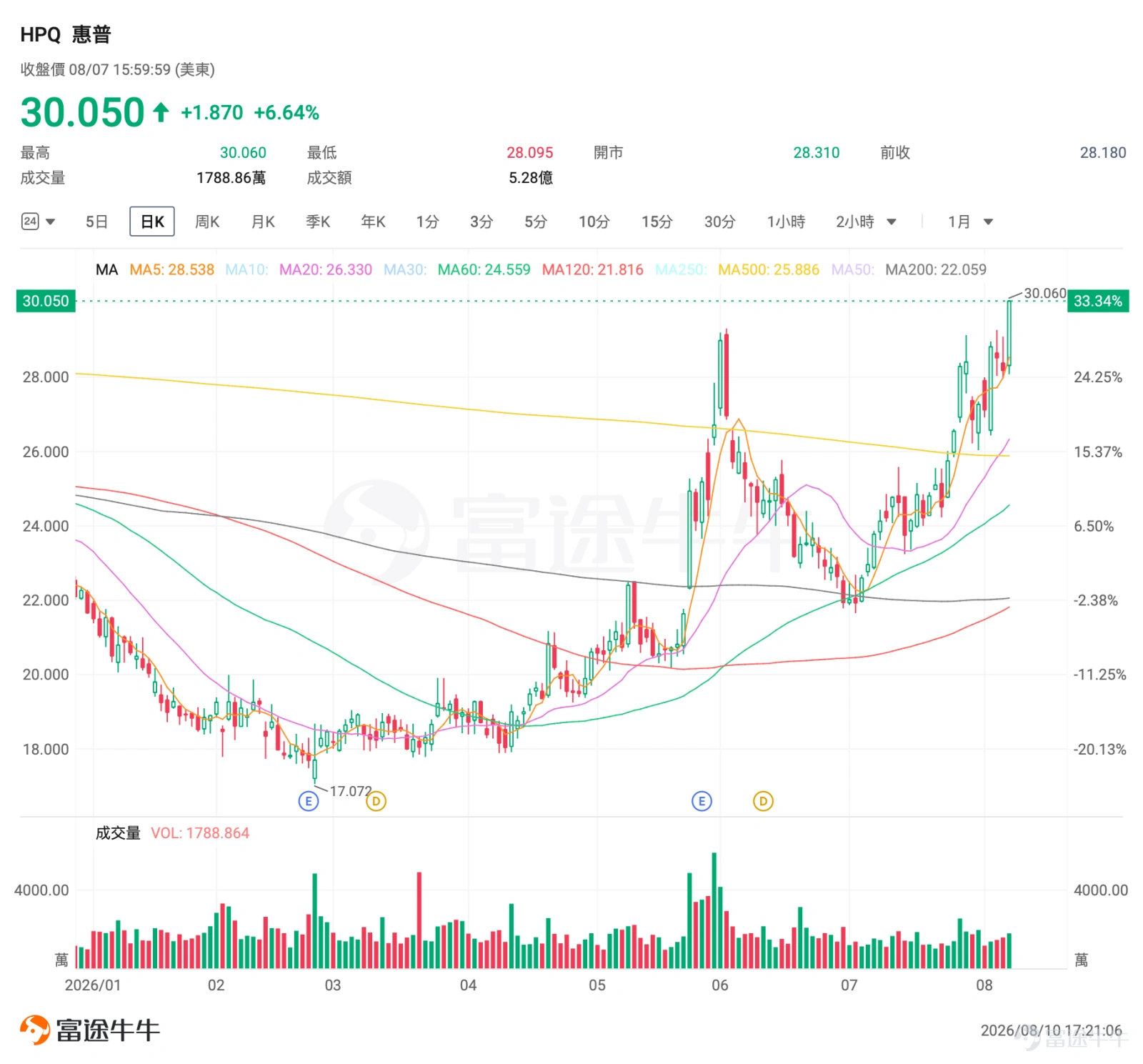
From a technical perspective, HPQ is currently in a strong short-term breakout phase.The stock price exhibits a classic 'stepwise rally' pattern: it surged 15.25% on May 22, breaking through the $25 mark; rose another 8.51% on June 1 to surpass $29; then entered a consolidation phase lasting about a month before resuming its upward momentum in late July, ultimately breaking above the $30 psychological level on August 7. The current price has surpassed the prior high set on June 1, marking a new 60-day high.
HP Inc has recently benefited from the long-term investment narrative surrounding rising AI PC adoption rates.
The market is currently pricing in an expectation gap regarding:While rising DRAM prices pose short-term cost pressures on HP Inc, the market is more focused on whether the company can successfully pass these increased costs on to end consumers through higher product pricing. HP Inc’s Q2 FY2026 earnings report showed revenue of $14.408 billion, up 8.99% year-over-year and exceeding the consensus estimate of $14.071 billion, indicating improving pricing power and market share.
Key variables to monitor going forward include:Key uncertainties include the persistence and magnitude of DRAM price increases and whether end-market PC demand can support sustained price hikes. Input cost pressures remain the core challenge in the second half of the year, with the Q3 earnings release on August 26 serving as a critical validation point. During the Q2 earnings call, management explicitly warned that sequentially rising costs for memory, storage, and CPUs would pressure margins in Q3 and Q4.
Regarding analyst sentiment, Wall Street remains generally cautious on HPQ.Among the eight covering analysts, 37.50% assigned a Hold rating and 62.50% issued a Sell rating, with no Buy ratings. The average price target is $21.14, representing a significant discount to the current share price. The core divergence lies in bears citing HP Inc’s structural demand weakness and margin pressures, while Hold-rated analysts believe cost management and restructuring measures could partially offset these headwinds.
3. Options Premium Collection Strategy
1. Cash Secured Put
Sell 1 contract of $HP Inc (HPQ.US)$260925 25P, estimated required margin (for reference only): $2,500
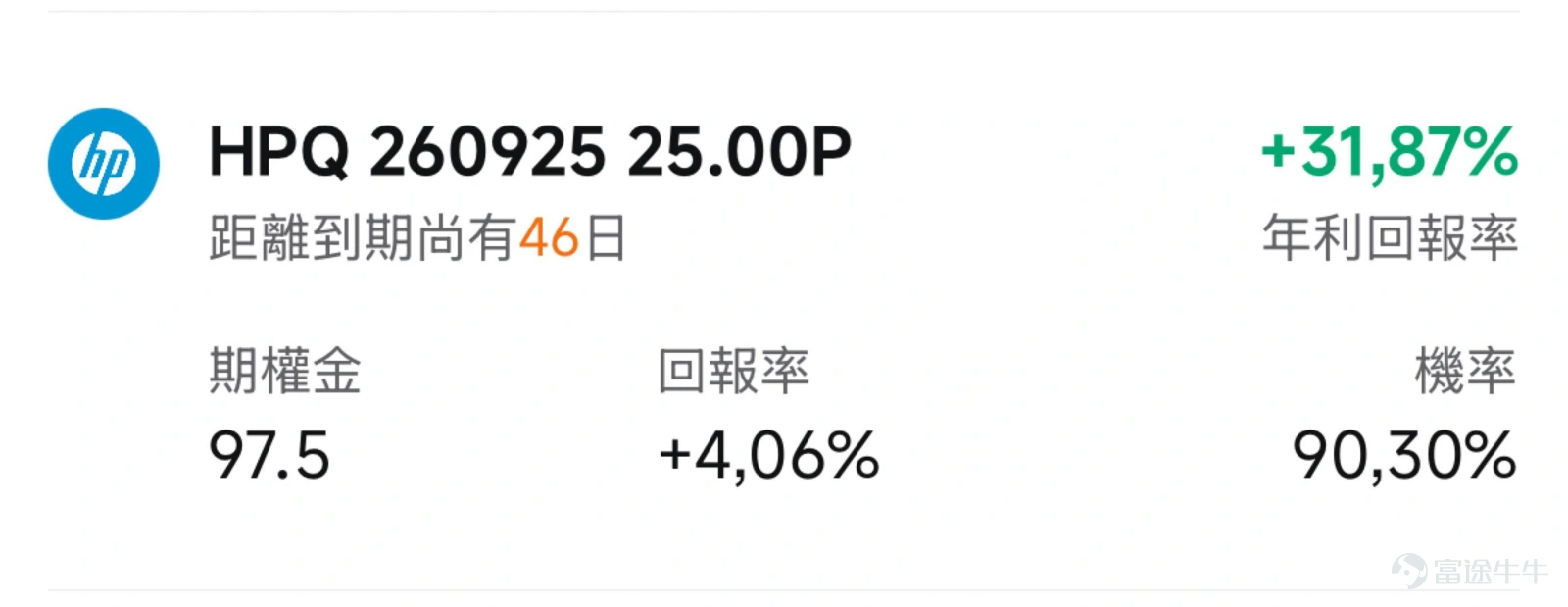
Opportunity Rationale:
For investors who acknowledge HP Inc’s AI PC replacement cycle and dividend value but have not yet established a position, the current share price has risen to $30, significantly increasing the risk of chasing the rally.
By selling put options, investors can collect premium income in a high implied volatility (IV) environment if the stock consolidates at elevated levels or pulls back. If the share price declines following the Q3 earnings report on August 26 due to margins falling short of expectations, they may also gain an opportunity to establish a position at a more attractive, higher-margin-of-safety price.
2. Covered Call
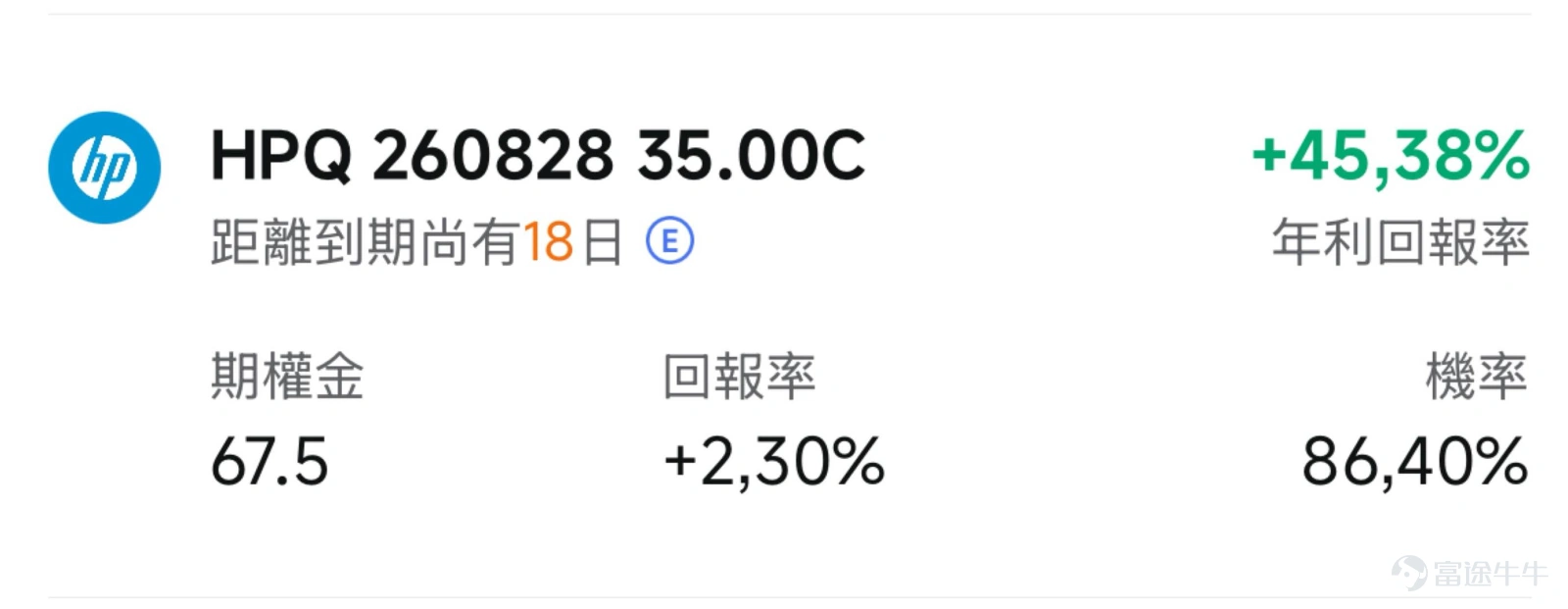
Opportunity Rationale:
For investors already holding HP Inc, cost pressures in the second half remain a tangible drag on margins, and uncertainty surrounds the Q3 earnings report on August 26. Investors who are bullish on the company’s long-term thesis but concerned about profit-taking after a potential short-term sentiment peak could consider selling call options.
If the stock trades sideways near current highs, the option premium collected can lower the effective cost basis of the position. Should the subsequent Q3 earnings confirm signs of margin stabilization and drive further upside—resulting in assignment—the investor would effectively achieve a phased profit-taking exit near resistance levels.
IV. Risk Management Advisory
Although seller strategies have a high win rate, investors must still implement proper risk management:
– Position management is everything.: The biggest risk for option sellers lies in black swan events. It is recommended that margin allocated to any single underlying should not exceed 20% of total capital. Never sell options beyond your capacity to absorb losses just for the sake of collecting higher premiums.
– Covered Call and Timely Rolling: When a covered call becomes deeply in-the-money (i.e., the stock price far exceeds the strike price), if you remain bullish on the underlying stock, you should decisively 'roll' the position—buy to close the current option and simultaneously sell a longer-dated call with a higher strike price—to avoid having your shares called away at an unattractive price.
– Cash-secured put options: Beware of 'left-tail risk': For cash-secured puts, if the stock price crashes due to fundamental deterioration (rather than a normal pullback), don’t hold on stubbornly. In such cases, exit with a stop-loss or roll the position down to buy time while waiting for volatility to normalize.
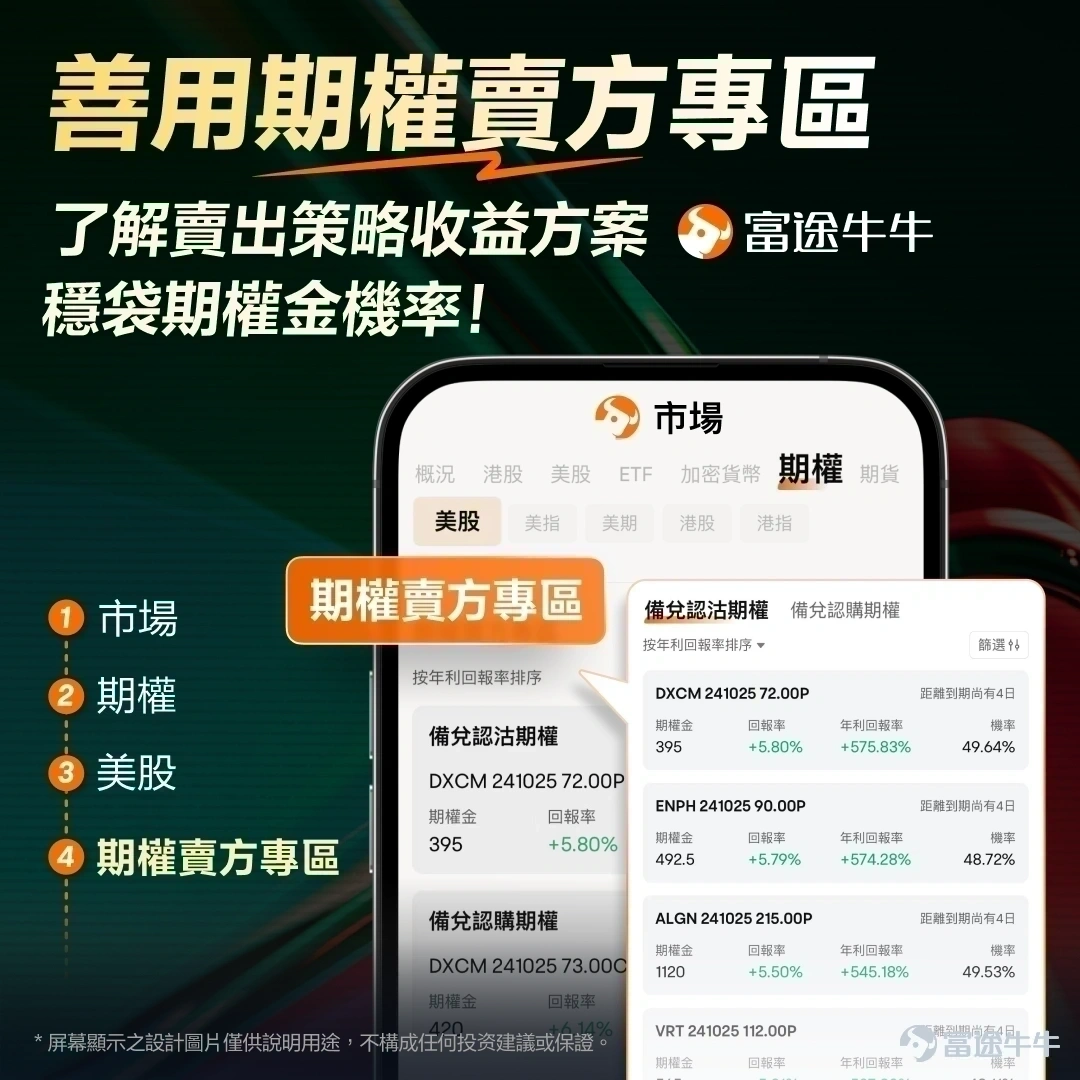
Make good use of the Options Seller Hub to understand income strategies for selling options and earnOption premiums!
Options Risk Disclosure
An option is a contract that gives the holder the right—but not the obligation—to buy or sell an underlying asset at a predetermined price on or before a specified date. Option prices are influenced by multiple factors, including the current price of the underlying asset, the strike price, time to expiration, and implied volatility. Implied volatility reflects the market's expectation of future volatility over the life of the option and is derived by back-solving from the Black-Scholes option pricing model. It is commonly viewed as an indicator of market sentiment. When investors anticipate higher volatility, they may be willing to pay more for options to hedge their risk, leading to higher implied volatility. Traders and investors use implied volatility to assess the attractiveness of option prices, identify potential mispricings, and manage risk exposure.
Disclaimer
This content does not constitute an offer, solicitation, recommendation, advice, opinion, or any guarantee regarding any securities, financial products, or instruments. The risk of loss in trading options can be substantial. In certain circumstances, your losses may exceed the initial margin deposit. Even if you place contingent orders, such as 'stop-loss' or 'limit' orders, there is no guarantee they will prevent losses. Market conditions may render such orders unexecutable. You may be required to deposit additional margin on short notice. If you fail to meet the required margin within the specified timeframe, your open positions may be liquidated. Nevertheless, you remain fully responsible for any resulting deficit in your account. Therefore, prior to trading options, you should thoroughly study and understand options and carefully consider whether such trading aligns with your financial situation and investment objectives. If you trade options, you should become familiar with the procedures for exercising options and handling expiration, as well as your rights and obligations upon exercise or expiration. Options trading involves substantial risk and is not suitable for all investors. Investors should carefully read 'Characteristics and Risks of Standardized Options' before engaging in any options trading strategy.
Risk Disclaimer: The above content only represents the author's view. It does not represent any position or investment advice of Futu. Futu makes no representation or warranty.Read more


Comments
to post a comment
4
5