
Jack Ma makes his first move in nearly three years! Is a re-rating of Alibaba's AI business on the c

[Comment to Earn Points] SMIC and Hua Hong Hongli earnings are here! Can the domestic semiconductor rally reignite?
The semiconductor market is heating up again! Previously, investors were most focused on AI computing power, advanced packaging, and HBM, but now, more and more investors are turning their attention to domestic foundry services. After all, even the most powerful AI chip designs ultimately depend on manufacturing capabilities.
Within this theme,$SMIC (00981.HK)$and$HUA HONG GRACE (01347.HK)$ SMIC and Hua Hong Hongli are undoubtedly among the most closely watched representative companies in the domestic foundry space. As China’s leading foundry, SMIC draws market focus primarily on its progress in advanced nodes, capacity utilization, pricing recovery in mature processes, and its ability to support the domestic supply chain. Hua Hong Hongli, by contrast, specializes more in differentiated and mature process platforms, with strengths in power devices, analog and power management ICs, and embedded non-volatile memory.
As themes like AI, automotive electronics, industrial control, and domestic substitution continue to gain traction, wafer foundry services are no longer just a 'back-end manufacturing link' in the semiconductor supply chain—they are becoming a key lever for the market to revalue domestic semiconductor assets. For investors, what truly matters may not be short-term hype, but whether recovering demand, price normalization, capacity ramp-up, and growth in local customers can collectively drive domestic foundries into a new upcycle.
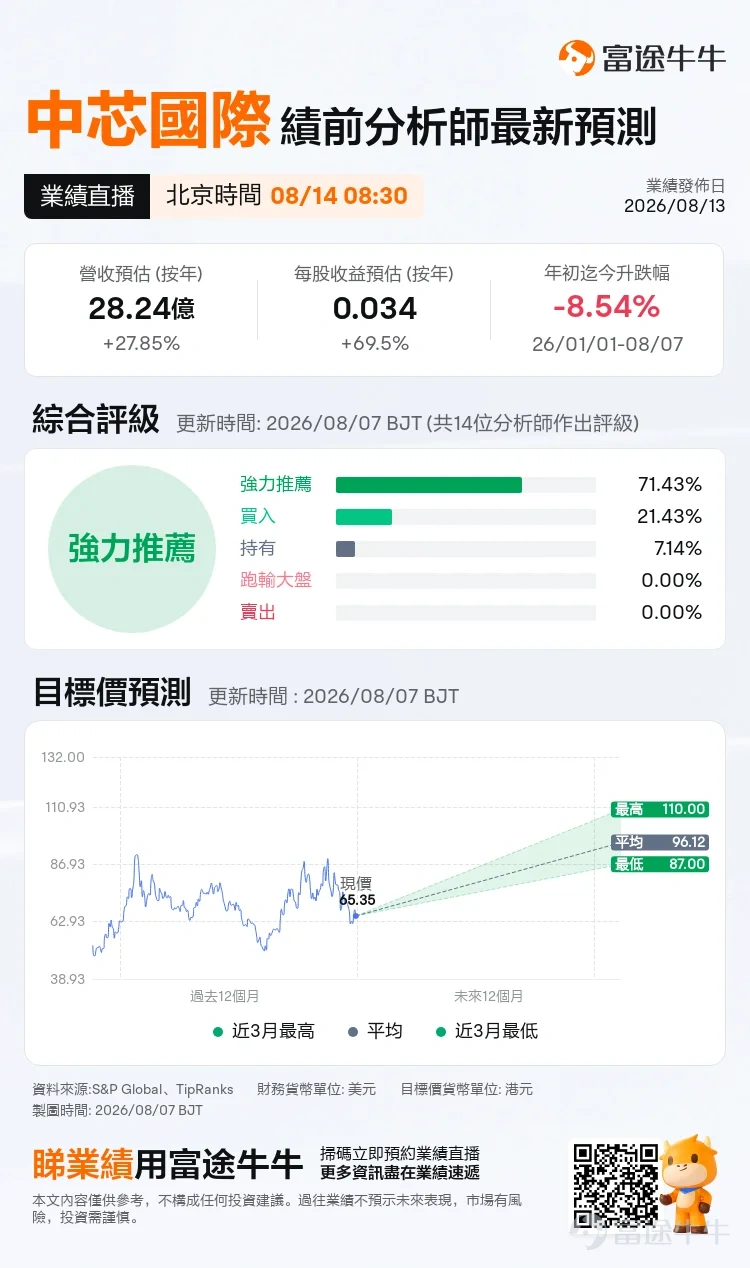
Institutional expectationsSMICAchieved revenue of $2.824 billion in Q2 2026, an increase of 27.85% year-over-year; EPS is expected to be $0.034, up 69.5% year-over-year.
![The semiconductor market is heating up again! Previously, investors were most focused on AI computing power, advanced packaging, and HBM, but now, more and more investors are turning their attention to domestic foundry services. After all, even the most powerful AI chip designs ultimately depend on manufacturing capabilities.[OK] Within this theme,$SMIC (00981.HK)$and$HUA HONG GRACE (01347.HK)$ SMIC and Hua Hong Hongli are undoubtedly among the most closely watched representative companies in the domestic foundry space. As China’s leading foundry, SMIC draws market focus primarily on its progress in advanced nodes, capacity utilization, pricing recovery in mature processes, and its ability to support the domestic supply chain. Hua Hong Hongli, by contrast, specializes more in differentiated and mature process platforms, with strengths in power devices, analog and power management ICs, and embedded non-volatile memory. As themes like AI, automotive electronics, industrial control, and domestic substitution continue to gain traction, wafer foundry services are no longer just a 'back-end manufacturing link' in the semiconductor supply chain—they are becoming a key lever for the market to revalue domestic semiconductor assets. For investors, what truly matters may not be short-term hype, but whether recovering demand, price normalization, capacity ramp-up, and growth in local customers can collectively drive domestic foundries into a new upcycle.[Respect] Institutional expectationsSMICAchieved revenue of $2.824 billion in Q2 2026, an increase of 27.85% year-over-year; expected...](https://nnqimage.futunn.com/sns_client_feed/999982/20260810/web-1786349427279-QLLNWHlPNp.webp/big?area=2&is_public=true&imageMogr2/ignore-error/1/format/webp)
Institutional expectationsHua Hong HongliAchieved revenue of $705 million in Q2 2026, an increase of 24.53% year-over-year; EPS is expected to be $0.024, up 382.0% year-over-year.
![The semiconductor market is heating up again! Previously, investors were most focused on AI computing power, advanced packaging, and HBM, but now, more and more investors are turning their attention to domestic foundry services. After all, even the most powerful AI chip designs ultimately depend on manufacturing capabilities.[OK] Within this theme,$SMIC (00981.HK)$and$HUA HONG GRACE (01347.HK)$ SMIC and Hua Hong Hongli are undoubtedly among the most closely watched representative companies in the domestic foundry space. As China’s leading foundry, SMIC draws market focus primarily on its progress in advanced nodes, capacity utilization, pricing recovery in mature processes, and its ability to support the domestic supply chain. Hua Hong Hongli, by contrast, specializes more in differentiated and mature process platforms, with strengths in power devices, analog and power management ICs, and embedded non-volatile memory. As themes like AI, automotive electronics, industrial control, and domestic substitution continue to gain traction, wafer foundry services are no longer just a 'back-end manufacturing link' in the semiconductor supply chain—they are becoming a key lever for the market to revalue domestic semiconductor assets. For investors, what truly matters may not be short-term hype, but whether recovering demand, price normalization, capacity ramp-up, and growth in local customers can collectively drive domestic foundries into a new upcycle.[Respect] Institutional expectationsSMICAchieved revenue of $2.824 billion in Q2 2026, an increase of 27.85% year-over-year; expected...](https://nnqimage.futunn.com/sns_client_feed/999982/20260810/web-1786349991045-cKyCADJChN.png/big?area=2&is_public=true&imageMogr2/ignore-error/1/format/webp)
So the question arises: Is the current rally in SMIC and Hua Hong Hongli driven merely by short-term sentiment, or does it mark the beginning of a long-term revaluation of domestic wafer foundries?
🔎 This analysis focuses on SMIC and Hua Hong Hongli, centering on three key questions:
First, can the ongoing recovery in mature-node semiconductor cycles continue to drive profitability improvements?
The semiconductor industry has recently weathered inventory cycles, demand volatility, and pricing pressures, which have impacted wafer foundries’ profitability. As downstream demand from consumer electronics, industrial control, and automotive electronics gradually recovers, the outlook for mature-node technologies is once again drawing market attention.
For SMIC and Hua Hong Hongli, mature-node processes are not just 'legacy capacity'—they form the critical foundation for domestic IC design companies to bring products to market, including automotive-grade chips, power devices, analog ICs, MCUs, and power management ICs. If downstream customers continue their restocking momentum and order mix keeps improving, wafer foundries’ capacity utilization rates and pricing levels could receive solid support.
The market will closely watch: Will mature-node pricing continue to recover? Is customer demand genuinely rebounding? Can the proportion of high-value-added products increase? If mature-node segments shift from 'low-price competition' toward 'structural recovery,' domestic wafer foundries’ profit elasticity may undergo a repricing.
Second, can new capacity ramp-up translate into tangible earnings elasticity?
The core competitiveness of the wafer foundry industry stems partly from technology and customers, and partly from production capacity. Without sufficient capacity, it is difficult to meet demand; however, if capacity expansion is too rapid and orders fail to keep pace, it could lead to depreciation pressure and utilization risk.
This is also why the market closely watches SMIC and Hua Hong Hongli. Domestic wafer foundries are positioned within the broader trend of expanding China’s semiconductor supply chain, where long-term demand potential remains. However, whether this potential can be realized in the near term hinges on the pace of new capacity ramp-up, order visibility from customers, and whether capacity utilization can be maintained at a healthy level.
If capacity expansion coincides with a recovery in demand, earnings elasticity could be further amplified; however, if industry demand rebounds less than expected or supply-demand imbalances emerge in certain segments, newly added capacity could temporarily exert depreciation and margin pressure. [Wise]
Therefore, what truly matters in this market move isn’t just 'whether capacity is being expanded,' but rather 'whether the newly added capacity can be absorbed by real demand.'
Third, between domestic substitution and specialty processes, which offers greater long-term growth potential?
If advanced nodes represent the technological frontier of semiconductor manufacturing, then mature and specialty processes form the industrial foundation that enables mass-market applications to actually materialize.
SMIC is primarily evaluated based on its comprehensive foundry capabilities, breadth of customer coverage, platform scale, and ability to integrate into the domestic supply chain. Hua Hong Hongli’s differentiation lies in its specialty process platforms, including power devices, analog, power management, and embedded memory technologies.
Amid trends like AI-enabled devices, smart automotive, industrial automation, IoT, and a recovery in consumer electronics, chip demand isn’t solely concentrated on the most advanced nodes. Many applications require stable, reliable, and cost-effective mature-node capacity. This implies that the long-term value of domestic wafer foundries may depend not only on breakthroughs in technology nodes but also on their ability to establish stable customer relationships and achieve scale advantages across more specialized segments.
For Hua Hong Hongli, the key focus for the market is whether its specialty processes can continue to widen its differentiation advantage. For SMIC, a critical variable for valuation reassessment is whether it can achieve stronger synergy among scale, technology, customers, and capacity.
So what should we really be watching this time?This time, the market’s focus may not just be on how SMIC and Hua Hong Hongli’s share prices perform in the short term, but whether domestic foundries can continue to demonstrate three key points:
✅ Will pricing and demand for mature process nodes continue to recover?
✅ Can newly added capacity align with real orders, rather than lead to oversupply?
✅ Can demand from AI, automotive electronics, industrial applications, and domestic substitution truly translate into revenue and profit?
✅ Can specialty processes become a differentiated advantage for Hua Hong Hongli?
✅ Can scaled manufacturing capabilities continue to support SMIC's leadership position?
If AI computing power is the 'front-end narrative' of the semiconductor market cycle, then wafer fabrication is the 'underlying capacity' supporting the entire supply chain. Without stable manufacturing capabilities, even the strongest design, packaging, and application demand struggles to form a complete closed loop.
Right now, the market is re-evaluating: should the value of domestic foundries be positioned more prominently?
🏆 Event: Bull Circle Opinion Leader ✨
SMIC and Hua Hong Hongli are gaining attention—who do you favor more?
Welcome to share your views in the comments section:
1️⃣ Are you more bullish on SMIC, Hua Hong Hongli, or both?
2️⃣ Do you think the current rally in domestic foundry stocks is short-term thematic speculation or a long-term industry re-rating?
3️⃣ Which metric are you most focused on: revenue growth, gross margin, capacity utilization, expansion pace, customer mix, or policy environment?
4️⃣ If the semiconductor sector continues to strengthen, which has greater upside potential—SMIC or Hua Hong Hongli?
5️⃣ In your view, where will the next major opportunity for domestic foundries come from: AI devices, automotive electronics, industrial control, or localization substitution?
Now it’s up to fellow investors’ judgment! Come to the comments section to share your opinion and join the discussion to earn reward points! 👇👇Share your thoughts in the comments below:
✅ At least 30 words ✅ Original viewpoint ✅ Complies with community guidelines
Eligible participants will share 20,000 points!
Click to reserve:
Hua Hong Semiconductor Q2 2026 Earnings Live Stream
SMIC Q2 2026 Earnings Live Broadcast
Note: All activities above will end at 12:00 Beijing Time on August 14; rewards will be distributed collectively after the conclusion of this earnings season.
Click to reserve:Hua Hong Semiconductor Q2 2026 Earnings Live Stream
SMIC Q2 2026 Earnings Live Broadcast
‘Earnings Express’ has been fully upgraded—with three key features to help you get ahead during earnings season!
![The semiconductor market is heating up again! Previously, investors were most focused on AI computing power, advanced packaging, and HBM, but now, more and more investors are turning their attention to domestic foundry services. After all, even the most powerful AI chip designs ultimately depend on manufacturing capabilities.[OK] Within this theme,$SMIC (00981.HK)$and$HUA HONG GRACE (01347.HK)$ SMIC and Hua Hong Hongli are undoubtedly among the most closely watched representative companies in the domestic foundry space. As China’s leading foundry, SMIC draws market focus primarily on its progress in advanced nodes, capacity utilization, pricing recovery in mature processes, and its ability to support the domestic supply chain. Hua Hong Hongli, by contrast, specializes more in differentiated and mature process platforms, with strengths in power devices, analog and power management ICs, and embedded non-volatile memory. As themes like AI, automotive electronics, industrial control, and domestic substitution continue to gain traction, wafer foundry services are no longer just a 'back-end manufacturing link' in the semiconductor supply chain—they are becoming a key lever for the market to revalue domestic semiconductor assets. For investors, what truly matters may not be short-term hype, but whether recovering demand, price normalization, capacity ramp-up, and growth in local customers can collectively drive domestic foundries into a new upcycle.[Respect] Institutional expectationsSMICAchieved revenue of $2.824 billion in Q2 2026, an increase of 27.85% year-over-year; expected...](https://nnqimage.futunn.com/sns_client_feed/999982/20260807/web-1786085378314-gq6tBuaejx.webp/big?area=2&is_public=true&imageMogr2/ignore-error/1/format/webp) Futubull AI Get instant answers to your questions, use intelligent stock selection to target promising upward momentum, and analyze your holdings to seize opportunities and avoid risks!
Futubull AI Get instant answers to your questions, use intelligent stock selection to target promising upward momentum, and analyze your holdings to seize opportunities and avoid risks!![The semiconductor market is heating up again! Previously, investors were most focused on AI computing power, advanced packaging, and HBM, but now, more and more investors are turning their attention to domestic foundry services. After all, even the most powerful AI chip designs ultimately depend on manufacturing capabilities.[OK] Within this theme,$SMIC (00981.HK)$and$HUA HONG GRACE (01347.HK)$ SMIC and Hua Hong Hongli are undoubtedly among the most closely watched representative companies in the domestic foundry space. As China’s leading foundry, SMIC draws market focus primarily on its progress in advanced nodes, capacity utilization, pricing recovery in mature processes, and its ability to support the domestic supply chain. Hua Hong Hongli, by contrast, specializes more in differentiated and mature process platforms, with strengths in power devices, analog and power management ICs, and embedded non-volatile memory. As themes like AI, automotive electronics, industrial control, and domestic substitution continue to gain traction, wafer foundry services are no longer just a 'back-end manufacturing link' in the semiconductor supply chain—they are becoming a key lever for the market to revalue domestic semiconductor assets. For investors, what truly matters may not be short-term hype, but whether recovering demand, price normalization, capacity ramp-up, and growth in local customers can collectively drive domestic foundries into a new upcycle.[Respect] Institutional expectationsSMICAchieved revenue of $2.824 billion in Q2 2026, an increase of 27.85% year-over-year; expected...](https://nnqimage.futunn.com/sns_client_feed/999982/20260807/web-1786085378068-HUQUY3PyxE.webp/big?area=2&is_public=true&imageMogr2/ignore-error/1/format/webp)
Risk Disclaimer: The above content only represents the author's view. It does not represent any position or investment advice of Futu. Futu makes no representation or warranty.Read more


Comments (85)
to post a comment
38
16