HK Stock Market Barometer | HK stocks continue to fluctuate and pull back! How much room for recover

At-a-Glance Preview | Tencent to Report Q2 Earnings on Wednesday! Likely to Show 'Steady Revenue, Margin Pressure' Pattern, with AI Investment as Key Battleground
Tencent’s Q2 results are very likely to show a pattern of 'stable revenue but profit under pressure.' For investors, the key focus of this earnings report is not merely the net profit figure, but rather an assessment of whether AI investments are purely expense-driven or are already delivering tangible incremental returns to advertising, cloud, and enterprise services. If the business benefits from AI continue to materialize, the short-term profit sacrifice will translate into medium- to long-term value; otherwise, the market will reassess its valuation logic.
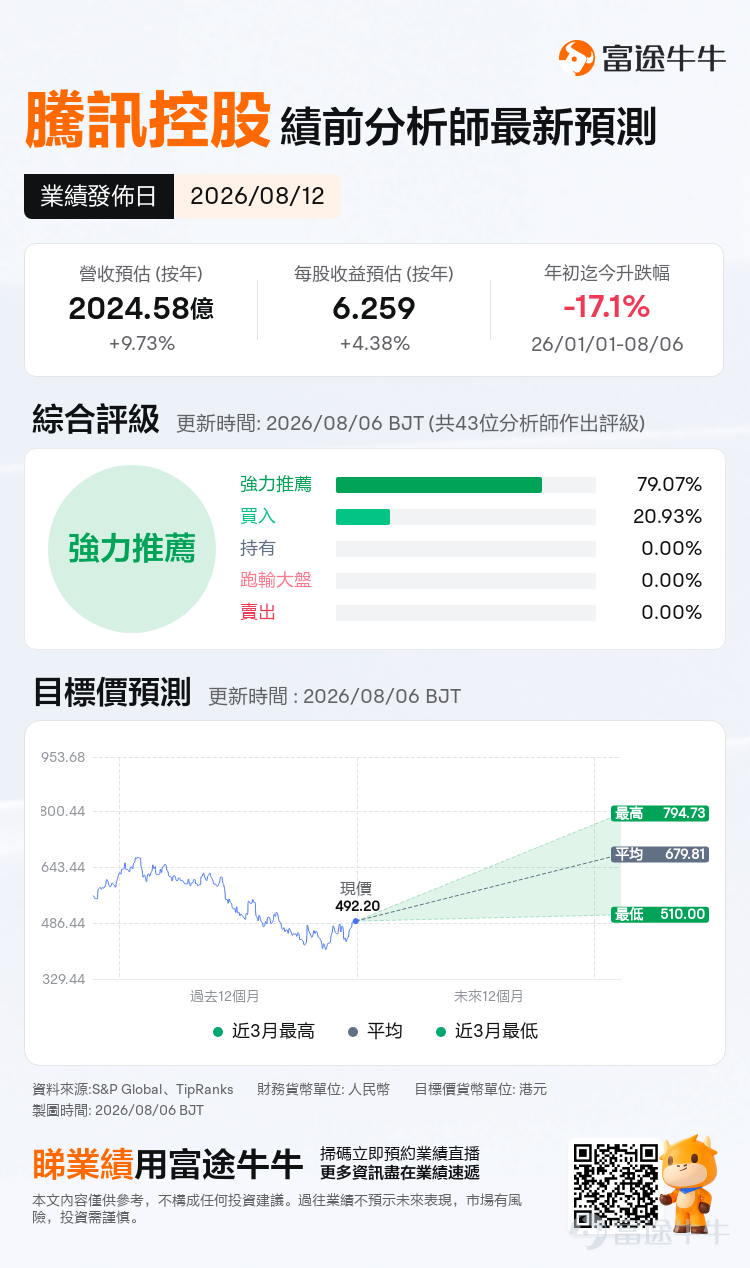
$TENCENT (00700.HK)$ It will release its Q2 results on Wednesday (August 12 Beijing time). Wall Street analysts expect Tencent to report Q2 revenue of RMB 202.458 billion, up 9.73% year-over-year, and earnings per share of RMB 6.259, up 4.38% year-over-year.
The market’s core view on Tencent’s Q2 performance is:The two cash-generating engines—gaming and advertising—remain highly robust; fintech and cloud businesses show structural divergence; and continued heavy investment in AI computing power and model development will weigh on short-term net profit growth. Excluding AI-related expenses, core business profitability remains strong.。

Looking back at Q1 2026, Tencent delivered a solid close on fundamentals, with total revenue up 9.1% year-over-year and adjusted net profit rising 11% YoY. Its two core segments—gaming and advertising—demonstrated strong resilience. However, on the secondary market, the stock price failed to follow the strength in fundamentals.Following the Q1 earnings release, Tencent’s share price remained range-bound, repeatedly failing to break through the HK$500 mark.

Market focus has gradually shifted from traditional business profitability to concerns over AI-related capital expenditures and margin compression. Valuation has been pushed down to a relatively low percentile in recent years, significantly widening investor divergence. On one hand, investors acknowledge the company’s strong cash flow and solid business foundation; on the other, they remain cautious, awaiting clarity on the short-term costs and long-term monetization timeline of AI investments.
The most critical narrative driver! AI becomes the central battleground for Q2
AI is currently the most important narrative variable for Tencent’s valuation, exerting a dual impact on earnings.
On the positive side, iterations of the HunYuan large model, gray-scale testing of WeChat AI agents, and rapid scaling of the enterprise-facing WorkBuddy are already enhancing existing businesses: the AI-powered ad recommendation model has been fully rolled out, boosting ad conversion efficiency; cloud services are capturing domestic AI compute demand, driving improved enterprise service revenue; and consumer-facing AI tools within the WeChat ecosystem are unlocking long-term product monetization potential.
However, significant headwinds remain. To build out its large models and computing infrastructure, the company has substantially increased capital expenditures. Rising costs from compute procurement, server depreciation, and R&D personnel are directly pressuring short-term margins in Q2. Most AI products are still in the user-acquisition phase, contributing limited direct revenue—this remains a stage where costs outweigh returns. The market’s focus has shifted beyond mere concept validation to whether Tencent can begin demonstrating quantifiable monetization signals from its AI initiatives, thereby clarifying the payback period on these investments.
Major brokerages broadly expect Tencent’s capital expenditures to rise significantly. Daiwa has sharply revised its 2026 capex forecast for Tencent upward from RMB 108 billion to RMB 181 billion. Bank of America projects Tencent’s capex this year will reach RMB 185 billion, while JPMorgan even forecasts the figure could approach RMB 200 billion, pushing the company’s free cash flow for the year down from over RMB 200 billion in 2025 to below RMB 70 billion.
Online Gaming: Strong domestic resilience, overseas gaming is the biggest variable
Gaming remains Tencent’s core profit engine,Institutions expect total gaming revenue in Q2 to reach approximately RMB 65 billion, an increase of about 10% year-over-year.
Domestically, evergreen titles such as Honor of Kings and Peacekeeper Elite have maintained stable revenue streams. Delta Force continues to contribute incremental growth, while the mobile version of LuoKe Kingdom is gradually monetizing. Newly approved titles are filling out the product portfolio, leading to an expected 11%–13% year-over-year growth in domestic gaming revenue. Q2 is traditionally a low season for gaming, lacking the boost from Chinese New Year promotions, so sequential growth is likely to be flat or slightly up, with expansion driven primarily by operations of existing titles and new game launches.
International gaming is the biggest variable this quarter. The Q2 2025 base for overseas gaming is relatively high, as Supercell and several other international titles delivered strong performances in the same period last year. As a result, overseas revenue growth is expected to slow to the 5%–8% range, significantly decelerating from the 13% growth seen in Q1. Key focus areas include management’s guidance on the overseas pipeline and the progress of DNF Mobile’s international launch and upcoming AAA titles, which will determine the growth elasticity for the second half of the year.
Advertising (Marketing Services): WeChat Channels + AI-driven ad placements continue strong growth
Advertising is a key growth driver for Tencent in 2026, with the market widely expecting Q2 advertising revenue to grow 18%–20% year-over-year.
The underlying drivers of this growth stem from two sources: First, WeChat Channels’ traffic continues to expand, with DAU and user time spent steadily rising, ad load rates moderately increasing, and the closed-loop integration of short videos and live-streaming e-commerce enhancing ad conversion efficiency. Second, penetration of AI-powered ad tools—such as AIM+ and Miaosi creative AI tools—is rising, helping advertisers improve ROI and boost eCPM; search ads are also contributing incremental revenue.
It should be noted that the pace of macroeconomic consumer recovery directly impacts advertisers’ budget allocations. Compared to Q1’s 20% growth rate, Q2 growth may see a slight deceleration. Given the advertising segment’s relatively high gross margin, any upside surprise here would directly offset profit pressure from AI investments.
FinTech and Business Services: Weak payments, cloud AI computing power drives acceleration
The FinTech and Business Services segment is expected to generate nearly RMB 60 billion in Q2 revenue, representing 8%–9% year-over-year growth, with clear divergence within the segment.
The FinTech payment business has maintained steady growth, influenced by the pace of household consumption recovery. Meanwhile, enterprise services (Tencent Cloud) stand out as the segment’s highlight: surging demand for AI computing power and the commercial rollout of HunYuan large models are driving cloud revenue growth potentially above 20%. GPU resources are in short supply, making them the core engine for B2B growth. Beyond revenue growth, close attention should also be paid to gross margin improvements in the cloud business to validate the effectiveness of the 'profitability-first' strategy.
Risks stem from macroeconomic headwinds impacting offline merchants’ payment volumes and intensified competition in the cloud sector exerting pricing pressure. The market is closely monitoring cloud revenue growth and gross margin trends to assess the actual adoption of AI-related B2B businesses, rather than relying solely on product user metrics.
What do major Wall Street banks think?
Based on the latest Q2 outlooks from major investment banks, the vast majority of institutions maintained their Buy/Overweight ratings. However, due to upward revisions in AI-related capital expenditures, several firms lowered near-term earnings forecasts, leading to divergent target prices.
– JPMorgan maintains an Overweight rating with a HK$690 price target, arguing that the core business fundamentals remain intact and that AI investments represent a long-term strategic initiative, albeit temporarily weighing on profitability;
– Morgan Stanley maintains an Overweight rating with a HK$650 price target, estimating that the company's underlying core profit growth remains robust after stripping out AI-related costs;
– Bank of America Securities sets a HK$780 price target, believing the market underestimates Tencent’s leadership in AI agent orchestration and remains optimistic about the AI monetization potential within the WeChat ecosystem;
– Nomura sets a HK$727 price target, highlighting strong growth prospects for enterprise-facing AI products.
Overall among major banks,the consensus target price range stands at HK$650–780, with institutional analysts primarily divided on two key issues: first, how long AI-related capital expenditures will weigh on profits; and second, the pace at which AI products within the WeChat ecosystem will achieve commercialization. During the upcoming earnings season, beyond revenue and profit figures, capital expenditure, depreciation expenses, and management guidance on AI-related businesses will become critical variables influencing the stock price.
Tencent's Q2 results are highly likely to show a pattern of 'stable revenue but pressured profits.' Its gaming business remains solid, advertising is the growth engine, and cloud services are benefiting from AI computing demand, though heavy AI investments remain an unavoidable short-term cost.
For investors, the key focus of these results isn't just the net profit figure, but rather assessing:Whether AI investments are purely expense-driven or are already delivering tangible incremental returns to advertising, cloud, and enterprise services. If the business benefits enabled by AI continue to materialize, the short-term profit sacrifice will translate into medium- to long-term value; otherwise, the market will reassess its valuation logic.
 AI-powered earnings snapshot—key insights in three stepsOptions strategies! Open Futubull > Stock Page > Tap [Company] >Performance updates
Editor/lambor
Risk Disclaimer: The above content only represents the author's view. It does not represent any position or investment advice of Futu. Futu makes no representation or warranty.Read more

Comments
to post a comment
10
1