Optical communication stocks lead the rebound; will the AI optical cycle continue?

In-Depth Analysis | AI Hardware Trends Shift Sharply: Is 'Optics In, Memory Out' a New Main Theme or Just a Short-Term Fad?
Last Friday, U.S. AI hardware stocks showed clear divergence. $Micron Technology (MU.US)$ 、 $SK hynix (SKHY.US)$ memory stocks collectively weakened; on the other side, $Applied Optoelectronics (AAOI.US)$ better-than-expected earnings ignited a rally in optical communication stocks, $Coherent (COHR.US)$ surging 13% in a single day, $Lumentum (LITE.US)$ Up more than 6%.
On one hand, memory valuations are cooling down; on the other, the optical communications sector is heating up—'optics in, memory out' has quickly become a focal point of market debate over the weekend.
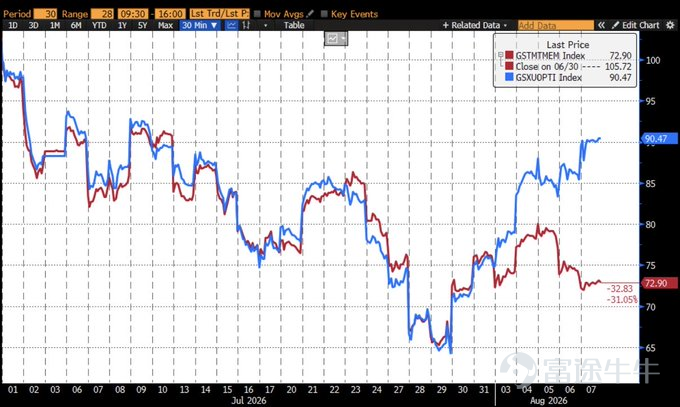
Goldman Sachs charts also show that both optical communication stocks (blue line) and memory stocks (red line) experienced roughly a 30% pullback in July. However, since August began, optical stocks have cumulatively outperformed memory stocks by more than 20 percentage points.
Goldman Sachs’ optical communications stock basket (blue) stands in stark contrast to its memory stock basket (red).
This divergence stems not only from earnings catalysts and positioning dynamics but also from the market’s repricing of next-generation AI system architectures.
Why has the market suddenly started trading the 'optics in, memory out' theme?
First, the two sectors are at different stages of market expectations.
Memory stocks had already fully priced in expectations of tight supply-demand dynamics, rising prices, and upward earnings revisions. With the pace of DRAM and NAND price increases slowing in Q3, market focus has gradually shifted from 'whether prices are still rising' to 'whether the rate of price increases has peaked.' Citi’s downgrade of Micron’s price target has reinforced this concern.
Meanwhile, optical communications is seeing fresh earnings validation. AAOI’s better-than-expected earnings report not only improved its own outlook but also reignited market interest in demand drivers such as 1.6T volume ramp-up, high-speed data center interconnects, and AI cluster expansions. The sharp rallies in leaders like Coherent essentially reflect capital rotating from memory—where expectations are already high—to optical communications, which offers a steeper earnings trajectory.
Second, this trading thesis has been further fueled by a recent report from SemiAnalysis. According to SemiAnalysis, the SOCAMM capacity for Vera CPUs may be reduced from 1.5TB to 768GB, and the HBM4E used in Rubin Ultra could be scaled back from 16 layers to either 8 or 12 layers.The market is extrapolating from this trend that AI systems are reducing memory allocation per chip, instead scaling up cluster size through more GPUs, memory pooling, and high-speed optical interconnects.
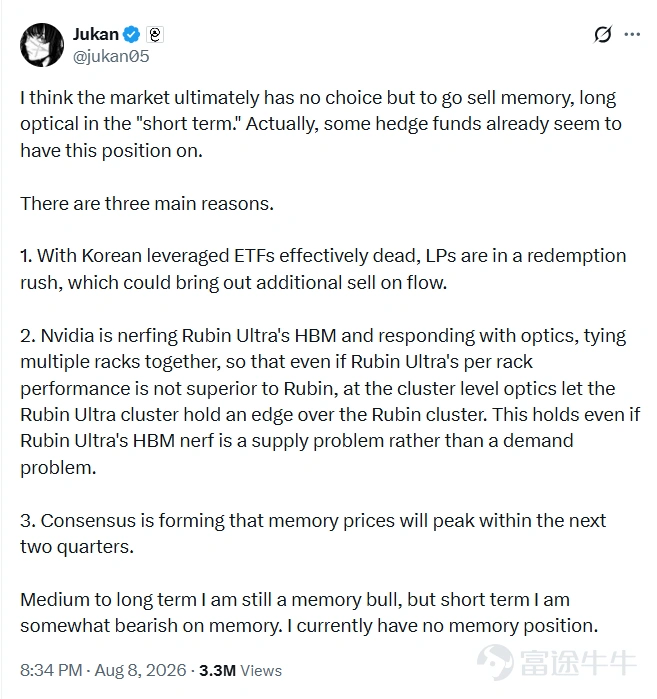
More notably, well-known memory bull Jukan also posted on X that the market may need to consider a 'short memory, long optics' strategy in the near term, based primarily on three observations:
First, after the functional breakdown of South Korea’s leveraged ETF market, affected investors face redemption pressure, which could add selling pressure on memory stocks; second, NVIDIA is adjusting its next-generation AI system architecture, with Rubin Ultra potentially reducing HBM capacity per rack and instead using optical interconnects to link multiple racks; third, market expectations that memory prices will peak within the next two quarters are strengthening.
However, Jukan emphasized that he remains constructive on the long-term outlook for memory. His shift toward caution in the short term stems more from a trading-level assessment. In his view, investment focus in AI infrastructure is shifting from simply increasing HBM capacity toward enhancing overall data center architectural efficiency—with high-speed optical interconnects being a key incremental driver.
Source: X
However, the biggest point of contention with this logic is:Does reduced memory capacity per GPU truly equate to lower overall memory demand for the entire AI system?
What do institutions think? The disagreement lies not in demand itself, but in the 'slope' and 'duration.'
According to the latest reports from JPMorgan, Morgan Stanley, Citi, Deutsche Bank, UBS Group, and Bernstein, institutions are not pessimistic about memory demand itself. The real divergence centers on:How much longer this cycle can last, and whether the phase of fastest earnings growth has already passed.
Morgan Stanley, Bernstein: Price increases continue, but the pace is slowing
Bernstein's latest price tracking shows that Q3 traditional DRAM contract prices are expected to rise by approximately 17% quarter-over-quarter; including SSDs, overall NAND price increases could also approach 20%.
The magnitude of the increase remains substantial, but it has clearly narrowed compared to Q2, with some products even falling short of the market's previously overly optimistic expectations. PC and smartphone manufacturers are cutting production volumes, NAND wafer customers are beginning to reject further price hikes, and some server DRAM long-term agreements are nearing their price ceilings.
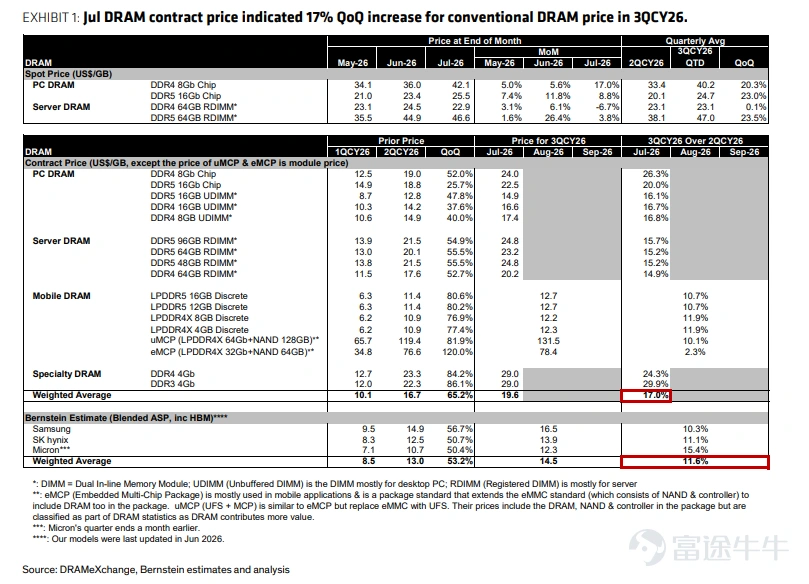
Morgan Stanley similarly believes the memory cycle may enter its later phase starting in Q4.Its channel checks indicate that Q3 DRAM contract prices rose by about 15%, below the earlier expectation of 20%; as inventories begin to rebuild and supply gradually increases, it will become significantly harder to drive earnings upgrades through price increases that exceed expectations.
Therefore, this camp does not believe memory prices are about to plummet, but rather thatthe second derivative of pricing has weakened: prices are still rising, but not as quickly as before.
UBS Group: Memory is too expensive, squeezing AI capital expenditures
UBS Group’s concern is more direct: rising memory prices are consuming an increasing share of AI capital expenditures.
Its estimates suggest that memory spending as a share of AI capital expenditures could rise from 14% in 2025 to 42% in 2026 and 89% in 2027. In 2026, around 60% of the incremental AI capex could stem from memory price increases, rising to as high as 97% by 2027.
In other words, although cloud vendors continue to increase their capital spending, an ever-larger share of that spending is going toward more expensive memory rather than deploying additional compute capacity.
This also explains why NVIDIA proactively downgraded certain memory specifications: it’s not that AI no longer needs memory, but rather that memory has become too expensive and supply too tight, forcing chipmakers to seek system architectures with better cost-performance ratios.
JPMorgan, Citi: Lowering specs per card does not equate to reduced system-level demand
JPMorgan characterizes this specification adjustment as 'capacity optimization under supply constraints.'
Following the downgrades to SOCAMM and Rubin Ultra configurations, JPMorgan simultaneously lowered its HBM bit-demand forecasts for 2026–2028 by 4% to 19%. However, even under more conservative assumptions, its model still indicates that HBM will remain in a supply deficit over the next three years.
The reason is that while per-GPU memory capacity is declining, AI systems are scaling out horizontally by increasing the number of GPUs and CPUs. JPMorgan expects that incremental GPU shipments along with Vera and Rosa CPU deliveries will offset the impact of reduced memory capacity per chip, leading it to raise its forecast for the global memory market size from 2026 to 2028 by 4% to 8%.
Citi’s analysis is even more straightforward. Even if HBM per GPU declines, the number of GPUs in next-generation AI systems could rise from 72 to 576, driving total HBM capacity per system from 20.7TB to 110.6TB,a 434% increase.
Therefore, scale-out indeed benefits optical communications, but it may not necessarily be bearish for total memory demand.Using less HBM per card may simply be a strategy to produce more GPUs and deploy larger clusters.
Deutsche Bank: Demand isn't disappearing—it's dispersing across more memory tiers
After discussions with Micron management, Deutsche Bank noted that AI infrastructure is shifting from a monolithic architecture heavily reliant on HBM to a more tiered memory hierarchy.
In the future, HBM will primarily handle the hottest, most latency-sensitive data; SOCAMM will manage KV Cache overflow; DDR5 memory pools will process long-tail data; and HBF and enterprise SSDs will store larger-capacity, less frequently accessed data.
The role of optical interconnects is to link memory resources scattered across different servers and racks. Therefore, what’s truly happening isn’t 'replacing memory with optical communication,' but ratherOptical interconnects and memory pooling are simultaneously penetrating the market, shifting memory demand from single-card stacking toward system-level tiering.
Is 'empty memory, more optics' an industry inflection point or just short-term trading?
Overall,'More optics, empty memory' does indeed carry short-term trading logic.
Optical communications are now entering a phase of earnings validation and architectural upgrades, while memory faces headwinds including slowing price increases, overly optimistic expectations, and leveraged capital exiting the sector. Even if both sectors’ fundamentals are improving simultaneously, optical communications may exhibit a steeper earnings trajectory and greater positive expectation gap, allowing it to continue outperforming memory.
However, equating this relative performance divergence directly with 'peak HBM demand' or 'the end of the memory supercycle' currently lacks sufficient evidence.
The real consensus among institutions is: the memory cycle has not yet turned, but the easiest phase—profiting purely from price hikes and earnings revisions—may be coming to an end.
Therefore,A more accurate phrasing of 'optics advance, memory retreats' might be 'optics advance, memory optimizes': the value contribution of optical interconnects in AI systems is rapidly increasing, while memory strategies are shifting from stacking on individual cards toward capacity optimization, memory pooling, and multi-tiered configurations.
Next, the market needs to closely monitor the final HBM specifications for Rubin and Rubin Ultra, the number of GPUs per system, the Q4 increase in memory prices, and changes in customer inventory levels.
If HBM per card declines but GPU shipments and total system memory capacity continue to grow, then 'optics advance, memory retreats' would ultimately represent merely a style rotation. Only when total demand, pricing, and long-term agreements all weaken simultaneously would the thesis of a reversal in the memory supercycle truly hold.
Risk Disclaimer: The above content only represents the author's view. It does not represent any position or investment advice of Futu. Futu makes no representation or warranty.Read more


Comments (36)
to post a comment
83
262