Apple and Amazon reported starkly contrasting earnings— which one are you bullish on?

Is Microsoft, Wall Street’s favorite, also a 'bottomless pit'?
Author | Ding Mao
Editor | Zhang Fan
Recently, the four major North American tech giants have successively released their latest quarterly earnings reports.
Compared to previous quarters, concerns this fiscal period about the 'bottomless pit' of AI-related capital expenditures have reached a peak. Wall Street has begun reevaluating these giants’ AI monetization capabilities and fundamental performance with an almost exacting scrutiny.
Microsoft emerged as the biggest winner in this efficiency test. While other giants faced investor concerns over massive capital expenditures eroding free cash flow, Microsoft surprised the market this quarter by revising its capital expenditure outlook downward by $15 billion, sparking optimism.
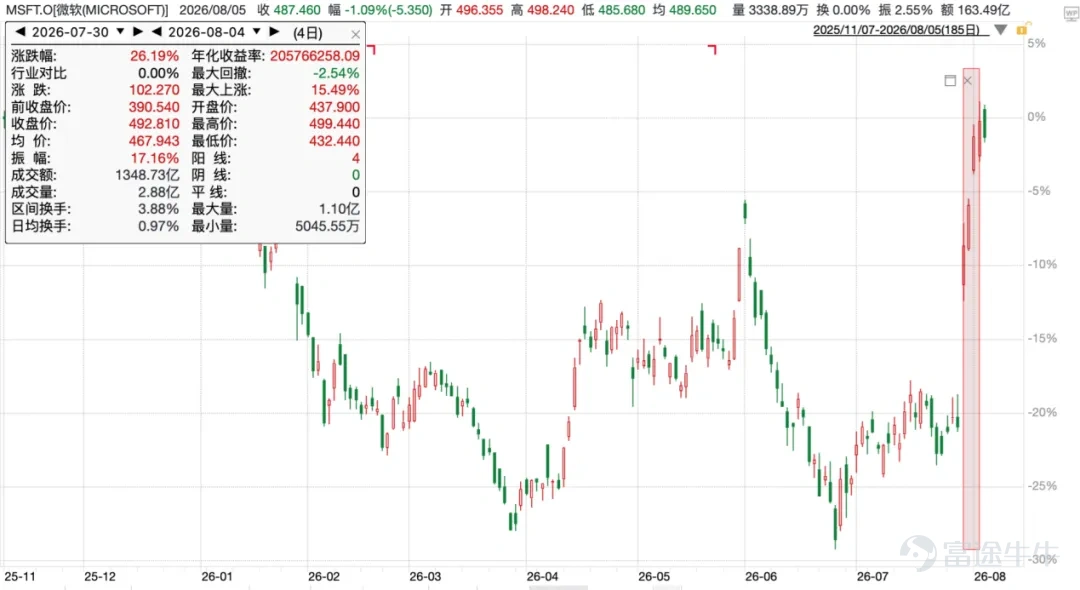
Buoyed by this news, Microsoft’s share price surged 15.51% the day after its earnings release, setting a record for the largest single-day increase in market capitalization. Over the next three trading days, the stock continued to climb, rising more than 25% cumulatively and adding nearly $1 trillion to its market value in just a few days.
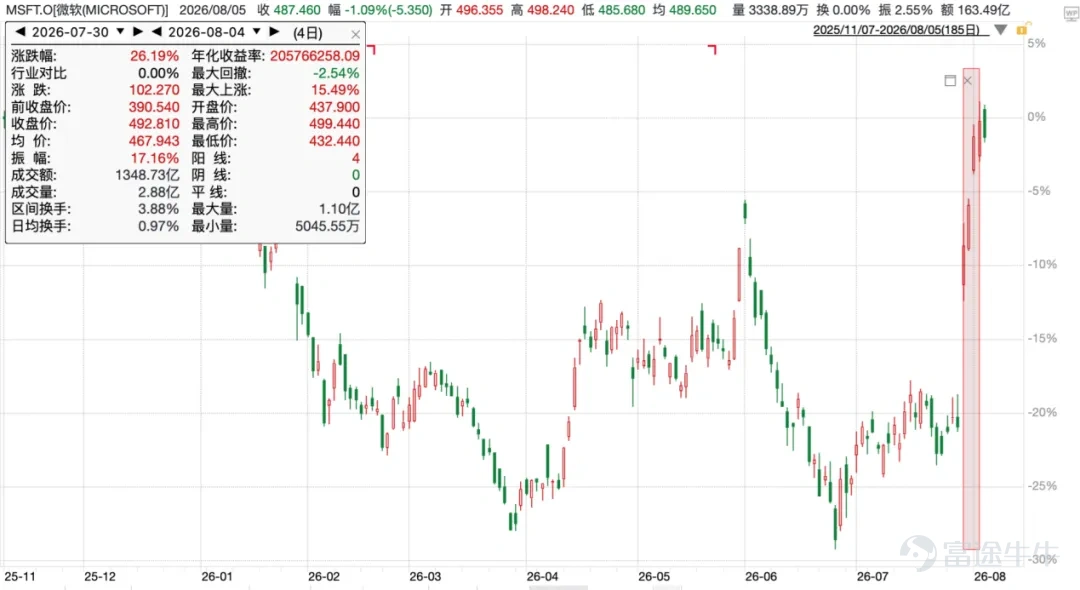
Chart: Microsoft’s stock performance following earnings release Data source: Wind, compiled by 36Kr
So, what’s driving Microsoft’s reduced capital expenditure outlook? And why does Wall Street favor Microsoft more?
Has Microsoft hit the brakes?
This quarter, the most closely watched aspect of Microsoft’s earnings report was its announcement that, starting next quarter, it will extend the estimated useful life of its data centers and office buildings from 15 years to 25 years. Due to this change in useful life assumptions, many data centers and office buildings will be reclassified from finance leases to operating leases, leading Microsoft to lower its projected capital expenditures for calendar year 2026 from approximately $190 billion to $175 billion.
Against the backdrop of heightened market anxiety that the AI compute arms race is eroding free cash flow, Microsoft’s downward revision has clearly alleviated investors’ pessimistic expectations.
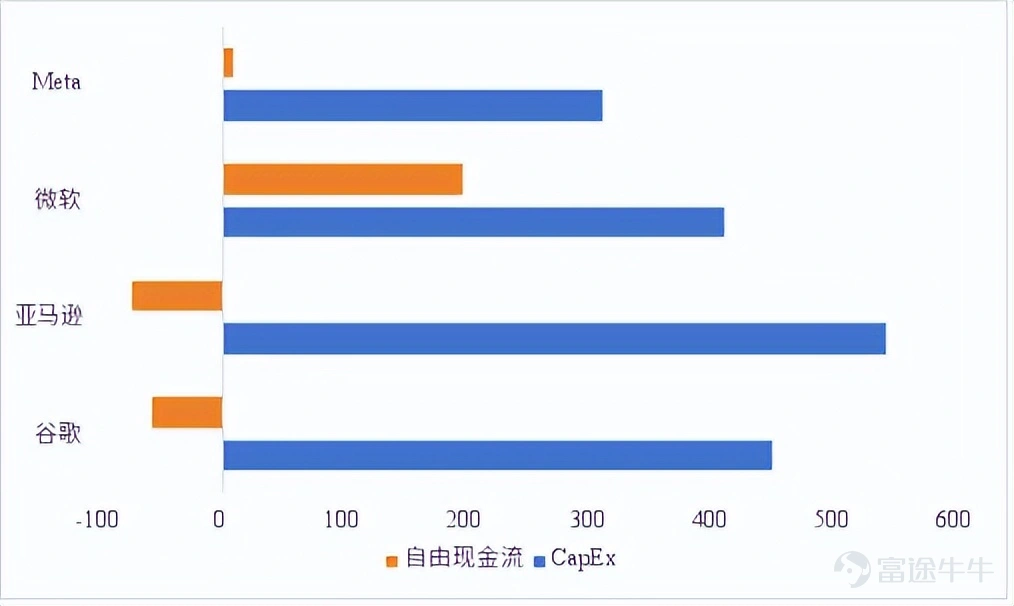
Chart: Comparison of capital expenditures and free cash flow among the Big Four in North America. Data source: Wind, compiled by 36Kr
Some investors believe that extending the accounting estimate for asset useful lives implies that the overall service life of AI computing infrastructure will lengthen, potentially reducing the rigidity of future capital expenditure requirements and supporting more stable cash flows and improved fundamentals going forward.
But is that really the case?
During its post-earnings call, Microsoft disclosed the specific allocation of its capital expenditures, with two-thirds directed toward short-lived core computing assets such as CPUs, GPUs, servers, and high-speed networking equipment.
However, the recent change in accounting estimates applies specifically to long-lived assets like office buildings and data centers. Microsoft’s previous 15-year useful life assumption was already conservative relative to industry norms, and this adjustment primarily aligns the company with prevailing industry practices.
This creates a financial paradox in AI infrastructure: support facilities such as office buildings, data centers, and cooling systems are used longer and longer, while the iteration cycle of chips—the core of computing power—continues to shorten. Crucially, it is precisely these shortest-lived chip assets that dictate the intensity of capital spending by tech giants.
Amid fierce competition among tech giants, none are likely to slow down the pace of GPU and other chip asset iteration and retirement at this stage, as they all pursue peak model performance and computing advantages. This means that unless the prisoner's dilemma is resolved, capital expenditure intensity among these giants is unlikely to diminish.
In other words, Microsoft’s move does not represent an abrupt halt to AI investment; rather, it uses an 'accounting maneuver' to dilute depreciation on paper, thereby offsetting the cash flow impact of massive chip purchases. This serves as the best possible 'financial bulletproof vest' to calm market anxiety without scaling back its computing capacity expansion.
In fact, this change in accounting estimates will not improve expectations for Microsoft’s future cash flows; on the contrary, it will somewhat weigh on its reported financial performance.
The underlying logic is that under finance lease accounting, lease payments are split into principal and interest. The interest portion is included in operating cash flow, while the larger principal portion is classified as financing cash flow and thus does not affect free cash flow. Consequently, under the original accounting treatment, outflows from operating cash flow were smaller, resulting in relatively higher reported free cash flow.
However, under operating lease accounting, the full amount of routine lease payments over the lease term must be recorded as outflows from operating cash flow, thereby exacerbating the reported pressure on Microsoft’s future free cash flow.
Of course, although this adjustment does not mean Microsoft will reduce the intensity of its capital expenditures, it is undeniable that it will create spillover effects for Microsoft across other financial statement dimensions:
First, finance lease depreciation and interest expenses exhibit a 'front-loaded' pattern—higher upfront and tapering off later—whereas operating leases use the straight-line method. As Microsoft transitions between the two, its lease-related expense outflows in the early periods become smoother, helping to stabilize and optimize its near-to-medium-term operating profit margin;
Second, given the extremely rapid iteration cycles in data center architecture today, compute assets face significant impairment risk. By shifting to operating leases, Microsoft no longer holds ownership and thus avoids potential depreciation and impairment pressures, enhancing the long-term stability of its earnings;
Third, under operating leases, Microsoft can leverage massive computing power with a lighter asset base, thereby improving key efficiency metrics such as overall asset turnover and return on total assets.
Why is Wall Street more bullish on Microsoft?
So, why does Wall Street favor Microsoft?
In fact, compared to the past two years—when the industry was in an early, aggressive phase focused purely on raw computing power and models—this quarter has seen a clear shift: Wall Street is now placing greater emphasis on the quality of cloud giants’ earnings reports. At its core, investors are seeking to validate one critical question: When, and at what pace, will the hundreds of billions of dollars in capital expenditures made by these giants translate into incremental profits?
Currently, Microsoft’s AI monetization logic appears significantly stronger than that of its competitors. According to the latest quarterly financial results, Microsoft Azure and other cloud services revenue (on a constant currency basis) surged by 43%. On the application side, revenue from the 'Productivity and Business Processes' segment—which includes Office 365 Commercial and Copilot—grew 14% year-over-year, while paid Microsoft 365 Copilot seats surpassed 30 million, doubling within the quarter. More importantly, its pricing model has expanded beyond per-seat subscriptions to include usage-based charges, meaning future Copilot growth could be driven jointly by increases in both seat count and average revenue per user.
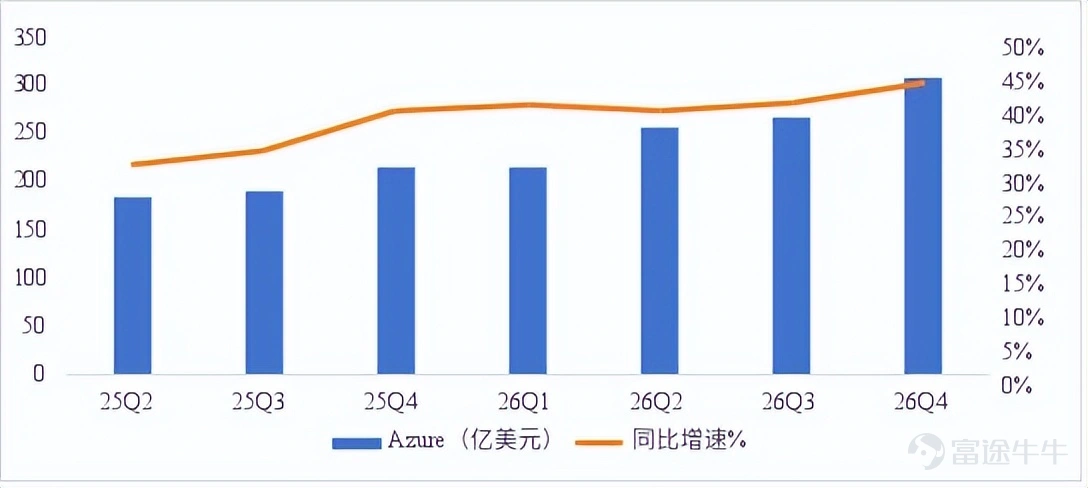
Chart: Microsoft Azure Revenue and Growth Rate Source: Wind, 36Kr compilation
Looking ahead, Microsoft’s commercial Remaining Performance Obligations (cRPO) soared 84% year-over-year this quarter, reaching $678 billion. This massive order backlog has significantly enhanced the company’s earnings visibility for the future.
Microsoft’s AI monetization logic is smoother primarily because its classic B2B model inherently offers cost and use-case advantages. Under this model, Microsoft holds a large base of long-term contracts, enabling it to upgrade existing products and increase average revenue per customer by simply adding AI modules—without needing to drive massive AI traffic acquisition, engage in customer churn, or compete fiercely for new users. Moreover, compared to individual users’ trial-driven demand, enterprise demand for AI centers on productivity gains, resulting in stronger willingness to pay and better retention.
More importantly, while tech giants are still vying for AI traffic gateways, Microsoft has already established a closed loop linking its upper-layer software with its lower-layer cloud computing services. This is critical because it means Microsoft’s cloud growth is no longer solely driven by infrastructure expansion; the opening of application-layer monetization pathways has enhanced its overall return on assets to some extent.
On the front end, Microsoft embedded Copilot into its existing Office productivity ecosystem, achieving AI penetration at the software application layer without altering user habits. The high-margin SaaS seat fees from this segment provide Microsoft with exceptionally robust and stable annual recurring revenue (ARR).
On the back end, every time users invoke Copilot to summarize documents or analyze data—or when developers use GitHub Copilot to write code—each interaction, along with data hosting and retrieval, is processed through Azure’s intelligent cloud server infrastructure, translating directly into IaaS and PaaS computing revenue for Azure.
By comparison, other tech giants exhibit structural gaps or frictions in their AI monetization value chains. Amazon lacks a dominant B2B software gateway, tying its AI monetization strictly to AWS’s underlying compute leasing. It can only profit from selling compute capacity and hosting models, lacking high-margin applications on the upper layer—a constraint that limits its commercial upside.
Google, while possessing Workspace, relies primarily on its traditional search advertising business for core revenue—a stream increasingly at risk of erosion from AI-driven interaction models, which heightens valuation friction costs.
Meta finds itself in an even more passive position: it lacks both a commercial public cloud infrastructure and a mature, enterprise-facing super-app gateway. For now, it can only indirectly enhance AI monetization by optimizing algorithms to improve legacy businesses. However, due to this circuitous path and the inability to directly quantify ROI, it continues to struggle for favor on Wall Street.
Market-driven defensive selection
Overall, in the second half of the AI race, the ultimate battleground among tech giants has shifted from high-growth narratives to a comprehensive test of capital allocation efficiency, commercialization closure, and financial resilience.
Microsoft’s recent rally appears on the surface to stem from solid earnings and an accounting estimate change—both of which triggered market sensitivity to free cash flow and improved expectations around the sustainability of its growth. Yet more fundamentally, it reflects the market’s recognition of Microsoft’s uniquely visible and robust AI monetization capability under its distinctive business model.
In the current high-pressure environment of continuously rising capital expenditures, a stable, clear, and verifiable AI commercialization loop enables Microsoft to better balance AI growth, earnings stability, capital investment, and cash flow—significantly enhancing its resilience to risk.
From this perspective, Wall Street's 'preference' for Microsoft is fundamentally a rational, comparative choice driven by defensive positioning. If the AI arms race inevitably forces tech giants to bleed in the short term, then the company that bleeds the least, recovers the fastest, and has the most transparent commercialization path will naturally become the preferred safe haven.
*Disclaimer:
The content of this article represents the author’s views only.
Investing involves risks, and caution is advised. Under no circumstances does the information or opinions expressed herein constitute investment advice for any individual. Investors should consult qualified professionals and exercise due diligence before making any investment decisions. We do not intend to provide underwriting services or any services that require specific qualifications or licenses.
Risk Disclaimer: The above content only represents the author's view. It does not represent any position or investment advice of Futu. Futu makes no representation or warranty.Read more

Comments
to post a comment
1