English
Back
Open Account
Hong Kong stocks are rebounding—what sectors deserve attention?

慢慢变富的牛牛
joined discussion · ·

ETF Showdown | Beyond Tech: New Options? A Guide to Global Healthcare and Innovative Drug ETFs

Recently, tech stocks have seen increased volatility, while healthcare, biotech, and innovative drug sectors are once again attracting investor attention.
The U.S. healthcare sector is benefiting from improved earnings, industry consolidation, and investors seeking allocations beyond tech stocks; meanwhile, China’s innovative drug sector continues to benefit from overseas licensing deals (license-out), product commercialization, and expectations of valuation recovery.
For investors who don’t want to analyze individual new drugs, clinical trial data, or single companies, ETFs offer a simpler way to gain exposure to the healthcare rally. However, there are significant differences among 'healthcare ETFs'—investors should first clarify whether they’re buying into large-cap healthcare giants or highly volatile innovative drug firms.
If your primary goal is reducing concentration in tech stocks versus capturing a rebound in innovative drugs, the suitable ETFs are actually completely different.
For relatively stable exposure, consider XLV and VHT first.
XLV: Focused on large-cap healthcare leaders
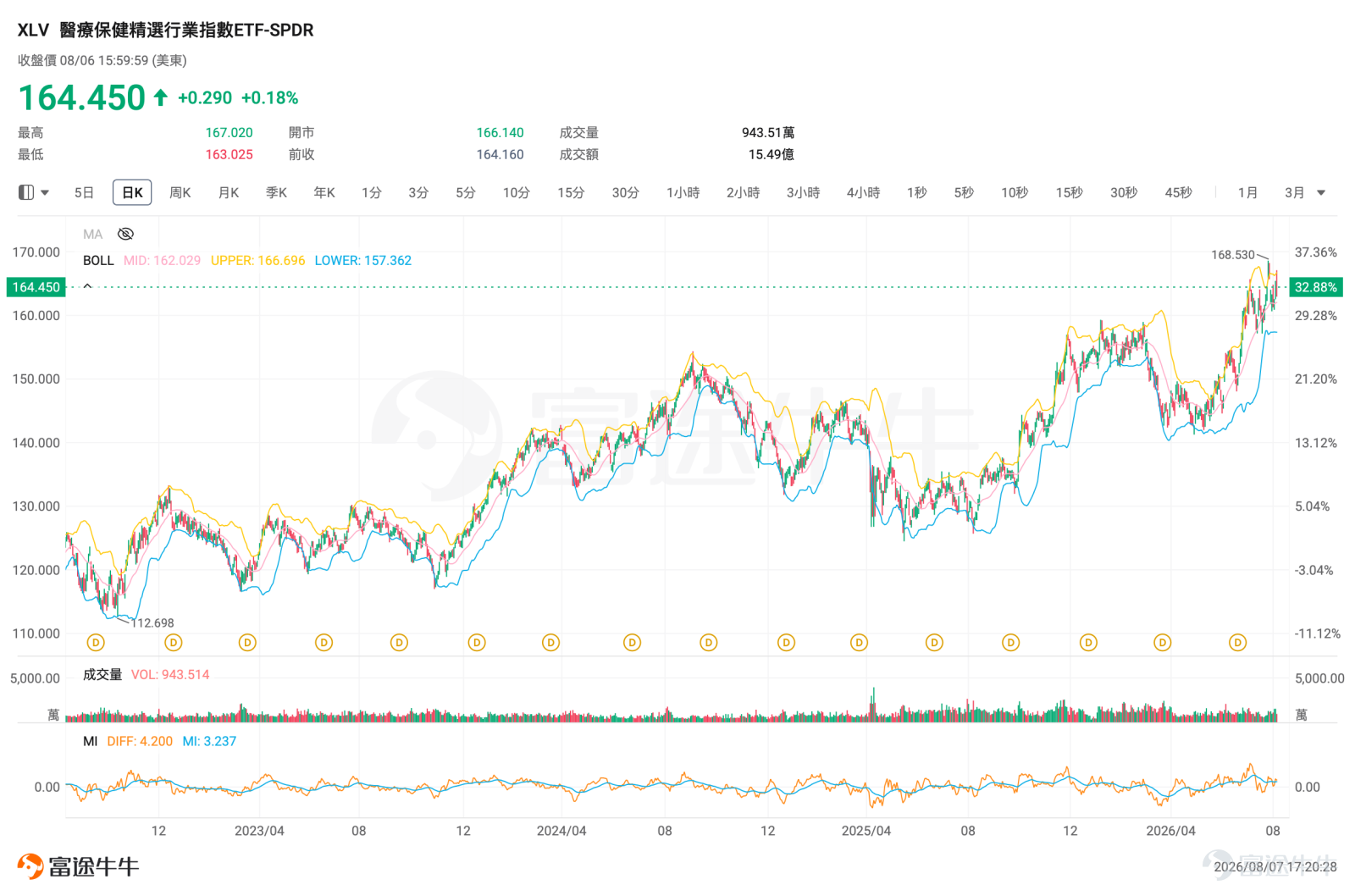
$The Health Care Select Sector SPDR® Fund (XLV.US)$ is one of the most representative healthcare ETFs in the U.S. market, primarily investing in large-cap healthcare companies within the S&P 500, including pharmaceuticals, biotechnology, medical devices, and healthcare services firms.
Its core holdings include Eli Lilly and Co, Johnson & Johnson, and AbbVie.
XLV's biggest feature isa higher concentration of large, mature companies, with many companies generating stable revenue and cash flow; compared to pure innovative drug ETFs, its overall volatility is generally lower.
If you're looking to add a more defensive sector allocation beyond tech stocks, XLV is a straightforward choice.
Recently, tech stocks have seen increased volatility, while healthcare, biotech, and innovative drug sectors are once again attracting investor attention. The U.S. healthcare sector is benefiting from improved earnings, industry consolidation, and investors seeking allocations beyond tech stocks; meanwhile, China’s innovative drug sector continues to benefit from overseas licensing deals (license-out), product commercialization, and expectations of valuation recovery. For investors who don’t want to analyze individual new drugs, clinical trial data, or single companies, ETFs offer a simpler way to gain exposure to the healthcare rally. However, there are significant differences among 'healthcare ETFs'—investors should first clarify whether they’re buying into large-cap healthcare giants or highly volatile innovative drug firms. If your primary goal is reducing concentration in tech stocks versus capturing a rebound in innovative drugs, the suitable ETFs are actually completely different. For relatively stable exposure, consider XLV and VHT first. XLV: Focused on large-cap healthcare leaders $The Health Care Select Sector SPDR® Fund (XLV.US)$ is one of the most representative healthcare ETFs in the U.S. market, primarily investing in large-cap healthcare companies within the S&P 500, including pharmaceuticals, biotechnology, medical devices, and healthcare services firms. Its core holdings include Eli Lilly and Co, Johnson & Johnson, and AbbVie. XLV's biggest feature isa higher concentration of large, mature companies, many of which already generate stable revenue and cash flow, compared to pure innovative drug ETFs...
VHT: Broader exposure to U.S. healthcare companies
$Vanguard Health Care ETF (VHT.US)$ has a broader investment scope than XLV, including not only large-cap healthcare companies but also more small- and mid-cap biotech, medical device, and healthcare service firms.
In simple terms:XLV leans toward large-cap leaders, whereas VHT more closely represents the 'entire U.S. healthcare market.'Their large-cap holdings overlap significantly, so it’s usually unnecessary to hold substantial positions in both ETFs simultaneously.
Recently, tech stocks have seen increased volatility, while healthcare, biotech, and innovative drug sectors are once again attracting investor attention. The U.S. healthcare sector is benefiting from improved earnings, industry consolidation, and investors seeking allocations beyond tech stocks; meanwhile, China’s innovative drug sector continues to benefit from overseas licensing deals (license-out), product commercialization, and expectations of valuation recovery. For investors who don’t want to analyze individual new drugs, clinical trial data, or single companies, ETFs offer a simpler way to gain exposure to the healthcare rally. However, there are significant differences among 'healthcare ETFs'—investors should first clarify whether they’re buying into large-cap healthcare giants or highly volatile innovative drug firms. If your primary goal is reducing concentration in tech stocks versus capturing a rebound in innovative drugs, the suitable ETFs are actually completely different. For relatively stable exposure, consider XLV and VHT first. XLV: Focused on large-cap healthcare leaders $The Health Care Select Sector SPDR® Fund (XLV.US)$ is one of the most representative healthcare ETFs in the U.S. market, primarily investing in large-cap healthcare companies within the S&P 500, including pharmaceuticals, biotechnology, medical devices, and healthcare services firms. Its core holdings include Eli Lilly and Co, Johnson & Johnson, and AbbVie. XLV's biggest feature isa higher concentration of large, mature companies, many of which already generate stable revenue and cash flow, compared to pure innovative drug ETFs...
For exposure to global large-cap pharmaceutical companies, consider IXJ.
$Ishares Global Healthcare Etf (IXJ.US)$ provides global exposure to the healthcare sector.
In addition to U.S. companies, it also includes large pharmaceutical and healthcare firms from markets such as Europe and Japan, including global drugmakers based in Switzerland, the UK, Denmark, and other regions.
However, a 'global ETF' does not imply equal allocation across all markets. Since large-cap healthcare companies globally are still predominantly U.S.-listed, IXJ maintains a relatively high U.S. weighting.
Therefore, IXJ is better suited for investors seeking exposure to large-cap pharmaceutical companies in Europe and Japan in addition to U.S. healthcare stocks.
Recently, tech stocks have seen increased volatility, while healthcare, biotech, and innovative drug sectors are once again attracting investor attention. The U.S. healthcare sector is benefiting from improved earnings, industry consolidation, and investors seeking allocations beyond tech stocks; meanwhile, China’s innovative drug sector continues to benefit from overseas licensing deals (license-out), product commercialization, and expectations of valuation recovery. For investors who don’t want to analyze individual new drugs, clinical trial data, or single companies, ETFs offer a simpler way to gain exposure to the healthcare rally. However, there are significant differences among 'healthcare ETFs'—investors should first clarify whether they’re buying into large-cap healthcare giants or highly volatile innovative drug firms. If your primary goal is reducing concentration in tech stocks versus capturing a rebound in innovative drugs, the suitable ETFs are actually completely different. For relatively stable exposure, consider XLV and VHT first. XLV: Focused on large-cap healthcare leaders $The Health Care Select Sector SPDR® Fund (XLV.US)$ is one of the most representative healthcare ETFs in the U.S. market, primarily investing in large-cap healthcare companies within the S&P 500, including pharmaceuticals, biotechnology, medical devices, and healthcare services firms. Its core holdings include Eli Lilly and Co, Johnson & Johnson, and AbbVie. XLV's biggest feature isa higher concentration of large, mature companies, many of which already generate stable revenue and cash flow, compared to pure innovative drug ETFs...
For greater flexibility: IBB and XBI
If your outlook is not on the entire healthcare sector, but rather on innovative drugs and biotech market trends,IBB and XBIare more direct choices.
IBB: Focused on large-cap biotech
$iShares Biotechnology ETF (IBB.US)$ primarily holds larger-cap biotechnology companies.
Many companies already have approved drugs on the market, generating revenue and even profits, making their fundamentals relatively more mature compared to the numerous small biotech firms still in clinical stages.
If you wish to participate in the biotech rally but want to avoid excessive exposure to the risks of small-cap pharma companies, IBB offers a more balanced approach.
Recently, tech stocks have seen increased volatility, while healthcare, biotech, and innovative drug sectors are once again attracting investor attention. The U.S. healthcare sector is benefiting from improved earnings, industry consolidation, and investors seeking allocations beyond tech stocks; meanwhile, China’s innovative drug sector continues to benefit from overseas licensing deals (license-out), product commercialization, and expectations of valuation recovery. For investors who don’t want to analyze individual new drugs, clinical trial data, or single companies, ETFs offer a simpler way to gain exposure to the healthcare rally. However, there are significant differences among 'healthcare ETFs'—investors should first clarify whether they’re buying into large-cap healthcare giants or highly volatile innovative drug firms. If your primary goal is reducing concentration in tech stocks versus capturing a rebound in innovative drugs, the suitable ETFs are actually completely different. For relatively stable exposure, consider XLV and VHT first. XLV: Focused on large-cap healthcare leaders $The Health Care Select Sector SPDR® Fund (XLV.US)$ is one of the most representative healthcare ETFs in the U.S. market, primarily investing in large-cap healthcare companies within the S&P 500, including pharmaceuticals, biotechnology, medical devices, and healthcare services firms. Its core holdings include Eli Lilly and Co, Johnson & Johnson, and AbbVie. XLV's biggest feature isa higher concentration of large, mature companies, many of which already generate stable revenue and cash flow, compared to pure innovative drug ETFs...
XBI: Higher upside potential from small- and mid-cap innovative drug companies
$SPDR S&P Biotech ETF (XBI.US)$ uses a weighting methodology closer to equal-weighting, giving greater influence to small- and mid-cap biotech companies.
XBI is typically more sensitive to the following factors: interest rates and financing conditions; large pharma M&A activity; FDA approvals; clinical trial data; and overall biotech market risk appetite.
When market sentiment improves, XBI usually exhibits higher elasticity; however, during periods of deteriorating financing conditions or declining risk appetite, its drawdowns can also be more pronounced.
This can be simply understood as:XLV leans defensive, IBB focuses more on large-cap biotech, while XBI tilts toward high-beta innovative drug plays.
Recently, tech stocks have seen increased volatility, while healthcare, biotech, and innovative drug sectors are once again attracting investor attention. The U.S. healthcare sector is benefiting from improved earnings, industry consolidation, and investors seeking allocations beyond tech stocks; meanwhile, China’s innovative drug sector continues to benefit from overseas licensing deals (license-out), product commercialization, and expectations of valuation recovery. For investors who don’t want to analyze individual new drugs, clinical trial data, or single companies, ETFs offer a simpler way to gain exposure to the healthcare rally. However, there are significant differences among 'healthcare ETFs'—investors should first clarify whether they’re buying into large-cap healthcare giants or highly volatile innovative drug firms. If your primary goal is reducing concentration in tech stocks versus capturing a rebound in innovative drugs, the suitable ETFs are actually completely different. For relatively stable exposure, consider XLV and VHT first. XLV: Focused on large-cap healthcare leaders $The Health Care Select Sector SPDR® Fund (XLV.US)$ is one of the most representative healthcare ETFs in the U.S. market, primarily investing in large-cap healthcare companies within the S&P 500, including pharmaceuticals, biotechnology, medical devices, and healthcare services firms. Its core holdings include Eli Lilly and Co, Johnson & Johnson, and AbbVie. XLV's biggest feature isa higher concentration of large, mature companies, many of which already generate stable revenue and cash flow, compared to pure innovative drug ETFs...
Bullish on gene technology: ARKG, IDNA
For investors seeking exposure to more cutting-edge healthcare technologies, the market also offers $ARK Genomic Revolution ETF (ARKG.US)$$Ishares Gold Trust Genomics Immunology And Healthcare Etf (IDNA.US)$ genomics and precision medicine ETFs such as these.
These products primarily focus on areas such as gene editing, gene sequencing, immunotherapy, and precision medicine.
The advantage is exposure to multiple cutting-edge technologies in a single investment; however, many of the underlying companies are still in the R&D or early commercialization stages, resulting in low earnings visibility, and their stock prices are highly sensitive to clinical trial results, financing activities, and valuation changes.
Therefore, these ETFs are better suited for thematic allocation and typically carry higher risk than traditional healthcare ETFs like XLV and VHT.
Hong Kong-listed Innovative Drug ETFs: 3069, 2820
One of the core market themes for Chinese innovative drugs in recent years isOverseas licensing (License-out)
An increasing number of Chinese pharmaceutical companies are licensing overseas rights to their independently developed drugs to large multinational pharma firms, gradually converting R&D capabilities into commercial value through upfront payments, milestone payments, and future sales royalties.
Hong Kong equity investors should pay close attention to two products:
3069: More concentrated exposure to Hong Kong-listed biotech
$ChinaAMC Hang Seng Biotech ETF (03069.HK)$ primarily tracks Hong Kong-listed biotech and innovative drug companies. Core holdings include Innovent Bio, BeiGene, Wuxi Bio, Akeso, and Wuxi Apptec.
If you are bullish on Hong Kong-listed 18A biotech firms, innovative drug license-out deals, and valuation recovery in the Hong Kong biotech sector, 3069 offers a relatively direct exposure.
Recently, tech stocks have seen increased volatility, while healthcare, biotech, and innovative drug sectors are once again attracting investor attention. The U.S. healthcare sector is benefiting from improved earnings, industry consolidation, and investors seeking allocations beyond tech stocks; meanwhile, China’s innovative drug sector continues to benefit from overseas licensing deals (license-out), product commercialization, and expectations of valuation recovery. For investors who don’t want to analyze individual new drugs, clinical trial data, or single companies, ETFs offer a simpler way to gain exposure to the healthcare rally. However, there are significant differences among 'healthcare ETFs'—investors should first clarify whether they’re buying into large-cap healthcare giants or highly volatile innovative drug firms. If your primary goal is reducing concentration in tech stocks versus capturing a rebound in innovative drugs, the suitable ETFs are actually completely different. For relatively stable exposure, consider XLV and VHT first. XLV: Focused on large-cap healthcare leaders $The Health Care Select Sector SPDR® Fund (XLV.US)$ is one of the most representative healthcare ETFs in the U.S. market, primarily investing in large-cap healthcare companies within the S&P 500, including pharmaceuticals, biotechnology, medical devices, and healthcare services firms. Its core holdings include Eli Lilly and Co, Johnson & Johnson, and AbbVie. XLV's biggest feature isa higher concentration of large, mature companies, many of which already generate stable revenue and cash flow, compared to pure innovative drug ETFs...
2820: Broader coverage of Chinese biotech
$Global X China Biotech ETF (02820.HK)$ It has broader coverage, not limited solely to the Hong Kong stock market, and can also include Chinese biotech companies listed in other markets. As of the end of July 2026, the fund's net asset value was approximately HK$637 million, with a management fee of about 0.68%.
3069 is more focused on Hong Kong-listed innovative drug companies, whereas 2820 leans toward the entire Chinese biotech industry.
Healthcare is often viewed as a defensive sector, butThe risk profiles of different healthcare ETFs can vary significantly.
Overall, XLV and VHT primarily hold established large-cap companies and are generally more stable; in contrast, XBI, ARKG, and Hong Kong innovative drug ETFs are more susceptible to clinical trial results, drug approvals, financing conditions, and market sentiment, typically exhibiting higher volatility.
Additionally, different ETFs may hold significant overlap in their underlying companies—buying multiple ETFs does not necessarily provide true diversification. ETFs can mitigate single-stock risk, but they cannot eliminate sector-wide risk.
How do price movements differ across various ETFs? Use Futubull’s ETF tools to effectively compare product differences:
Recently, tech stocks have seen increased volatility, while healthcare, biotech, and innovative drug sectors are once again attracting investor attention. The U.S. healthcare sector is benefiting from improved earnings, industry consolidation, and investors seeking allocations beyond tech stocks; meanwhile, China’s innovative drug sector continues to benefit from overseas licensing deals (license-out), product commercialization, and expectations of valuation recovery. For investors who don’t want to analyze individual new drugs, clinical trial data, or single companies, ETFs offer a simpler way to gain exposure to the healthcare rally. However, there are significant differences among 'healthcare ETFs'—investors should first clarify whether they’re buying into large-cap healthcare giants or highly volatile innovative drug firms. If your primary goal is reducing concentration in tech stocks versus capturing a rebound in innovative drugs, the suitable ETFs are actually completely different. For relatively stable exposure, consider XLV and VHT first. XLV: Focused on large-cap healthcare leaders $The Health Care Select Sector SPDR® Fund (XLV.US)$ is one of the most representative healthcare ETFs in the U.S. market, primarily investing in large-cap healthcare companies within the S&P 500, including pharmaceuticals, biotechnology, medical devices, and healthcare services firms. Its core holdings include Eli Lilly and Co, Johnson & Johnson, and AbbVie. XLV's biggest feature isa higher concentration of large, mature companies, many of which already generate stable revenue and cash flow, compared to pure innovative drug ETFs...
The Futu Wealth Creation Conference on August 8, 2026, is coming soon! Join thousands offline to explore investment opportunities for the next decade together.
This event has invited multipleTop investment experts, renowned economists, and million-follower financial KOLs will be onsite to share wealth-building opportunities face-to-face.
Interested fellow investors canClick here to register and claim your ticket >>Seats are limited—first come, first served!
Recently, tech stocks have seen increased volatility, while healthcare, biotech, and innovative drug sectors are once again attracting investor attention. The U.S. healthcare sector is benefiting from improved earnings, industry consolidation, and investors seeking allocations beyond tech stocks; meanwhile, China’s innovative drug sector continues to benefit from overseas licensing deals (license-out), product commercialization, and expectations of valuation recovery. For investors who don’t want to analyze individual new drugs, clinical trial data, or single companies, ETFs offer a simpler way to gain exposure to the healthcare rally. However, there are significant differences among 'healthcare ETFs'—investors should first clarify whether they’re buying into large-cap healthcare giants or highly volatile innovative drug firms. If your primary goal is reducing concentration in tech stocks versus capturing a rebound in innovative drugs, the suitable ETFs are actually completely different. For relatively stable exposure, consider XLV and VHT first. XLV: Focused on large-cap healthcare leaders $The Health Care Select Sector SPDR® Fund (XLV.US)$ is one of the most representative healthcare ETFs in the U.S. market, primarily investing in large-cap healthcare companies within the S&P 500, including pharmaceuticals, biotechnology, medical devices, and healthcare services firms. Its core holdings include Eli Lilly and Co, Johnson & Johnson, and AbbVie. XLV's biggest feature isa higher concentration of large, mature companies, many of which already generate stable revenue and cash flow, compared to pure innovative drug ETFs...
Risk Disclaimer: The above content only represents the author's view. It does not represent any position or investment advice of Futu. Futu makes no representation or warranty.Read more
Thumbs Up
25
Respect
1
139K Views
Report
Comments
Write a Comment...
26
64