Optical communication stocks lead the rebound; will the AI optical cycle continue?

Earnings Options Playbook | AI Infrastructure Enabler Lumentum’s Earnings Countdown: Capacity Shortfalls Meet the 'Optical Module Ban'—What Should You Watch Most Closely?
After U.S. market hours on August 11 (Eastern Time), $Lumentum (LITE.US)$ the company will report its Q4 and full-year fiscal 2026 results. For investors focused on the AI optical communications supply chain, there is pressure to deliver on institutional expectations of year-over-year revenue doubling on one hand, while core components remain in a supply-demand gap on the other.
Following Reuters’ exclusive report on August 4 that the Trump administration was considering banning imports of new optical modules made in China, the market has already priced in the 'beneficiary expectation.' This earnings season, investors are watching whether Lumentum can stand firm between management’s commentary and production capacity realities.
I. Market Consensus: Revenue Expected to Double Year-over-Year
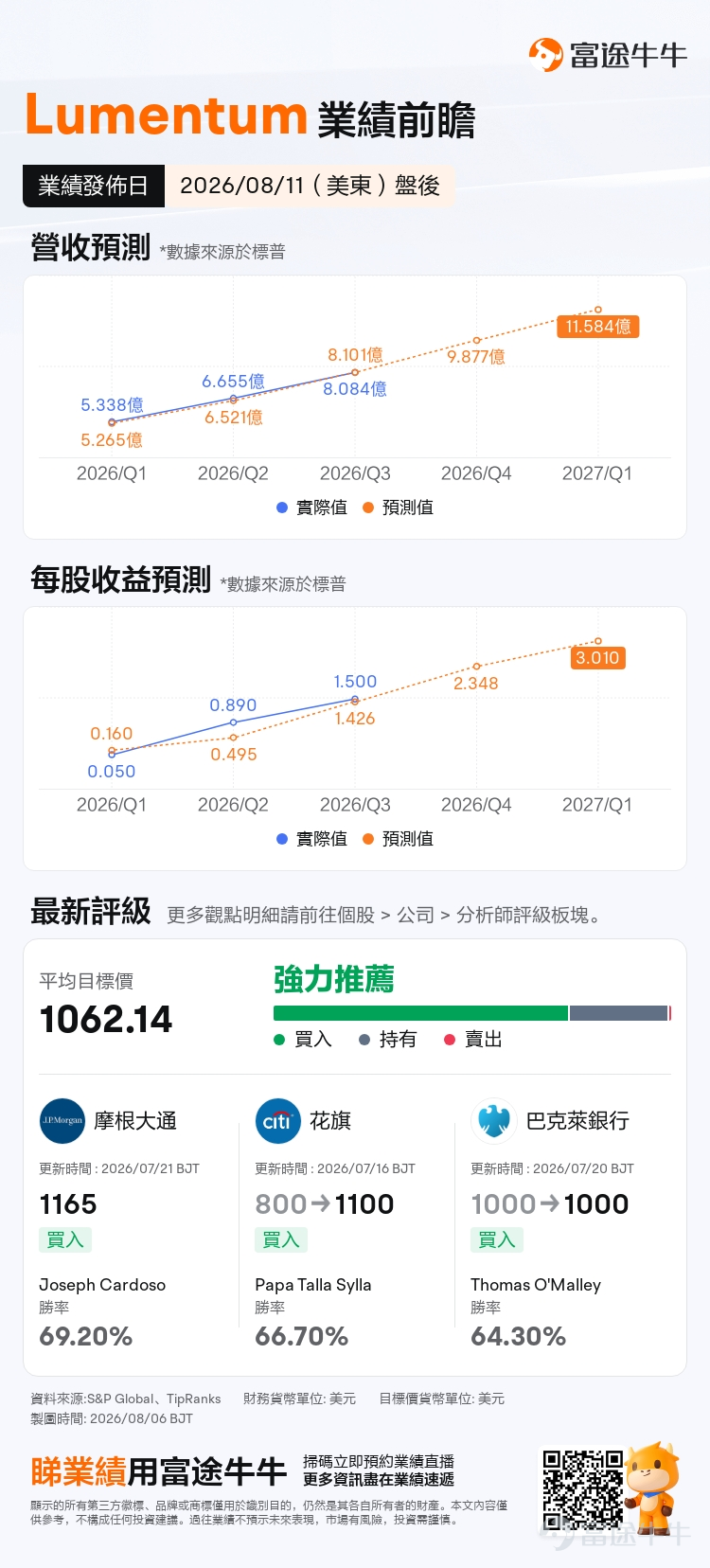
According to consensus analyst estimates (US-GAAP), $Lumentum (LITE.US)$ Q4 fiscal 2026 revenue is expected to reach approximately $988 million, an increase of about 105.47% year-over-year; EPS is forecast at approximately $2.35, down roughly 20.68% year-over-year.

From a retail investor’s perspective, these figures can be misleading: why is EPS declining despite revenue doubling? This discrepancy stems from accounting treatments—under GAAP, stock-based compensation, acquisition-related amortization, and one-time items are all included. Short-term profit margin volatility is common in the optical modules and photonic components sector. What the market truly prices in areorder visibility, gross margin trends, and whether next-quarter guidance continues to be raised.
Compared to the company’s prior Q4 guidance of $960–1,010 million in revenue and Non-GAAP EPS of $2.85–3.05, this outlook indicates that operations remain on an expansion trajectory. Therefore, investors must clearly distinguish between GAAP and Non-GAAP metrics when reviewing earnings reports to avoid being misled by a single reporting standard.
Investors with existing positions or planning to establish new ones should not only monitor whether Lumentum’s revenue falls at the high end of guidance, whether gross margin/operating expenses are spiraling out of control, and whether next quarter’s outlook aligns with expected financial figures, but also pay attention to the following information potentially disclosed during the earnings call.
II. Key Focus Areas in Earnings Report: Ramp-up Timelines of Three Strategic Product Lines and Narratives Related to the 'Optical Module Export Restriction'
1. Ramp-up Timelines of the Three Strategic Product Lines
The market is closely watching the ramp-up timelines of several business lines that are expected to drive$Lumentum (LITE.US)$earnings upside—optical circuit switches (OCS), co-packaged optics (CPO), and 1.6T high-speed optical modules.
- Ramp-up progress of 1.6T optical modules and CPO:The company has clearly stated that 1.6T optical modules will enter volume production in the fourth fiscal quarter, and its CPO-related products will begin mass shipments to customers such as $NVIDIA (NVDA.US)$ in the second half of 2026. The market will focus on these new products’ revenue contribution, gross margin levels, and whether capacity ramp-up proceeds smoothly.
- Volume ramp-up timeline for OCS:OCS operations are viewed as key to long-term growth, with the company’s order backlog surpassing $400 million and a target to achieve $100 million in quarterly revenue by the end of 2026. Investors will closely monitor delivery progress and new customer acquisition for this business.
During last quarter’s earnings conference calls, management teams across major North American optical module vendors uniformly emphasized that supply capacity is far outstripped by customer demand, with insufficient production capacity now serving as the core bottleneck limiting growth.Lasers—particularly indium phosphide-based EMLs, pump lasers, and CW lasers—are currently the tightest segment in the supply chain.
During the Q3 earnings call in May, $Lumentum (LITE.US)$ the CEO explicitly stated, 'Orders are already booked into 2028.' Regarding capacity constraints, the current supply gap for the company’s products—especially EML lasers and pump lasers—exceeds 30%.The market may press management on their outlook for the supply-demand gap, the ramp-up timeline for new capacity (such as the recently acquired new factory in North Carolina), and how long-term supply agreements will support capital expenditures.
Beyond the aforementioned fundamentals—such as OCS orders, CPO progress, or EML chip shipment volumes—the market is also closely watching a recent new variable: rumors that the Trump administration is considering banning imports of new optical modules made in China.
2. Narrative Around the 'Optical Module Ban'
On August 4, Reuters exclusively reported that the Trump administration is drafting a ban that would prohibit the import of new optical modules manufactured in China. Immediately following the report, $Lumentum (LITE.US)$ the stock price surged nearly 9%, as the market quickly priced in a shift in market share from Chinese suppliers to U.S.-based vendors.
However, benefiting from the ban does not equate to immediate financial performance realization; several critical issues must be addressed:
First, production capacity simply cannot keep up. Even if customer orders shift away from Chinese suppliers, U.S. vendors will struggle in the short term to fully replace the shipment volumes of China’s leading optical module manufacturers; Chinese firms account for over 60% of global high-speed optical module capacity, $ZJ INNOLIGHT (03308.HK)$ with one Chinese company alone holding approximately 27% market share in the U.S. datacom optical module market.
Morgan Stanley explicitly noted that current non-Chinese vendors’ production capacity is insufficient to meet the massive demand driven by AI-related capital expenditures. If the policy is implemented, it is more likely to initially cause delivery bottlenecks and cost increases.
Second, raw material constraints remain. $Lumentum (LITE.US)$Indium phosphide—the core raw material—is still partially sourced from Chinese supply chains.This means that efforts to decouple China from the optical communications supply chain could stall right at the first step—its own raw materials.
Third, there is significant uncertainty around actual policy implementation. Citi believes the ban will most likely include exemptions rather than a blanket prohibition, for four key reasons: seven of the world’s top ten optical module makers are Chinese companies, the supply chain is already highly strained, Chinese vendors enjoy cost advantages, and Chinese leaders have already established overseas production capacity.
Reuters also emphasized that the draft could still be revised or even shelved; until formal rules are issued, stock prices trade on expectation gaps, not confirmed regulatory benefits.
Therefore, in this quarter's earnings call, management's assessment of the ban's impact may be more market-sensitive than whether quarterly revenue slightly beats expectations:If management indicates that short-term demand visibility has improved but capacity and supply chains remain constraints, the market may interpret this as limited upside; if they explicitly discuss customer adoption windows and long-term industry reshaping, the narrative could be amplified further.
III. Options Strategy
With earnings season approaching amid policy uncertainty, $Lumentum (LITE.US)$ Implied volatility (IV) is in the moderately high range (67%), with IV absolute value exceeding 100%.

Options market pricing suggests the market expects the stock price to move by approximately 15.01% following this earnings report.

1. Long volatility strategy: Betting on high volatility
Suitable for investors who believe $Lumentum (LITE.US)$ that 'actual post-earnings volatility will exceed expectations,' buying options to capture directional or volatility-driven returns.
- Advantages:Limited risk (maximum loss is the premium paid).
- Disadvantages:Option premiums are relatively expensive; if the stock price moves only mildly or fails to meet expectations after earnings, the premium will significantly erode due to 'time decay' and a decline in 'implied volatility.'
(1) Buy a straddle or strangle:Simultaneously buy a call and a put option with the same expiration date. In a straddle, the call and put have the same strike price, offering a higher probability of profit but at a higher premium cost. In a strangle, the strikes differ, resulting in lower upfront premium but also a lower probability of profit.
If the stock price moves sharply in either direction after earnings, the profit potential is theoretically unlimited, while the maximum loss is limited to the premium paid.

(The design images shown on screen are for illustrative purposes only and do not constitute any investment advice or guarantee; market conditions change rapidly, and displayed prices may not reflect actual market values.)
(2) Directional bet:Based on an outlook for the earnings direction (incorporating prior regulatory tailwinds and fundamental analysis), directly buy a call or put option. However, current volatility levels indicate that options are not cheap.
2. Seller strategies: Harvesting high IV
An implied volatility (IV) above 100% means option sellers can currently collect relatively generous premiums. If an investor believes the market has overestimated the risk of post-earnings volatility, they can profit by selling options.
However, the core risk of this strategy lies in the fact that LITE’s past earnings reports have frequently exceeded the ranges priced into options. Naked short positions or spread strategies with insufficient width may have low win rates, making naked option selling relatively risky. Investors could consider the following two strategies:
(1) Sell a put spread (expressing a mildly bullish view)

(The design images shown on screen are for illustrative purposes only and do not constitute any investment advice or guarantee; market conditions change rapidly, and displayed prices may not reflect actual market values.)
Sell one higher-strike put option and simultaneously buy one lower-strike put option. This is a more conservative approach compared to naked option selling, as it caps the maximum downside risk, though it also limits the maximum upside profit.
2. Covered call writing
For investors already holding $Lumentum (LITE.US)$ Investors who remain optimistic about long-term AI optical interconnect demand but are concerned about heightened volatility around earnings may consider selling call options. If the stock price oscillates repeatedly within a high range, the premium income can help reduce the cost basis of their holdings. If Q4 results materialize and drive the stock price upward enough to trigger assignment, it would effectively realize a阶段性 profit near the current consensus analyst target price (currently $1,062).


(The design images shown on screen are for illustrative purposes only and do not constitute any investment advice or guarantee; market conditions change rapidly, and displayed prices may not reflect actual market values.)
- Trading discipline:Investors attempting short-option strategies should carefully manage position sizing and implement timely stop-loss measures.
Summary
LITE currently sits at a peculiar inflection point: its fundamentals appear relatively certain, yet geopolitical uncertainties loom even larger.
If the ban takes effect, LITE stands to benefit; however, if the market realizes that U.S. suppliers’ capacity constraints may struggle to meet AI infrastructure order demand—or if the policy ultimately ends up significantly watered down—the current 'ban premium' could evaporate. How management characterizes the supply chain realities under the shadow of this potential ban during this earnings call may well become the true anchor for market pricing.
Fellow investors, what do you think LITE's stock price will do after the earnings report is released?Finally, we’ve got a little perk for our fellow investors—feel free to claim it!Options Starter Pack
*This promotion is exclusively available to invited Hong Kong users. Click to learn more.Detailed terms and conditions of the promotion >>

Disclaimer
This content does not constitute an offer, solicitation, recommendation, opinion, or any guarantee regarding any securities, financial products, or instruments. The risk of loss in trading options can be substantial. In certain circumstances, your losses may exceed the initial margin deposit you made. Even if you have placed contingent orders, such as stop-loss or limit orders, these may not necessarily prevent losses. Market conditions may prevent such orders from being executed. You may be required to deposit additional margin on short notice. If you fail to meet the required margin within the specified time, your open positions may be liquidated. Nevertheless, you remain fully liable for any resulting deficit in your account. Therefore, you should thoroughly research and understand options before trading, and carefully consider whether such transactions are appropriate for you based on your financial situation and investment objectives. If you trade options, you should familiarize yourself with the procedures for exercising options and handling expiration, as well as your rights and responsibilities upon exercise or expiration.
Risk Disclaimer: The above content only represents the author's view. It does not represent any position or investment advice of Futu. Futu makes no representation or warranty.Read more


Comments
to post a comment
59
89