SpaceX's second wave of lock-up expirations is here; how should investors position themselves in spa

Hot Stock Commentary | SpaceX’s lock-up expiration wave isn’t over—why is its better-than-expected earnings performance being met with lukewarm investor sentiment?
💡Core insight
🔸 $SpaceX (SPCX.US)$ Q2 results significantly exceeded expectations: revenue$7.814 billionand adjusted EBITDA$3.538 billionrose year-over-year by92% and 191%, respectivelyityet the market didn’t rally—in fact, it dropped sharply,indicating that the valuation anchor has shifted from top-line revenue to capital expenditures and supply dynamics。
🔸The lock-up expiration isn’t a one-off event on August 6 but a sustained supply shock unfolding throughout the year:An initial tranche of up to 911.5 million shares was unlocked, followed by multiple additional rolling expirations and another ~28% release after the Q3 earnings report, with core executives including Elon Musk not fully unlocked until June 2027.
🔸Short interest has reached a share of the public float36% with a securities lending utilization rate of approximately95%, which is at an extreme historical level;however, until supply expectations undergo a fundamental shift, "short squeeze" dynamics alone do not constitute a bullish rationale—confirmation via fundamentals or event-driven catalysts is still required。
🔸From a strategic standpoint, prioritize defensive positioning and event-driven trades; consider adding positions only after confirming either price stabilization or insider selling pressure coming in below expectations. Avoid aggressive directional bets in the near term.; key upcoming catalysts to monitor include Starship’s 14th test flight, Starlink V3 deployment, and the execution of AI-related contracts.
I. SpaceX Performance: Beat Expectations, but Valuation Anchors Have Shifted
Overall, SpaceX delivered Q2 revenue and profits significantly ahead of expectations, yetthe bar for its valuation narrative has also been raised. Q2 revenue came in at$7.814 billion, compared to $4.1 billion in the same period last yearan increase of 92%, significantly above the market expectation range of $6.81–$6.93 billion; adjusted EBITDA was$3.538 billion, compared to $1.2 billion in the same period last yearan increase of 191%, also substantially higher than the market expectation of approximately $2 billion. On a GAAP basis, the company reported an operating loss of only$143 million, compared to $9.70 billion in the same period last yearSignificantly narrowed,indicating that not only is revenue growing, but operating leverage is also being realized simultaneously。
The significance of this earnings report lies in the fact that it provides the first public confirmation that the company’s IPO narrative—'Space (rocket launches) + Connectivity (Starlink) + AI'—is no longer purely reliant on long-term storytelling. Among these segments, the traditionally most favored Starlink connectivity business continues to scale steadily, while the AI segment, which had previously faced the most skepticism, is no longer just a pure investment sink.Has already started contributing meaningful revenue and driving overall EBITDA above expectations。
However, the market did not respond positively to the better-than-expected results; instead, the stock dropped significantly in after-hours trading and the following day. This suggests that SpaceX’s valuation anchor does not lie in quarterly revenue itself, but rather in capital expenditures, ongoing financing pressures, and supply-side dynamics. For a newly listed company whose AI-related capital intensity far exceeds that of traditional peers,"Beating expectations" is merely a necessary condition, not a sufficient one for share price appreciation. Q2 capital expendituresUSD 18.369 billionrose substantially from $28.25 billion a year ago, exceeding the upper end of market expectations, and represent the key variable truly weighing on the stock price.
II. Cash Flow and Balance Sheet: Safe in the Short Term, Still Dependent on Capital Markets Over the Long Run
At the end of Q2, the company held approximately $100 billion in cash, cash equivalents, and marketable securities, with a backlog of $47.5 billion. Additionally, its June IPO raised net proceeds of approximately $85.7 billion, and it issued $25 billion in senior unsecured notes, bringing total debt to about $38.433 billion.This means SpaceX faces no liquidity issues in the near term。
However, this does not mean the capital expenditure challenge has disappeared. Rather, the question becomes: Is the current cash position sufficient to support intensive, concurrent expansion in AI, satellites, and Starship over the next two to four years? Sell-side analysts are sharply divided on this point—optimists argue that the company’s rapid AI investment payback and deep cash reserves are ample to fund accelerated growth, while more cautious views contend that substantial external capital will still be needed post-2027, raising the risk of equity dilution. Some research even estimates average annual external funding requirements between $72 billion and $95 billion from 2027 to 2034.Overall, persistent financing pressure cannot be ignored。
This means that SpaceX is currently not cash-constrained, but rather"the discounted valuation of future funding needs" is occurring in advance. As long as AI returns are proven to exceed the cost of capital, the market will reassign a high multiple; conversely, if there is any marginal weakening in AI leasing rates, GPU supply, customer renewals, or power deployment,the stock price will quickly revert to the logic of financing dilution.。
III. Short sellers’ impact: strong short-term downside pressure, yet simultaneously creating a source of potential short squeeze volatility
1) Short positions have already reached extreme levels.
As of Wednesday, according to S3 Partners, SpaceX’s short interest accounts for approximately36%of its public float,$24 billion; meanwhile, about 95% of available shares to borrow have already been lent out.This means SpaceX has become one of the most heavily shorted large-cap names in the U.S. market, with a nominal short value even exceeding that of Tesla.。
There are three main reasons for such concentrated short interest: first, the company has not yet achieved GAAP profitability; second, upcoming share lock-up expirations pose a clear supply shock risk; and third, excessive AI-related capital expenditures raise concerns about free cash flow sustainability.
2) Shorts could also become fuel for a rally—but only if the catalyst is strong enough.
High short interest combined with high stock loan utilization means that just a few positive surprises could trigger an extremely sharp short squeeze in the near term. Potential short squeeze catalysts include:
- A major successful Starship test flight, particularly achieving stage-two recovery;
- New large-scale AI contracts with demonstrably very high returns;
- Actual selling pressure post-lockup expiration significantly lower than market fears;
- Starlink’s enterprise or government business once again exceeding expectations;
- An increase in index weighting or passive fund inflows.
However, it must be emphasized that under the current backdrop of persistently constrained supply expectations,merely having 'high short interest' alone does not constitute a valid reason to go long.Short interest will only shift from a suppressing factor to an upward catalyst when fundamentals or event-driven triggers are strong enough to alter the market’s perception of supply shocks.。
IV. Future lock-up expiration dates: Supply shocks are the dominant short-term trading theme.
Lock-up structure: Not a one-time event, but a 'year-long' supply pressure curve.
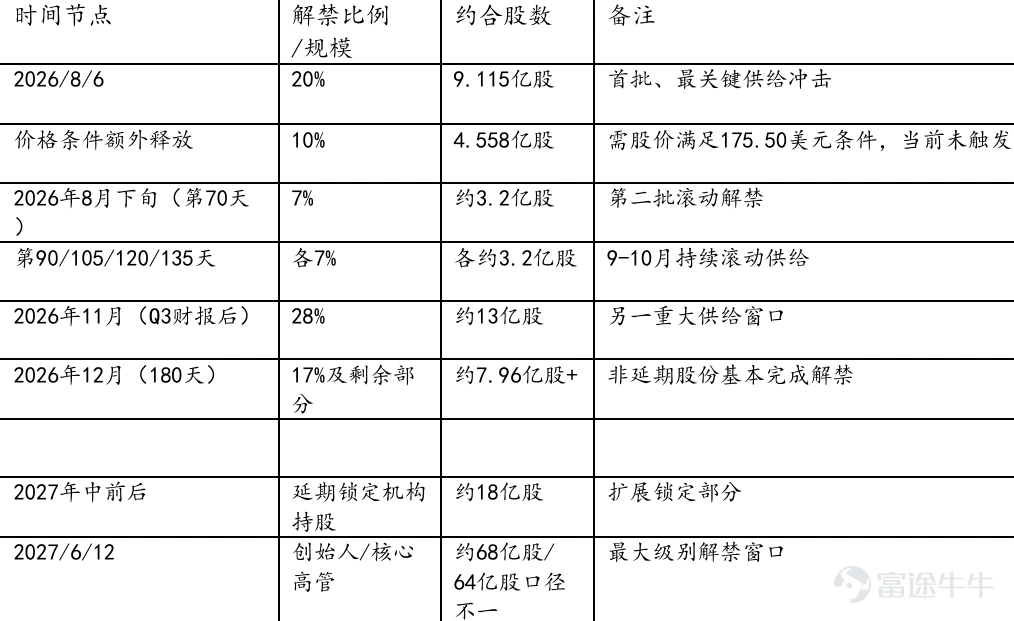
SpaceX’s lock-up arrangement clearly differs from traditional IPOs. Instead of a single release after 180 days, it employs a tiered structure combining 'earnings-triggered releases,' 'calendar-based rolling unlocks,' and 'partial deferrals.' The first tranche is scheduled forAugust 6, i.e., the second trading day following Q2 earnings, with up to911.5 million sharesshares eligible for release, representing20%of qualifying shares. Additionally, there was originally an extra 10% price-triggered unlock clause: if the share price traded above 30% of the IPO price (i.e., USD 175.50) on at least five of the ten trading days preceding the earnings release, approximately 455.8 million additional shares could have been unlocked. However, this condition has not been met, so this portion remains untriggered.
Subsequently, further rolling unlocks of roughly 7% each will occur on days 70, 90, 105, 120, and 135 post-listing; another ~28% will be released after Q3 earnings; the remaining 17% unlocks after day 180; and Elon Musk’s and core executives’ shares remain locked until June 12, 2027.August 6 is not the end of supply pressure—it marks the beginning.The initial unlock is not a 'one-off event.' According to the schedule, SpaceX will repeatedly face incremental supply entering the trading system from August through December.
Chart 1: SpaceX Major Lock-up Expiration Schedule
Source: SpaceX Prospectus
V. Magnitude of the Initial Unlocking Pressure: A "Repricing-Level" Shock to the Float
The commonly cited market estimate is that at SpaceX’s IPO, publicly tradable shares accounted for less than 5% of total outstanding shares, resulting in a pre-unlock float of approximately 280 million to 640 million shares, while the initial batch of unlocked shares911.5 million sharesalone would be sufficient to double or even multiply the float. Based on the share price range around the earnings release, the market value corresponding to this initial unlocking is roughly$100–114 billionin that range.
The core impact of this scale goes beyond merely "increased supply"; more importantly,the scarcity premium embedded in the small float will undergo systematic repricing. Shortly after listing, the share price surged from the IPO price of $135 to as high as $225.64, largely driven by the extremely limited float and aggressive buying from both passive and active funds,As the number of tradable shares expands, this scarcity premium will naturally diminish.。
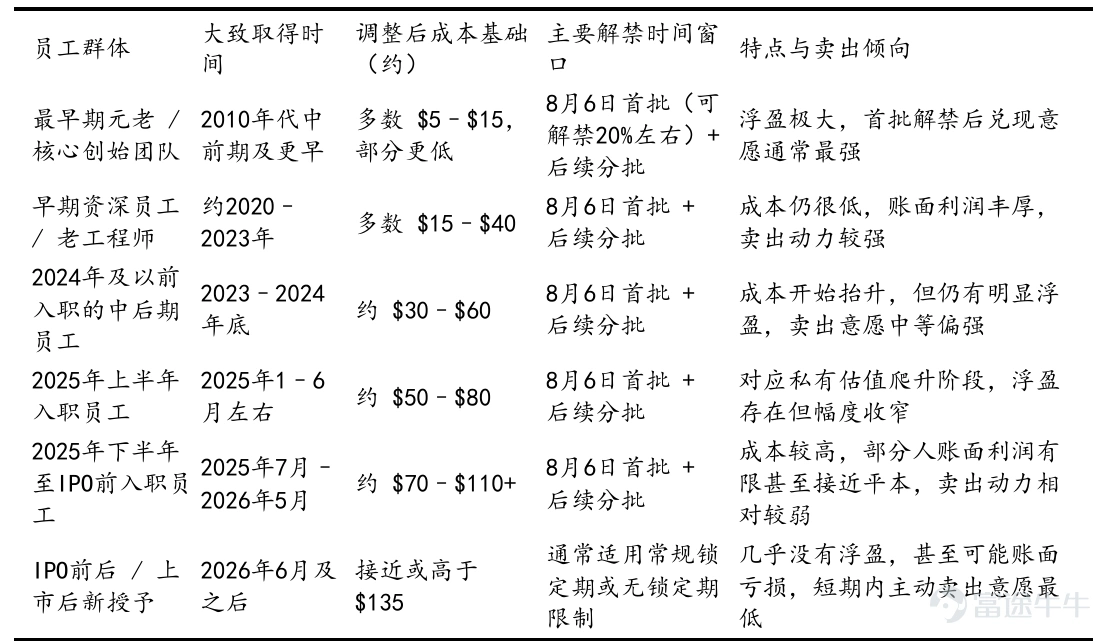
6. Will insiders sell? Supply pressure is high, but actual selling pressure may not be released proportionally.
Some bearish arguments often simplistically assume that since 9.115 billion shares become eligible for sale initially, massive selling will inevitably follow, butthis reasoning is overly linear. A more appropriate framework should distinguish between 'eligible to sell' and 'likely to sell.'。
On one hand, employees and early investors have extremely low cost bases; even if the share price falls below the IPO price, many still hold substantial unrealized gains, creating a clear incentive to cash in. On the other hand, market contacts have also relayed feedback suggesting that some insiders are not rushing to sell heavily during this window, especially if they remain confident in the long-term outlook.Therefore, the actual selling pressure is likely to be lower than the 'maximum eligible sale volume.'。
So far, the selling pressure from the lock-up expiration has been milder than previously anticipated by the market, with the stock closing higher yesterday6%, primarily because the share price had already declined in advance, marginal sellers in the market were largely exhausted, and some short interest was covered.
Exhibit 2: SpaceX Employee Shareholding Structure
Source: S-1/424B4 filings and subsequent Form S-8
7. Strategy: Focus on defensive positioning and event-driven trades during the lock-up expiration window
Looking ahead over the coming weeks,SpaceX’s core issue remains the supply-demand imbalance triggered by share lockup expirations.Even if earnings exceed expectations, the market will continue testing absorption capacity through successive lockup expirations in late August and September–October. Therefore,in the near term, a more prudent approach is not to chase the idea that 'all bad news is priced in,' but rather to wait for confirmation from the following two types of signals:。
One isprice signals:post-expiration trading volume surges and gradual price stabilization indicate that part of the new supply has already been absorbed by the market; the other isbehavioral signals:if the market gradually confirms that insider selling pressure is lower than expected, the overhang from lockup expirations will ease.Until then, short-term traders are better off maintaining light positions, scaling in gradually, and trading around events rather than taking aggressive directional bets.。
Upcoming catalysts:
Around late August, Starship will conduct its 14th test flight, with objectives including the first orbital deployment of operational-grade Starlink V3 satellites and an attempt to recover the upper stage using the launch tower's 'chopstick' arms. If successful, this would marka significant milestone toward fully reusable Starship operations, drawing considerable market attention.。
In the second half of the year, investors should also monitor the large-scale deployment of Starlink V3 and the realization of AI-related business initiatives: the company has already secured $14.1 billion in cloud services contracts, the acquisition of Cursor is expected to close in Q3, and the Grok model continues to undergo iterative improvements.Any improvement in AI business gross margins or acceleration in contract conversion would be viewed by the market as a significant positive signal.。
⚠️ Risk Warning
Business progress falling short of expectations
Downstream demand falling short of expectations
[Investment Advisory Information]
Yang Yi, Licensed Representative, CE No.: BUR210
Disclaimer
This report is prepared by Futu Securities International (Hong Kong) Limited ("Futu Securities"). Without Futu Securities’ prior written consent, this report and the information contained herein may not be (i) reproduced, copied, or stored in any form, or (ii) distributed or transmitted directly or indirectly to any other person for any purpose. The information in this report is derived from sources that Futu Securities believes to be accurate and reliable as of the date of publication; however, this report is not intended to contain all information required by investors and may be subject to delays, obstructions, or interception in transmission. Futu Securities makes no express or implied representation or warranty regarding the adequacy, accuracy, completeness, reliability, or fairness of such information or opinions. Accordingly, Futu Securities and its affiliates (collectively, the "Futu Group") shall not be liable for any losses (including, without limitation, direct, indirect, or consequential damages) arising from any actions taken by third parties relying on the content of this report. The views, recommendations, suggestions, and opinions expressed in this report do not necessarily reflect those of Futu Securities or its affiliates and may be changed at any time without notice. Futu Securities undertakes no obligation to update any such information or opinions. This report is provided for general informational purposes only and is intended solely for the general reference of Futu Securities’ clients, without regard to the specific investment objectives, financial situation, or particular needs of any individual recipient. Nothing in this report constitutes or should be construed as an offer, recommendation, or solicitation by any member of the Futu Group to buy or sell any securities, investments, or other financial instruments. It should not be interpreted as an offer or invitation to purchase or sell securities. Any decision to purchase securities mentioned in this report should be based on publicly available information, including relevant prospectuses. The products referenced in this report may not be suitable for all investors, and readers should carefully consider all relevant factors and seek professional advice before making any investment decisions. This report is provided to recipients on the assumption that they are capable of independently evaluating investment risks and exercising independent judgment in making investment decisions. In certain jurisdictions or countries, the distribution, issuance, or use of this report may violate applicable laws, regulations, rules, or other registration or licensing requirements. This report is not intended for distribution to, or use by, any person or entity in such jurisdictions or countries. Hong Kong-based investors with questions regarding Futu Securities research reports should contact Futu Securities directly. The SFC Central Entity Reference Number of the report’s author is disclosed next to the author’s name on the report’s cover page. The analyst primarily responsible for preparing this report confirms that: (i) the views expressed in this report accurately reflect his/her personal views regarding the subject listed companies; and (ii) none of the compensation he/she has received, currently receives, or will receive—directly or indirectly—is linked to the specific recommendations or views expressed in this report. The analyst confirms that neither he/she nor any related party has traded in the securities of the subject listed companies or their related securities within 30 days prior to the publication of this report or within three business days following its publication. Neither the analyst nor any related party serves as a senior officer of the subject listed companies or holds any financial interest in them. In this report, Futu Securities does not hold a financial interest equal to or greater than 1% of the listed company’s market capitalization and has had no investment banking relationship with the company in the past 12 months. None of the company’s employees are employed by the listed company.
Risk Disclaimer: The above content only represents the author's view. It does not represent any position or investment advice of Futu. Futu makes no representation or warranty.Read more

Comments
to post a comment
1