Welcome Zone | Claim your 100,000 anniversary reward and kickstart your investment journey!

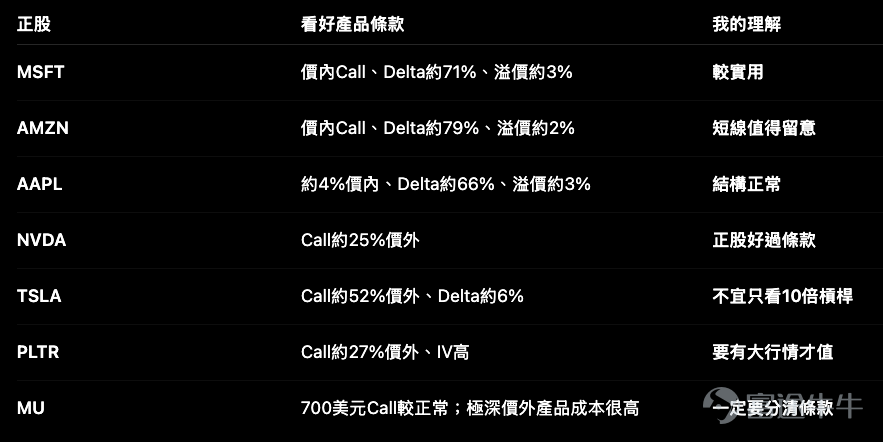
Individual US stocks | NVDA, Tesla, Microsoft, and Micron all have warrants, but their terms vary wildly: some appear to offer 10x leverage but barely track the underlying stock.
If the biggest issue with US equity index products is the 'knock-out distance,' then the biggest problem with individual stock warrants right now is:
Don't just look at leverage.
Among the popular US stocks in this dataset, warrant terms differ significantly. Some call warrants are in-the-money, with delta above 70% and only a few percentage points of premium; another group of products touts 6x or even 10x leverage, yet their strike prices are dozens of percentage points away from the underlying stock price, with deltas as low as around 5%.
Even though they’re all labeled 'US stock warrants,' their actual trading purposes can be worlds apart.
Microsoft $Microsoft (MSFT.US)$ : Among these US stock calls, this batch actually has the most normal terms.
Microsoft rose 2.54% on August 6, closing at approximately $499.86. Over the past few trading days, it climbed from around $464 to near $500, showing clear short-term strength.
The Microsoft call warrant in the data:
– Strike price around $450
– Approximately 7.4% in-the-money
– Expires in early October
– Effective gearing of approximately 6.7x
– Delta of approximately 71%
– Premium of approximately 3.2%
– Daily time decay of approximately 0.6%
These terms are actually very clear.
You're not buying a ticket that's waiting for a miracle, but a call warrant that is genuinely sensitive to the underlying stock's price movements.
If Microsoft rises by 1%, the product theoretically shows a relatively noticeable reaction; meanwhile, the premium and time value have not yet reached excessively high levels.
Of course, with an October expiry, it’s not suitable for long-term holding like a stock, but if you’re aiming to capture a short-to-medium-term breakout, this type ofin-the-money + high deltastructure is far more practical than calls that are 20% or 30% out-of-the-money.
Amazon $Amazon (AMZN.US)$ falls into the same category: the leverage isn’t the highest, but the terms offer trading value.
Amazon recently pulled back after a sharp rally from late July, trading around $272 on August 6.
Its call warrant has a strike price of approximately $245, making it about 10.5% in-the-money:
– Effective leverage is approximately 6.2x
– Delta is approximately 79%
– Premium of approximately 2.3%
– Daily time decay of approximately 0.6%
These figures are actually quite attractive.
The issue, however, is that the expiration date is relatively near—falling in late September, soit's suitable for short-term plays betting on a rebound, not for holding over several months.
If the market moves against you or Amazon continues to trade sideways, the time decay of this near-expiry product will accelerate progressively.
But it does have at least one advantage:
You know you're buying directional exposure.
When the underlying stock rebounds, the product can keep up; this is much healthier than simply buying a deeply out-of-the-money, low-priced call option that only appears to offer high leverage.
NVDA $NVIDIA (NVDA.US)$ : A strong underlying stock doesn't necessarily mean the existing call terms are attractive.
NVDA rose steadily from $200.75 on July 31 to $219.22 on August 5, and dipped just 0.1% on August 6—the overall trend remains very strong.
But this time, I wouldn't chase the NVDA call warrant just because the underlying stock is strong.
The call warrant terms are approximately:
– Strike price: $275
– About 25% out-of-the-money
– Expires at the end of December
– Effective gearing of approximately 6.4x
– Implied volatility (IV) of approximately 45.6%
– Delta of approximately 28%
– Premium of approximately 29.7%
– Daily time decay approximately 1.2%
The problem is already very obvious.
NVDA would need to rise from $219 to $275, which itself requires a gain of more than 25%. Therefore, the 6.4x effective gearing you see shouldn't be interpreted in isolation as 'if NVDA rises 1%, I gain 6.4%'.
What really matters first is the delta of only about 28%.
This means the call option still heavily relies on the underlying stock continuing to rise significantly, and with a premium of nearly 30%, the product isn't cheap.
Put warrants are similar—the $168 strike price is still about 23.5% out-of-the-money, with a delta of only around 15%.
So NVDA products are quite interesting right now:
The underlying stock itself is worth trading, but existing warrants may not be the most comfortable instruments to use.
Tesla$Tesla (TSLA.US)$Even more extreme: being bullish and using calls is actually the hardest side to trade
Tesla recently rose from around $311 to $327 before pulling back to approximately $319, re-entering a short-term consolidation range.
However, the call warrant terms are quite aggressive:
– Strike price: $490
– Approximately 52% out-of-the-money
– Expires in early October
– Effective leverage is approximately 10.2x
– Implied volatility (IV) is approximately 61%
– Delta is only about 6%
– Premium is approximately 53%
– Daily time decay is as high as approximately 5.8%
Seeing '10x leverage' can easily be tempting.
But when you look at all the other figures together, it tells a completely different story.
52% out-of-the-money, 6% delta, and nearly 6% daily time decay.
The biggest risk with this product isn't Tesla falling—it's Tesla simply not surging immediately.
If the underlying stock hovers around $320 for a few trading days, the call option itself can already be significantly eroded by time decay.
In contrast, Tesla put warrants have much more standard terms.
With strike prices between $330 and $340 already in-the-money, these puts have delta of approximately 44% to 48%, effective leverage of about 3.1x, a premium of roughly 10% to 12%, and expire in December.
The leverage is much lower, but for investors who are already bearish on Tesla, the directional sensitivity of these puts is actually more practical.
This set of Tesla products is the perfect example: 10x leverage isn't necessarily more effective than 3x leverage.
Micron $Micron Technology (MU.US)$: There’s one option worth studying, and several others that practically serve as textbook examples of 'don’t buy just because it’s cheap'
MU has recently experienced extremely volatile price swings.
It was around $823 at the end of July, surged 7.6% in a single day on August 4 to approximately $892, and was still at $881 on August 6.
Its call warrants come in two entirely different structures.
One has a strike price of approximately $700, about 19% in-the-money:
– Effective leverage of 2.6x
– Delta approximately 76%
– Premium approximately 9.8%
– IV approximately 99%
It still maintains normal directional sensitivity, at the very least.
But another strike price even goes as high as $1,800:
– More than 100% out-of-the-money
– Premium exceeding 110%
– Delta approximately 19%
– IV close to 100%
MU Put is even more extreme, with a $400 strike price, over 50% away from the underlying stock:
– Delta is only about 5.8%
– Premium is approximately 56%
– Implied volatility (IV) exceeds 100%
Even if this product appears cheap, I wouldn’t equate 'cheap' with 'worth betting on.'
Because what really needs to happen is a very large one-sided move in the underlying stock.
PLTR$Palantir (PLTR.US)$: The underlying stock rose over 29%, but chasing calls requires first accepting a very high time-value cost
On August 4, PLTR surged nearly 29% in a single day, jumping from around $125 to $162, then pulled back for two consecutive days to about $156.
This kind of stock naturally tempts investors to chase warrants.
But the call’s terms are:
– Strike price: $200
– Approximately 27% out-of-the-money
– Effective leverage of 7.8x
– Implied volatility (IV) around 62%
– Delta: approximately 21%
– Premium: nearly 30%
– Daily time decay exceeding 3%
In simple terms:
You're paying a very high option premium to bet on PLTR making another big move in the short term.
If PLTR indeed surges another 20%–30%, it could certainly trigger a significant response; however, if PLTR trades sideways between $150 and $165, the product terms are unfavorable for holders.
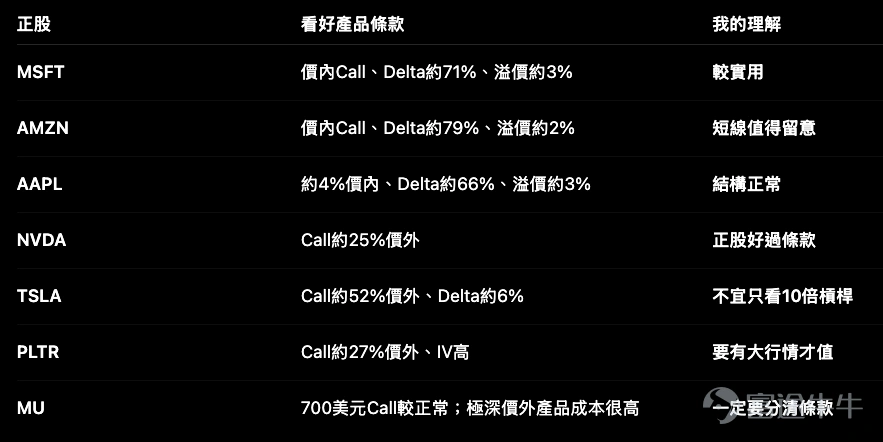
This is also the key point that investors should pay most attention to regarding this equity-linked product.
In the past, when evaluating U.S. equity warrants, people would often ask first:
“What’s the leverage multiple?”
But this batch of data more clearly tells us we should reverse that approach:
First assess how far the strike price is from the current price, then examine Delta, followed by premium, implied volatility (IV), and time decay—only lastly consider leverage.
A 10x-leveraged call option with only a 6% delta isn't necessarily more tradable than a 6x-leveraged call with a 70% delta.
A truly effective warrant isn't the one with the highest headline leverage, but rather one that keeps pace when the underlying stock moves—and doesn't rapidly decay due to its terms when the underlying stock is stagnant.
Risk Disclaimer: The above content only represents the author's view. It does not represent any position or investment advice of Futu. Futu makes no representation or warranty.Read more

Comments
to post a comment
1