
A paper gain of RMB 400 million fails to mask the bleeding core business—how genuine is Zhu Shihui’s transformation strategy at XianDao JiDian?
Produced by | Bullet Finance
Author | Qiong Ma
Editor | Egg Chief
Art Direction by | Qianqian
Reviewed | Songwen
Since July, XianDao JiDian’s share price has plunged nearly 50% from its peak of RMB 50.99. Following the announcement of a package including a 12-month non-reduction commitment by the controlling shareholder and share purchases by executives, coupled with a stabilized broader market, the stock has recently rebounded. As of the August 6 close, it stood at RMB 28.44, up more than 20% from its low.
The stock's short-term rebound cannot mask its fragile fundamentals. A closer look at the company's 2026 interim report reveals a starkly divided reality:Non-GAAP net loss reached RMB 112 million, the worst in a decade, with reported profits sustained solely by a RMB 4 billion unrealized paper gain from its investment in Zhenbao Technology. However, this unrealized gain—locked in during a restricted period—faces significant risk of substantial reversal in the future.
A previously high-profile related-party acquisition has taken an unexpected turn. The company took on debt to acquire assets controlled by its actual controller, with the target’s valuation multiplying several-fold within half a year. Meanwhile, the much-anticipated indium phosphide business was quietly divested, triggering wild stock price swings and prompting a series of regulatory inquiries from the exchange, leaving XDJE facing multiple tough questions.
Behind the stock’s extreme volatility, XDJE has been repeatedly flagged by regulators for disclosure irregularities and governance deficiencies. While aggressively pushing forward its semiconductor transformation, the company’s frequent capital maneuvers starkly contrast with its weak core operational performance—raising serious doubts about the true substance of this cross-sector pivot.
1. Core business continues bleeding; RMB 4 billion in paper investment gains
XDJE was formerly known as Wanye Enterprise, which listed on the Shanghai Stock Exchange Main Board in 1993 and originally operated as a foreign-invested real estate company. As China’s property sector entered a deep adjustment phase, the company began divesting its real estate assets starting in 2015.
At the end of 2024, Zhu Shihui of the 'XD Group' officially took control of Wanye Enterprise, after which the company was renamed 'XDJE' and accelerated its strategic shift toward building a platform-style hard-tech industrial layout encompassing 'semiconductor equipment, advanced materials, and components.'
According to financial statements, in the first half of 2026, XDJE reported total operating revenue of RMB 1.147 billion, up 64.06% year-over-year; attributable net profit reached RMB 210 million, surging 414.95% year-over-year; however, non-GAAP attributable net loss amounted to RMB 112 million, compared to a loss of RMB 11.75 million in the same period last year.
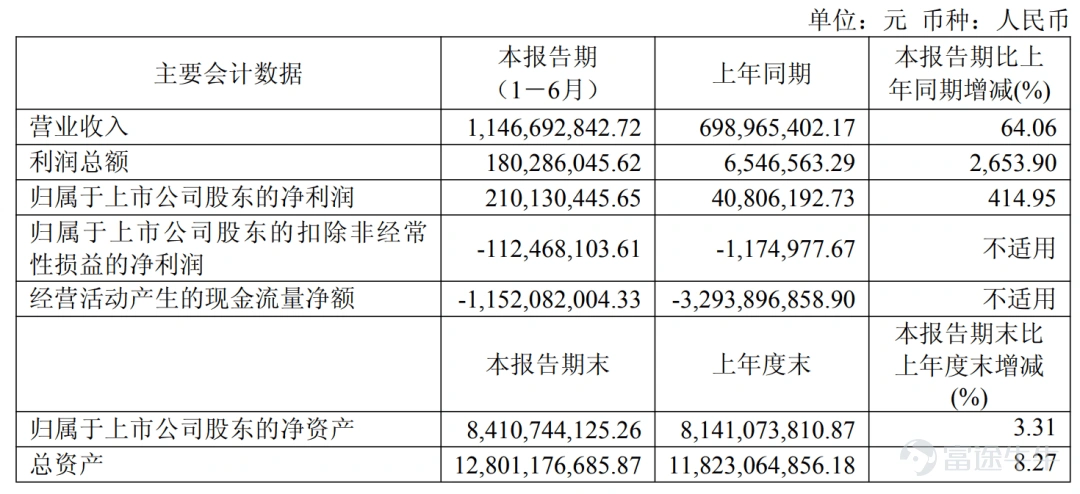
(Chart / XDJE Interim Report)
The revenue growth in the first half was primarily driven by Anhui Wandao Electronic Technology Co., Ltd., a wholly owned subsidiary, whose bismuth material business—launched in 2025—saw sales revenue rise 89% year-over-year, significantly boosting the company’s top and bottom lines for the period.
From a business segment perspective, bismuth materials have become the core growth engine, accounting for over 70% of revenue in 2025, while specialized equipment manufacturing for semiconductors and other applications represented 18.9%, and property sales contributed 6.7%.
However, according to the 2025 annual report, the gross margin of the bismuth materials segment was only 14.38% in 2025, significantly lower than that of property sales (54.33%) and the specialized equipment manufacturing segment (27.19%). The company previously stated,the semiconductor equipment segment is the company's biggest source of losses,despite the rapid growth of the bismuth business, its profits are still insufficient to offset this shortfall.
Regarding the first-half non-GAAP net loss of RMB 112 million, which widened compared to the same period last year, this was primarily due to an increase in the fair value of the company's financial assets during the first half, with the resulting gain classified as non-recurring and thus excluded from adjusted earnings. Additionally, the company further expanded its investments in semiconductor-related assets, personnel, and R&D during the first half, leading to higher expenses compared to the same period last year.
In the first half of this year, Xiandao Jidian recorded a fair value change gain of RMB 416 million, compared to a loss of RMB 251 million in the same period last year. The company explicitly stated in its interim report,that this gain mainly arose from the appreciation in share prices of other non-current financial assets, amounting to RMB 409 million. This represents unrealized gains from external investments, unrelated to core operations, and is therefore non-recurring.
Further review of the financial statements revealed that this gain primarily stemmed from Xiandao Jidian’s holdings of Zhenbao Technology shares.
According to relevant disclosures, in the first half of this year, Xiandao Jidian participated in Zhenbao Technology’s IPO strategic placement as a strategic investor through its wholly owned subsidiary, Chizhou Wanye Technology Development Co., Ltd. (hereinafter “Chizhou Wanye”), receiving an allocation of 936,292 shares at an issue price of RMB 44.56 per share, resulting in an initial investment cost of approximately RMB 41.72 million.
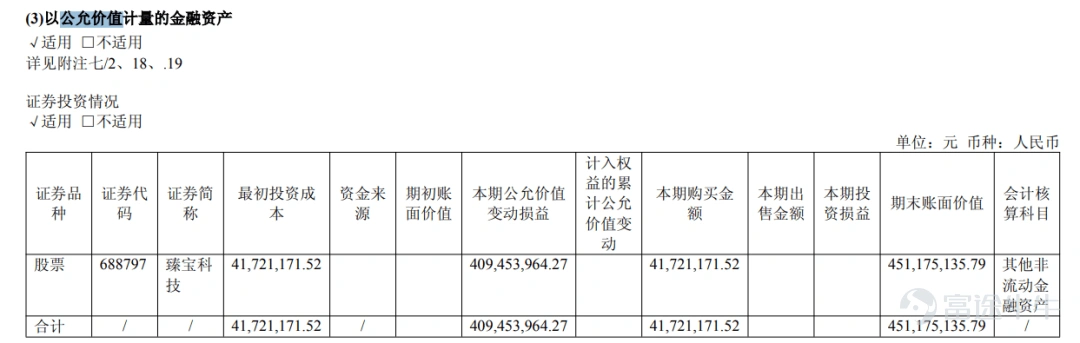
(Chart / Xiandao Jidian Interim Report)
Zhenbao Technology is a supplier of semiconductor equipment components and listed on the STAR Market on June 24, 2026. On its debut day, its share price surged by over 900% at one point, reaching an intraday high of RMB 465 per share. With Zhenbao Technology's listing, the value of XianDao JiDian's stake in the company has risen significantly.
The carrying value of this investment at the end of the reporting period was approximately RMB 451 million, making it the primary driver behind XianDao JiDian’s substantial year-on-year increase in net profit attributable to shareholders for the first half of the year.
However, the unrealized gain on this investment is now under pressure from erosion.Since July 1, Zhenbao Technology’s share price has fallen by more than 50% cumulatively, implying that the market value of XianDao JiDian’s stake has declined to approximately RMB 300 million.If Zhenbao Technology’s share price continues to trade at depressed levels by the end of the third quarter, the fair value gains recognized so far could be substantially reversed, potentially dragging down third-quarter net profit.
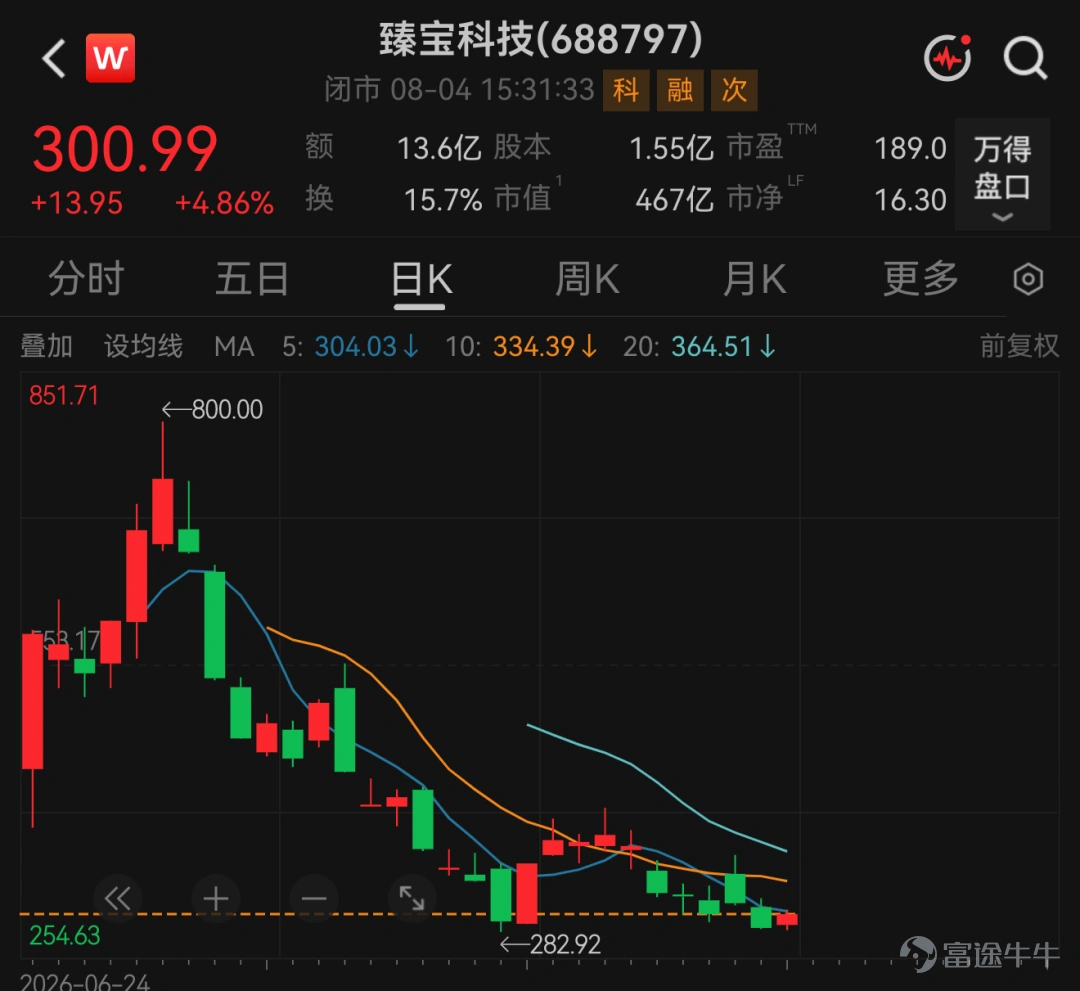
(Image / Wind)
Even without considering share price volatility, the unrealized gain remains merely a paper profit. As Chizhou Wanye participated in the strategic placement, its shares are subject to a 12-month lock-up period, meaning the current unrealized gain has not yet generated any cash inflow. Whether and at what price the shares will be sold after the lock-up expires in June 2027 will directly affect the realized investment return.
Given XianDao JiDian’s ongoing core business losses and tight cash flow, the actual realization of returns from this investment warrants close monitoring.
2. Controlling Shareholder Shuffles Assets Internally—Will the Move into Indium Phosphide Come to Nothing?
In recent years, XianDao JiDian has pursued a dual-track strategy of 'external acquisitions plus industrial integration' to enter sectors such as semiconductor equipment and new materials, increasing the weight of integrated circuits within its overall business portfolio.
On July 1, 2026, the company announced plans to inject capital into Guangdong XianDao Microelectronics Co., Ltd.—a company controlled by its actual controller Zhu Shihui—acquiring a 50.63% equity stake. The company stated that the transaction aims to optimize its product structure, expand into new business areas, and enhance overall profitability.
However, this related-party acquisition has sparked widespread market controversy due to the valuation premium, leveraged buyout structure, and asset divestitures.
According to the announcement, the target company, First Microelectronics, reported revenue of RMB 884 million and net profit of RMB 911.892 million for 2025. As of the end of April 2026, its net assets stood at only RMB 8.44 billion, yet its pre-investment valuation was as high as approximately RMB 20 billion, representing a premium of 139.28%.

(Image / Shutterstock, licensed under VRF agreement)
Notably, First Microelectronics had just completed its Series A financing in January 2026, with investor Benjian Private Equity investing RMB 67.98 million for a 1.1465% stake in the company, implying a valuation of only about RMB 5.93 billion at that time.
In just half a year, First Microelectronics’ valuation surged by 2.37 times. The Shanghai Stock Exchange swiftly issued an inquiry letter, questioning the fairness and reasonableness of this capital increase transaction.
Furthermore, according to First Electronics’ response to the Shanghai Stock Exchange’s inquiry letter, of the RMB 20 billion capital injection, RMB 14 billion came from bank loans, while only RMB 6 billion was sourced from internal funds. As of the end of March 2026, the company’s cash and cash equivalents amounted to RMB 14.37 billion, while interest-bearing debt already reached approximately RMB 18.28 billion.
The Shanghai Stock Exchange directly highlighted the core contradiction: given the company’s ongoing losses and the fact that the acquisition target operates in a business line different from its core operations, what is the rationale for acquiring assets controlled by its actual controller, and does this harm the interests of minority shareholders?
It is worth noting that First Microelectronics’ indium phosphide business had been the market’s primary expectation driving interest in this acquisition.
A research report from Dongwu Securities noted that Guangdong XianDao Microelectronics, a core subsidiary of XianDao Technology Group, has an annual production capacity of 240,000 indium phosphide substrates and has already begun mass shipments to major domestic and international clients, including Source Photonics, Sanan Optoelectronics, and Coherent.
In fact, less than a week before First Electronics’ announcement, Guangzhi Technology—a separate listed company also controlled by Zhu Shihui—disclosed plans to increase its capital contribution to acquire a controlling stake in the indium phosphide business assets spun off from First Microelectronics.
However, even in the formal transaction announcement and inquiry response disclosed on July 14, First Electronics still did not directly clarify the process of the indium phosphide business divestiture, the destination of these assets, or whether they were included in the scope of this transaction.Yet its listed product portfolio no longer includes the indium phosphide business.
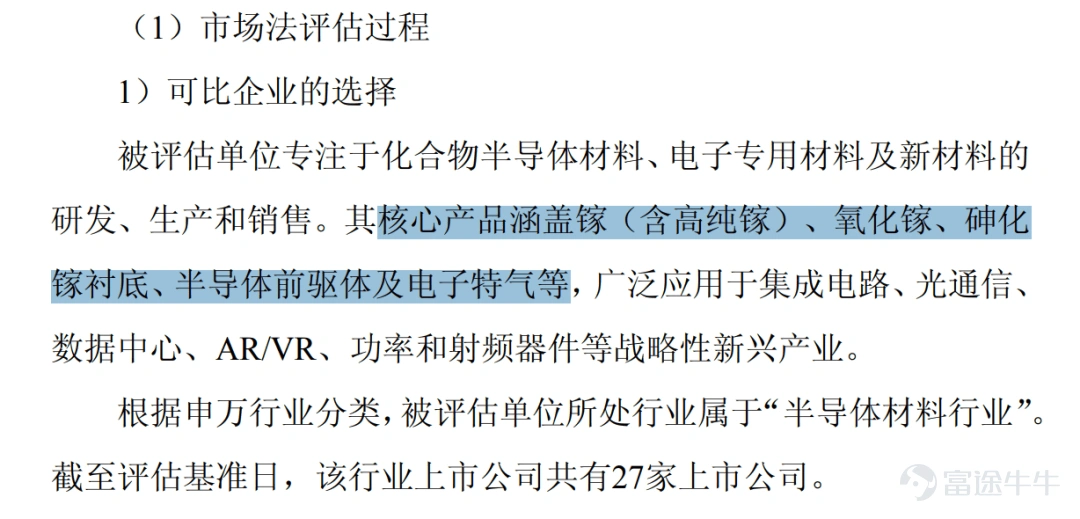
(Figure / Leadgene Electric's reply to the Shanghai Stock Exchange)
This capital narrative, which failed to meet market expectations, left a clear mark on the stock price trend. On June 30 and July 1, Leadgene Electric’s shares hit the daily trading limit for two consecutive sessions; after the company disclosed an announcement on the evening of July 1, its shares rose by the daily limit again on July 2, achieving a three-day streak of trading limits and reaching a record high of RMB 48.24.
In response to the stock price 'front-running,' the Shanghai Stock Exchange requested the company to investigate whether material non-public information had been leaked in advance. The situation then reversed: on July 16, 17, and 20, Leadgene Electric’s shares fell by the daily trading limit for three consecutive sessions, closing at RMB 24.80 on July 30—again hitting the daily limit. In less than a month, the company’s share price tumbled nearly 50% from its historical peak.
Given that Leadgene Electric did not clarify at the time of announcing the capital increase that its indium phosphide business had already been divested—and failed to promptly correct or guide market expectations—investors made decisions based on incomplete information. Consequently, some investors questioned whether the company’s conduct constituted delayed disclosure.
Zidan Finance reached out to Leadgene Electric regarding the above issues, but had not received a response as of publication. Currently, uncertainties remain about the relevant disclosures, pending further clarification from regulators.
3. Governance Failures and Disclosure Inaccuracies: Persistent Issues on the Transformation Path
The concerns over disclosure deficiencies are not unfounded.
On August 1, Leadgene Electric issued corrections to its 2025 interim and annual reports, adding disclosure of a warning letter issued to director Xu Lei.
It is understood that Xu Lei had already received a warning letter from the Shanghai branch of the China Securities Regulatory Commission (CSRC) on April 9, 2025, and this matter was recorded in the securities and futures market integrity archive database. However, this information was omitted from the company’s periodic report disclosures.
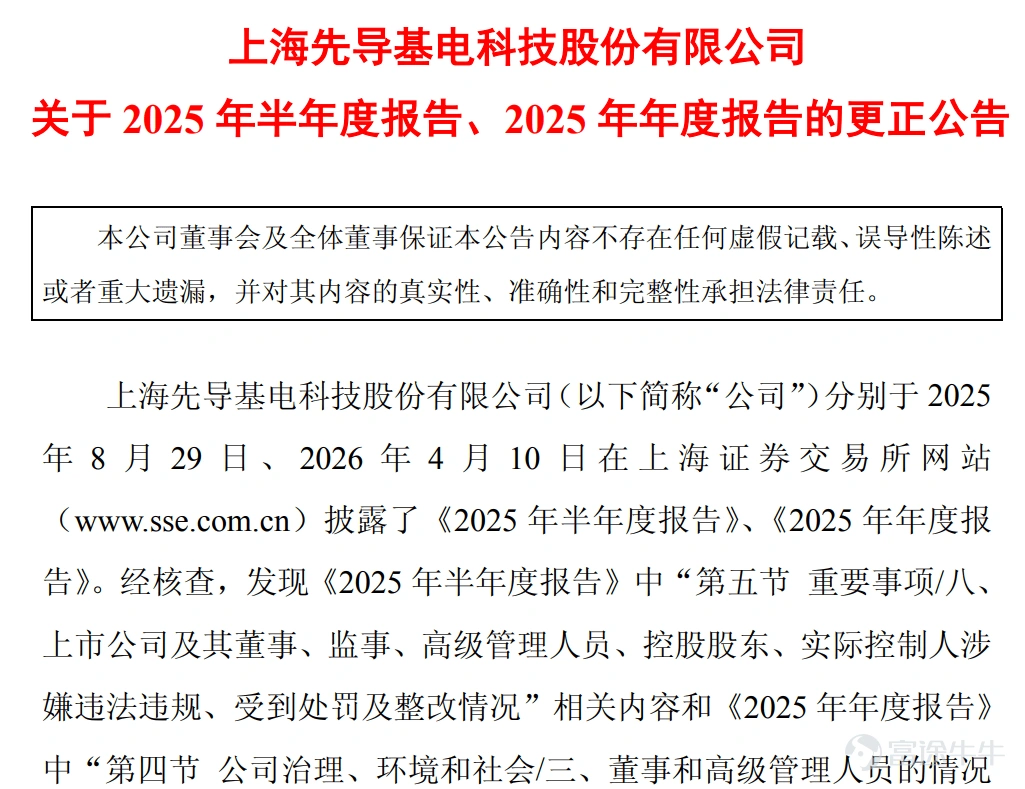
(Figure / Leadgene Electric announcement)
This is not the first time Lead Genius Electronics has exposed issues related to information disclosure and corporate governance.
On January 31, 2024, the company’s '2023 Annual Earnings Forecast' disclosed an estimated non-GAAP net profit that significantly diverged from the figure reported in its official annual report released on April 27 of the same year. Due to inaccurate information disclosure, the Shanghai Securities Regulatory Bureau issued a regulatory attention letter, and the Shanghai Stock Exchange delivered an oral warning on this matter in August 2024.
In January 2026, the Shanghai Securities Regulatory Bureau again issued a regulatory attention letter to the company, identifying multiple deficiencies: the company’s articles of association lacked provisions regarding the composition and responsibilities of specialized committees; shareholder meetings were convened and documented improperly; board meeting records and voting procedures were noncompliant; independent directors’ working records were incomplete and their annual reports were nearly identical; compensation for directors, supervisors, and senior management was approved through irregular procedures; and insider information management and registration practices were inadequate. The regulator required the company to revise its charter, standardize the operations of its three key governance bodies (shareholders’ meeting, board of directors, and board of supervisors), and strengthen insider information controls.
Lead Genius Electronics has been repeatedly flagged by regulators for inaccurate disclosures and noncompliant governance practices, collectively reflecting a gap between its rapid expansion and the maturity of its corporate governance capabilities relative to its pace of capital market activities.
Meanwhile, controlling shareholder Zhu Shihui is accelerating efforts to consolidate control.
In March 2026, Lead Genius Electronics announced a draft plan for a private placement of shares, proposing to issue up to 236 million new shares to Lead Genius Technology—a company controlled by Zhu Shihui—at a fixed price of RMB 14.90 per share, raising up to RMB 3.51 billion. Upon completion, Lead Genius Technology and its concert party, Lead Genius Huixin, would increase their combined stake from 24.27% to 39.57%.
At the same time, Sanlin Wan Ye, an early major shareholder, has been steadily exiting its position.

(Image / Shutterstock, licensed under VRF agreement)
According to related announcements, between March and June 2026, Sanlin Wan Ye reduced its holdings by 9,047,495 shares via centralized bidding, amounting to approximately RMB 2.08 billion, lowering its stake to 4.80%. It remains the company’s second-largest shareholder.
While the new narrative has yet to materialize, old problems have resurfaced. Lead Genius Electronics’ strategic shift—divesting real estate and pivoting toward semiconductor materials and equipment—is logically sound from an industry perspective. However, its reliance on external investments to generate short-term paper gains, persistent core business losses, high-premium related-party acquisitions, and repeated disclosure inaccuracies may erode market confidence.
Ultimately, the true quality of Lead Genius Electronics’ transformation will require time to validate, and Bullet Finance will continue monitoring developments closely.
*The featured image in the article is from the official website of XianDao JiDian.
Risk Disclaimer: The above content only represents the author's view. It does not represent any position or investment advice of Futu. Futu makes no representation or warranty.Read more
Comments
to post a comment