English
Back
Open Account
August ETF Trading Challenge! Share your trading stories and win great prizes 🎁

慢慢变富的牛牛
joined discussion · ·

ETF Showdown | Gold and Silver Rally Strongly! How to Use ETFs Smartly to Capture Precious Metals Moves?

Gold and silver have once again become the market's focus recently.
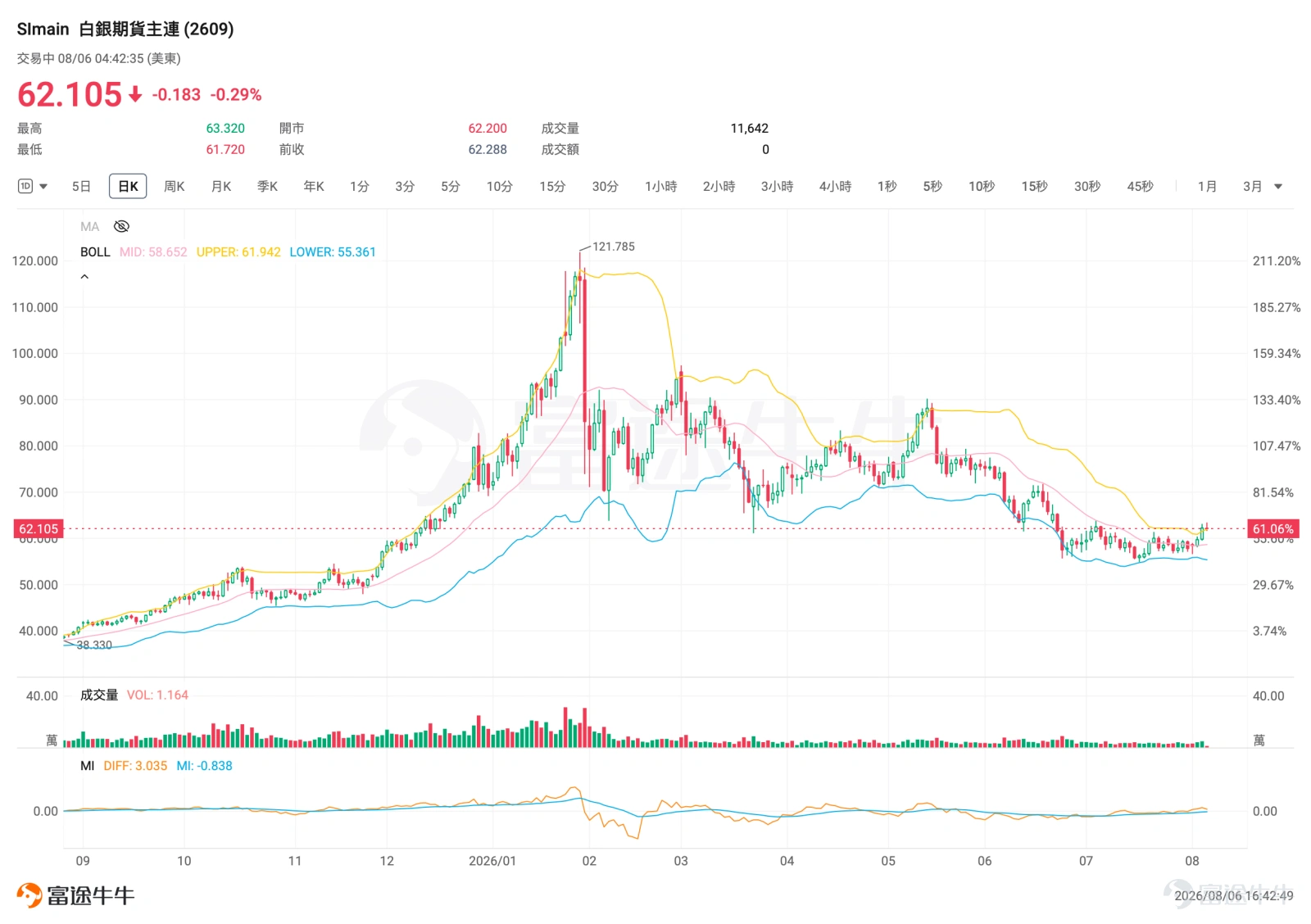
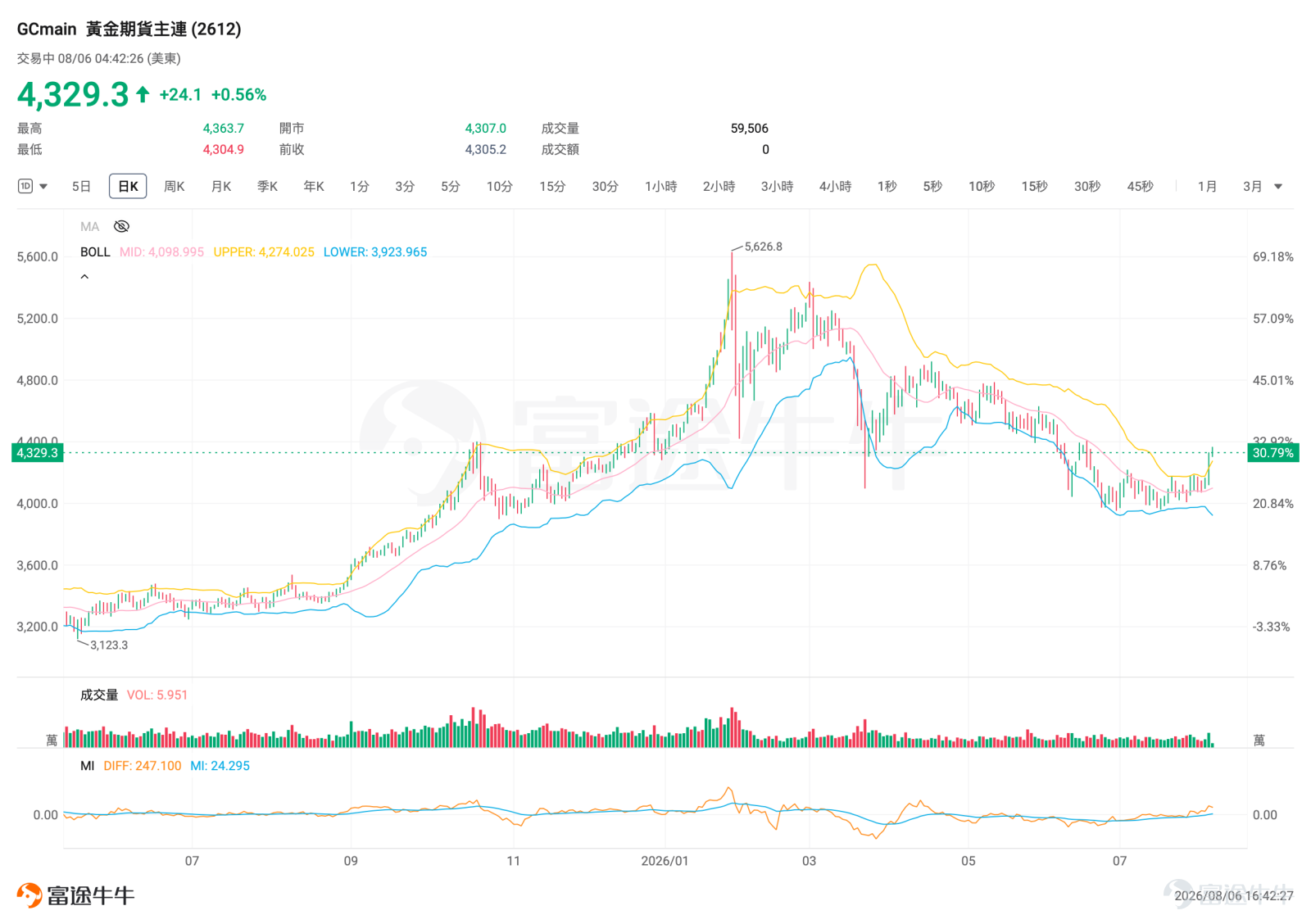
As of the Asian trading session on August 6, spot gold rose for the fourth consecutive trading day, briefly hitting $4,254.98 per ounce—the highest level in nearly two months. Silver, after surging the previous day, saw a slight pullback and traded around $61.78 per ounce.
This rally isn't driven solely by risk-off sentiment. A weaker dollar, falling U.S. Treasury yields, and declining oil prices—which reduced market expectations for further Fed rate hikes—all provided support for gold prices. Silver followed gold higher, but due to its inherently higher volatility, its short-term price action has been notably more erratic.
For individual investors,Precious metals ETFs allow us to conveniently participate in gold and silver price movements without having to buy and store physical bullion ourselves.However, gold, silver, and mining stock ETFs differ in their risk and return drivers. Investors shouldn’t simply pick the one that has risen the most recently—they also need to understand the underlying sources of risk and return.
Gold and silver have once again become the market's focus recently. As of the Asian trading session on August 6, spot gold rose for the fourth consecutive trading day, briefly hitting $4,254.98 per ounce—the highest level in nearly two months. Silver, after surging the previous day, saw a slight pullback and traded around $61.78 per ounce. This rally isn't driven solely by risk-off sentiment. A weaker dollar, falling U.S. Treasury yields, and declining oil prices—which reduced market expectations for further Fed rate hikes—all provided support for gold prices. Silver followed gold higher, but due to its inherently higher volatility, its short-term price action has been notably more erratic. For individual investors,Precious metals ETFs allow us to conveniently participate in gold and silver price movements without having to buy and store physical bullion ourselves.However, gold, silver, and mining stock ETFs differ in their risk and return drivers. Investors shouldn’t simply pick the one that has risen the most recently—they also need to understand the underlying sources of risk and return. Gold Is More Stable, Silver Offers Higher Elasticity Gold primarily serves as a monetary reserve and a diversification tool. Its price is typically influenced by the U.S. dollar, U.S. Treasury yields, central bank demand, geopolitical developments, and market risk-aversion sentiment. When the US dollar weakens or real interest rates decline, the opportunity cost of holding non-yielding gold decreases, which is typically favorable for gold prices. For many investors, the primary purpose of holding gold is not to chase short-term gains, but rather to add a diversification tool alongside equities, bonds, or currency assets. Silver, on the other hand, simultaneously possessesthe dual characteristics of a precious metal and an industrial raw material.。...
Gold Is More Stable, Silver Offers Higher Elasticity
Gold primarily serves as a monetary reserve and a diversification tool. Its price is typically influenced by the U.S. dollar, U.S. Treasury yields, central bank demand, geopolitical developments, and market risk-aversion sentiment.
When the US dollar weakens or real interest rates decline, the opportunity cost of holding non-yielding gold decreases, which is typically favorable for gold prices. For many investors, the primary purpose of holding gold is not to chase short-term gains, but rather to add a diversification tool alongside equities, bonds, or currency assets.
Silver, on the other hand, simultaneously possessesthe dual characteristics of a precious metal and an industrial raw material.In addition to being affected by the US dollar and interest rates, silver prices are also tied to demand from electronics, solar energy, automotive, and manufacturing sectors. When markets price in expectations of monetary easing, economic recovery, and supply tightness simultaneously, silver’s upside can significantly outpace gold’s; however, when sentiment reverses, its pullback is typically sharper.
The market action earlier this year was a clear example. Spot silver briefly broke above $90 per ounce in mid-January, and COMEX silver subsequently surged to a record high of $115.08 on January 29,only to plunge 26% in a single day on January 30. By August 3, the price had already retreated to $57.67—nearly halving from its peak.
This price movement illustrates that even if the long-term supply-demand fundamentals remain intact,when market sentiment becomes extremely overheated and capital rushes in en masse, short-term prices can deviate significantly from fundamentals.Silver may appear 'cheaper' than gold, but that does not mean it carries lower risk. During periods of sharp, consecutive short-term rallies, position sizing requires extra caution.Avoid chasing in at high levels all at once due to fear of missing out
Gold and silver have once again become the market's focus recently. As of the Asian trading session on August 6, spot gold rose for the fourth consecutive trading day, briefly hitting $4,254.98 per ounce—the highest level in nearly two months. Silver, after surging the previous day, saw a slight pullback and traded around $61.78 per ounce. This rally isn't driven solely by risk-off sentiment. A weaker dollar, falling U.S. Treasury yields, and declining oil prices—which reduced market expectations for further Fed rate hikes—all provided support for gold prices. Silver followed gold higher, but due to its inherently higher volatility, its short-term price action has been notably more erratic. For individual investors,Precious metals ETFs allow us to conveniently participate in gold and silver price movements without having to buy and store physical bullion ourselves.However, gold, silver, and mining stock ETFs differ in their risk and return drivers. Investors shouldn’t simply pick the one that has risen the most recently—they also need to understand the underlying sources of risk and return. Gold Is More Stable, Silver Offers Higher Elasticity Gold primarily serves as a monetary reserve and a diversification tool. Its price is typically influenced by the U.S. dollar, U.S. Treasury yields, central bank demand, geopolitical developments, and market risk-aversion sentiment. When the US dollar weakens or real interest rates decline, the opportunity cost of holding non-yielding gold decreases, which is typically favorable for gold prices. For many investors, the primary purpose of holding gold is not to chase short-term gains, but rather to add a diversification tool alongside equities, bonds, or currency assets. Silver, on the other hand, simultaneously possessesthe dual characteristics of a precious metal and an industrial raw material.。...
If you want direct exposure to gold prices, consider physical gold ETFs
The most representative gold product in the U.S. equity market is $SPDR Gold ETF (GLD.US)$ . It aims to reflect the performance of gold prices net of operating expenses and features relatively large assets under management and high trading liquidity, making it more suitable for investors who prioritize liquidity or need to trade frequently.
For those seeking to reduce long-term holding costs, consider $iShares Gold Trust (IAU.US)$and $Spdr Gold Minishares Trust (GLDM.US)$ . IAU also provides gold price exposure backed by physical gold, with an annual management fee of 0.25%; GLDM has a lower per-unit price and holding cost, making it more convenient for smaller, incremental allocations.
The Hong Kong stock market also offers several physical gold ETFs to choose from.$SPDR Gold Trust (02840.HK)$ shares the same gold trust as the U.S.-listed GLD and has a longer listing history; $Value Gold ETF (03081.HK)$$Hang Seng Gold ETF (03170.HK)$$CSOP Gold ETF (03030.HK)$among others, are also worth watching.
The most mainstream physical silver product in the U.S. equity market is $iShares Silver Trust (SLV.US)$SLV primarily holds silver and aims to reflect the performance of silver prices. It has a large asset base and high trading volume, making it more suitable for investors who prioritize trading liquidity.
Another option is $Abrdn Silver ETF Trust (SIVR.US)$ . SIVR is also backed by physical silver and has an expense ratio of 0.30% per year, making it relatively more suitable for investors who are more cost-conscious.
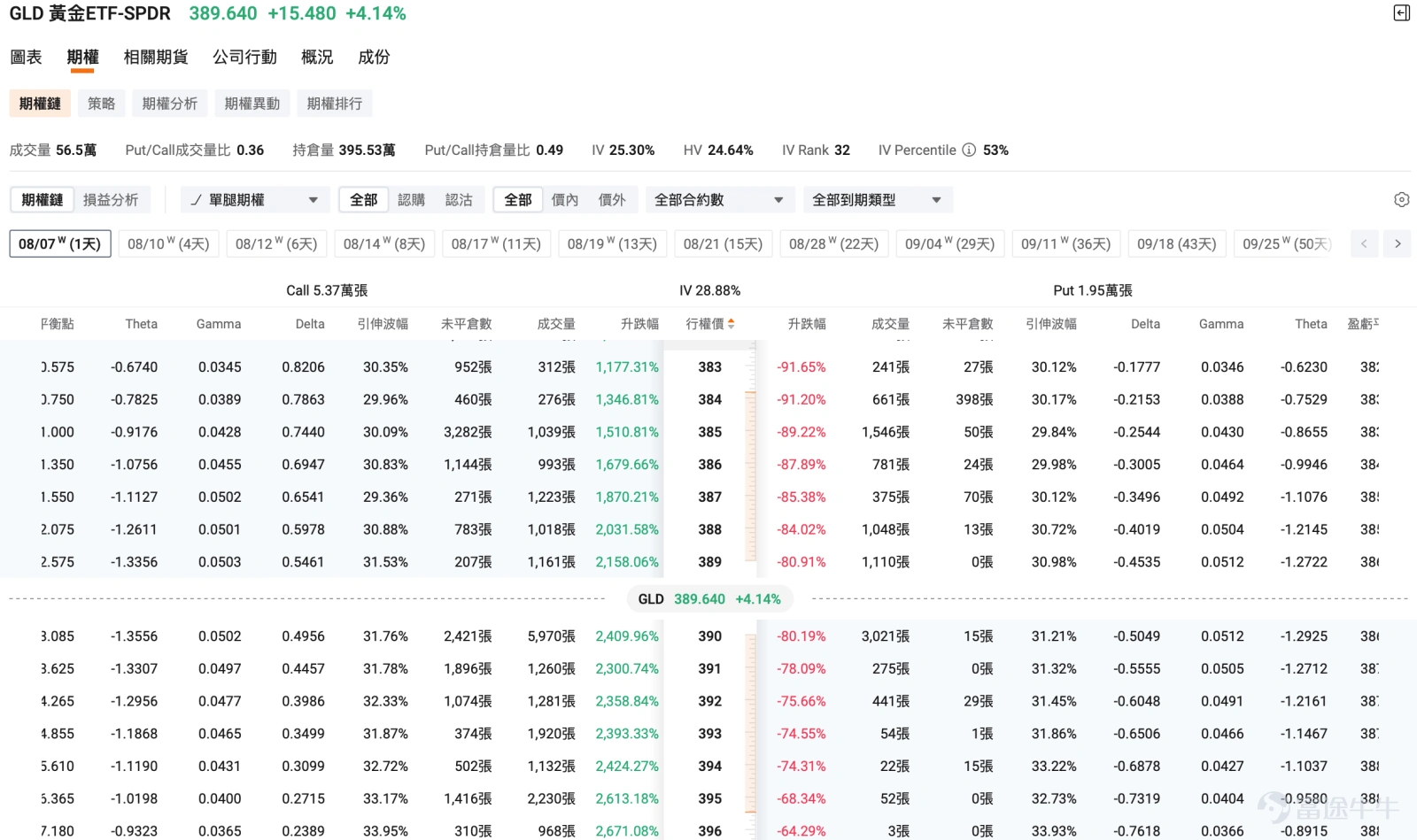
If you wish to access options trading opportunities related to gold and silver ETFs, these are primarily concentrated in GLD and SLV, as options on other products tend to have lower liquidity.
Gold and silver have once again become the market's focus recently. As of the Asian trading session on August 6, spot gold rose for the fourth consecutive trading day, briefly hitting $4,254.98 per ounce—the highest level in nearly two months. Silver, after surging the previous day, saw a slight pullback and traded around $61.78 per ounce. This rally isn't driven solely by risk-off sentiment. A weaker dollar, falling U.S. Treasury yields, and declining oil prices—which reduced market expectations for further Fed rate hikes—all provided support for gold prices. Silver followed gold higher, but due to its inherently higher volatility, its short-term price action has been notably more erratic. For individual investors,Precious metals ETFs allow us to conveniently participate in gold and silver price movements without having to buy and store physical bullion ourselves.However, gold, silver, and mining stock ETFs differ in their risk and return drivers. Investors shouldn’t simply pick the one that has risen the most recently—they also need to understand the underlying sources of risk and return. Gold Is More Stable, Silver Offers Higher Elasticity Gold primarily serves as a monetary reserve and a diversification tool. Its price is typically influenced by the U.S. dollar, U.S. Treasury yields, central bank demand, geopolitical developments, and market risk-aversion sentiment. When the US dollar weakens or real interest rates decline, the opportunity cost of holding non-yielding gold decreases, which is typically favorable for gold prices. For many investors, the primary purpose of holding gold is not to chase short-term gains, but rather to add a diversification tool alongside equities, bonds, or currency assets. Silver, on the other hand, simultaneously possessesthe dual characteristics of a precious metal and an industrial raw material.。...
For greater leverage, consider gold and silver mining stock ETFs.
In addition to directly tracking gold and silver prices, investors can also gain exposure to mining companies through ETFs.
$VanEck Gold Miners Equity ETF (GDX.US)$ is a representative gold mining stock ETF in the U.S. market, primarily investing in large- and mid-cap gold mining companies globally. When gold prices rise while energy, labor, and extraction costs remain relatively stable, mining companies’ profits may grow faster than the gold price itself; therefore, GDX typically exhibits higher volatility than physical gold ETFs.
For exposure to smaller gold mining companies, consider $VanEck Junior Gold Miners ETF (GDXJ.US)$Smaller and mid-sized mining companies have a lower production base, so news on resource exploration or mergers and acquisitions may lead to greater price elasticity, but they also carry higher financing, operational, and individual mine-related risks.
In the silver mining space, investors may want to watch $Global X Funds Global X Silver Miners Etf (Post Rev Spl (SIL.US)$. This product invests in a basket of global silver mining companies. However, silver miners’ revenue does not necessarily come entirely from silver; some companies also produce gold, copper, or other metals.
It’s important to note that mining stocks are not equivalent to physical gold or silver. Even if gold prices rise, mining company share prices can still be affected by energy costs, exchange rates, mine accidents, capital expenditures, corporate management, and overall stock market conditions. When gold and silver prices fall, declines in mining stocks may be amplified.
GDXU: 3x Leveraged Long Gold Miners
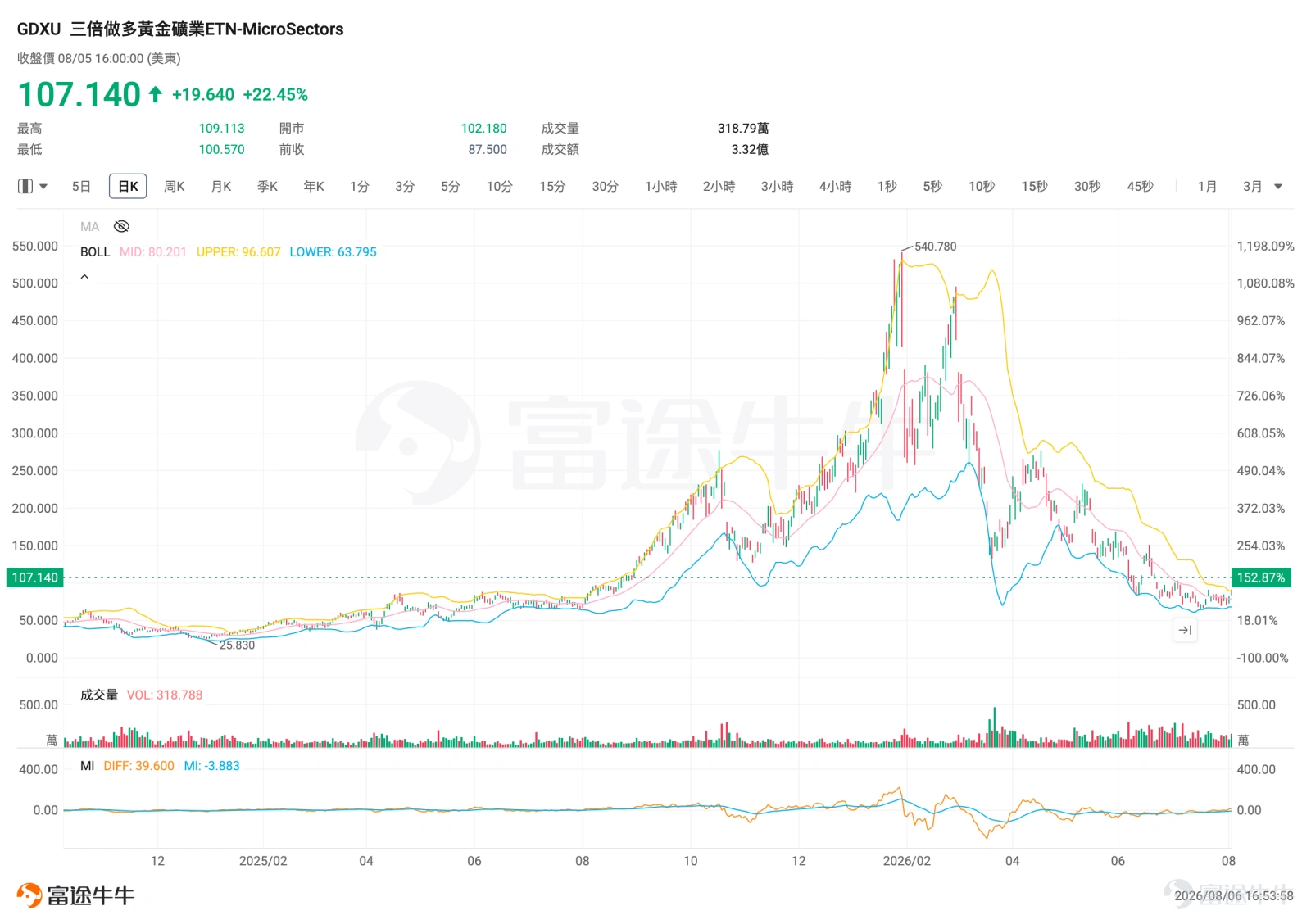
Investors seeking higher-risk short-term trades might also consider $MicroSectors Gold Miners 3X Leveraged ETN (GDXU.US)$
GDXU, officially known as the MicroSectors Gold Miners 3X Leveraged ETN, is technically an exchange-traded note (ETN), not a standard ETF. The product is based on indices related to GDX and GDXJ and seeks three times the daily positive return of the underlying index
Gold and silver have once again become the market's focus recently. As of the Asian trading session on August 6, spot gold rose for the fourth consecutive trading day, briefly hitting $4,254.98 per ounce—the highest level in nearly two months. Silver, after surging the previous day, saw a slight pullback and traded around $61.78 per ounce. This rally isn't driven solely by risk-off sentiment. A weaker dollar, falling U.S. Treasury yields, and declining oil prices—which reduced market expectations for further Fed rate hikes—all provided support for gold prices. Silver followed gold higher, but due to its inherently higher volatility, its short-term price action has been notably more erratic. For individual investors,Precious metals ETFs allow us to conveniently participate in gold and silver price movements without having to buy and store physical bullion ourselves.However, gold, silver, and mining stock ETFs differ in their risk and return drivers. Investors shouldn’t simply pick the one that has risen the most recently—they also need to understand the underlying sources of risk and return. Gold Is More Stable, Silver Offers Higher Elasticity Gold primarily serves as a monetary reserve and a diversification tool. Its price is typically influenced by the U.S. dollar, U.S. Treasury yields, central bank demand, geopolitical developments, and market risk-aversion sentiment. When the US dollar weakens or real interest rates decline, the opportunity cost of holding non-yielding gold decreases, which is typically favorable for gold prices. For many investors, the primary purpose of holding gold is not to chase short-term gains, but rather to add a diversification tool alongside equities, bonds, or currency assets. Silver, on the other hand, simultaneously possessesthe dual characteristics of a precious metal and an industrial raw material.。...
If the relevant gold miners index rises 1% in a single day, GDXU targets an approximate 3% gain; however, if the index drops 1% in a day, the product could also fall by approximately 3%.
Because the product resets its leverage daily, holding it for more than one day means actual returns will be affected by daily compounding and market volatility, and will not simply equal three times the return of GDX over the same period. In choppy markets,even if gold mining stocks ultimately return to their original level, GDXU may still incur losses due to volatility decay.
As an ETN, GDXU also carries financing costs and issuer credit risk. Such products are moresuitable for experienced short-term traders who can actively manage their positions, and are not appropriate as long-term vehicles for gold exposure.
Before buying, there are three additional points to note:
First is liquidity.Even among ETFs tracking the same gold or silver price, differences in trading volume and bid-ask spreads can lead to significantly different actual trading costs. This is especially important to consider for newly listed ETFs.
Second is exchange rates.Gold and silver are typically priced in U.S. dollars, so when investing in U.S.-listed ETFs or Hong Kong-listed dollar-denominated assets, your final HKD returns may also be affected by fluctuations in the USD exchange rate.
Lastly, timing your entry.Gold and silver can serve as diversification tools, but that doesn’t mean any price level is suitable for chasing. Particularly for silver, its sharp rally early in the year followed by a near 50% decline has already demonstrated that when market sentiment overheats and leveraged or momentum-driven capital concentrates, pullbacks can be extremely rapid.
Aside from ETFs, there are also some mutual fund products worth watching, such as $BlackRock World Gold Fund (LU0788108826.MF)$ funds primarily investing in stocks of companies engaged in gold and silver-related businesses, as well as$Jupiter Gold & Silver Fund (IE00BYVJR809.MF)$ funds primarily investing in companies involved in gold and precious metals mining operations globally. Their investment focus is similar to that of GDX, and their active management may potentially deliver some degree of outperformance.
Overall, gold and silver have recently regained strength, primarily driven by concurrent shifts in the US dollar, Treasury yields, oil prices, and US interest rate expectations—not solely by safe-haven demand. Physical gold ETFs are better suited as portfolio diversifiers, while silver and mining stock ETFs offer higher elasticity but come with greater volatility and drawdown risk.
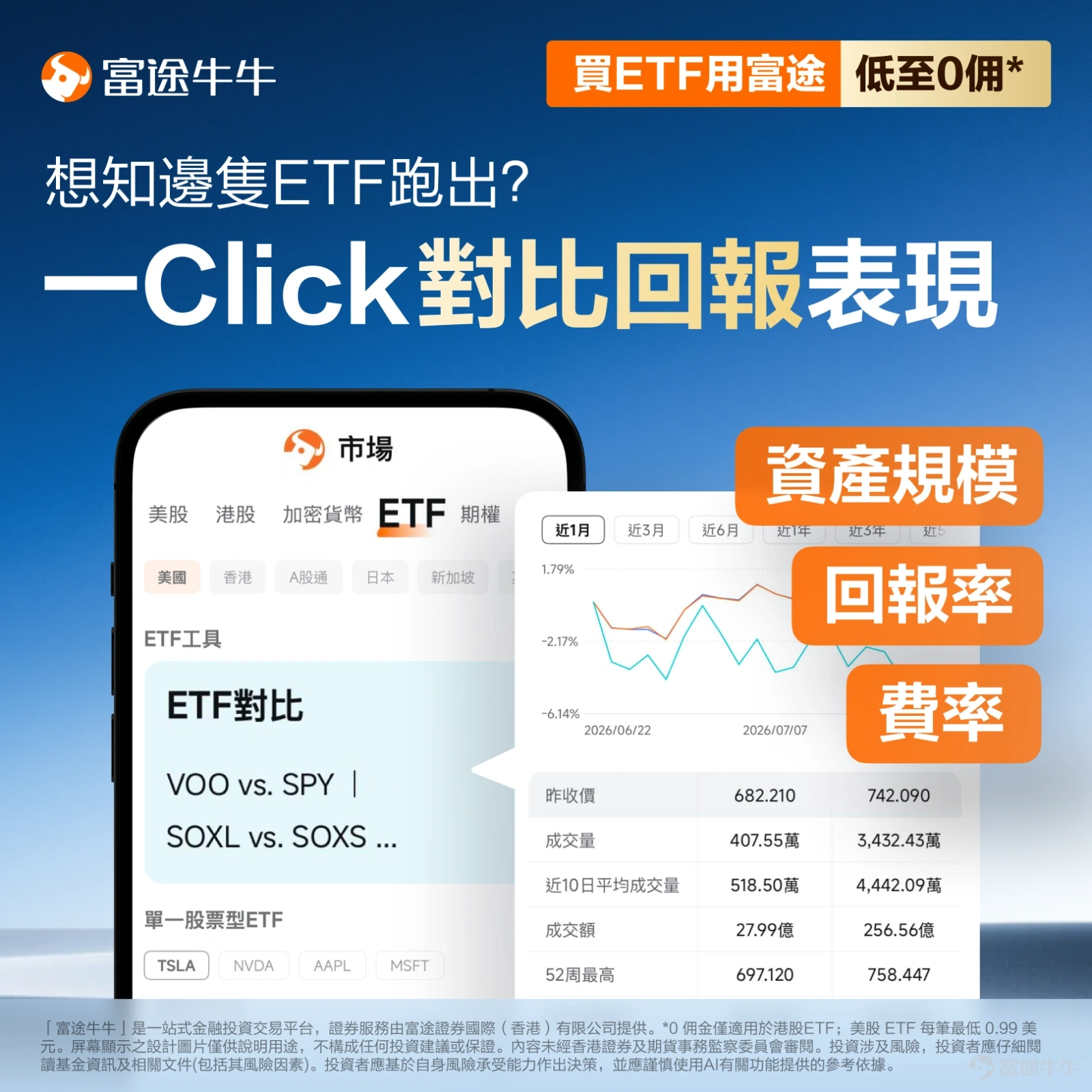
How do price movements differ across various ETFs? Use Futubull’s ETF tools to effectively compare product differences:
Gold and silver have once again become the market's focus recently. As of the Asian trading session on August 6, spot gold rose for the fourth consecutive trading day, briefly hitting $4,254.98 per ounce—the highest level in nearly two months. Silver, after surging the previous day, saw a slight pullback and traded around $61.78 per ounce. This rally isn't driven solely by risk-off sentiment. A weaker dollar, falling U.S. Treasury yields, and declining oil prices—which reduced market expectations for further Fed rate hikes—all provided support for gold prices. Silver followed gold higher, but due to its inherently higher volatility, its short-term price action has been notably more erratic. For individual investors,Precious metals ETFs allow us to conveniently participate in gold and silver price movements without having to buy and store physical bullion ourselves.However, gold, silver, and mining stock ETFs differ in their risk and return drivers. Investors shouldn’t simply pick the one that has risen the most recently—they also need to understand the underlying sources of risk and return. Gold Is More Stable, Silver Offers Higher Elasticity Gold primarily serves as a monetary reserve and a diversification tool. Its price is typically influenced by the U.S. dollar, U.S. Treasury yields, central bank demand, geopolitical developments, and market risk-aversion sentiment. When the US dollar weakens or real interest rates decline, the opportunity cost of holding non-yielding gold decreases, which is typically favorable for gold prices. For many investors, the primary purpose of holding gold is not to chase short-term gains, but rather to add a diversification tool alongside equities, bonds, or currency assets. Silver, on the other hand, simultaneously possessesthe dual characteristics of a precious metal and an industrial raw material.。...
The Futu Wealth Creation Conference on August 8, 2026, is coming soon! Join thousands offline to explore investment opportunities for the next decade together.
This event has invited multipleTop investment experts, renowned economists, and million-follower financial KOLs will be onsite to share wealth-building opportunities face-to-face.
Interested fellow investors canClick here to register and claim your ticket >>Seats are limited—first come, first served!

Gold and silver have once again become the market's focus recently. As of the Asian trading session on August 6, spot gold rose for the fourth consecutive trading day, briefly hitting $4,254.98 per ounce—the highest level in nearly two months. Silver, after surging the previous day, saw a slight pullback and traded around $61.78 per ounce. This rally isn't driven solely by risk-off sentiment. A weaker dollar, falling U.S. Treasury yields, and declining oil prices—which reduced market expectations for further Fed rate hikes—all provided support for gold prices. Silver followed gold higher, but due to its inherently higher volatility, its short-term price action has been notably more erratic. For individual investors,Precious metals ETFs allow us to conveniently participate in gold and silver price movements without having to buy and store physical bullion ourselves.However, gold, silver, and mining stock ETFs differ in their risk and return drivers. Investors shouldn’t simply pick the one that has risen the most recently—they also need to understand the underlying sources of risk and return. Gold Is More Stable, Silver Offers Higher Elasticity Gold primarily serves as a monetary reserve and a diversification tool. Its price is typically influenced by the U.S. dollar, U.S. Treasury yields, central bank demand, geopolitical developments, and market risk-aversion sentiment. When the US dollar weakens or real interest rates decline, the opportunity cost of holding non-yielding gold decreases, which is typically favorable for gold prices. For many investors, the primary purpose of holding gold is not to chase short-term gains, but rather to add a diversification tool alongside equities, bonds, or currency assets. Silver, on the other hand, simultaneously possessesthe dual characteristics of a precious metal and an industrial raw material.。...
Risk Disclaimer: The above content only represents the author's view. It does not represent any position or investment advice of Futu. Futu makes no representation or warranty.Read more
Thumbs Up
47
Lol
1
Heart
1
411K Views
Report
Comments
Write a Comment...
49
38