Welcome Zone | Claim your 100,000 anniversary reward and kickstart your investment journey!

ETF Battle | Hesitant to invest despite the market recovery? Master this strategy to steadily capture the 'US equity rally' through monthly ETF contributions!
Entering August, the US stock market indeed delivered a strong 'opening rally' and staged a partial recovery following July’s sharp pullback.
This rebound was primarily driven by robust Q2 earnings reports from tech giants, as the market began to see AI-related capital expenditures (CapEx) translating into tangible returns on investment (ROI), along with a temporary easing of geopolitical tensions in the Middle East, which sent WTI crude oil prices plunging by over 3% and significantly cooled risk-off sentiment. Exchange data shows that at the start of August, all three major US indices posted consecutive gains, with both the Dow Jones Industrial Average and the S&P 500 hitting record highs—the S&P 500 even briefly surpassing the 7,700 mark, sending a strong signal of market recovery.
But does this mean we can blindly jump into the market now?
Based on the latest market developments, US equities quickly demonstrated their volatile nature on the evening of August 5 (after-hours trading on August 4 and regular trading hours on August 5, Eastern Time).
Although major indices hit new highs during the day, two high-profile stocks that reported earnings after the close suffered sharp declines due to heightened market expectations:
– $Advanced Micro Devices (AMD.US)$ : Despite a 50% year-over-year revenue surge and a doubling of its data center business in Q2, the stock plummeted nearly 10% in after-hours trading as market expectations for forward guidance were even higher;
– $SpaceX (SPCX.US)$ : Reporting its first earnings since IPO, the company saw Q2 revenue jump 92%, far exceeding expectations; however, profits were weighed down by a surge in capital expenditures—particularly in AI data centers—causing its stock to drop 7% after hours.
This extreme market behavior—where stocks plunge despite delivering earnings that vastly beat expectations—perfectly captures the current psychological dilemma among investors:
On one hand, they watch major indices hit new highs every day, feeling FOMO (fear of missing out) and worrying they’ll miss this AI-driven structural bull market if they don’t get in;
on the other hand, they’re deeply concerned that the current rally is merely a short-lived 'bull trap,' fearing that buying individual stocks now would make them the proverbial 'bag-holding retail investors'—immediately getting rekt by the market after jumping in.
If you’re also torn between wanting to capture some gains and fearing the massive volatility of individual stocks, there’s actually a very convenient strategy widely used by the market’s 'smart money'—Use a monthly investment plan to regularly allocate funds into 'ETFs'。
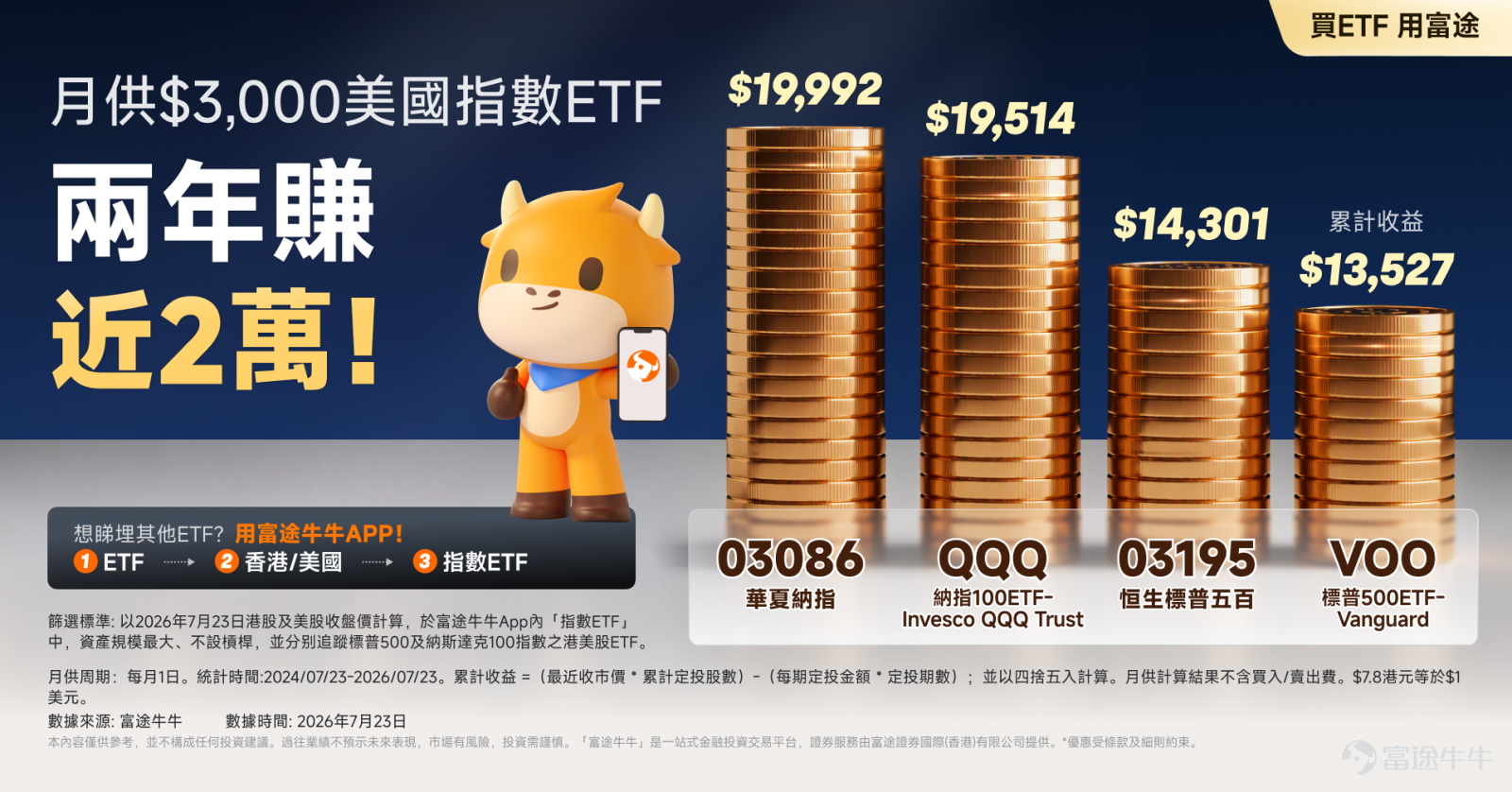
📊 Real-world data speaks: How much could you earn investing $3,000 monthly in U.S. index ETFs over two years?
Many people underestimate the power of combining 'monthly investments' with 'index ETFs.' Let's take a look at the latest real-world data.
Assume you started two years ago,investing HK$3,000 every month into the following popular ETFs tracking the two core U.S. equity indices ($NASDAQ 100 Index (.NDX.US)$ and $S&P 500 Index (.SPX.US)$ ) . As of July 23, 2026 (just before the recent stabilization of U.S. equities), the cumulative returns are remarkably impressive:
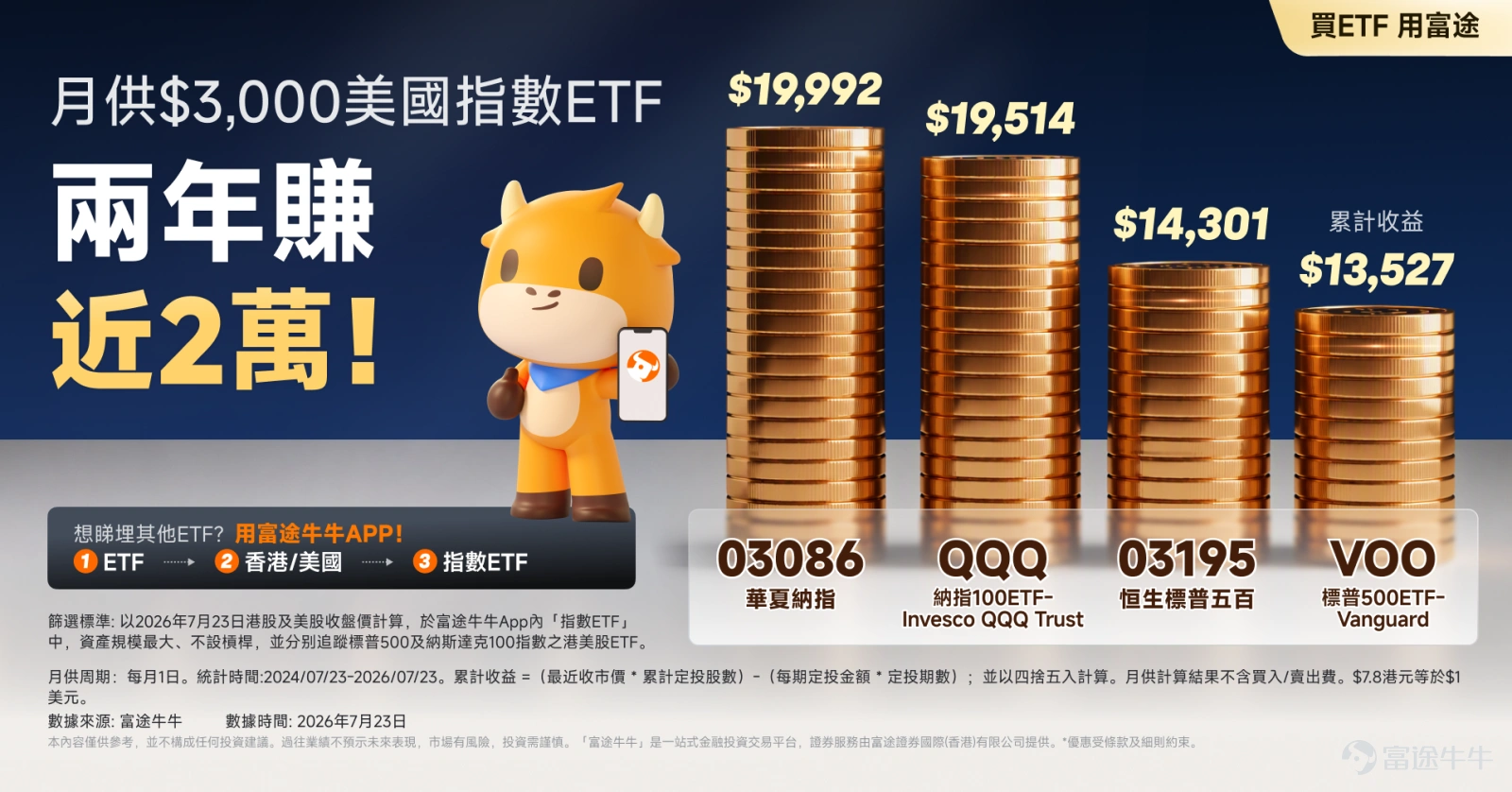
Data selection criteria: Based on Hong Kong and U.S. market closing prices as of July 23, 2026, sourced from the 'Index ETFs' section of the Futubull app. Selected ETFs are the largest by assets under management, non-leveraged, and track the S&P 500 and Nasdaq-100 indices respectively. Monthly contributions occur on the 1st of each month. Cumulative return = (Latest closing price × Total shares purchased) − (Monthly contribution amount × Number of contributions), rounded to the nearest whole number. Transaction fees for purchases/sales are excluded. HK$7.8 equals US$1. Data source: Futubull. Data date: July 23, 2026. Past performance does not guarantee future results. Investing involves risk; please proceed with caution.
💡 Why does consistently investing monthly in these broad-market ETFs generate such impressive returns over two years?
After reviewing the real-world data above, you might be wondering:Why not just buy individual stocks? Simply by 'mindlessly' dollar-cost averaging into these few broad-market index ETFs each month, you could steadily earn tens of thousands of HKD in just two years.
This outcome primarily stems from the perfect synergy of two core principles:
1. The multiplier effect of Dollar-Cost Averaging (DCA)
Over the past two years, US equities didn’t rise in a straight line; they experienced multiple fluctuations driven by recurring inflation data releases, shifting Federal Reserve rate-cut expectations, and the recent sharp tech-sector pullback in July.
a. If you hadinvested in individual stocks with a lump sum,you could easily have bought at the peak, suffering through volatility and possibly even selling at a loss;
b. whereas by choosingMonthly investment, when the market drops and panic sets in, your fixed monthly contribution automaticallybuys more shares at lower prices for youWhen the market rebounds sharply and resumes its upward trend—as it did in early August—these positions accumulated at lower levels can surge instantly, significantly lowering your average holding cost and realizing the profit formula of 'buy less at highs, buy more at lows.'
2. Backed by the 'strongest moat on Earth'
These two index constituents bring together the world’s most profitable companies with the strongest cash flows. Regardless of individual stock rotation, they continuously drive the broader market upward over the long term.
🔍 What exactly are the differences among these 4 popular ETFs? How should you choose?
These 4 ETFs actually fall intotwo major camps, and thoughtfully offer investors dual trading channels: 'Hong Kong-listed (HKD)'andand 'US-listed (USD)':
Camp One: Pursuing Maximum Growth — Nasdaq 100 Index Series
$ChinaAMC NASDAQ 100 ETF (03086.HK)$ & $Invesco QQQ Trust (QQQ.US)$ : Concentrated exposure to global tech giants (such as Microsoft, Apple, Nvidia, Alphabet, Meta, etc.). While the tech sector is highly volatile, dollar-cost averaging allows you to automatically 'accumulate shares in batches' at lower prices. Ideal for investors who are bullish on AI and the long-term explosive potential of global technology, seek higher upside and returns, and can tolerate some volatility.
Camp Two: Pursuing Steady Balance — S&P 500 Index Series
$Hang Seng S&P 500 Index ETF (03195.HK)$ & $Vanguard S&P 500 ETF (VOO.US)$ : Spanning 500 leading multinational corporations across the U.S., with a more balanced sector allocation (technology, financials, consumer goods, etc.), it serves as an excellent stabilizer during market sector rotations. Ideal for defensive investors who prefer diversified exposure across sectors (technology, financials, consumer, healthcare, etc.), wish to avoid heavy concentration in any single sector, and seek steady asset growth.
Dual channels in HKD/USD—flexibly avoid foreign exchange fees
– If you’d rather not frequently convert USD or worry about wire transfer and FX fees eroding your returns, you can directly choose monthly investment plans on Futu for HK-listed ETFs tracking $ChinaAMC NASDAQ 100 ETF (03086.HK)$ or $Hang Seng S&P 500 Index ETF (03195.HK)$ . These closely track U.S. index performance and trade directly in HKD—extremely convenient!
– If you already hold idle USD funds, you can opt directly for monthly investment plans in top-tier U.S.-listed ETFs. $Invesco QQQ Trust (QQQ.US)$ or $Vanguard S&P 500 ETF (VOO.US)$ 。
🛡️ Balanced Offense and Defense: Learn in One Move How to Build an Investment Moat with 'Monthly ETF Investments + Cash Plus'
In 2026—a unique year marked by both 'AI commercialization in practice' and 'macroeconomic volatility'—we often find ourselves lamenting:We miss fleeting upside opportunities and struggle to withstand sharp, frequent market downturns. In fact, the smartest strategy right now isn’t blindly going all-in or betting everything on one outcome—it’s building yourself a flexible capital safety net that allows you to both seize opportunities and manage risks.
🛡️ 'Defense': Futu Cash Plus + Monthly Investment in U.S. Index ETFs (a stable, defensive foundation)
This is the 'anchor' of your entire portfolio, designed to smooth out volatility and achieve steady gains:
– Futu Cash PlusDeposit your everyday reserve cash or idle funds awaiting investment into Cash Plus to earn money market fund yields while maintaining high liquidity. When a golden opportunity arises in the market, you’ll be ready to invest immediately.
– Monthly investment in broad U.S. equity index ETFs: Set up automatic monthly deductions to invest regularly in $Invesco QQQ Trust (QQQ.US)$ or $Vanguard S&P 500 ETF (VOO.US)$or HKD-traded$ChinaAMC NASDAQ 100 ETF (03086.HK)$ 、 $Hang Seng S&P 500 Index ETF (03195.HK)$. Use dollar-cost averaging (DCA) to smooth out market volatility and let America’s most profitable multinational companies work for you.
⚔️ 'Offense': Allocate a small portion of funds to monthly investments in 'thematic ETFs' (to capture high-growth, elastic returns)
If, after establishing solid defense, you still seek greater upside potential in the market, consider setting aside a modest amount of 'play money'—funds you can afford to lose in the short term without emotional distress—to invest monthly in high-growth thematic ETFs, such asSemiconductor/Technology sector ETFs.
These ETFs allow you to 'one-click bundle' dozens or even hundreds of industry-leading stocks.When market momentum picks up, their explosive potential and elasticity often far exceed those of broad-market ETFs; however, you must also remain vigilant about the 'high volatility' that comes with such 'high elasticity.'While choosing an aggressive approach, you need to be mentally prepared to withstand sharp declines and technical corrections similar to what the tech and semiconductor sectors just experienced.
Therefore, avoid blindly taking heavy positions in this segment, and'Monthly investing' is the best tool for gradually accumulating positions and averaging down the cost of these highly volatile assets.
💡 As for how to select US-listed AI-themed ETFs, you can refer to our previous in-depth analysis:
🛠️ How to find these popular ETFs in the Futubull app?
If you’d also like to start a hassle-free monthly investment journey, it only takes a few simple steps:
1. Open the Futubull app and enter "" in the search barMonthly investment」Enter the dedicated section.
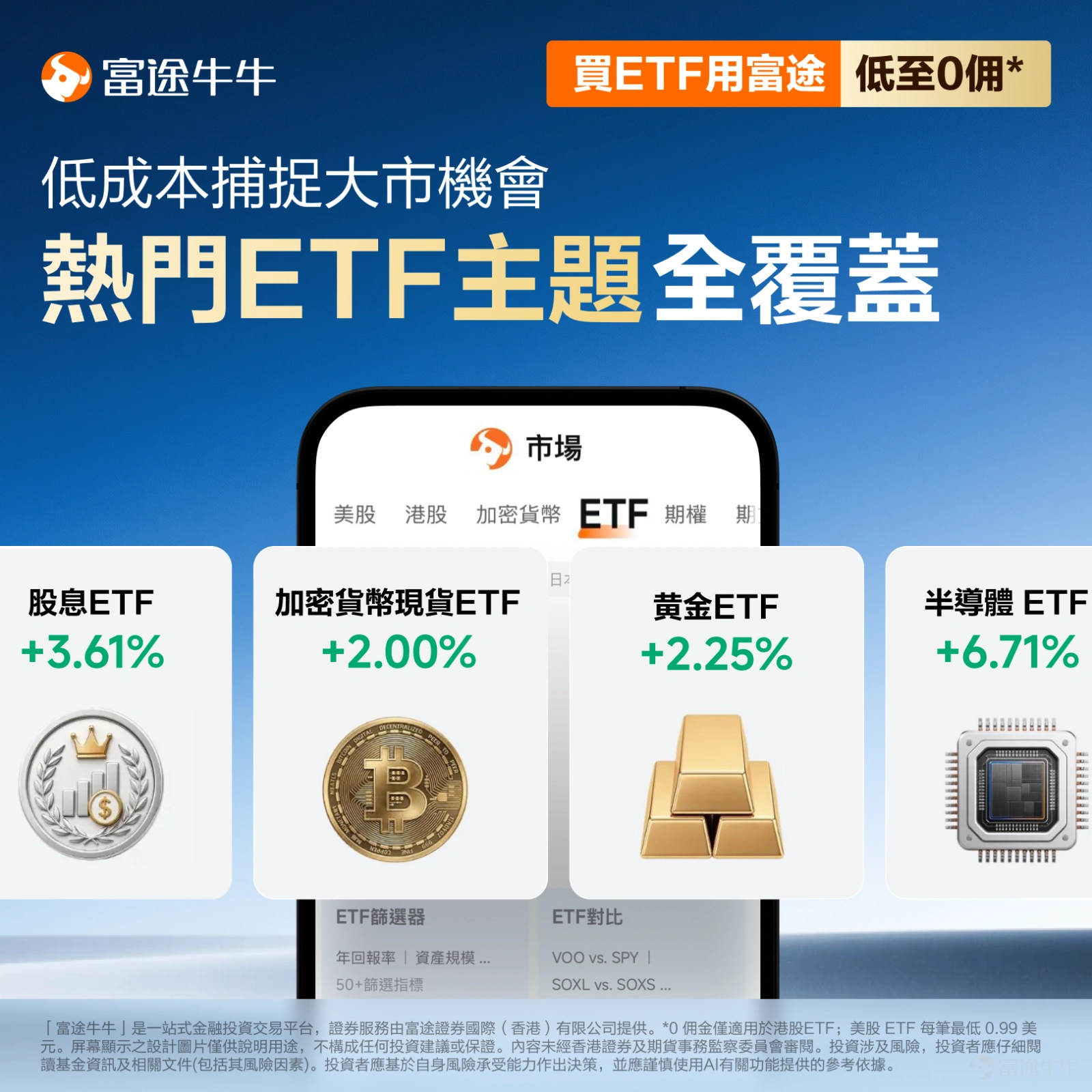
2. Alternatively, go to the 'Index ETFs' section, or follow the path:‘Market’ ➔ ‘ETFs’ ➔ ‘Hong Kong/US’ ➔ ‘Index ETFs’ / ‘Thematic ETFs’ to filter.
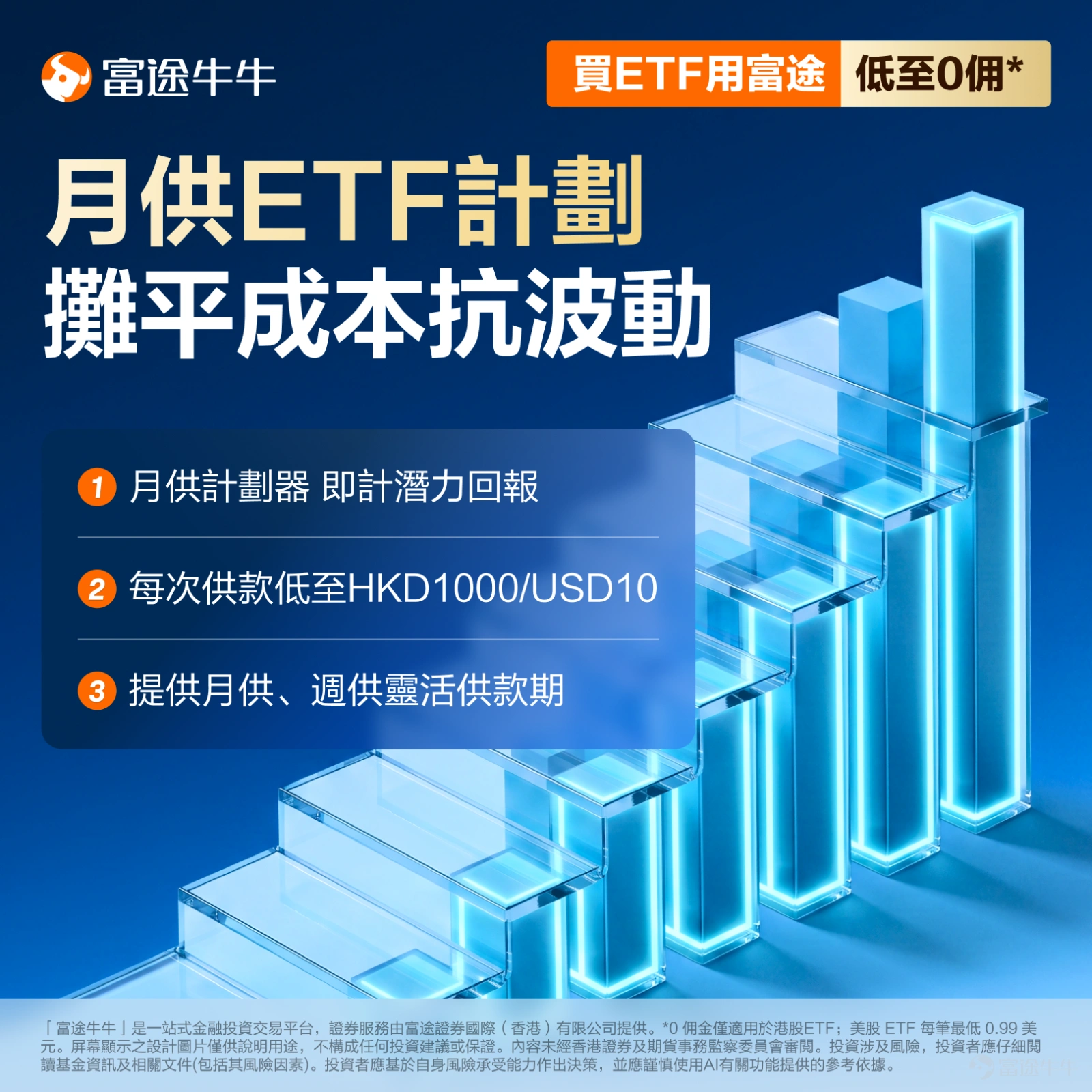
3. Use the built-in‘Monthly Investment Calculator’in the app to estimate your investment returns. Based on your risk tolerance, tap ‘Create Monthly Investment’, enter your monthly contribution amount (as low as HK$1,000 or US$100) and the deduction date to get started easily!
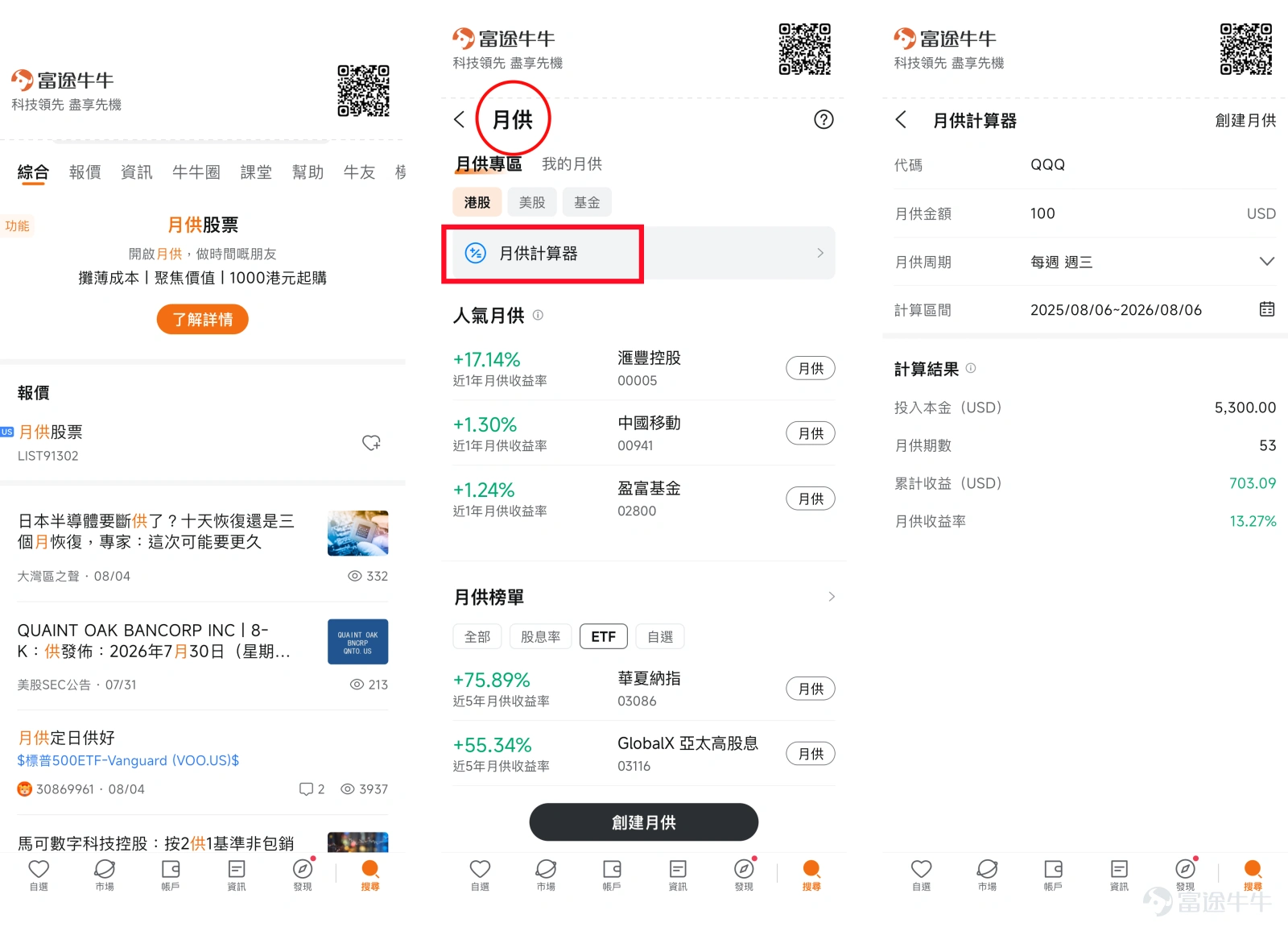
The stocks shown in the chart are for illustrative purposes only and do not constitute any investment advice. The data presented does not represent future returns, and investing involves risk.
Risk Disclaimer:
‘Futubull’ is an all-in-one financial investment and trading platform. Brokerage services are provided by Futu Securities International (Hong Kong) Limited. This content is for investor education purposes only and does not constitute an offer, solicitation, recommendation, opinion, or any guarantee regarding any specific securities, financial products, or instruments. Investing involves risks; prices of securities and funds may rise or fall. Please fully understand the product risks and consult professional advice before investing. *Promotions are subject to terms and conditions.
Risk Disclaimer: The above content only represents the author's view. It does not represent any position or investment advice of Futu. Futu makes no representation or warranty.Read more

Comment (1)
to post a comment
32
16