Optical communication stocks lead the rebound; will the AI optical cycle continue?

Repeating the DRAM ETF success story? Roundhill Photonics & Optical ETF launches tonight, with nearly half its holdings betting on Chinese optical modules
Following the phenomenal success of its memory ETF, $Roundhill Memory ETF (DRAM.US)$ Roundhill Investments has now placed its next bet on another critical AI infrastructure bottleneck—optical interconnects.
On August 6, the Roundhill Photonics & Optical ETF $Roundhill Photonics & Optics ETF (LYTE.US)$ will officially debut on the U.S. stock market. The fund employs an active management strategy with a 0.65% management fee and primarily invests in optical modules, lasers, silicon photonics chips, optical interconnect systems, and fiber optic connectivity.
Its investment thesis is straightforward: as AI clusters continue to scale, intra-data center connections will gradually shift from copper to optical links, which offer higher speeds, longer reach, and greater energy efficiency. If GPUs determine how fast AI can compute and HBM determines how quickly data can be accessed, optical interconnects determine whether thousands of GPUs can work together efficiently.
Which companies does this ETF hold?
$Roundhill Photonics & Optics ETF (LYTE.US)$ It is not a broadly diversified optics sector fund, but rather a highly concentrated portfolio focused on AI optical interconnects.

--
--
--
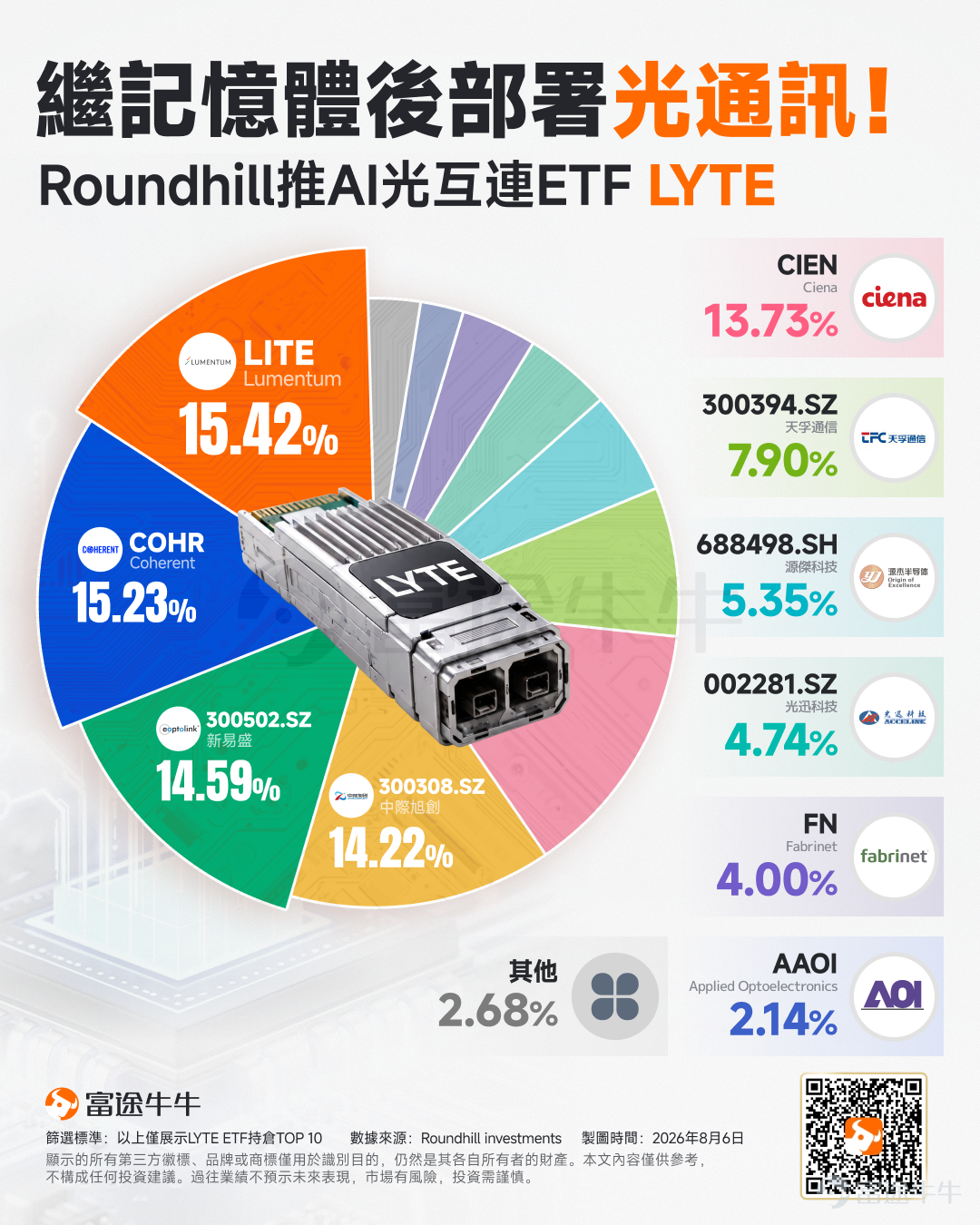
The fund’s top five holdings are $Lumentum (LITE.US)$ 、 $Coherent (COHR.US)$ 、 $Eoptolink Technology Inc., (300502.SZ)$ 、 $Zhongji Innolight (300308.SZ)$ and $Ciena (CIEN.US)$ , with weights of 15.42%, 15.23%, 14.59%, 14.22%, and 13.73%, respectively, totaling 73.19%.
Followed by $Suzhou TFC Optical Communication (300394.SZ)$ 、 $Yuanjie Semiconductor Technology (688498.SH)$ 、 $Accelink Technologies (002281.SZ)$ 、 $Fabrinet (FN.US)$ and $Applied Optoelectronics (AAOI.US)$ 、 $AXT Inc (AXTI.US)$Together, the top ten holdings account for approximately 97.32% of the fund, virtually determining its overall performance.
From an industrial division-of-labor perspective, Lumentum and Coherent primarily cover lasers and core optical components; Eoptolink, Accelink, and Applied Optoelectronics mainly benefit from upgrades to high-speed optical modules; TFC, Source Photonics, and FiberHome focus on optical components and photonic chips; Ciena provides optical networking equipment, while Fabrinet handles precision manufacturing.
More notably, Eoptolink, Accelink, TFC, Source Photonics, and FiberHome together represent a combined weighting of 46.8%. Roundhill gains exposure to these companies primarily through total return swaps, making LYTE one of the few ETFs in the U.S. equity market with such a high allocation to leading Chinese optical communications firms.
LYTE is not the first U.S.-listed optical communications ETF either.Tema ETFs launched on June 30 $Tema Photonics & Optical ETF (LAZR.US)$ , holding approximately 28 assets, including not only optical communications companies but also a private equity exposure to Anthropic; meanwhile, Tuttle Capital has already $Tuttle Capital Pure Play Photonics ETF (FOTO.US)$ , focusing on the photonics industry chain, including optical communications, silicon photonics, lasers, and InP (indium phosphide).
In comparison, FOTO emphasizes small- and mid-cap photonics specialty firms, while LAZR benefits from cross-sector diversification; LYTE, on the other hand, concentrates its bets on leading Chinese and U.S. optical communications companies, offering more direct exposure to AI data center optical interconnects—but with higher portfolio concentration and potentially greater volatility.
From memory chips to optical communications, Roundhill is replicating the same playbook.
In April this year, Roundhill launched the world’s first memory chip ETF—DRAM.
The fund surpassed $1 billion in assets under management (AUM) within just 10 trading days of its listing, and reached $10 billion in roughly 50 days, becoming the fastest ETF in history to achieve that milestone. Even after recent pullbacks, it still manages approximately $24.75 billion.
DRAM’s success stems not only from catching the upswing in the memory cycle but also from providing U.S. investors with rare global memory exposure. Roughly 70% of the fund is concentrated in Micron, Samsung Electronics, and SK Hynix, and it recently added CXMT, China’s leading DRAM manufacturer, to its top ten holdings.
With the launch of LYTE, Roundhill clearly aims to replicate this strategy: identify structural bottlenecks in AI infrastructure and package leading companies—spread across U.S. and Asian markets—into a highly focused thematic ETF.
Memory addresses data read bottlenecks, while optical interconnects solve data movement challenges. As AI clusters scale to tens of thousands or even hundreds of thousands of GPUs, computational efficiency is determined not only by chip performance but also by bandwidth, latency, and power consumption between GPUs.
Traditional copper interconnects are suitable for short-distance transmission, but as data rates upgrade from 800G to 1.6T and 3.2T, their limitations in transmission distance, signal loss, and power consumption are becoming increasingly evident. Optical modules, silicon photonics, co-packaged optics (CPO), and optical switching technologies are shifting from peripheral support components to core elements.
NVIDIA’s recent moves further validate this thesis. In March this year, NVIDIA invested $2 billion each in Lumentum and Coherent, establishing long-term capacity and R&D partnerships. These two companies happen to be the top two holdings in LYTE, together accounting for over 30% of its portfolio weight.
Goldman Sachs estimates that as AI networking expands from scale-out architectures to scale-up within racks and super-nodes, the relevant market size could grow from approximately $15 billion in 2026 to $154 billion by 2028.
Roundhill is not betting on a new concept, but rather on the next phase of AI capital expenditure expanding beyond GPUs and HBM into networking and interconnects.
Is now still a good time to 'dive into optics'?
From an industry trend perspective, the outlook is not pessimistic. AI clusters continue to expand, and transmission speeds are upgrading from 800G to 1.6T and even 3.2T,Optical communications remains one of the most robust and earnings-certain segments within AI hardware.
It is particularly worth emphasizing that Chinese optical communications companies are no longer just cost-competitive manufacturers; through rapid technology iteration, large-scale manufacturing, delivery efficiency, and customer validation, they have become key players in high-speed optical modules, optoelectronic components, and photonic chips—critical links in the global AI optical interconnect supply chain.
LYTE allocates 46.8% of its portfolio to Innolight, Accelink, TFC, Source Photonics, and Oclaro—not merely a bet on the Chinese market, but a recognition of the current global optical communications industry landscape. It is now nearly impossible for a U.S.-listed ETF aiming to build a high-purity optical interconnect portfolio to bypass China’s leading players.
Therefore, what truly matters now is not whether optical communications has a future, but whether order growth and profit increases over the next few years can justify the stock price’s recent rapid rise.
On one hand, cloud vendors are still ramping up AI-related capital expenditures, 1.6T optical modules are gradually scaling up in volume, and NVIDIA has further secured optical capacity through investments in Lumentum and Coherent—indicating that optical interconnects are transitioning from market expectations to actual order fulfillment. If core companies continue to see rising shipments, revenue, and gross margins, the recent pullback could actually help ease valuation pressures.
On the other hand, the optical communications sector has already seen substantial gains, with the market pricing in significant growth expectations ahead of time. If subsequent orders merely remain elevated rather than continuing to exceed expectations, stock prices could still experience a scenario of 'earnings growth accompanied by valuation contraction.'
LYTE’s high concentration is itself a double-edged sword. With its top five holdings accounting for over 70%, the ETF can more fully capture earnings leverage from leading companies—but if any single core holding misses earnings expectations, fund volatility will also be amplified. The concern isn’t excessive exposure to Chinese firms, but rather the ETF’s heavy reliance on just a few companies and a single AI capex cycle.
Going forward, three key signals warrant close attention: whether cloud vendors continue to raise their capital expenditure guidance, whether 1.6T optical module shipments and gross margins materialize as expected, and whether next-generation technologies like CPO can transition from roadmaps to large-scale orders.
If stock prices correct while orders, revenue, and profits continue to rise, the pullback likely reflects valuation digestion within a high-growth environment. However, if stock prices rebound significantly faster than improvements in earnings expectations, it would be unwise to chase the rally solely due to a new ETF listing.
Overall, the underlying trend in optical communications has not reversed, and the global competitiveness of Chinese leaders in this space continues to strengthen. After the earlier sharp rally and recent correction, the current phase is better suited for staged, earnings-driven positioning rather than committing a large position all at once.
'Optical replacing copper' is not just a market narrative—it reflects real demand driven by AI cluster expansion. Whether optical communications can become the next memory market no longer hinges on whether demand exists, but on how quickly orders and profits can be realized.
Risk Disclaimer: The above content only represents the author's view. It does not represent any position or investment advice of Futu. Futu makes no representation or warranty.Read more


Comments (27)
to post a comment
132
1025