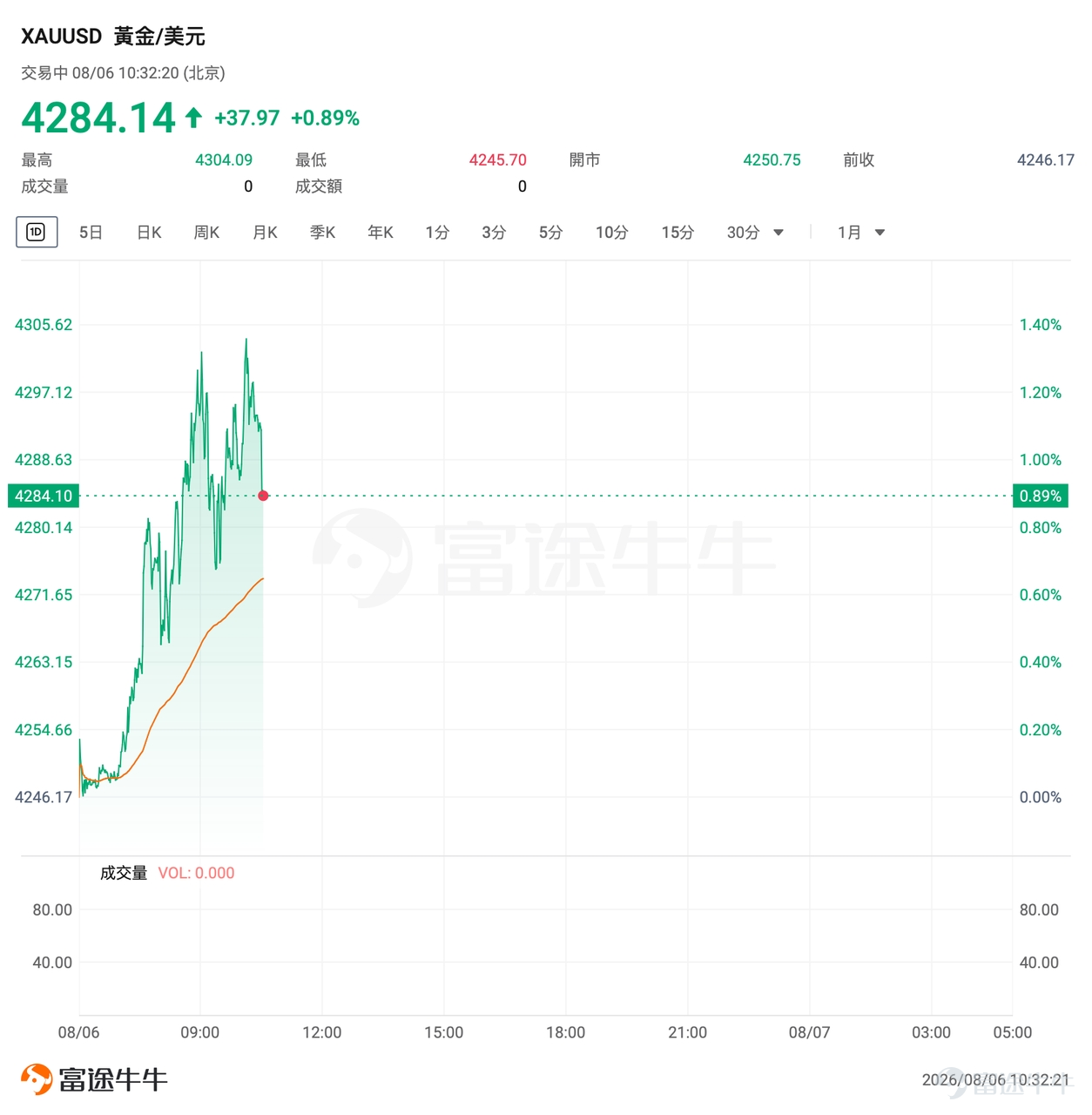
Gold prices break above USD 4,400—can the precious metals rally accelerate?

Gold hits $4,300! With cooling employment data and easing geopolitical tensions, how should investors position themselves in gold and silver-related assets?
On the morning of August 6, Beijing time, $XAU/USD (XAUUSD.CFD)$ briefly touched the $4,300 per ounce mark, the first time since June 18; $XAG/USD (XAGUSD.FX)$ rose above around $62 per ounce on August 5, the first time since July 7.
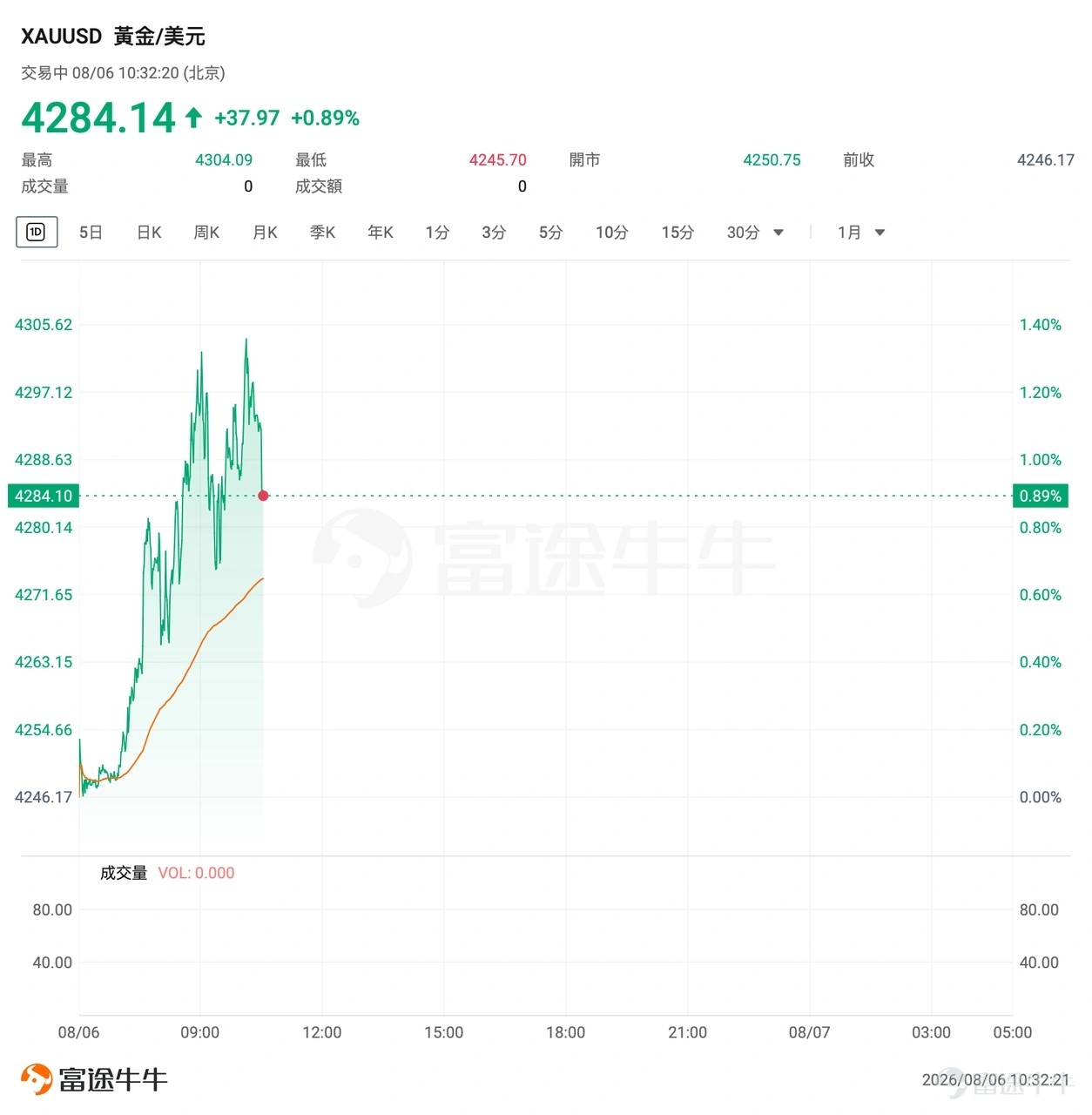
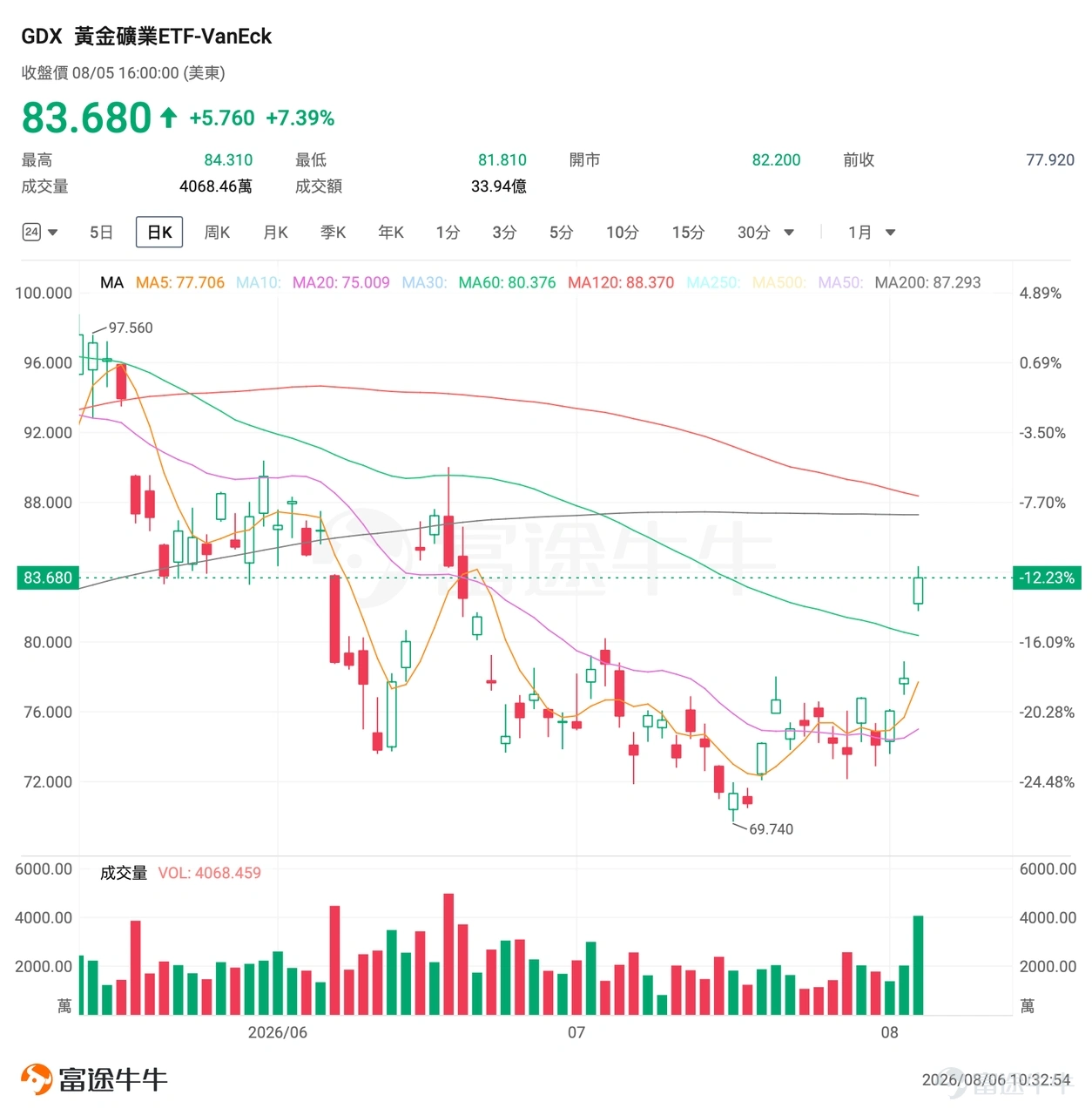
At the close of U.S. markets on August 5, $SPDR Gold ETF (GLD.US)$ closed at $389.64, up approximately 4.1%, $iShares Silver Trust (SLV.US)$ closed at $56.07, up approximately 4.1%, $VanEck Gold Miners Equity ETF (GDX.US)$ surged even more sharply by about 7.4% to $83.68,The precious metals sector became one of the standout asset classes of the day.
July ADP private-sector employment increased by only 44,000, significantly below the market expectation of approximately 75,000, and the June figure was revised down to 95,000, causing U.S. Treasury yields and interest rate hike probabilities to decline. Combined with easing signals from Strait of Hormuz shipping negotiations pressuring oil prices, the holding cost of non-yielding assets temporarily decreased.
The question then arises:Is this rebound a brief short-covering rally, or is the macro pricing logic shifting?
I. What is the core driver behind the current rally in gold and silver?
The recent rise in gold and silver prices reflects a three-way convergence of 'interest rate trajectory + oil-driven inflation expectations + USD liquidity.'
On July 29, the Federal Reserve kept the target range for the federal funds rate unchanged at 3.50%–3.75%. Markets had previously remained concerned about a potential rate hike in September. However, following yesterday’s ADP release, CME FedWatch showed the probability of a 25-basis-point rate hike in September briefly falling back to around 55%; concurrently, the 10-year U.S. Treasury yield edged slightly lower.
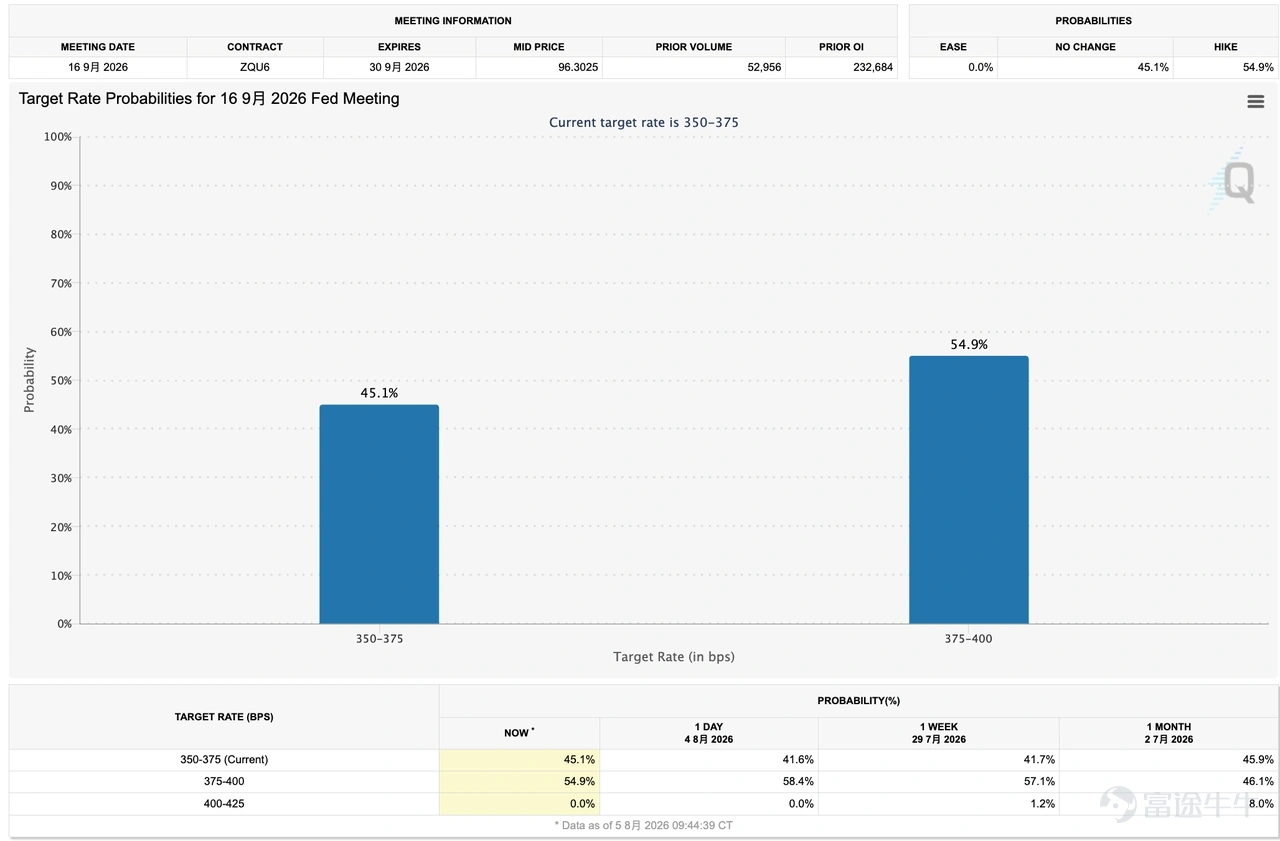
The market’s trading logic follows this chain: 'weaker employment data → reduced urgency for further rate hikes → lower opportunity cost of holding gold.'
On the geopolitical front, Trump signaled that a Strait of Hormuz agreement is nearing completion, and reports also intensified regarding Iran and Oman holding consultations on coordinates for a temporary shipping corridor. $Crude Oil Futures (NOV6) (CLmain.US)$ Recently, oil prices have pulled back to around $75. This retreat in oil prices has weakened the reflationary pressure from the energy sector that could have forced the Fed into a more hawkish stance, thereby further opening a trading window for precious metals. However, since there has been no definitive resumption of shipping through the Strait of Hormuz yet, the more accurate current pricing reflects gold and silver benefiting from a marginal decline in reflationary pressures, rather than a complete removal of risk.
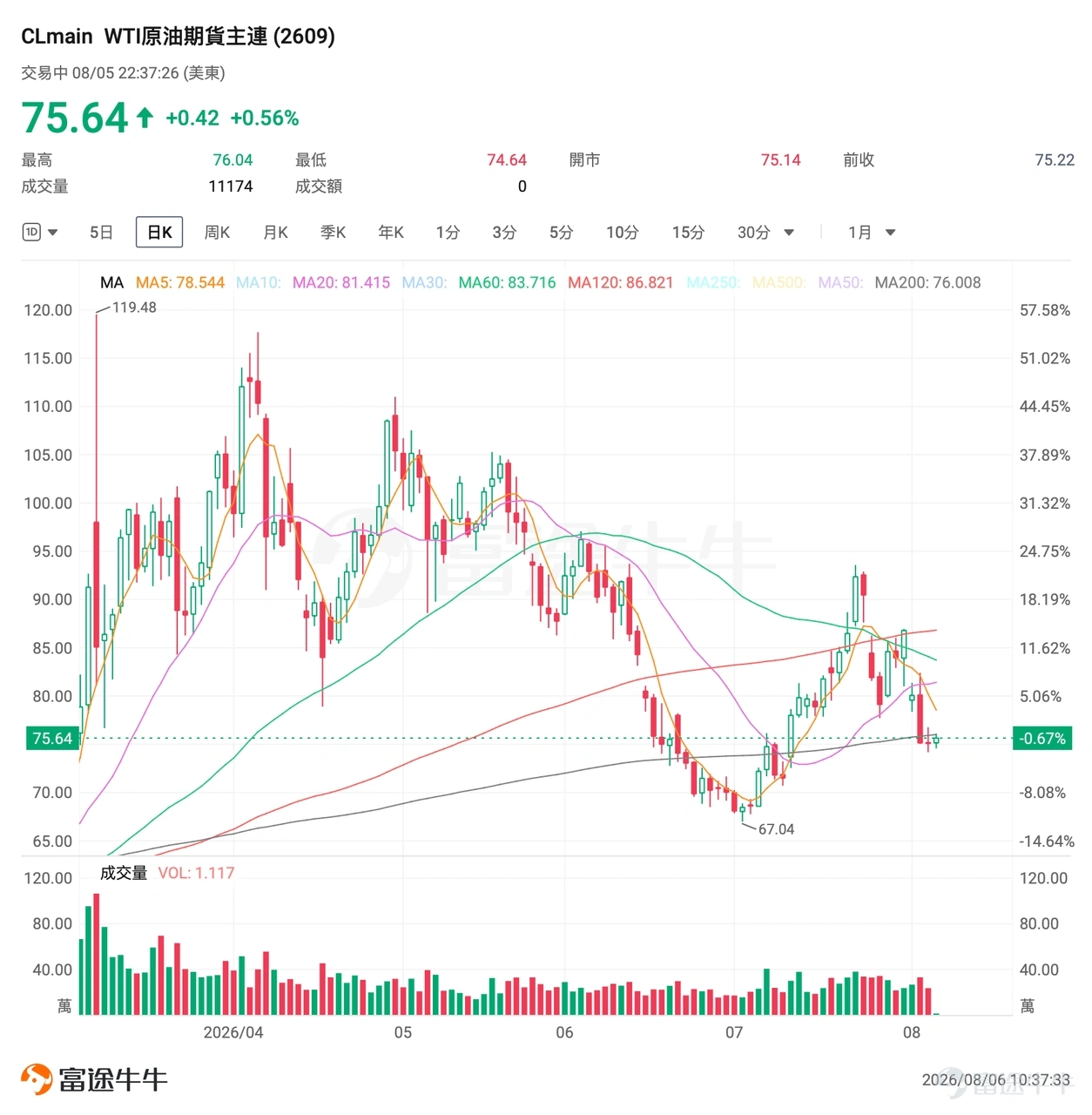
The US Dollar Index has softened in tandem, coupled with coordinated intervention by the US and Japan to support the yen, $USD/JPY (USDJPY.FX)$ which has retreated from above 163 to around 157, providing support for gold prices from both the perspective of the pricing currency and global liquidity.

In addition, as gold prices rose above the key threshold of $4,200 per ounce, some CTA short-position funds closed their positions, further pushing prices higher. Sustained central bank buying has also supported gold prices. According to data from the World Gold Council, global central banks purchased 288.9 tonnes of gold in Q2, a 62% year-over-year increase—the strongest second quarter on record. Notably, South Korea resumed gold purchases after a 13-year hiatus.
II. After gold’s rebound, focus shifts to nonfarm payrolls and the next catalyst
From a technical perspective, $XAU/USD (XAUUSD.CFD)$ gold prices surged early in the session to around $4,300, reclaiming both the 20-day and 60-day moving averages. Key resistance now lies in the $4,300–$4,400 zone, while support levels to watch include the 60-day moving average at $4,218 and the round numbers at $4,200 and $4,100. Structurally, gold has broken out above the upper boundary of its recent trading range, strengthening the short-term bullish signal. However, whether this rally can evolve into a sustained trend recovery still hinges on whether upcoming macroeconomic data continues to lower real rate expectations.

Current mainstream institutional views on gold are as follows:
UBS Group stated that if the Fed avoids further rate hikes, investment demand recovers, and central bank buying remains robust, gold prices could resume their upward trajectory in the second half of 2026. It forecasts prices reaching approximately $4,400 by September and $4,600 by December, and notes that a pullback to around $3,850 could present a strategic entry point for long-term investors.
Citi believes gold prices may consolidate near current levels in the near term—or even give back some gains—but expects them to recover to around $4,500 per ounce by Q4 2026 and rise to approximately $5,000 in the first half of 2027.
Goldman Sachs maintains its year-end target of approximately $4,900 per ounce and emphasizes that central bank gold purchases are offsetting the negative impact from geopolitical disruptions and rate hike speculation.
Investors should closely watch this Friday’s (August 7) US nonfarm payrolls data.ADP has already signaled a cooldown, but nonfarm payrolls are the key indicator shaping the Fed's September rate decision path. If nonfarm payrolls come in significantly weaker than expected and unemployment rises, the probability of a rate hike and real yields on US Treasuries could continue to decline, potentially driving gold prices higher. Conversely, if nonfarm payrolls surprise to the upside, markets may reprice in stronger labor market resilience and renewed rate hike expectations, putting downward pressure on gold’s recent gains.
III. How to participate in gold and silver price movements?
In an environment of shifting interest rate expectations and evolving geopolitical narratives, investors are often less concerned with directional calls and more focused on which financial instruments to use for exposure. Below is an overview of common approaches across four dimensions: US equities, futures, ETFs, and options.
1. US Equities: High elasticity of gold and silver mining companies
Miners’ profits exhibit operating leverage to metal prices, often delivering higher elasticity than spot prices during upswings—but also amplifying drawdowns.Suitable for investors with a positive medium-term outlook on gold and silver who can tolerate company-specific operational and equity risks; short-term traders should beware of profit-taking following event-driven reversals.
Overnight, $Gold (LIST2110.US)$ 、 $Silver (LIST2093.US)$ gold-related stocks broadly rose. Among gold概念股, $Newmont (NEM.US)$ up nearly 7%, $Coeur Mining (CDE.US)$ 、 $Barrick Mining (B.US)$ rising over 7%, $Agnico Eagle (AEM.US)$ up nearly 10%.

--
--
--
$Silver (LIST2093.US)$ Among related concept stocks, $First Majestic Silver (AG.US)$ up nearly 7%, $Endeavour Silver (EXK.US)$ up nearly 8%, $Aya Gold & Silver (AYA.US)$ up over 9%.

--
--
--
2. Futures: The most direct way to track price movements, but also the most demanding in terms of margin management
Gold and silver futures are the primary arena for institutional hedging and short-term trading. Common instruments include:
Investors can accessthe Market > Futures > U.S. Futures > Metals Futures pageto find gold and silver-related futures contracts.

The core advantages of trading precious metals via futures include price discovery closely aligned with spot/international benchmarks, support for two-way trading, flexible leverage enabling a relatively small margin to control a larger notional exposure, and ease of pairing with spot ETFs or mining stock positions for precise hedging.
Primary Strategy:
- Event-driven / Trend-following:Around key events such as non-farm payrolls, CPI releases, or major developments in the Strait of Hormuz, use nearby-month contracts to go long or short to express views on short-term interest rates and geopolitical risk premiums;
- Hedging:Investors holding long positions in gold mining stocks, physical gold, or commodity ETFs can use short futures positions to hedge against price pullbacks;
Investors should be wary of overnight price gaps, margin calls, delivery obligations, and rollover costs; those with limited capital should prioritize micro or mini contracts and strictly manage leverage and position size.
3. Commodity ETFs:
For detailed analysis, refer to the 'ETF Battle Strategies' column.
(1) Commodity ETFs — Directly Linked to Gold and Silver Prices
Primary holdings include: $SPDR Gold ETF (GLD.US)$ 、 $iShares Gold Trust (IAU.US)$ 、 $ProShares Ultra Gold (UGL.US)$ 、 $Direxion Daily Gold Bull 2X ETF (UGLD.US)$ 、 $iShares Silver Trust (SLV.US)$ 。
Commodity ETFs offer strong liquidity, making them suitable for investors who prefer not to pick individual stocks and simply want exposure to the direction of precious metals. Note that trust fees and tracking error should be monitored; silver typically exhibits higher volatility.
(2) Equity ETFs — Indirect Exposure to Mining Companies’ Upside
Primary holdings: $VanEck Gold Miners Equity ETF (GDX.US)$ 、 $Direxion Daily Gold Miners Index Bull 2X Shares (NUGT.US)$ 、 $iShares MSCI Global Gold Miners ETF (RING.US)$ 、 $VanEck Junior Gold Miners ETF (GDXJ.US)$ 、 $Global X Gold Explorers ETF (GOEX.US)$ 、 $Global X Funds Global X Silver Miners Etf (Post Rev Spl (SIL.US)$
These ETFs invest in gold mining and processing companies. Their performance correlates with gold prices but is also influenced by company operations and broader market sentiment, often resulting in higher volatility. Suitable for investors comfortable with 'amplified gains on the upside and amplified losses on the downside.'
Investors can explore more options through gold- and silver-related ETFs.

--
--
--

--
--
--
4. Options: Use structured strategies to express views such as 'bullish but worried about pullbacks' or 'selling options in high-volatility environments'
Taking $SPDR Gold ETF (GLD.US)$ For example (provided solely for illustrative strategy purposes and not as investment advice). After recent rallies in gold and silver, implied volatility has increased, making option premiums more expensive; strategy selection thus requires greater caution.
(1) Covered Call:
Suitable for investors who already hold ETFs and expect short-term gains to be followed by consolidation; they may consider selling out-of-the-money call options to enhance yield, though upside potential will be capped.

(The illustrative chart displayed on screen uses GLD as an example for demonstration purposes only and does not constitute any investment advice or guarantee; market conditions change frequently, and the prices shown do not reflect actual market data.)
(2) Cash-Secured Put:
Suitable for investors with a neutral-to-bullish outlook who are willing to buy on dips; they can sell puts with lower strike prices to collect premiums. However, if the price drops sharply and the option is exercised, they will still bear the downside risk.

(The illustrative chart displayed on screen uses GLD as an example for demonstration purposes only and does not constitute any investment advice or guarantee; market conditions change frequently, and the prices shown do not reflect actual market data.)
(3) Bull Call Spread:
Suitable for investors seeking limited-cost exposure to further upside; they can buy a call with a lower strike price and sell a call with a higher strike price, capping maximum loss at the net premium paid.
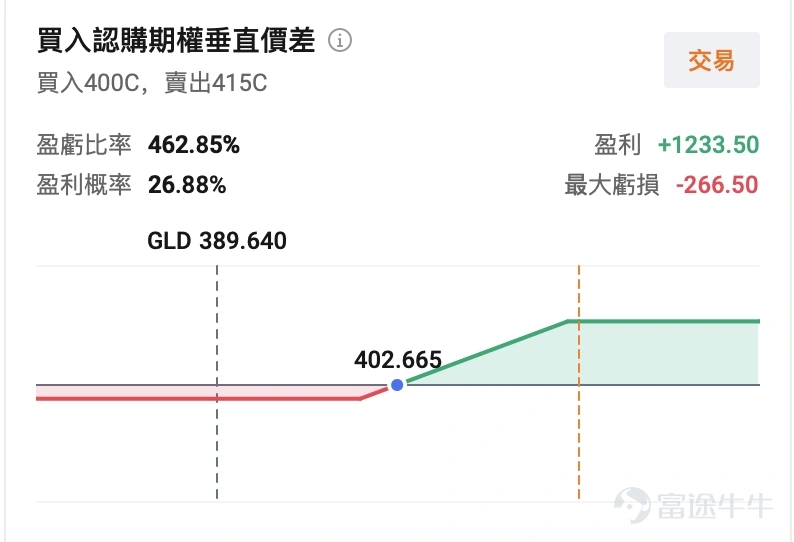
(The illustrative chart displayed on screen uses GLD as an example for demonstration purposes only and does not constitute any investment advice or guarantee; market conditions change frequently, and the prices shown do not reflect actual market data.)
Summary
Gold’s recent rally reflects repricing following cooler-than-expected jobs data (reducing rate hike premiums), easing tensions in the Strait of Hormuz (suppressing oil-driven inflation premiums), and concurrent loosening in both the U.S. dollar and real interest rates. Looking ahead, whether gold can break above 4,300 and challenge the 4,400 level hinges critically on Friday’s nonfarm payroll report and subsequent inflation trajectory. On the downside, if geopolitical optimism proves unfounded, oil prices rebound, or unexpectedly strong employment data pushes real rates higher, the rally could fade.
 Fellow investors, how far do you think this gold and silver rally can go? Is it the start of a medium- to long-term trend, or just an emotional spike ahead of the non-farm payrolls data?
Finally, we’ve got a little perk for our fellow investors—feel free to claim it!Options Starter Pack
*This promotion is exclusively available to invited Hong Kong users. Click to learn more.Detailed terms and conditions of the promotion >>

Disclaimer
This content does not constitute an offer, solicitation, recommendation, opinion, or any guarantee regarding any securities, financial products, or instruments. The risk of loss in trading options can be substantial. In certain circumstances, your losses may exceed the initial margin deposit you made. Even if you have placed contingent orders, such as stop-loss or limit orders, these may not necessarily prevent losses. Market conditions may prevent such orders from being executed. You may be required to deposit additional margin on short notice. If you fail to meet the required margin within the specified time, your open positions may be liquidated. Nevertheless, you remain fully liable for any resulting deficit in your account. Therefore, you should thoroughly research and understand options before trading, and carefully consider whether such transactions are appropriate for you based on your financial situation and investment objectives. If you trade options, you should familiarize yourself with the procedures for exercising options and handling expiration, as well as your rights and responsibilities upon exercise or expiration.
Risk Disclaimer: The above content only represents the author's view. It does not represent any position or investment advice of Futu. Futu makes no representation or warranty.Read more


Comments (2)
to post a comment
30
21