
Domestically developed AI large models are gaining pricing power—will the industry chain undergo a r

From DeepSeek's Price Hike to Compute Pricing Power: Morgan Stanley Outlines Three AI Scenarios—Who Will Be the 'Greatest Common Denominator' Dominating the Market?
Today, DeepSeek announced plans to significantly raise API service prices across the board in the near term, with specific details to be communicated in subsequent notices.

This is not an isolated price hike.The model market has recently undergone a seemingly 'counterintuitive' shift: closed-source models are becoming cheaper, while the actual usage costs of open-source models continue to rise.
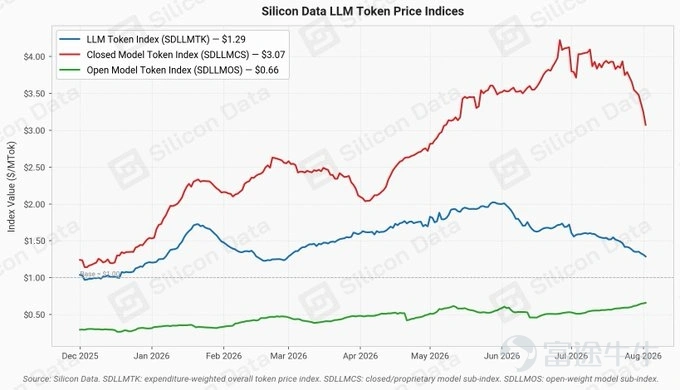
According to the latest data from Silicon Data, which tracks large model inference pricing, the overall LLM token price index has remained stable with a slight decline, currently around $1.29 per million tokens; the closed-source model index has steadily declined from a high of $3.07, while the open-source model index has continuously climbed from a low of $0.66.
In other words, closed-source models are getting cheaper and open-source models more expensive, rapidly narrowing the price gap between the two.
Open-source does not mean free, nor does it imply reduced compute requirements.
Silicon Data tracks the actual total cost of using large models. The rising open-source model index does not necessarily indicate uniform price increases across all models; it could also reflect increased usage of higher-performance, more computationally expensive models such as DeepSeek, Kimi, and GLM.
Releasing model weights openly does not equate to zero cost. Enterprises still need to purchase GPUs, rent cloud computing resources, or pay per token via APIs. As model parameters grow, inference chains lengthen, and agents repeatedly invoke tools, the compute consumed per task continues to rise.DeepSeek’s price increase reflects a broader trend: open-source models are shifting from 'low-price user acquisition' toward pricing based on performance, compute intensity, and service capabilities.
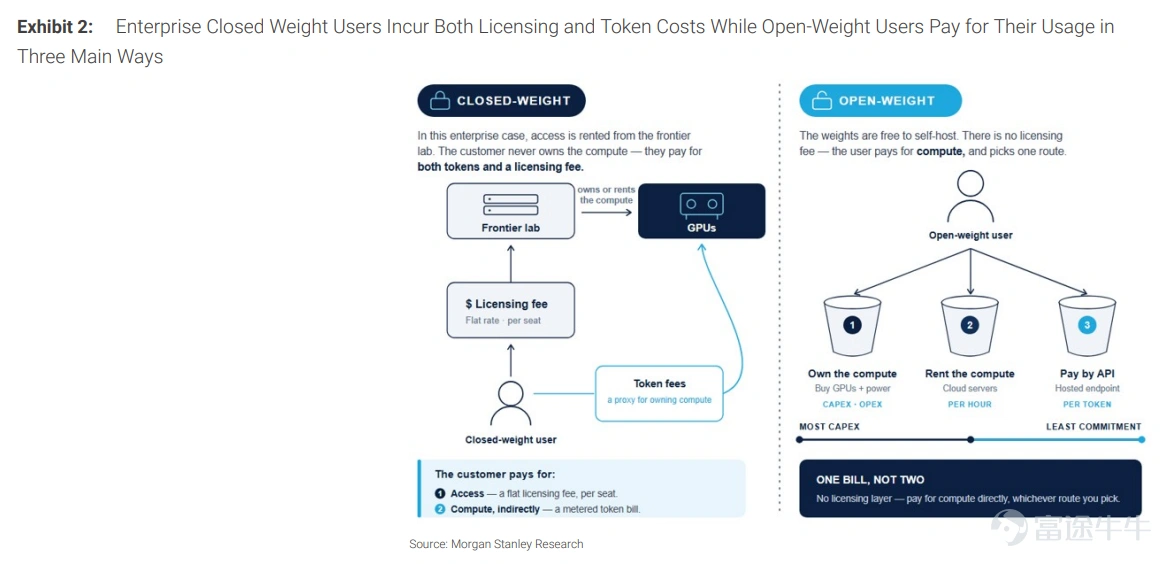
However, Morgan Stanley believes that improvements in model efficiency will lower the barrier to AI adoption through the 'Jevons Paradox,' driving more enterprises and use cases to adopt AI. Compute demand is determined not just by per-token pricing, but by:Total compute consumption = number of users × invocation frequency × tokens per task × model inference complexity.
Even if the per-token price declines, demand for GPUs, storage, networking, and power will continue to expand as long as user count, invocation frequency, and inference length grow faster.
Currently, over 60% of surveyed enterprises are already using both open-weight and closed-source models, suggesting there may not be a single winner in the future. Based on differences in model capabilities, costs, and deployment methods, Morgan Stanley has outlined three potential scenarios for the AI industry’s development.
Morgan Stanley’s three projected AI industry scenarios
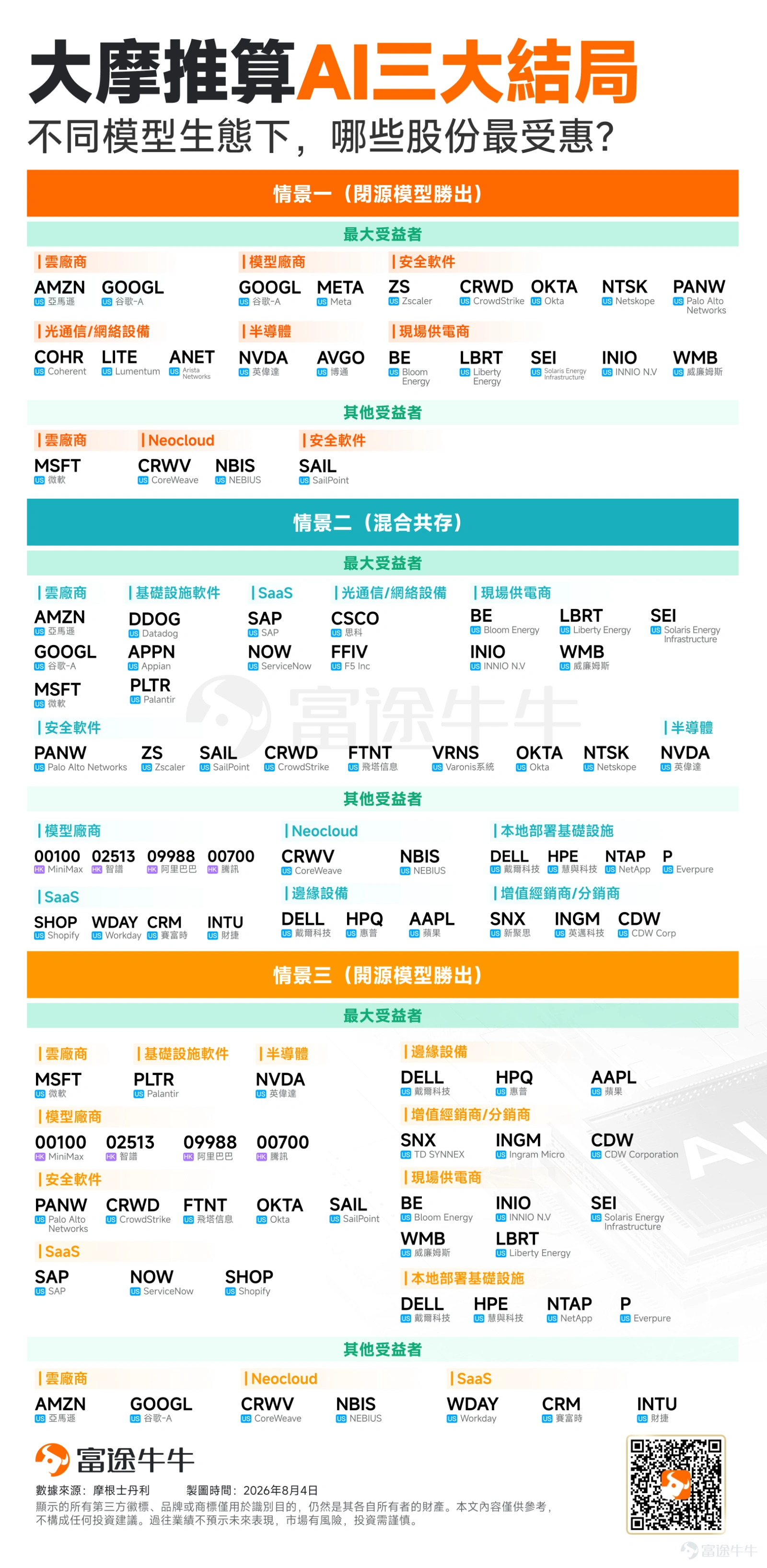
Scenario 1: Closed-source models prevail
If cutting-edge models remain difficult to replicate, a few well-funded labs will continue to dominate the market.
Enterprises will prioritize accuracy, reliability, security, intellectual property indemnification, and ease of deployment over model control. AI training and inference will remain concentrated in large cloud data centers, allowing closed-source models to retain strong pricing power.
Key beneficiaries under this scenarioTotal compute consumption = number of users × invocation frequency × tokens per task × model inference complexity.Including:
• Security software: $Palo Alto Networks (PANW.US)$ 、 $CrowdStrike (CRWD.US)$ 、 $Zscaler (ZS.US)$ 、 $Netskope (NTSK.US)$ 、 $Okta (OKTA.US)$
• Fiber optics/networking: $Arista Networks (ANET.US)$ 、 $Lumentum (LITE.US)$ 、 $Coherent (COHR.US)$
• On-site power suppliers:$Bloom Energy (BE.US)$ 、 $INNIO N.V (INIO.US)$ 、 $Solaris Energy Infrastructure (SEI.US)$ 、 $Williams (WMB.US)$ 、 $Liberty Energy (LBRT.US)$
The more powerful the closed-source models become and the larger the training clusters scale, the greater the demand for high-speed interconnects, optical modules, and gigawatt-scale power supply.
Scenario Two: A hybrid landscape emerges with both open-source and closed-source models
This scenario also most closely resembles current enterprise deployment approaches.
Cutting-edge closed-source models handle complex reasoning and agent tasks, while open-weight models manage high-frequency, cost-sensitive, and highly specialized workloads. Enterprises automatically route different tasks to different models based on accuracy, cost, latency, and security requirements.
Under this paradigm, what truly matters will no longer be just the models themselves, but the middleware layer responsible for model selection, routing, monitoring, evaluation, and security governance.
Morgan Stanley's favored sectors include:
• On-site power suppliers:$Bloom Energy (BE.US)$ 、 $INNIO N.V (INIO.US)$ 、 $Solaris Energy Infrastructure (SEI.US)$ 、 $Williams (WMB.US)$ 、 $Liberty Energy (LBRT.US)$
• Semiconductors: $NVIDIA (NVDA.US)$
The more models enterprises deploy and the more geographically dispersed their deployments are, the greater their need for unified orchestration, observability, and security management platforms.
Scenario 3: Open-weight models prevail
If open-weight models achieve performance broadly approaching frontier levels, foundational model capabilities will gradually become commoditized, and model API prices could decline again due to competition.
Enterprises can fine-tune models using their own data and deploy AI to private clouds, on-premises data centers, or even edge devices such as PCs and smartphones, based on cost, latency, and data sovereignty requirements.
The focus of innovation will also shift from large-scale pre-training toward fine-tuning, inference optimization, agent tools, and industry-specific applications.
Key beneficiaries include:
• Cloud service providers:$Microsoft (MSFT.US)$
• Chinese model vendors: $MINIMAX-W (00100.HK)$、 $Z.AI (02513.HK)$、 $BABA-W (09988.HK)$、 $TENCENT (00700.HK)$;
• Infrastructure software: $Palantir (PLTR.US)$
• On-premises infrastructure: $Dell Technologies (DELL.US)$、 $Hewlett Packard Enterprise (HPE.US)$、 $NetApp (NTAP.US)$、 $Everpure (P.US)$
• On-site power suppliers:$Bloom Energy (BE.US)$ 、 $INNIO N.V (INIO.US)$ 、 $Solaris Energy Infrastructure (SEI.US)$ 、 $Williams (WMB.US)$ 、 $Liberty Energy (LBRT.US)$
• Semiconductors: $NVIDIA (NVDA.US)$
Open-source dominance does not mean the end of cloud computing; rather, computing power will further disperse from a few hyperscale data centers to public clouds, private clouds, on-premises deployments, and edge devices.
Regardless of open-source or closed-source, who emerges as the greatest common denominator?
Although Morgan Stanley's three scenarios have differing impacts on model vendors, cloud service providers, and networking equipment companies, several trends run through nearly all configurations.
First is $NVIDIA (NVDA.US)$。In a closed-source victory, larger frontier training clusters are needed; a hybrid scenario requires support for multiple models and inference workloads simultaneously; an open-source win would drive more enterprises to deploy GPUs on their own. Model strategies may differ, but underlying computing power remains essential.
Second is power.Whether computing power is concentrated in hyperscale data centers or distributed across private clouds and on-premises facilities, power supply remains an unavoidable bottleneck.
Third is security and model management software.The more models there are and the more dispersed their deployment locations, the more complex the risks enterprises face—such as data breaches, model attacks, access control, and compliance challenges.
Therefore, what’s truly worth noting about DeepSeek’s price increase isn’t whether 'open source is still cheap,' but rather that AI models are shifting from a technological race toward commercialization and compute-based pricing.
Model weights can be released openly for free, but GPUs, video memory, electricity, and inference services will never be free. Whether open-source or closed-source models ultimately prevail will determine who deploys the compute infrastructure and captures the profits; however, as long as AI usage continues to grow, compute infrastructure remains the biggest common beneficiary across all three scenarios.
Risk Disclaimer: The above content only represents the author's view. It does not represent any position or investment advice of Futu. Futu makes no representation or warranty.Read more


Comments (14)
to post a comment
103
291