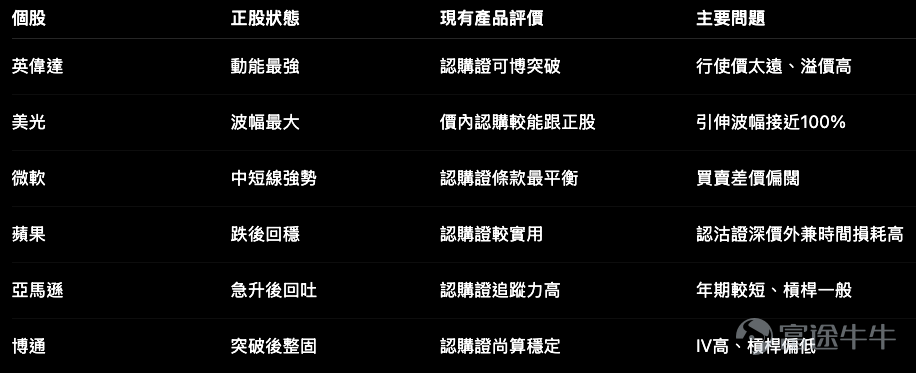

US stock warrants: NVIDIA is the most tradable, Micron is the easiest to get trapped in, while Microsoft and Apple are comparatively more practical
There is currently a clear limitation for US stock warrant products listed in Hong Kong: they primarily consist only of call and put warrants, with no corresponding bull/bear certificates available. This means investors cannot manage risk solely through knock-out prices and must pay closer attention to strike price, delta, implied volatility, premium, and expiry date. According to the latest product availability, warrants exist for NVIDIA, Micron, Microsoft, Broadcom, Apple, and Amazon, but typically only one or two products per stock. Fewer products do not mean easier selection; on the contrary, if the terms are unsuitable, it’s better not to trade at all.
NVIDIA last traded at USD 219.22, up 3.43% on the day, with a 5-day gain expanding to 15.37% and a 20-day increase of approximately 7.4%. Among these stocks, it currently shows the strongest short-term momentum. The existing call warrant has a strike price of around USD 275, expires at the end of December, is about 27% out-of-the-money, offers an effective gearing of approximately 6.6x, a delta of roughly 27%, implied volatility of about 45%, and a premium of approximately 31%. The main issue with these terms is not insufficient gearing, but rather that the underlying stock would need to rise another ~25% to reach the strike price—meaning the warrant remains deeply out-of-the-money. If NVIDIA only rises from USD 219 to USD 225 or 230, the call warrant may indeed increase in value, but its upside will also be affected by changes in implied volatility and time decay, and thus may not fully reflect the underlying stock’s movement. Therefore, this call warrant is better suited for investors who expect NVIDIA to maintain strong momentum and potentially achieve a significant breakout; if one is merely speculating on a 3% rise over the next day or two, the current terms are not ideal.
On the put side, a warrant with a strike price of approximately USD 168 is relatively closer, about 22.5% out-of-the-money, offering an effective gearing of around 5x, a delta of roughly 16%, implied volatility of about 52%, and a premium of approximately 26%. If NVIDIA pulls back 5% from its recent high, this put warrant could benefit—but due to its low delta, it won’t surge significantly with every small drop in the underlying. As for the put warrant with a USD 130 strike price, it is 40% out-of-the-money, has a delta below 6%, a premium exceeding 40%, and even lower practical trading value. The conclusion on NVIDIA warrants is clear: the underlying stock is the most tradable, but current warrant terms are only average.
Micron $Micron Technology (MU.US)$ Highest volatility, but the product's implied volatility is close to 100%.
Micron Technology (MU) last traded at USD 893.19, up 20.86% over the past five days, but still down approximately 6.9% over ten days, reflecting extremely high stock volatility. There are currently two call warrants available. One, with a strike price around USD 700, is already about 22% in-the-money, has a delta of approximately 78%, an effective gearing of about 2.6x, and a premium of roughly 8.8%. It tracks the underlying stock relatively well, but its price exceeds HKD 4, offering limited leverage. The other call warrant has a much higher strike price of USD 1,800—more than 100% out-of-the-money—with a delta of about 21% and a premium exceeding 106%. This product is cheaper and offers higher effective gearing of approximately 3.8x, appearing more aggressive than the in-the-money warrant. However, the real issue is that even if the underlying stock rises another 20%, it would still be far from reaching the strike price.
More importantly, both Micron call warrants have implied volatilities close to 97%, while the put warrants’ implied volatility exceeds 108%. This indicates the market has already priced in significant expected volatility for Micron. Even if investors correctly anticipate the direction, a subsequent cooling-off in the underlying stock’s volatility—and a corresponding drop in implied volatility—could offset potential gains in the warrant. The terms of Micron’s put warrants are even less attractive: a strike price of USD 400 (about 55% out-of-the-money), a delta of only around 5%, and a premium of 57%. This is not a typical short-term bearish instrument but rather a deeply out-of-the-money product with very low sensitivity. Micron is the stock among current single-stock warrant offerings most prone to being mistakenly perceived as highly tradable simply because of its large underlying volatility. In reality, the opposite is true—the higher the volatility, the more expensive the warrant may already be.
Microsoft $Microsoft (MSFT.US)$ The call warrant terms are the most balanced, but bid-ask spreads warrant attention.
Microsoft last traded at USD 487.46. Although it dipped 1.09% on the day, it gained nearly 25% over both the past 5 and 10 days, and is up over 27% in the past 20 days. The existing call warrant has a strike price of USD 450, placing it about 8.6% in-the-money, expires in early October, has a delta of approximately 75%, a premium of around 2.5%, and daily time decay of roughly 0.5%. Judging solely by its terms, this is currently one of the more balanced single-stock call warrants:
– Strike price already in-the-money;
– High delta, better tracking of the underlying stock;
– Low premium;
– Time decay not yet too severe;
– Effective gearing remains around 6.7x.
Its issue is that the product price is around HK$0.86, with a bid-ask spread of HK$0.05. In other words, immediately after purchase, the underlying would need to rise by approximately 6% just to cover the spread. Therefore, while this product has decent directional sensitivity, it is unsuitable for very short-term, frequent trading. If you expect Microsoft to continue trending upward, the terms are acceptable; however, if you're only betting on an intraday move of 1%, transaction costs could significantly erode returns.
The Microsoft put warrant has a strike price of USD 390, about 21% out-of-the-money, with a delta of only 6.5% and daily time decay exceeding 5%. Even though its effective gearing shows around 13x, this doesn't mean it will respond 13-fold to a small decline in the underlying stock. Its extremely low delta and short time to maturity make this put warrant behave more like a rapidly decaying out-of-the-money product, unsuitable for typical pullback strategies.
Apple $Apple (AAPL.US)$ Call warrants have good tracking ability, while put warrants are too short-dated and too far out-of-the-money
Apple is currently trading at USD 311, having stabilized gradually after an earlier sharp drop—but it’s still down roughly 8% over five days and about 4.6% over ten days. The existing call warrant has a strike price of USD 300, already about 3.6% in-the-money, expiring in early October, with an effective gearing of approximately 8.6x, a delta of around 63%, and a premium of about 3.8%. These terms are significantly more practical than those of NVIDIA call warrants. Although Apple’s short-term trend isn’t as strong as NVIDIA’s, this warrant tracks the underlying more closely, so it should respond more readily if the stock climbs back to the USD 315–320 range.
The put warrant has a strike price of USD 248, about 20% out-of-the-money, expiring at the end of September, with a delta below 6% and daily time decay exceeding 5%. Here we encounter the same pitfall again: although the effective gearing appears high at around 14x, because the warrant is deeply out-of-the-money, a 2%–3% drop in Apple’s share price may not be enough to trigger a meaningful response. As each day passes, its value continues to erode. Thus, bullish investors may consider call warrants, but the current put warrant terms are not suitable for bearish positioning.
Amazon $Amazon (AMZN.US)$ and Broadcom $Broadcom (AVGO.US)$ Call warrants track the underlying stock well, but their leverage is relatively low
Amazon is currently trading at USD 272.65. After a prior sharp rally, it has been pulling back consecutively, yet it’s still up about 20% over five days. The existing call warrant has a strike price of USD 245—already about 12% in-the-money—with a delta of approximately 80% and a premium of around 2.5%. Tracking ability is excellent, but effective gearing is only about 5.5x, and with expiry in September, remaining time isn’t long. Amazon’s put warrant, meanwhile, has a strike price of USD 180—about 35% out-of-the-money—with a delta of only around 5% and a premium of 36%, making it unsuitable for capturing typical technical pullbacks.
Broadcom is currently trading at USD 418.28, up roughly 13% over five days. Its call warrant has a strike price of USD 380—about 9% in-the-money—with a delta of approximately 69%, effective gearing of 3.6x, and a premium of about 9.7%. Broadcom call warrants offer reasonable directional sensitivity, but gearing is low and implied volatility is close to 60%. If you’re purely seeking high capital efficiency, they’re less attractive than Microsoft or Apple call warrants.
How should investors choose among individual stock-linked warrants?
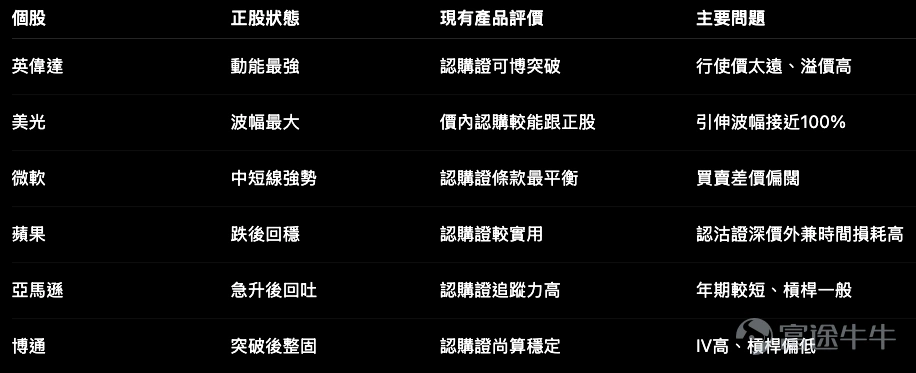
The biggest issue with individual stock warrants today isn’t a lack of popular underlying stocks—it’s that there are too few choices per stock. Investors often have to choose between 'mediocre terms' and 'entirely unsuitable.' Therefore, when positioning in individual stocks, the first question shouldn’t be which underlying is strongest, but whether the available warrants can actually translate the underlying’s direction into meaningful returns.
At this stage, we favor in-the-money or near-the-money call warrants on Microsoft, Apple, and Amazon, as their terms are generally more practical than NVIDIA's deep out-of-the-money calls. Although Micron exhibits the highest volatility, its implied volatility is also the most expensive. On the bearish side, most stock put warrants suffer from being deeply out-of-the-money, having low delta, and high time decay, making them unsuitable for capturing ordinary pullbacks.
In summary: U.S. equity warrants aren't necessarily worth buying just because the underlying stock is popular; when warrant terms are unfavorable, choosing not to trade is itself a valid trading decision. Warrants are leveraged products that can result in total loss of principal—investors should assess their risk tolerance and strictly adhere to stop-loss discipline before entering a position.
Risk Disclaimer: The above content only represents the author's view. It does not represent any position or investment advice of Futu. Futu makes no representation or warranty.Read more

Comments
to post a comment
1