
After the three major U.S. indices hit new highs, should you chase the bull or wait for the bear? The key isn't direction—it's regaining distance.
The latest movements of the three major US indices are not synchronized. The S&P 500 has risen close to a record high, while the Dow Jones Industrial Average has directly broken through its previous peak; meanwhile, the Nasdaq 100 rebounded sharply from a low but encountered resistance near the 30,000 mark. On the surface, all appear strong, but when it comes to trading warrants and callable bull/bear certificates (CBBCs) listed in Hong Kong, their deployment strategies cannot be generalized. The reason is straightforward: the higher the index level, the less attractive chasing upside products may become. Conversely, some bear certificates have strike prices too close to the current index level, resulting in excessively high leverage that has already unbalanced risk and reward.
Dow Jones Industrial Average $Dow Jones Industrial Average (.DJI.US)$ The breakout is the cleanest, but chasing gains shouldn’t rely solely on high leverage.
The Dow closed at 54,349 points, up 0.49%, reaching an intraday high of 54,744 points—a new recent peak. The index has clearly pierced above the upper Bollinger Band at approximately 53,866 points, and the short-term RSI has climbed above 77, indicating strong momentum but also heightened overbought signals. This scenario presents a dilemma for investors bullish on the Dow: the trend remains upward, yet entry levels are already elevated. The market offers a relatively ample selection of Dow-linked bull certificates—around 28 in total—with call prices ranging from 40,100 to 50,100 points, representing distances of roughly 7.4% to 25.9% from the current index level and leverage ratios between approximately 3.6x and 10.7x.
For those still bullish in the short term, the more tradable instruments aren’t those with the furthest call prices, but rather bull certificates with call prices around 49,000 to 50,100 points. These products maintain a buffer of roughly 7% to 10% from the current index level, with leverage of about 8x to 11x—offering sufficient sensitivity while avoiding being too close to the knock-in level during a normal pullback. Bull certificates with even further call prices may offer greater safety margins, but their leverage drops to around 4x–6x. If the goal is merely to capture one or two days of follow-through after a breakout, such products may offer suboptimal capital efficiency.
Conversely, Dow-linked bear certificates appear more attractive at first glance. Existing products have knock-in levels concentrated between 55,000 and 58,000 points, with leverage ranging from approximately 19x to 60x. The closest-to-market products sit less than 2% away from the current index level. That’s precisely the problem. The Dow has just broken out, and its intraday volatility alone can easily exceed several hundred points. Choosing a bear certificate with a knock-in near 55,000 means the product could be forcibly called if the index rises another ~1.7%. Such instruments don’t merely reflect a bearish view—they bet on an immediate reversal, leaving virtually no room for error. For those expecting a pullback due to overbought conditions, bear certificates with knock-in levels between 56,000 and 57,000 points are more reasonable, offering a buffer of roughly 3.5% to 5.4% and leverage of about 25x to 35x. While still aggressive, they at least don’t require pinpoint accuracy in timing the exact intraday peak.
As for put warrants, the market primarily offers strike prices between 45,000 and 48,000 points, with effective leverage of approximately 10x–12x. However, most are 11%–17% out-of-the-money, with deltas of only about 10%–18%. This means these products may not respond as sensitively as expected to minor pullbacks in the Dow. Therefore, for short-term bearish views on the Dow, near-the-money bear certificates are more direct than deeply out-of-the-money put warrants—but only if one is willing to accept the associated knock-in risk.
S&P 500 $S&P 500 Index (.SPX.US)$ The strongest, yet the closest-to-the-money bear warrant is nearing 'knock-out upon touch.'
The S&P 500 closed at 7,723, hitting an intraday high of 7,794—already breaking above the upper Bollinger Band at approximately 7,709—and the RSI has risen to around 76. Chart-wise, the S&P is the index showing the most vertical upward breakout among the three major indices. This momentum could continue, but profit-taking pullbacks are also likely. There are about 14 outstanding bull warrants on the S&P, with knock-out levels ranging from 5,800 to 7,200—roughly 6.9% to 25% below current levels—and leverage between 3.8x and 10.6x. For those still bullish, warrants with knock-out levels between 7,000 and 7,200 are more suitable for short-term positioning, offering leverage of about 8x to 11x. Even if the index pulls back 2% to 3%, there would still be a buffer before reaching the knock-out level, so there’s no need to sacrifice excessive leverage by choosing warrants with overly distant knock-out prices.
Bear warrants on the S&P require extra caution. The closest-to-the-money warrant currently has a knock-out level of just 7,800—less than 1% away from the reference index—with leverage as high as approximately 86x. While this appears highly attractive, in reality, even a normal gap-up opening in the S&P could trigger a knock-out. A common misconception with such products is that investors assume they can use maximum leverage to bet on a pullback simply because the index looks overbought. However, 'overbought' only indicates a rapid rise—it doesn’t mean the index can’t climb another 1%. A more reasonable choice would be bear warrants with knock-out levels near 8,000—about 3.4% away—offering leverage of roughly 33x to 35x. These remain high-risk instruments, but at least they don’t require the index to reverse immediately.
The market for S&P call warrants shows clear polarization:
– One group with strike prices around 7,200: Already in-the-money, with delta exceeding 80% and premium around 1%, tracking the index more closely;
– Another group with strike prices as high as 9,000: Deep out-of-the-money by over 16%, with delta below 12% and daily time decay exceeding 2%.
Although both appear to be call warrants, their practical uses are entirely different. The first serves as a tracking tool, while the latter functions more like a low-cost, high-leverage speculative trade. If the S&P rises only another 1% to 2%, the in-the-money call warrants will typically respond more steadily; the 9,000-strike product, however, requires a combination of price movement, implied volatility expansion, and favorable timing—it shouldn’t be deemed a 'bargain' merely because its price is low.
Nasdaq $NASDAQ 100 Index (.NDX.US)$ The rebound has been the sharpest, yet 30,000 remains the key short-term threshold.
The Nasdaq-100 closed at 29,488 points, down 0.83%. Earlier, the index rebounded sharply from around 27,200 points to nearly 30,000 points, but faced noticeable pressure on the latest trading day and failed to hold above the 30,000-point mark despite an intraday high of 29,947 points. Currently, the upper Bollinger Band is around 30,257 points, with the middle band at approximately 28,812 points. In simple terms, the Nasdaq remains in a rebound structure, but the 30,000–30,300 point range represents immediate resistance. Bull certificates on the Nasdaq are the most numerous, with about 33 available; their call prices range from 21,000 to 27,100 points, representing distances of roughly 8.9% to 29.4% from the current level, and leverage ratios of approximately 3.2x to 9.2x.
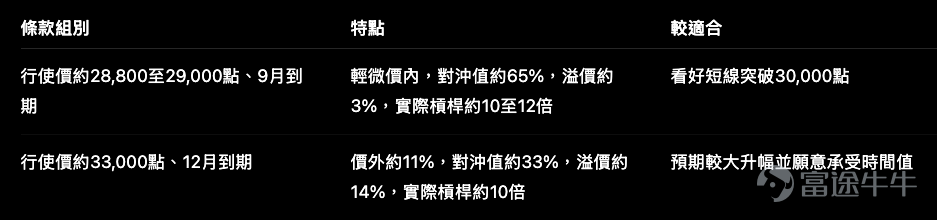
For investors bullish on the Nasdaq retesting the 30,000-point level, bull certificates with call prices between 26,600 and 27,100 points offer more practical trading value. These have leverage of about 8x to 9x and call distances of roughly 9% to 11%, which isn’t extremely close-to-the-money. Note that while the Nasdaq has recently exhibited large intraday swings, most existing bull certificates aren’t particularly close-to-the-money, so their effective leverage is lower than many investors expect. For higher sensitivity, the market primarily relies on call warrants. Nasdaq call warrants have strike prices ranging from 28,800 to 35,800 points, with effective leverage of approximately 5x to 13x. Two groups among them deserve special attention:

Both groups offer similar leverage, but their quality differs significantly. Near-the-money call warrants are driven primarily by movements in the underlying index, whereas the 33,000-point call warrants contain more out-of-the-money and time value components—meaning even if the Nasdaq rises by 1%, the product’s response may not be proportional.
On the bearish side, Nasdaq bear certificates have call prices concentrated between 30,500 and 34,000 points, offering leverage of roughly 10x to 44x. Products with a 30,500-point call price are only about 2.6% away from the reference price—an aggressive choice given the Nasdaq is still in a rebound phase. A more reasonable short-term bearish option features call prices between 31,500 and 32,000 points, representing distances of approximately 6% to 8% and leverage of about 17x to 21x. If you merely believe the 30,000-point level poses resistance—not expecting a sharp decline—this group offers greater room for error compared to very close-to-the-money bear certificates.
Key considerations for trading index-linked products
A common feature across the three major indices right now is that they’re trading at relatively elevated levels, yet the most actively traded products in the market are concentrated in bear certificates and put warrants. This reflects significant capital positioning for a pullback from highs, but product selection must be carefully differentiated:
– Bullish on continued upside: For the Dow and S&P, consider bull certificates with call distances of roughly 7% to 10%; for the Nasdaq, choose between near-the-money call warrants and bull certificates.
– Bearish on short-term pullback: Avoid bear certificates with call distances under 2%, or else your directional view could be correct while your product gets called away prematurely.
– Expecting a modest pullback: Put warrants carry no knockout risk, but deep out-of-the-money products have low delta and high premium, making them potentially unsuitable if you only anticipate a 1% to 2% decline.
In short: At current elevated index levels, higher leverage isn't necessarily better—products must first have sufficient buffer to survive. Bull and bear warrants are subject to mandatory knockout; once knocked out, their value drops to zero immediately. Always set stop-loss levels and implement risk management before entering a position.
Risk Disclaimer: The above content only represents the author's view. It does not represent any position or investment advice of Futu. Futu makes no representation or warranty.Read more
Comments
to post a comment
1