
As gaming displays move beyond specs wars, who is defining the next-generation screen?

The esports display industry is undergoing a shift in its competitive logic.
Over the past few years, the industry's buzzword has been 'specification wars.' However, as specs continue to break new ground, a new issue has emerged: user perception hasn’t kept pace.
An increasing number of consumers find themselves overwhelmed by the array of specifications and unsure how to choose; more and more manufacturers realize that simply stacking specs makes it harder to create genuine product differentiation; and the industry as a whole is beginning to recognize that a few isolated metrics can no longer fully capture the true value of an esports monitor.
The release of the 'TÜV Rheinland Native Esports High-Performance Display Standard' during ChinaJoy 2026 marked a turning point for the industry—shifting from 'spec leadership' to 'experience leadership,' and further toward 'experience standardization.'
As technology enters deeper waters, what truly determines competitiveness is no longer individual lab-based metrics, but the real-world experience users can actually perceive.
The history of esports displays is, at its core, a story of continuous breakthroughs in technical specifications.
Specification competition was once a major driver of rapid growth in the esports display industry. However, technological advancement follows cyclical patterns—specification-driven competition doesn't equate to better user experience, and many brands have become mere 'spec Frankenstein monsters.'
"Different brands have been promoting their products based on refresh rate, with everyone assuming higher is better, but the esports experience isn't just about refresh rate," stated George Toh, Vice President of Lenovo Group and General Manager of Global Display Business, frankly. He pointed out that many products compete solely on single specs, sometimes even resorting to inflated claims and excessive marketing. Gamers end up paying for so-called specs without receiving a commensurate improvement in experience, ultimately eroding trust in the entire industry.

George Toh, Vice President of Lenovo Group and General Manager of Global Display Business
The development of any mature industry must evolve from 'specification-based competition' to 'experience-driven competition.' The same holds true for gaming displays. George Toh believes it is time to shed outdated labels and break free from the vicious cycle of ever-inflating specs.
Thus, the concept of 'native gaming displays' has emerged.
‘Native gaming displays’ do not simply mean pushing refresh rates or response times higher. Instead, they holistically evaluate motion clarity, input latency, image quality, and visual comfort based on real-world esports scenarios—ensuring display performance genuinely serves player experience. This approach aims to address challenges that pure spec-based competition has failed to resolve.
This is not the responsibility of any single manufacturer but stems from an industry-wide lack of a unified evaluation framework. A new standard is urgently needed to define what constitutes a 'native gaming display.'
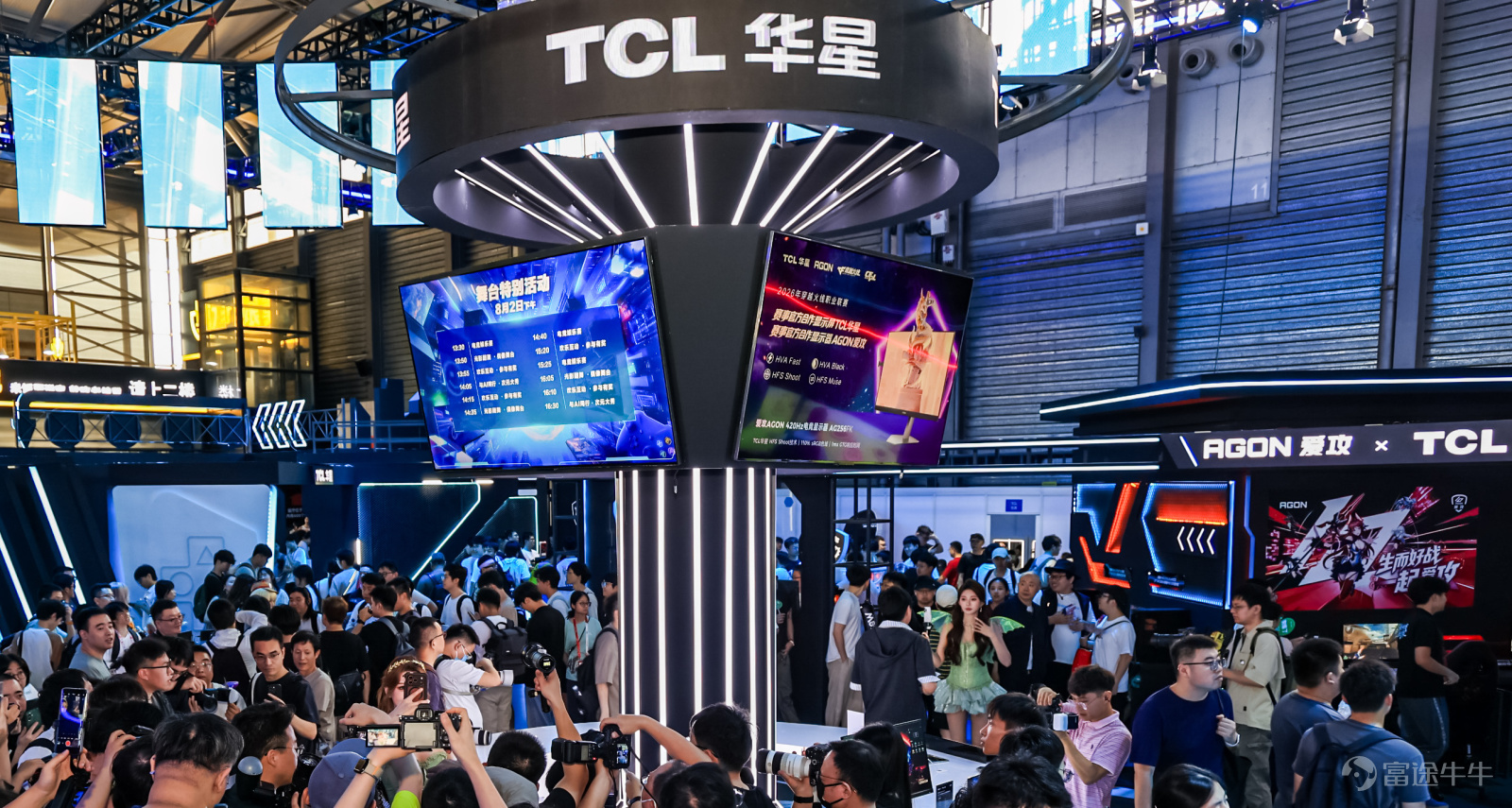
On the opening day of ChinaJoy 2026, TCL CSOT’s exhibition booth delivered the definitive answer. The launch of the 'TÜV Rheinland Native Gaming High-Performance Display Standard' establishes a complete scientific linkage—from 'display specifications' to 'human visual perception' to 'esports performance'—through systematic human-factor experiments. This is more than just a certification mark; it provides consumers with a clear benchmark for purchasing decisions and creates a level playing field for manufacturers, setting industry standards and bringing order to the chaos of inflated specs.


It should be noted that this evaluation framework did not arise from unilateral input by a third-party organization but through deep co-creation across the entire supply chain based on shared consensus. TÜV Rheinland collaborated closely with TCL CSOT, Lenovo, and others to connect lab data, panel technologies, and end-user needs into a closed-loop system—shifting R&D focus from isolated technical metrics toward user-experience-centered scientific exploration.
This represents not only a standardization effort for evaluating esports display experiences but also sends a clear signal to the industry: advancing esports display experiences and implementing native gaming standards require active collaboration from leading players in the supply chain like TCL CSOT.
The introduction of this standard signifies a fundamental shift in competitive dynamics. Previously, the focus was on raw performance; now, it’s about holistic industrial capabilities. Bridging the gap between standards and real-world user experiences demands a comprehensive capability framework spanning R&D, products, and applications—and this is precisely where companies like TCL CSOT and Lenovo deliver their value.
In George Toh’s view, native gaming isn’t just another marketing concept; it’s about adopting a more systematic approach to deliver three 'authenticities': authentic specifications, authentic experience, and authentic quality—making it easier for users to choose products and enjoy a more genuine, stable, and reliable gaming experience they can truly feel.
As industry evaluations become more transparent and competition shifts its focus from 'specification metrics' to 'holistic user experience,' panel manufacturers are no longer mere 'hardware suppliers.' Instead, they must become co-creators of experience standards, providers of technical solutions, and connectors within the broader ecosystem.
As one of the standard-setters, TCL CSOT has consistently taken steps grounded in real user experience, aiming to offer a definitive example of what 'native gaming' should look like.
Unlike many companies in the industry that pursue isolated technological breakthroughs, TCL CSOT has built three core technology platforms—HVA, HFS, and printed OLED—to provide tailored technical solutions for native experiences across diverse scenarios.

Among these, HVA and HFS support high refresh rates, fast response times, and high stability, making them ideal for mainstream gaming monitors and gaming laptops. The HFS technology further enhances dynamic image performance, ensuring every frame appears crisp and clean. More importantly, this smoothness is natively sustained—it remains stable over long, intense gaming sessions without performance degradation.
For users who demand high-end gaming, content creation capabilities, and eye comfort, printed OLED technology offers the optimal solution. Beyond delivering OLED’s native contrast ratio, wide color gamut, and rapid response, it also significantly reduces color fringing around text and image edges, greatly improving clarity and opening new possibilities for future gaming displays in terms of color accuracy, response speed, and form-factor innovation.
Industry observers believe that standards aren’t abstract rules—they must be implemented through tiered technical solutions capable of addressing the diverse needs of everyone from entry-level players to professional users.
From HVA to HFS and now printed OLED, TCL CSOT has consistently aligned its technologies with gamers’ needs, turning technical specifications into tangible experience enhancements users can actually feel. Market data strongly validates TCL CSOT’s approach: its HVA and HFS gaming panels have led global sales for four consecutive years and are selected by more than 16 leading gaming monitor brands.

Zhao Jun, Senior Vice President of TCL Technology and CEO of TCL CSOT
‘Pursuing a full-category strategy ensures every gaming scenario can find its most suitable display solution—this is the core confidence behind TCL CSOT’s deep commitment to the gaming sector,’ said Zhao Jun, Senior Vice President of TCL Technology and CEO of TCL CSOT. Indeed, building a comprehensive display capability system—from today’s needs to tomorrow’s innovations—centered on gamers’ demands forms the very foundation for realizing native gaming experiences.
"Standards" have redefined esports displays and, in turn, redefined the role of enterprises within the industry. Truly competitive companies no longer merely supply high-performance panels; instead, they integrate foundational technologies, product innovation, industrial collaboration, and user needs into a cohesive whole.
However, this shift in role doesn’t happen overnight—it relies not just on a single technological breakthrough, but on end-to-end systemic capabilities spanning R&D, products, and ecosystem collaboration.
Putting users first as the fundamental principle is the starting point of the native esports standard. From handheld portable gaming devices to large-screen TVs in living rooms, esports has evolved into an all-scenario lifestyle. Unlike past device-centric parameter evaluations, 'native esports' places greater emphasis on dynamic clarity, response latency, visual comfort, and subjective experience during actual gameplay.
Technology, as the intermediary layer of systemic transformation, translates user demands into tangible experiences and sets the upper limit for esports display performance. Equally important is the ecosystem—the essential pathway that turns technology into real-world user experiences.
From panel technology to end-user products; from display calibration to gaming ecosystems; from standard-setting to user feedback—every link affects the final experience. In a sense, future competition in esports displays is fundamentally a competition of ecosystems.
Deconstructing TCL CSOT’s 'native esports' display strategy reveals precisely these elements as its 'system code' for leading industry transformation. The recent collaboration between TCL CSOT and Lenovo exemplifies a practical exercise in connecting foundational display capabilities directly to gamers’ real-world needs.
On the R&D front, TCL CSOT and Lenovo jointly established a co-innovation lab to define product development directions together. At the product level, both parties continuously co-create to transform technical capabilities into user-facing solutions. In manufacturing, they jointly developed the GDS AI analytics system to deepen quality collaboration. On the branding side, they’ve launched multiple joint marketing campaigns to convert technical specifications into perceptible user experience advantages.

"TCL CSOT is an industry leader—with exceptional strength in both technology and manufacturing capabilities. To succeed with native esports, we need strong partners like TCL CSOT," said George Toh.
Beyond Lenovo, TCL CSOT also maintains ongoing collaborations with TPV, AGON, JD.com, and other brands, forming an extensive 'native esports' alliance.
The market will ultimately vote on the industry's direction. From 2022 to 2025, TCL CSOT ranked first globally for four consecutive years in both market share and shipments of gaming monitors, with one out of every three gaming displays worldwide featuring a TCL CSOT panel.
However, native gaming displays are not the final destination but rather the starting point of the industry’s shift toward experience-driven innovation. AI is emerging as the next core variable reshaping the display industry’s value proposition. While these two domains may appear distinct, their underlying logic aligns closely: both involve understanding users and delivering more tailored experiences.
A deeper industry logic suggests that over the next two decades, gaming displays are likely to evolve from mere gaming peripherals into catalysts for a human-computer interaction revolution, triggering a fundamental restructuring of the industry paradigm.
This is not a speculative vision detached from industrial realities; it precisely reflects an evolutionary pattern repeatedly validated by the industry. In the past, gaming’s relentless demand for ultra-high image quality and smooth frame rates pushed GPUs to continuously break through performance limits in graphics rendering. The parallel computing architecture originally designed solely for gaming visuals unexpectedly became the foundational infrastructure powering AI large-model training and inference—unintentionally laying the groundwork for a computing revolution.
Today’s gaming displays stand at a similar historical inflection point, with an evolutionary trajectory clearly emerging—from gaming-specific scenarios toward broader AI-driven interaction.
Starting from native gaming’s pursuit of millisecond-level response times, display devices now need to further sense changes in on-screen content, user inputs, and even viewing states.
To enable more precise dynamic adjustments, AI algorithms and intelligent computing are being integrated into display systems, allowing screens to understand the focal points of different scenes and optimize picture quality, refresh rate, and visual effects in real time.
Looking further ahead, as eye-tracking, cameras, microphones, and spatial awareness technologies gradually become embedded in display devices, screens will no longer be passive objects 'to be viewed' but will instead perceive 'who is watching, what they’re watching, and what they intend to do.'
Displays and computing will also become increasingly integrated, leveraging technologies such as AI frame interpolation, intelligent super-resolution, foveated rendering, and predictive imaging to allocate limited computational resources precisely where users are focusing their attention.
This means that, driven by demand from the esports sector, displays are evolving from traditional information output terminals into edge intelligent terminals capable of perception, understanding, and feedback.
In the future, when display devices simultaneously possess capabilities for rendering, perception, understanding, and interaction, they will become a critical gateway connecting users with AI agents. Moreover, the interaction capabilities refined in esports scenarios will further extend into broader applications such as office productivity, education, healthcare, automotive systems, and industrial control, unlocking greater industrial value.
If GPUs once solved the question of 'how to compute' in the AI era—becoming the foundational computing infrastructure of the digital world—then today’s esports displays are likely poised to address the next pivotal challenge: 'how humans can interact naturally with AI,' thereby evolving into the key foundation for next-generation human-computer interaction.

With this understanding clarified, it becomes natural to grasp TCL CSOT’s strategic rationale behind its early move into AI.
Embracing the 'AI for Display' philosophy, TCL CSOT is transitioning from a focus on 'panel parameter leadership' toward a new phase centered on 'panel plus AI scenario optimization,' having established a comprehensive enterprise-level AI architecture.
Among its initiatives, TCL CSOT’s self-developed X-Intelligence large model has now reached version 3.0, ranking first globally in the semiconductor display field, and is deeply integrated across R&D, manufacturing, and operations. This reflects not only TCL CSOT’s ambition to expand its industrial boundaries but also lays a solid hardware foundation for future AI-driven, immersive esports interactions.
Looking back at every major technological inflection point, what ultimately changed was never just a single specification—but rather how the industry defines value. The evolution of esports displays follows the same trajectory: the real competition has long moved beyond merely setting new parameter records to redefining 'what makes a great display' and driving the industry from 'parameter leadership' toward 'experience standardization.'
The purpose of standards has never been to constrain innovation, but rather to provide a common yardstick against which innovation can be measured. Starting again from TCL CSOT’s exhibition booth, native esports displays are merely the beginning of a broader transformation in the display industry. What this shift drives is not just an upgrade of a single screen, but a fundamental reshaping of the competitive logic within the display sector—and this restructuring has only just begun.(Originally published on TMTPost App, author: Du Zhiqiang)
Risk Disclaimer: The above content only represents the author's view. It does not represent any position or investment advice of Futu. Futu makes no representation or warranty.Read more

Comments
to post a comment
3