
Cancer vaccines ignite rally in innovative drugs! Hong Kong and US pharmaceutical stocks continue to

Merck & Co's 'Torch Relay' Initiative
(This article was authored by PoJian Bio and published by TMTPost with permission)
By PoJian Bio
What often determines the stature of a multinational pharmaceutical company is its flagship product.Just look at Merck & Co today to understand the weight of that statement.
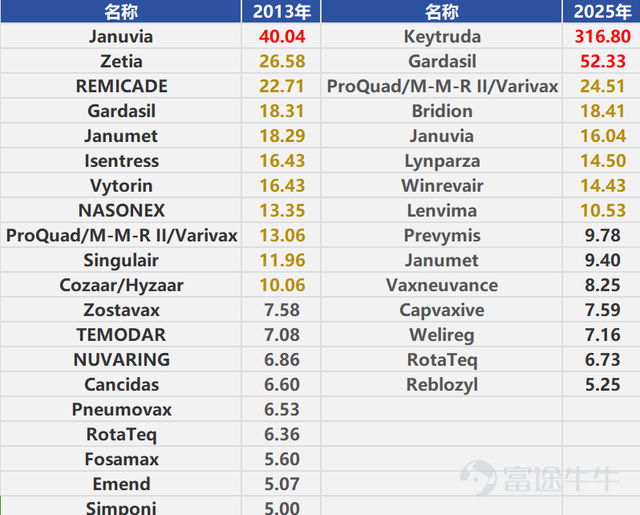
Before Keytruda (commonly referred to as 'K drug'), Merck & Co, though still part of the top tier of multinational pharmaceutical companies, was somewhat 'strong on the outside but weak within,' relying largely on a large portfolio of products to accumulate revenue.In 2013, Merck & Co had 20 products each generating over $500 million in revenue, but only Januvia surpassed $3 billion.The biggest drawback of this revenue model was that Merck & Co lacked a clear strategic focus and had to continuously develop new products to sustain growth.

Figure: Comparison of Merck & Co's product revenues in 2013 versus 2025 (in billions of USD)
After Keytruda received approval and launched, Merck & Co quickly established a clear strategic direction. Although the number of products generating over $500 million in revenue dropped to 16, the company’s total revenue rapidly increased from $44.033 billion in 2013 to $65.011 billion in 2025.It was this single product that transformed Merck & Co from a 'follower' into a 'definer.'
However,Keytruda's core patent is set to expire in 2028, coupled with the inclusion of Keytruda in the Inflation Reduction Act (IRA) drug price negotiations, cracks are beginning to appear in Merck & Co's throne.The 'gray rhino' will eventually arrive—how should Merck & Co respond?
Merck & Co’s current success follows a classic 'blockbuster product' strategy.
The core engine is the renowned Keytruda. When first approved in 2014, Keytruda held no clear first-mover advantage in the PD-1 space—BMS’s Opdivo (O药) had already launched first in Japan, forcing Keytruda to secure the U.S. first-mover position in the PD-1 market. In the early commercial phase, Opdivo consistently outperformed Keytruda in revenue.

Figure: Revenue of Keytruda and Opdivo (in billions of USD)
What truly enabled Keytruda to stage a comeback was Merck & Co.'s strategic focus on building a core 'blockbuster' drug.By investing heavily in clinical trials without regard to cost, Merck & Co. rapidly expanded Keytruda’s indications from non-small cell lung cancer to triple-negative breast cancer, and from late-stage treatment to early adjuvant therapy, achieving comprehensive coverage across more than 40 indications. In contrast, Bristol Myers Squibb (BMS) was clearly unprepared, with a much slower pace of indication expansion, causing Opdivo to gradually lose market competitiveness.

Figure: Comparison of indications between Keytruda and Opdivo
This clearly shows that Keytruda’s success stems not only from its strong efficacy but also from Merck & Co.’s successful 'blockbuster strategy.' Thus, the revenue-generating power of a core blockbuster ultimately determines a company’s ceiling.
Despite Keytruda’s current dominance, underlying concerns have already begun to emerge.Intensifying competition in the PD-1 space, combined with Keytruda’s looming patent cliff, has turned it into a sword of Damocles hanging over Merck & Co.'s head.
Of course, beyond Keytruda, Merck & Co. has another growth engine—its HPV vaccine, Gardasil. Unlike Keytruda’s explosive growth, vaccine products like Gardasil demonstrate exceptional staying power. In particular, the 9-valent HPV vaccine has maintained rapid growth in the Chinese market in recent years, once serving as the company’s second pillar outside oncology.
However, in 2025, Gardasil’s sales performance in China took a sharp downturn. Due to the progress of domestic 9-valent HPV vaccine development and heightened competitive pressures, Gardasil suffered a full retreat in the Chinese market, leading to a 39% year-over-year plunge in global sales in 2025.
With both its primary and secondary engines—one nearing its peak and the other suddenly losing momentum—Merck & Co. understands better than anyone else:The peak of Keytruda marks the beginning of a crisis.
Faced with the patent cliff in 2028, Merck & Co.'s strategy can be summarized in two sentences:Extend Keytruda’s lifecycle as long as possible and broaden the pipeline beyond Keytruda as widely as possible.
The first line of defense for extending Keytruda’s lifecycle is combination therapy.Merck & Co. is advancing combination regimens of Keytruda with LAG-3 inhibitors and CTLA-4 inhibitors; its mRNA-based personalized cancer vaccine V940 (mRNA-4157), developed in collaboration with Moderna, is already being used in Phase III trials alongside Keytruda for adjuvant treatment of early-stage non-small cell lung cancer and melanoma.
The rationale behind these combination therapies is straightforward:When the patent on single-agent PD-1 expires, combination regimens may create a new patent moat.
The second line of defense is dosage form innovation.In the second half of 2025, the FDA approved Keytruda’s subcutaneous formulation, Keytruda Qlex.In the first half of 2026, Qlex achieved $590 million in sales in the U.S., demonstrating exceptional breakout potential.Subcutaneous injection reduces administration time from 30 minutes with intravenous infusion to just 2–3 minutes, significantly enhancing convenience and serving as a defensive strategy to extend Keytruda’s patent life.
But the real answer actually lies beyond Keytruda.
During Merck & Co's Q4 2025 earnings call, CEO Robert Davis revealed that the company’s current pipeline could generate over $70 billion in non-risk-adjusted commercial opportunities by the mid-2030s—double Keytruda’s projected peak revenue of $35 billion in 2028.
To support this goal, Merck & Co has aggressively pursued acquisitions over the past two years. It completed the acquisitions of Verona Pharma and Cidara Therapeutics in 2025; early in 2026, there were reports it was considering acquiring RAS inhibitor developer Revolution Medicines for $28–32 billion, though the deal ultimately did not materialize. Meanwhile, the company restructured its human health business into two strategic clusters: oncology and specialty care, and primary care and infectious diseases.
Over the past five years, Merck & Co has spent more than $60 billion on business development—essentially trading capital for time and using acquisitions to fill its pipeline.
Among the pipeline candidates following Keytruda,two new products have already pulled ahead: Winrevair and Capvaxive—one a therapeutic drug and the other a vaccine.

Let’s first take a look at the one with astonishing breakout potential:Winrevair. This is a first-in-class activin signaling inhibitor, and it is not a vasodilator in the traditional sense. Instead, it targets and modulates abnormal signaling pathways associated with PAH disease progression, thereby inhibiting pathological remodeling of pulmonary blood vessels at its source.
PAH is a rare but rapidly progressive and severe disease, with a five-year mortality rate of approximately 43%. Prior to Winrevair, most PAH therapies on the market were vasodilators that only alleviated symptoms without altering the underlying disease course. The arrival of Winrevair has ushered PAH treatment into a new era—from 'symptom management' to 'disease modification.'
Notably,Winrevair was acquired by Merck & Co as part of its core pipeline when it purchased Acceleron Pharma for $11.5 billion in 2021, a deal met with widespread skepticism at the time. Today, however, Winrevair is responding to the market with strong sales performance.
Following FDA approval in March 2024, Winrevair generated global sales of $419 million in its first year on the market. In 2025, Winrevair entered a phase of accelerated uptake, achieving full-year sales of $1.443 billion—more than triple its 2024 figure. Within less than 12 months of launch, cumulative sales surpassed $1 billion.In the first half of this year alone, Winrevair generated revenue of $1.114 billion, making it Merck & Co’s fourth-highest revenue-generating product.

Figure: Revenue from Merck & Co’s key products in recent years
Market expectations for the drug extend far beyond current performance. Citi forecasts sales could reach $6.2 billion by 2030; Evaluate Pharma projects over $6 billion for the same period; JPMorgan estimates $5 billion; and GlobalData’s consensus forecast places the figure at $6.3 billion.Regardless of which institution’s projection is considered, Winrevair is widely viewed as the next 'blockbuster'-level product.
More importantly, Winrevair’s indications continue to expand. In October 2025, the FDA updated Winrevair’s label to include a new indication for reducing the risk of clinical worsening in patients with pulmonary arterial hypertension (PAH), including hospitalization, lung transplantation, and death. In January 2026, the drug was approved for marketing in China and subsequently received approvals in Japan and South Korea. Additionally, the Phase II CADENCE trial evaluating Winrevair in patients with combined post-capillary and pre-capillary pulmonary hypertension associated with heart failure with preserved ejection fraction (CpcPH-HFpEF) met its primary endpoint, and Merck & Co plans to advance it into Phase III.
Merck & Co aims to achieve $10 billion in annual sales from its cardiovascular therapies by the 2030s, and Winrevair is central to this strategy.
If Winrevair represents a meticulously orchestrated high-stakes bet, then Capvaxive is a precisely targeted 'replacement-in-place' offensive move.
Capvaxive is a 21-valent pneumococcal conjugate vaccine approved by the FDA in June 2024, making it the world’s first pneumococcal vaccine specifically designed for adults.Its core competitive advantage lies in serotype coverage: according to CDC epidemiological data from 2018–2022, the 21 serotypes covered by Capvaxive account for 84% of invasive pneumococcal disease cases in adults aged 50 and older, compared to approximately 52% coverage for Pfizer’s Prevnar 20 (20-valent). A 30-percentage-point gap is nearly decisive in a mature, competitive vaccine market like this one.
Moreover, Capvaxive’s market rollout has been textbook-perfect. In October 2024, the CDC voted 14–1 to recommend Capvaxive for individuals aged 50 and older—a recommendation that immediately unlocked the core U.S. adult pneumococcal vaccine market. By Q4 2024, Capvaxive had already generated $50 million in sales. Sales accelerated in 2025, reaching $759 million for the full year.In the first half of this year, Capvaxive generated $325 million in revenue, up 38% year-over-year.
Against the backdrop of overall pressure on the global vaccine industry—where Pfizer, Sanofi, and GSK have all seen varying degrees of decline in their vaccine portfolios—Capvaxive’s performance stands out as truly counter-cyclical growth.
Of course, Capvaxive’s potential extends beyond the adult market. In September 2025, Merck & Co announced positive immunogenicity data for Capvaxive in high-risk children and adolescents aged 2 to 17. Then, in June 2026, the FDA approved a supplemental indication for Capvaxive, expanding its use to this population. From adults to children, Capvaxive’s addressable market ceiling continues to rise.
In the global pneumococcal vaccine market—worth approximately $9 billion—Capvaxive is rapidly closing the gap with Pfizer’s Prevnar franchise. It is not only stepping up as the successor to Merck & Co’s vaccine portfolio following Gardasil’s slowdown but may also lead the entire pneumococcal vaccine market’s transition from 15-valent and 20-valent formulations to 21-valent.
In addition to the two promising new products mentioned above,Merck & Co. also acquired another promising drug, Ohtuvayre (ensifentrine), through its acquisition of Verona Pharma. Ohtuvayre is the world’s first inhaled PDE3/PDE4 dual inhibitor, approved for maintenance treatment of chronic obstructive pulmonary disease (COPD) in adults.It acts directly on the lungs via nebulization without requiring complex inhalation flow coordination, making it suitable for patients who have difficulty synchronizing hand and breathing movements.
Ohtuvayre received FDA approval in June 2024 and was commercialized by the end of August.Although it has only been commercialized for two years, Ohtuvayre generated $335 million in revenue in the first half of this year by effectively filling an unmet clinical need, demonstrating strong growth potential.
Winrevair, Capvaxive, and Ohtuvayre represent three distinct growth pathways for Merck & Co. in the 'post-Keytruda era': Winrevair targets high-value specialty drugs, Capvaxive represents a replacement strategy within the existing vaccine portfolio, and Ohtuvayre was acquired directly through M&A.
These three products collectively contributed $17.74 billion in revenue in the first half of 2026, and all are still in the early stages of ramp-up—a reassuring start for a multinational pharmaceutical company preparing for the patent expiration of Keytruda.Such a 'succession lineup' offers, at the very least, a reassuring beginning.
Keytruda has undoubtedly elevated Merck & Co into the top tier of multinational pharmaceutical companies. However, the decline that will follow Keytruda is equally beyond doubt.
Analytical models forecast that Keytruda’s sales will peak between $34 billion and $35.5 billion in 2027 or 2028, then begin to decline starting in 2029, falling back to a baseline of $19 billion by 2031. Meanwhile, under the U.S. Inflation Reduction Act, Keytruda will be included in the drug price negotiation list in 2026, with mandatory discounts taking effect on January 1, 2028—delivering another blow.
‘Patent expiration plus administrative price cuts’ may well represent the most powerful ‘double whammy’ in pharmaceutical history. This is precisely why Merck & Co must launch its ‘succession’ plan.
Winrevair has already demonstrated it can generate $1.4 billion in sales during its first full commercial year; Capvaxive is growing against the tide amid a vaccine market downturn—a promising start. But what matters even more is the upcoming wave of pipeline breakthroughs:Sacituzumab tirumotomab vedotin (sac-TMT), licensed from Kelun-Biotech, is now in 16 Phase III clinical trials; the oral PCSK9 inhibitor Enlicitide has already received approval and will soon contribute to revenue.
Yet the risks remain worthy of caution—after all, every candidate in the pipeline still faces potential clinical failure, regulatory setbacks, and underwhelming commercial performance. Between Winrevair, a promising new star, and a $70 billion pipeline portfolio lies a vast gulf of time, capital, and countless Phase III trial readouts.
Merck & Co today is merely at the beginning of its ‘succession’ plan. Over the next five to ten years, the company could enter a period of frequent drug incubation cycles—acquiring assets, reading out clinical data, launching products, scaling up sales, and repeating the cycle.
Keytruda placed Merck & Co on the throne—but the foundation beneath that throne is now being meticulously rebuilt, brick by brick.
Risk Disclaimer: The above content only represents the author's view. It does not represent any position or investment advice of Futu. Futu makes no representation or warranty.Read more


Comments
to post a comment
4