
Robinhood's Bigger Basket
By Prathik Desai
Translated by Block Unicorn
A few weeks ago, I called Robinhood a financial supermarket because it fulfills all Americans’ financial needs on a single platform. In my article 'Building the Financial Supermarket,' I wrote that as long as Robinhood could connect its dozen-plus businesses and cross-sell products to its more than 28 million registered users, its newly launched marketplace wouldn’t need to be profitable on its own.
I still believe the direction of this argument is correct, but it lacks strength.
This morning, from the other side of the globe, I watched Robinhood's second-quarter earnings call. Afterward, I felt that the 'financial supermarket' concept actually understates the company's future growth potential. A supermarket thrives by drawing more customers into the store. Robinhood’s Q2 results show that its real strength lies in getting users who initially bought Product A through the Robinhood app to buy more of Product A, trade more frequently, and gradually become interested in Products B, C, and D on the platform as well.
Precisely because the company can achieve this, it has grown rapidly recently—even without necessarily attracting many new users to walk through its doors for the first time.
In today’s article, I’ll walk you through the mechanics behind Robinhood’s supermarket model—the system that, over time, turns each customer into a denser revenue node—and explain why two of Robinhood’s least profitable businesses launched (or soon to be launched) this year—its physical branches and social feed—could become among the most critical components.
Robinhood went public just five years ago and launched its app only eleven years ago, yet it has already surpassed $5 billion in annualized revenue. By comparison, brokerage giant Charles SchwabCharles Schwabtook nearly 30 years after its founding in 1971 to reach $5 billion in annual revenue. One of the biggest drivers behind Robinhood’s revenue growth is its massive user base—30 million funded accounts. Its product lineup spans a broad spectrum, from cryptocurrency trading to gold and retirement accounts, catering to users across all age groups. For most companies, these metrics would signify strong user penetration. Yet Robinhood chooses not to measure its progress using these indicators.
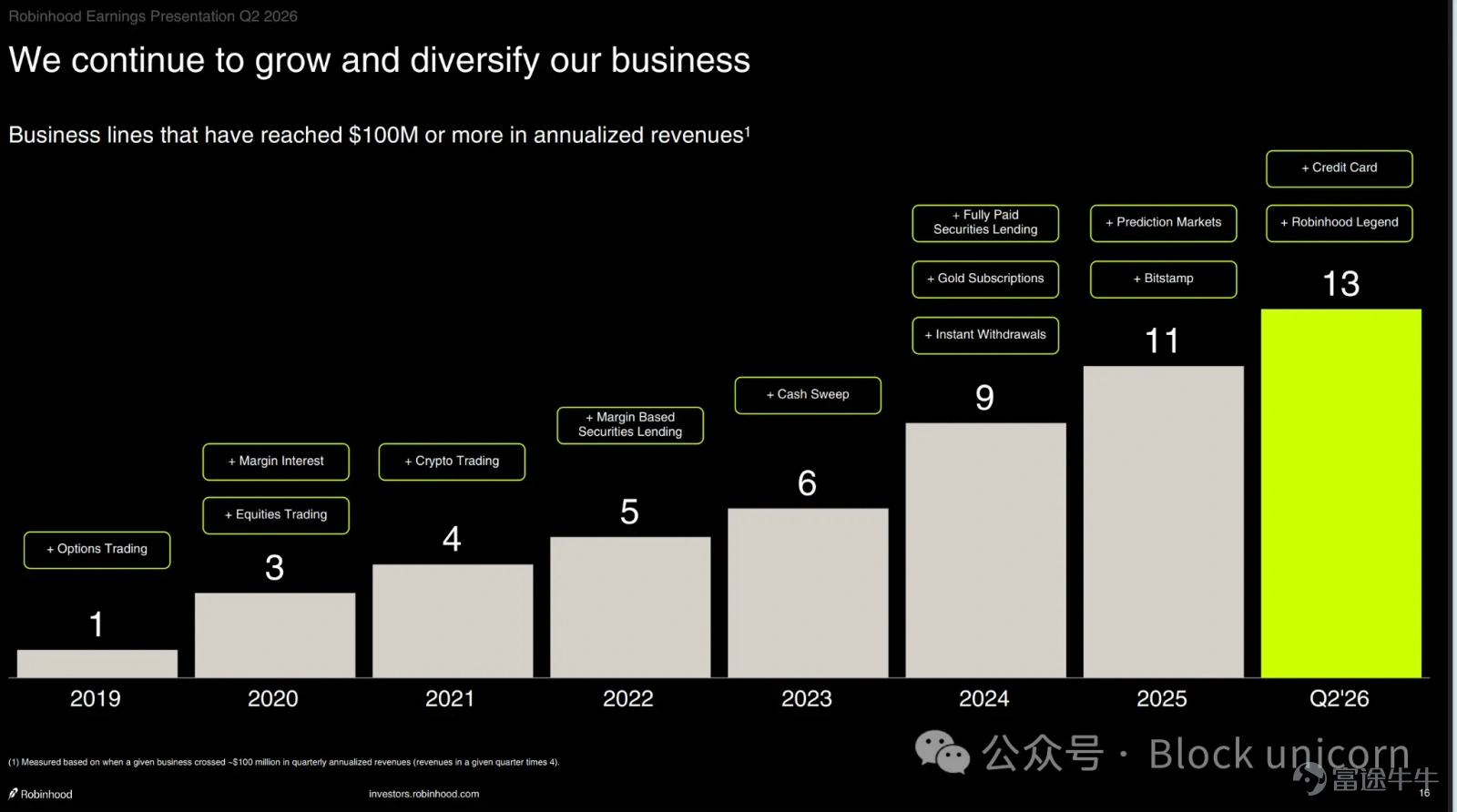
Early in the earnings call, Robinhood CFO Shiv Verma told investors to evaluate the company based on three metrics: net deposits, the Rule of 40, and the number of business lines with annualized revenue ratesARRof $100 million or more.
In Q2 2026, Robinhood’s desktop trading and analytics platform Legend and its credit card business became the latest additions to the $100 million annual recurring revenue (ARR) club. The company now has 13 business lines on this list.

But let’s set these metrics aside for a moment and dive into the finer details.
As of the end of the second quarter of 2026, Robinhood’s paying users increased by 7% year-over-year, rising from 26.5 million to 28.4 million. During the same period, average revenue per user (ARPU) grew by 24%, increasing from $151 to $187.
Revenue per customer is growing more than three times as fast as the customer base.
Trading data reflects this trend as well. In the second quarter, Robinhood reported that nominal equity trading volume per trader rose 56% year-over-year, while options contract volume per trader increased by 43%. However, the number of customers trading equities grew by only 13%, and those trading options rose by just 3%.

Robinhood’s active contracts business didn’t even exist 15 months ago, yet it now generates $156 million in revenue—a 50% increase quarter-over-quarter—all without acquiring any new user segments.
Back in May, I wrote that Robinhood’s ability to bundle stock, options, perpetual fund trading, and event contracts together enables it to offer a superior information-pricing platform compared to its competitors.
All of this suggests that the right metric for evaluating a company like Robinhood is how much sales per order have grown at this financial supermarket—essentially, the growth in its average revenue per user (ARPU).
Although Robinhood operates more than a dozen businesses, one of the key drivers of its growth engine is its Gold subscription service. In just the past two years, the penetration rate of Robinhood Gold has nearly doubled, rising from 8.2% to 17% of total paying users.
In the second quarter of 2026, the Gold subscription business generated $216 million in annualized subscription revenue, accounting for approximately 4% of total revenue. However, the benefits each Gold member brings to the company’s overall business extend far beyond that. Gold members hold about 4.2 times more assets under custody than regular customers and are roughly 3.1 times more likely to purchase retirement products.
During the earnings call, CFO Verma noted that 40% to 50% of Robinhood’s new customers sign up for Gold, regardless of which product initially brought them to the platform.
This demonstrates Robinhood's powerful cross-selling moat. Even if customers initially come for commission-free stock trading, World Cup prediction markets, or a 3% cashback credit card, half of them eventually upgrade to Gold membership. IRA Once they subscribe to the $5-per-month membership, they join an exclusive community of 4.8 million members and gain access to lower-priced options contracts, employer-matched contributions of 3%,

a 3.5% annual interest rate on bank deposits, credit cards, and many other benefits.
This cross-adoption is measurable. Verma noted that users of prediction markets are more likely to also open retirement accounts on Robinhood. Thus, someone placing bets on soccer matches via Robinhood’s prediction market is simultaneously using Robinhood’s retirement account to boost their Individual Retirement Account (IRA) returns.
Robinhood’s financial supermarket doesn’t segment its customers into 'gamblers' and 'serious investors.' It sells products to the same customer, and each product a customer uses increases the likelihood they’ll adopt others.
Two Catalysts Robinhood Chain In my article 'Building a Financial Supermarket,' I argued that Robinhood Chain barely generates profits—and doesn’t need to. At the time, I positioned Robinhood Chain as a connective layer designed to enhance user stickiness across other businesses. After reviewing the Q2 earnings report, I’ve slightly adjusted my outlook: Robinhood Chain, along with the upcoming Robinhood Social, will serve as two key catalysts that horizontally span Robinhood’s entire product suite and drive cross-selling across its dozen-plus offerings.
Think about what this chain enables. Customers buy tokenized stocks. These tokens become collateral in lending markets. The loans are then used to purchaseperpetual futures positionsNow, with just one dollar, users can engage with three products in a single transaction—all without leaving the app. In the previously fragmented brokerage ecosystem, these three actions would have occurred across three disconnected platforms, each with its own cumbersome onboarding process and requiring customers to make separate decisions. Composability eliminates this friction.
The chain integrates cross-selling into its infrastructure, enabling customers to cross-buy with minimal or zero friction.
Robinhood CEO Vlad Tenev said the company plans to roll out its social feed to all users by the end of the third quarter. Tenev expects this internal feed to enhance credibility by supporting trade ideas with verifiable portfolios on the Robinhood trading platform. Currently, trade ideas typically originate from disparate channels—traders might hear about potential trades from Twitter, podcasts, or friends. Customers then form trading intent and ultimately execute the trade on Robinhood. Robinhood Social aims to bring this entire process in-house.
This is the most underrated aspect of its social feed. The trust it can instill among its 30 million funded users surpasses anything achievable through screenshots or podcast mentions on external platforms. Once the feed opens broadly, Robinhood will internalize the final step in the customer’s trading-intent journey that currently relies on external sources.
I don’t view Robinhood Chain and Social as standalone business lines. Rather, I see them as catalysts driving growth across all other parts of the company. A community of 30 million users discussing the latest event contracts, how they’re building disciplined lifestyles through retirement accounts and the newest stock tokens—giving them a chance to invest ahead of Anthropic’s IPO—creates an atmosphere far more compelling than any user acquisition marketing campaign.
Robinhood’s value capture strategy resembles that of Costco, which we’ve seen before. The third-largest U.S. retailer derives most of its profits from membership fees, while pricing shelf goods close to cost to draw members into stores. Profit doesn’t reside in the neutral layer itself—but these neutral layers often create adjacent spaces where value accumulates. Just as Costco’s shelf placement and inventory management encourage people to subscribe, so too can Robinhood’s neutral infrastructure drive subscription uptake.
Robinhood Chain and Social function similarly as neutral layers that generate cumulative value. Both give investors or traders compelling reasons to choose Robinhood Gold memberships and explore multiple products within Robinhood’s financial supermarket.
One of the biggest questions facing Robinhood over the years has been cyclicality. Despite achieving record-high stock and options trading volumes in the second quarter, its cryptocurrency trading volume has declined for three consecutive quarters. Even on Robinhood Chain, more than 80% of trading activity remains driven by meme coin speculation.
Skeptics may find all of this problematic. But I respectfully disagree.
Robinhood's diversified and robust business lines—generating $100 million in annual recurring revenue—ensure that its combined operations are no longer subject to market cycles. Even if trading volumes decline, interest-earning assets do not necessarily decrease. Its margin book has grown 127% year-over-year to $21.6 billion.
On a platform like Robinhood, prediction markets—traditionally driven primarily by sports events and elections—take on a different form. Robinhood’s joint venture with Susquehanna International Group, Rothera, has been granted a Commodity Futures Trading Commission (CFTC)-regulated prediction market trading license, enabling it to create its own event contracts. This allows the company to mitigate the cyclical volatility associated with seasonal categories like sports and elections and instead offer year-round event contracts tied to macroeconomic announcements and S&P 500-related news.
Gold membership subscription revenue provides fixed monthly income unaffected by monthly market performance. Over five years, Robinhood has integrated multiple businesses whose peak revenue periods occur at different times, making the overall company significantly less susceptible to cyclicality than any single business line.
This is reflected in average revenue per user (ARPU), which has grown by 24% as the typical customer now engages with more business lines. A customer connected to five uncorrelated revenue streams exhibits far greater asset stability than one tied to a single, highly volatile revenue source.
The more products each user engages with, the more stable Robinhood’s own revenue curve becomes. Downturns in one business line are offset by peaks in another—often both stemming from the same user’s account.
Coinbase reallocates existing crypto capital between retail and institutional clients. Traditional brokers hold assets but fail to generate user engagement. Robinhood’s unique advantage lies in its ability to transform a single customer relationship into a compounding, self-diversifying revenue node spanning both traditional and crypto businesses—both of which can be interconnected and amplified through its native blockchain infrastructure.
Risk Disclaimer: The above content only represents the author's view. It does not represent any position or investment advice of Futu. Futu makes no representation or warranty.Read more

Comments
to post a comment
1