US Stock Market Talk | The Fed Resumes Rate Hikes After a Three-Year Pause! Is a New Shift Ahead for

【Investor Story】From 2,300% gains to drawdown losses—why did he turn to options income after retiring at 34?
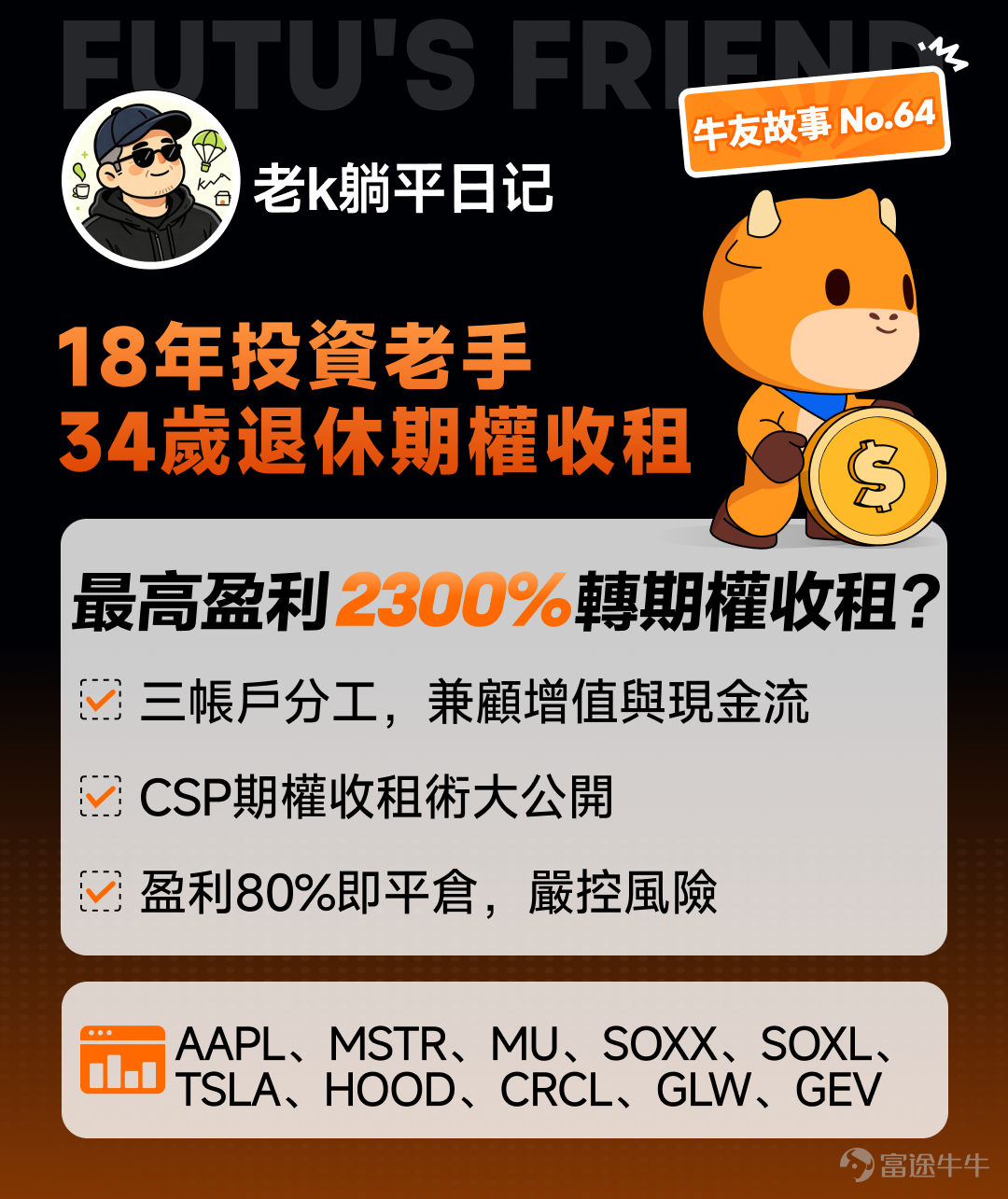
His account once achieved a 2,300% return, but later suffered continuous drawdowns amid market volatility, eventually turning into a loss. This experience prompted him to rethink:Is the goal of investing to chase a single spectacular return, or to build a system that can operate sustainably over the long term and consistently generate cash flow?
He started investing in stocks in 2008 and worked for years at financial institutions after graduation, managing teams of hundreds. At age 34, despite earning an annual salary in the millions and having accumulated eight-figure liquid assets, he chose to leave his career behind to dedicate more time to himself and his family.
After retiring, he allocated his assets across three accounts: two focused on long-term growth and one dedicated specifically to generating cash flow through options. Today, he lives in Malaysia with his family of six. For him, the purpose of investing is no longer just about growing account value, but about creating regular, spendable income from his portfolio.
In this edition of Investor Story, we invited fellow investor @老k躺平日记, to share how he shifted from chasing high returns as an options buyer to building cash flow through Cash-Secured Put (CSP) strategies, along with the applicable conditions and risk boundaries underlying this approach.
 Tip: This article is quite long. We recommend liking and bookmarking it for a thorough read—there’s a surprise waiting for you at the end!
![His account once achieved a peak return of 2,300%, but later suffered continuous drawdowns amid market volatility, eventually turning into a loss. This experience prompted him to rethink:Is the goal of investing to chase a single spectacular return, or to build a sustainable system that consistently generates cash flow over the long term? He started investing in stocks in 2008 and worked for years at financial institutions after graduation, managing teams of hundreds. At age 34, earning an annual salary in the millions and having already accumulated eight-figure cash assets, he chose to leave his career behind to spend more time with himself and his family. After retirement, he split his assets across three accounts: two focused on long-term growth and one dedicated specifically to generating cash flow through options. Today, he lives in Malaysia with his family of six. For him, the purpose of investing is no longer just about growing account value—it’s about creating regular, usable income from his assets. In this edition of Investor Story, we invite fellow investor @老k躺平日记, to share how he shifted from chasing high returns as an options buyer to building cash flow through cash-secured put (CSP) selling, along with the conditions under which this strategy works and its risk boundaries. [Microphone]Tip: This article is quite long. We recommend liking and bookmarking it for a thorough read—there’s a surprise waiting for you at the end! 1. Retiring at 34: What’s truly scarce isn’t income, but time Q: Could you first introduce your professional background and investment experience...](https://nnqimage.futunn.com/sns_client_feed/999992/20260805/web-1785914666894-H8uBsSrhaw.png/big?area=1&is_public=true&imageMogr2/ignore-error/1/format/webp)
1. Retiring at 34: What’s truly scarce isn’t income, but time
Q: Could you first introduce your professional background and investment experience?
Lao K’s FIRE Journal:I started getting into stocks in 2008, influenced by 'Rich Dad Poor Dad' and because my family was also trading stocks. I used their brokerage accounts to learn and practice investing.
After graduating from university in 2012, I worked continuously at financial institutions. By now, I’ve been involved in stocks for 18 years. I began studying options in 2019, initially treating them mainly as a tool to enhance returns and manage risk, and gradually shifted toward using options to generate cash flow.
Q: Why did you choose to retire early at age 34?
Lao K’s FIRE Journal:This decision wasn’t easy. In my second year after graduation, my annual income already exceeded RMB 1 million, and by the fourth year, it surpassed RMB 2 million. By age 34, I had accumulated eight-figure liquid assets, and combined with stocks and real estate, the cash flow generated by these assets was sufficient to cover my family’s expenses.
But what truly drove me to leave wasn’t just having enough money—it was my growing realization of the value of time. At that point, I was managing a team of hundreds, under immense work pressure, and nearly all my time belonged to the company. There were times I hadn’t seen my kids for months, and trips I wanted to take with my parents kept getting postponed again and again.
Many people assume that earning a bit more will bring greater freedom, but as income rises, so can desires, spending, and work commitments. If your income always comes from selling your time, then once you stop working, your income stops too.
So I’ve decided to gradually shift from relying on active income to depending on asset-based income.My understanding of financial freedom isn’t about earning more, but rather having assets that continue to generate cash flow even when I’m not working.
Q: After retirement, why split funds into three accounts?
Old K’s FIRE Journal:Right now, I havetwo accounts primarily invested in stocks and ETFs, aiming for long-term compounding to keep growing the portfolio, while the third account is dedicated specifically to generating options-based cash flow, with returns regularly transferred to my bank card to cover household expenses.
![His account once achieved a peak return of 2,300%, but later suffered continuous drawdowns amid market volatility, eventually turning into a loss. This experience prompted him to rethink:Is the goal of investing to chase a single spectacular return, or to build a sustainable system that consistently generates cash flow over the long term? He started investing in stocks in 2008 and worked for years at financial institutions after graduation, managing teams of hundreds. At age 34, earning an annual salary in the millions and having already accumulated eight-figure cash assets, he chose to leave his career behind to spend more time with himself and his family. After retirement, he split his assets across three accounts: two focused on long-term growth and one dedicated specifically to generating cash flow through options. Today, he lives in Malaysia with his family of six. For him, the purpose of investing is no longer just about growing account value—it’s about creating regular, usable income from his assets. In this edition of Investor Story, we invite fellow investor @老k躺平日记, to share how he shifted from chasing high returns as an options buyer to building cash flow through cash-secured put (CSP) selling, along with the conditions under which this strategy works and its risk boundaries. [Microphone]Tip: This article is quite long. We recommend liking and bookmarking it for a thorough read—there’s a surprise waiting for you at the end! 1. Retiring at 34: What’s truly scarce isn’t income, but time Q: Could you first introduce your professional background and investment experience...](https://nnqimage.futunn.com/sns_client_feed/999992/20260805/web-1785914669499-AyVzTcWBRa.png/big?area=1&is_public=true&imageMogr2/ignore-error/1/format/webp)
Many people find it hard to actually withdraw money once it’s in a brokerage account: they’re reluctant to sell when prices rise, unwilling to sell when prices fall, and after breaking even, they always want to wait a bit longer. As a result, their assets keep fluctuating in the account without ever turning into usable cash flow for daily life.
By separating the accounts, the long-term account doesn’t need to be liquidated to cover daily expenses, and the cash flow account isn’t burdened with the pressure of rapidly growing the portfolio.One takes care of the future; the other takes care of the present.
2. From 2,300% Profit to Drawdown Loss: High Returns Do Not Equal Sustainability
Q: What has been your most profitable investment since you started investing?
Lao K's Chill Investing Journal:Based on a single investment, the position that has generated the highest return for me so far is Apple.
At the time, the market was skeptical because Apple had not yet shown clear progress in AI, causing its stock price to drop to just over $100. I believed $Apple (AAPL.US)$it still controlled key user-facing entry points for numerous AI applications, so I bought long-term equity appreciation rights (LEAPS Calls).Later, as market sentiment recovered and positive developments gradually materialized, this investment ultimately yielded over $260,000 in profit.
![His account once achieved a peak return of 2,300%, but later suffered continuous drawdowns amid market volatility, eventually turning into a loss. This experience prompted him to rethink:Is the goal of investing to chase a single spectacular return, or to build a sustainable system that consistently generates cash flow over the long term? He started investing in stocks in 2008 and worked for years at financial institutions after graduation, managing teams of hundreds. At age 34, earning an annual salary in the millions and having already accumulated eight-figure cash assets, he chose to leave his career behind to spend more time with himself and his family. After retirement, he split his assets across three accounts: two focused on long-term growth and one dedicated specifically to generating cash flow through options. Today, he lives in Malaysia with his family of six. For him, the purpose of investing is no longer just about growing account value—it’s about creating regular, usable income from his assets. In this edition of Investor Story, we invite fellow investor @老k躺平日记, to share how he shifted from chasing high returns as an options buyer to building cash flow through cash-secured put (CSP) selling, along with the conditions under which this strategy works and its risk boundaries. [Microphone]Tip: This article is quite long. We recommend liking and bookmarking it for a thorough read—there’s a surprise waiting for you at the end! 1. Retiring at 34: What’s truly scarce isn’t income, but time Q: Could you first introduce your professional background and investment experience...](https://nnqimage.futunn.com/sns_client_feed/999992/20260805/web-1785914670240-8IGr05fXv0.png/big?area=1&is_public=true&imageMogr2/ignore-error/1/format/webp)
I typically limit any single stock position to no more than 20% of my total portfolio. This trade made me realize thatsignificant gains sometimes come from independent judgment during periods of market pessimism—but only if your position size can withstand temporary lack of market validation.
Q: You previously shared a story about MicroStrategy (MSTR) declining continuously for three months, during which you sold cash-secured put options to generate substantial income. Could you elaborate on that?
Old K's Lay-Flat Journal:This trade took place in the second half of 2025, when $Strategy (MSTR.US)$ the implied volatility (IV) of MSTR had been consistently high for an extended period, making option premiums particularly attractive for sellers.
At the time, I held over $800,000 in cash and used a cash-secured put strategy. My rationale wasn’t simply to collect premium income; rather, I fundamentally believed in MSTR’s long-term value and was willing to buy the stock at the strike price if it dropped that low, as part of my pre-planned strategy. MSTR subsequently underwent a pullback of nearly 60%, but because my strike price remained well above the market price and I actively managed the position, I ultimately realized cumulative gains of approximately RMB 600,000.
![His account once achieved a peak return of 2,300%, but later suffered continuous drawdowns amid market volatility, eventually turning into a loss. This experience prompted him to rethink:Is the goal of investing to chase a single spectacular return, or to build a sustainable system that consistently generates cash flow over the long term? He started investing in stocks in 2008 and worked for years at financial institutions after graduation, managing teams of hundreds. At age 34, earning an annual salary in the millions and having already accumulated eight-figure cash assets, he chose to leave his career behind to spend more time with himself and his family. After retirement, he split his assets across three accounts: two focused on long-term growth and one dedicated specifically to generating cash flow through options. Today, he lives in Malaysia with his family of six. For him, the purpose of investing is no longer just about growing account value—it’s about creating regular, usable income from his assets. In this edition of Investor Story, we invite fellow investor @老k躺平日记, to share how he shifted from chasing high returns as an options buyer to building cash flow through cash-secured put (CSP) selling, along with the conditions under which this strategy works and its risk boundaries. [Microphone]Tip: This article is quite long. We recommend liking and bookmarking it for a thorough read—there’s a surprise waiting for you at the end! 1. Retiring at 34: What’s truly scarce isn’t income, but time Q: Could you first introduce your professional background and investment experience...](https://nnqimage.futunn.com/sns_client_feed/999992/20260805/web-1785914667672-lrWTHPASux.png/big?area=1&is_public=true&imageMogr2/ignore-error/1/format/webp)
For me, the greatest significance of this trade was validatingthe core principle of option selling strategies: it’s not about predicting the market, but about generating returns from time decay and volatility within a price and risk range you’re comfortable with.
Q: You once shared an account that achieved a cumulative return of 611%, with a peak gain of 2,300%—what happened during that period?
Old K's Lay-Flat Journal:When I first started trading options,like many investors, I primarily bought options, hoping to use a small amount of capital to chase high returns.Riding on favorable U.S. market conditions, my account once achieved a peak return of 2,300%.
However, after several major market swings, the account experienced a significant drawdown from its peak and even turned into a loss. In hindsight, the problem wasn’t that the companies I bought were bad—it was that I approached trading with a gambler’s mindset, using short-term options (held for a few weeks to three months) to speculate on direction.
As an options buyer, you not only need to be right about direction but also timing. If the move happens too late, you can still incur losses due to time decay—even if your long-term thesis is correct. I had several trades $Microsoft (MSFT.US)$$Broadcom (AVGO.US)$ that lost over $100,000 each, which made me realize:Higher returns aren’t necessarily worth chasing—the real challenge is sustainability.。
Since then, I’ve stopped trading short-term speculative long options. When I do take long positions, I prefer long-dated, deep-in-the-money LEAPS. I also maintain cash reserves, manage position sizing carefully, and have gradually shifted my focus toward options selling.Later, this account’s cumulative return recovered to 611%, and I gradually transferred part of those gains into a long-term account.
![His account once achieved a peak return of 2,300%, but later suffered continuous drawdowns amid market volatility, eventually turning into a loss. This experience prompted him to rethink:Is the goal of investing to chase a single spectacular return, or to build a sustainable system that consistently generates cash flow over the long term? He started investing in stocks in 2008 and worked for years at financial institutions after graduation, managing teams of hundreds. At age 34, earning an annual salary in the millions and having already accumulated eight-figure cash assets, he chose to leave his career behind to spend more time with himself and his family. After retirement, he split his assets across three accounts: two focused on long-term growth and one dedicated specifically to generating cash flow through options. Today, he lives in Malaysia with his family of six. For him, the purpose of investing is no longer just about growing account value—it’s about creating regular, usable income from his assets. In this edition of Investor Story, we invite fellow investor @老k躺平日记, to share how he shifted from chasing high returns as an options buyer to building cash flow through cash-secured put (CSP) selling, along with the conditions under which this strategy works and its risk boundaries. [Microphone]Tip: This article is quite long. We recommend liking and bookmarking it for a thorough read—there’s a surprise waiting for you at the end! 1. Retiring at 34: What’s truly scarce isn’t income, but time Q: Could you first introduce your professional background and investment experience...](https://nnqimage.futunn.com/sns_client_feed/999992/20260805/web-1785914667677-Rd2KFfTs20.png/big?area=1&is_public=true&imageMogr2/ignore-error/1/format/webp)
III. Options Income: Building a Cash Flow Account
Q: Why refer to cash-secured put (CSP) selling as 'collecting rent'?
Lao K’s FIRE Journal:After retirement, I care less about account balances and more about how much cash actually arrives in my account each month. I own properties both domestically and in Europe, and the rental income covers part of my household expenses. Later, inspired by Duan Yongping, I realized that CSP (Cash-Secured Put) can create a similar cash flow experience.
When selling a put, you receive the premium upfront; if it's cash-secured, the reserved funds can still be actively managed for modest cash yield.My CSP account isn't aimed at getting rich quick, but rather atgenerating stable income. A single trade might earn only a few hundred to one or two thousand dollars, but over time, this can help cover part of the living expenses for a family of six.
Q: How do you typically select stocks and contracts?
Lao K's FIRE Journal:I have three main criteria:First, the stock must have sufficiently large market capitalization; second, I prefer implied volatility to be relatively high; third—and most importantly—I only choose companies or ETFs that I understand well and whose fundamentals I can consistently monitor.
Slow-bull blue-chip stocks like this $Direxion Daily Semiconductor Bull 3x Shares ETF (SOXL.US)$ This kind ofFor high-volatility stocks, I typically choose puts with expirations between 2 to 7 days and strike prices far from the current market price.It’s a 3x leveraged ETF; I wouldn’t hold it as a long-term position—it’s primarily used for options trading. $Micron Technology (MU.US)$ 、 $SK hynix (SKHY.US)$ and $iShares Semiconductor ETF (SOXX.US)$ falls into the category of positions I’m willing to hold long-term.
![His account once achieved a peak return of 2,300%, but later suffered continuous drawdowns amid market volatility, eventually turning into a loss. This experience prompted him to rethink:Is the goal of investing to chase a single spectacular return, or to build a sustainable system that consistently generates cash flow over the long term? He started investing in stocks in 2008 and worked for years at financial institutions after graduation, managing teams of hundreds. At age 34, earning an annual salary in the millions and having already accumulated eight-figure cash assets, he chose to leave his career behind to spend more time with himself and his family. After retirement, he split his assets across three accounts: two focused on long-term growth and one dedicated specifically to generating cash flow through options. Today, he lives in Malaysia with his family of six. For him, the purpose of investing is no longer just about growing account value—it’s about creating regular, usable income from his assets. In this edition of Investor Story, we invite fellow investor @老k躺平日记, to share how he shifted from chasing high returns as an options buyer to building cash flow through cash-secured put (CSP) selling, along with the conditions under which this strategy works and its risk boundaries. [Microphone]Tip: This article is quite long. We recommend liking and bookmarking it for a thorough read—there’s a surprise waiting for you at the end! 1. Retiring at 34: What’s truly scarce isn’t income, but time Q: Could you first introduce your professional background and investment experience...](https://nnqimage.futunn.com/sns_client_feed/999992/20260805/web-1785914668907-e37CDTEEls.png/big?area=1&is_public=true&imageMogr2/ignore-error/1/format/webp)
Q: When selling 50 to 100 put contracts at once, how do you determine position size?
Old K’s Passive Investing Journal:The quantity must be aligned with total capital.I have over a million dollars in cash, spread across multiple accounts, and never deploy all my capital at once.Most trades are fully cash-secured; in select scenarios, I may use modest leverage, typically around 1.5x and never exceeding 2x, while also keeping backup funds in other accounts.
When a contract reaches 80% of its maximum profit, I consider closing it early—I don’t chase the final 20%.。This approach can both reduce tail risk as expiration approaches and free up capital for the next round of trades.
Q: How much cash flow do you aim to generate with this strategy?
Lao K's Passive Income Journal:Based on my experience, a monthly net income target of $5,000 to $10,000 is reasonable for a cash flow account. Roughly speaking, a $200,000 principal has the potential to generate about $5,000 per month. If you want to more consistently achieve $10,000 per month, you might need around $500,000 in capital, while also keeping emergency funds outside the account.
However, this is only a reference based on my own strategy, capital size, and past experience—it doesn’t guarantee monthly results nor apply to all investors. Receiving option premiums doesn’t automatically mean the trade is profitable; you still need to account for costs such as buybacks, rolling positions, and losses from unsuccessful trades.
Q: What is the biggest risk of this strategy?
Lao K's Passive Income Journal:The biggest risk is sustained deterioration in the underlying asset’s fundamentals, leading to a prolonged decline in its stock price.。Stock selection can reduce the likelihood of this scenario but cannot eliminate it entirely. In my view, there are generally five situations one might encounter when selling cash-secured puts (CSP):
1:The stock is rising, earning the premium risk-free.
2:stocks fall,, but the decline isn't enough to reach your strike price, so you still collect the premium.
3:The stock moves sideways with no significant upward or downward trend., collecting the premium.
4:The stock drops sharply to your strike price., you can choose to close the position at a loss and then open a new one; if you pick well, the gains and losses may offset each other, possibly resulting in a small profit.
5:The stock’s fundamentals deteriorate, leading to a sustained sharp decline., this is the scenario that would actually cause you a real loss.
However, if you select high-quality stocks, the likelihood of this scenario is low. So among these five scenarios, three are profitable, one might be profitable, and only one leads to a real loss—which you can largely avoid through careful stock selection.I will continue monitoring fundamentals closely and maintain cash reserves to avoid being fully invested or over-leveraged.
Memory stocks recently dropped sharply; my long positions incurred significant unrealized losses, but my put options account continued generating steady profits because I set my strike prices low enough—making it even easier to profit when the market rises.
4. Market Outlook: Bullish on AI in the long term, accepting short-term volatility
Q: After the recent market correction, are you still bullish on memory and AI?
Old K's Chill Journal:I remain optimistic,AI adoption—both personal and enterprise—is still relatively low, and infrastructure such as computing power, storage, robotics, and power may continue to benefit over the long term.
Regarding memory, I pay closer attention to supply-demand dynamics and production capacity. If manufacturers significantly expand capacity, causing sustained price declines, that could undermine the sector’s valuation logic. A short-term stock price drop alone isn’t sufficient evidence that the industry cycle has ended.
Currently, Micron, SK Hynix, and SOXX are more suited for long-term positions; I only use SOXL for options trading and won’t hold it long term. Beyond that, I’m also watching $Alphabet-C (GOOG.US)$ , Microsoft,$Corning (GLW.US)$ , as well as companies in the power, healthcare, and select crypto-related sectors. These are my personal observations and do not constitute individual stock recommendations.
Q: You’ve also been following Tesla closely for a long time—may I ask what primarily drives your interest?
Old K's Chill Diary:Actually, I've thought a lot about this question, but I feel only one sentence captures my core idea:
If there were only one entrepreneur in the world capable of articulating and executing ideas that are 50 years ahead of humanity, it would be Musk. Investing in Tesla is simply about believing in this person.I could talk about industrial structure, Tesla’s multi-business strategy, or its robotics and autonomous driving initiatives, but none of that matters as much as the statement above—that’s my conviction in him.
Q: From today’s perspective, how do you view the U.S. stock market outlook for the next six to twelve months?
Old K's Chill Diary:I’ll be watchinggeopolitics, oil prices, inflation, monetary policy, and the U.S. midterm electionsamong other variables. However, from a long-term perspective, I remain generally optimistic on U.S. equities, with the core strategy being to gradually accumulate high-quality assets I understand well whenever the market undergoes a clear correction.
Since establishing an options-based cash flow stream, my mindset toward market downturns has also shifted. While my equity portfolio may experience real unrealized losses, as long as my cash flow account continues to operate smoothly, I won’t be forced to sell long-term assets at depressed prices to cover living expenses.
Stable cash flow, in turn, also supports equity positions. Maintaining a good mindset is a crucial factor in successful investing—it helps you avoid being dragged along by market swings, chasing rallies and selling into dips.
Q: Which sectors or specific companies are still worth watching right now?
Old K’s Hands-Off Diary:There are quite a few promising directions. In memory chips, I’ve been gradually adding to Micron and SK Hynix on their pullbacks. Corning also offers solid value at current levels, so I’m slowly building a position.
Among the big tech leaders, I’ve been consistently allocating to long-dated LEAPS calls on Google and Microsoft during the market dip two weeks ago, treating them as long-term core holdings. Healthcare can serve as a defensive allocation, and the computing power sector also deserves ongoing attention. I’m also bullish on crypto-related assets ahead of year-end. $Robinhood (HOOD.US)$ and $Circle (CRCL.US)$ I’ve been consistently allocating to them. I also hold positions in the power sector, such as $Eaton (ETN.US)$ 、 $GE Vernova (GEV.US)$ 。
5. Futu User Experience: From Options Screening to Cash Management
Q: Having used Futu for many years, which features have genuinely helped improve your investment efficiency?
Old K’s Hands-Off Diary:I started using Futu in 2018 through a friend’s referral. Initially, I appreciated the convenient account opening process. After years of use, I particularly value the cohesive experience formed by the overall interface, charting tools, Futu Research, and Bull Community.
As a options seller, I constantly monitor implied volatility and Delta values to screen suitable underlying assets and contracts. The options chain is clearly laid out—premiums for different expiration dates and strike prices are displayed together, allowing instant comparison. The profit/loss analyzer directly shows payoff boundaries under various stock price scenarios, making outcomes like rolling positions, closing trades, or assignment crystal clear in advance.I also use conditional orders—for example, automatically closing a position when profit reaches 80%. This eliminates the need to constantly watch the market, saving significant effort for traders like me who prioritize cash flow.
![His account once achieved a peak return of 2,300%, but later suffered continuous drawdowns amid market volatility, eventually turning into a loss. This experience prompted him to rethink:Is the goal of investing to chase a single spectacular return, or to build a sustainable system that consistently generates cash flow over the long term? He started investing in stocks in 2008 and worked for years at financial institutions after graduation, managing teams of hundreds. At age 34, earning an annual salary in the millions and having already accumulated eight-figure cash assets, he chose to leave his career behind to spend more time with himself and his family. After retirement, he split his assets across three accounts: two focused on long-term growth and one dedicated specifically to generating cash flow through options. Today, he lives in Malaysia with his family of six. For him, the purpose of investing is no longer just about growing account value—it’s about creating regular, usable income from his assets. In this edition of Investor Story, we invite fellow investor @老k躺平日记, to share how he shifted from chasing high returns as an options buyer to building cash flow through cash-secured put (CSP) selling, along with the conditions under which this strategy works and its risk boundaries. [Microphone]Tip: This article is quite long. We recommend liking and bookmarking it for a thorough read—there’s a surprise waiting for you at the end! 1. Retiring at 34: What’s truly scarce isn’t income, but time Q: Could you first introduce your professional background and investment experience...](https://nnqimage.futunn.com/sns_client_feed/999992/20260805/web-1785914668039-bipvDa9ese.png/big?area=1&is_public=true&imageMogr2/ignore-error/1/format/webp)
Q: Aside from trading tools, how do you leverage Futu for cash management to improve capital efficiency?
Old K’s Lazy Trading Journal:I park the reserve capital for my CSPs (Cash-Secured Puts) in money market funds—redeemable anytime and counted as available cash, which can be directly used as collateral for options trading.
These funds also generate an annualized yield of over 3%, which is like unexpected extra income. For instance, if an options seller achieves a 20% annualized return, adding the interest from the money market fund lifts the total to 23%. This significantly boosts cash utilization efficiency—I highly recommend everyone give this method a try.
![His account once achieved a peak return of 2,300%, but later suffered continuous drawdowns amid market volatility, eventually turning into a loss. This experience prompted him to rethink:Is the goal of investing to chase a single spectacular return, or to build a sustainable system that consistently generates cash flow over the long term? He started investing in stocks in 2008 and worked for years at financial institutions after graduation, managing teams of hundreds. At age 34, earning an annual salary in the millions and having already accumulated eight-figure cash assets, he chose to leave his career behind to spend more time with himself and his family. After retirement, he split his assets across three accounts: two focused on long-term growth and one dedicated specifically to generating cash flow through options. Today, he lives in Malaysia with his family of six. For him, the purpose of investing is no longer just about growing account value—it’s about creating regular, usable income from his assets. In this edition of Investor Story, we invite fellow investor @老k躺平日记, to share how he shifted from chasing high returns as an options buyer to building cash flow through cash-secured put (CSP) selling, along with the conditions under which this strategy works and its risk boundaries. [Microphone]Tip: This article is quite long. We recommend liking and bookmarking it for a thorough read—there’s a surprise waiting for you at the end! 1. Retiring at 34: What’s truly scarce isn’t income, but time Q: Could you first introduce your professional background and investment experience...](https://nnqimage.futunn.com/sns_client_feed/999992/20260805/web-1785914669121-dfUL1dpGho.png/big?area=1&is_public=true&imageMogr2/ignore-error/1/format/webp)
VI. Advice for Beginners: Understand how much you could lose before calculating how much you could earn
Q: For beginners who have never traded options before, what should they learn first?
Old K’s Lazy Trading Journal:First, thoroughly grasp the most fundamental concepts:What are calls and puts, and how does an option’s time value decay? Understand the difference between ITM (in-the-money) and OTM (out-of-the-money), as well as the distinction between LEAPS (long-term options) and short-term options.。
It's also important to understand the respective risks and rewards of buying calls versus selling calls.
Futu itself offers a dedicated options education section; beginners are advised to go through the full course—it’s sufficient for getting started.
Q: Do you recommend beginners start with CSP (Cash-Secured Put)?
Old K’s Passive Investing Journal:I think beginners can start with CSP—this strategy has a high win rate and offers a smooth onboarding experience.
In the stock market, everyone wants something different. Some dream of getting rich overnight, but in reality, very few actually succeed with that mindset—most retail investors lose money. Be objective and don’t assume you’re one of the lucky few. I see myself as an ordinary person and prefer the more conservative path.
A well-executed CSP strategy can yield annualized returns of 15% to 20%; in favorable market conditions, it can reach 25% to 30%. I’m already very satisfied with this return—it’s far more stable than simply holding stocks.
In terms of capital, CSP becomes more meaningful with a principal of over $100,000.The cash flow generated can genuinely supplement daily living expenses. If your regular expenses are low, $100,000 in annual cash flow could even cover your monthly spending. Only a moderate risk tolerance is needed, as it’s cash-secured—already relatively conservative—and you can further reduce risk by proactively setting a lower strike price.
Q: Could you give three pieces of advice to fellow investors just starting to learn options trading?
Old K’s Semi-Retirement Diary:My advice is:
1. Don’t recklessly use leverage.
2. Avoid short-term options speculation whenever possible.
3. For U.S. equities, the overarching strategy is simple: selectively deploy capital in quality names during market pullbacks.
Reflecting on his 18 years of investing experience, Old K’s Semi-Retirement Diary recounts periods of high returns as well as single losses exceeding $100,000. Today, he no longer views 'fastest gains' as the sole objective of investing. For him—who has already left the workforce—his long-term account ensures continued asset growth, while his cash flow account safeguards his family’s lifestyle from short-term market volatility. These three accounts aren’t just about separating funds; they ensure every dollar has a clear purpose.
As he puts it:One account takes care of the future, and one takes care of the present. True financial freedom begins only when your assets truly start working for your life.
[Contest Interaction]
Share your reflections on this article in the comments section. The first 150 fellow investors whose comments exceed 30 words and offer thoughtful insights will receive 66 points.
If you find this article inspiring for your investment, feel free to @ your friends to read it together~
Campaign end date: From now until August 9, 2026
If you have more suggestions for our column, feel free to leave a comment below! Follow@fellow investor, you called it!so you won’t miss the next Investor Story!
Disclaimer: The content of this article is compiled from an interview with @老k躺平日记 Accept@fellow investor, you called it!, and the images in the article are provided and authorized for use by @老k躺平日记 . The examples in this article are for reference only and do not constitute any investment advice. The information presented does not imply any recommendation regarding specific industries or indicators. Any mention of individual stocks and related commentary reflects the personal opinion of the user and does not constitute a stock recommendation. Past performance of individual stocks does not guarantee future results. The stock market involves risks; please invest with caution.
Risk Disclaimer: The above content only represents the author's view. It does not represent any position or investment advice of Futu. Futu makes no representation or warranty.Read more


Comments (227)
to post a comment
356
268