
What's the Talk on US Stocks | A Quiet Week, but Are US Treasuries Poised for Turmoil?

AMD's Q2 earnings beat expectations, yet its stock price plunged
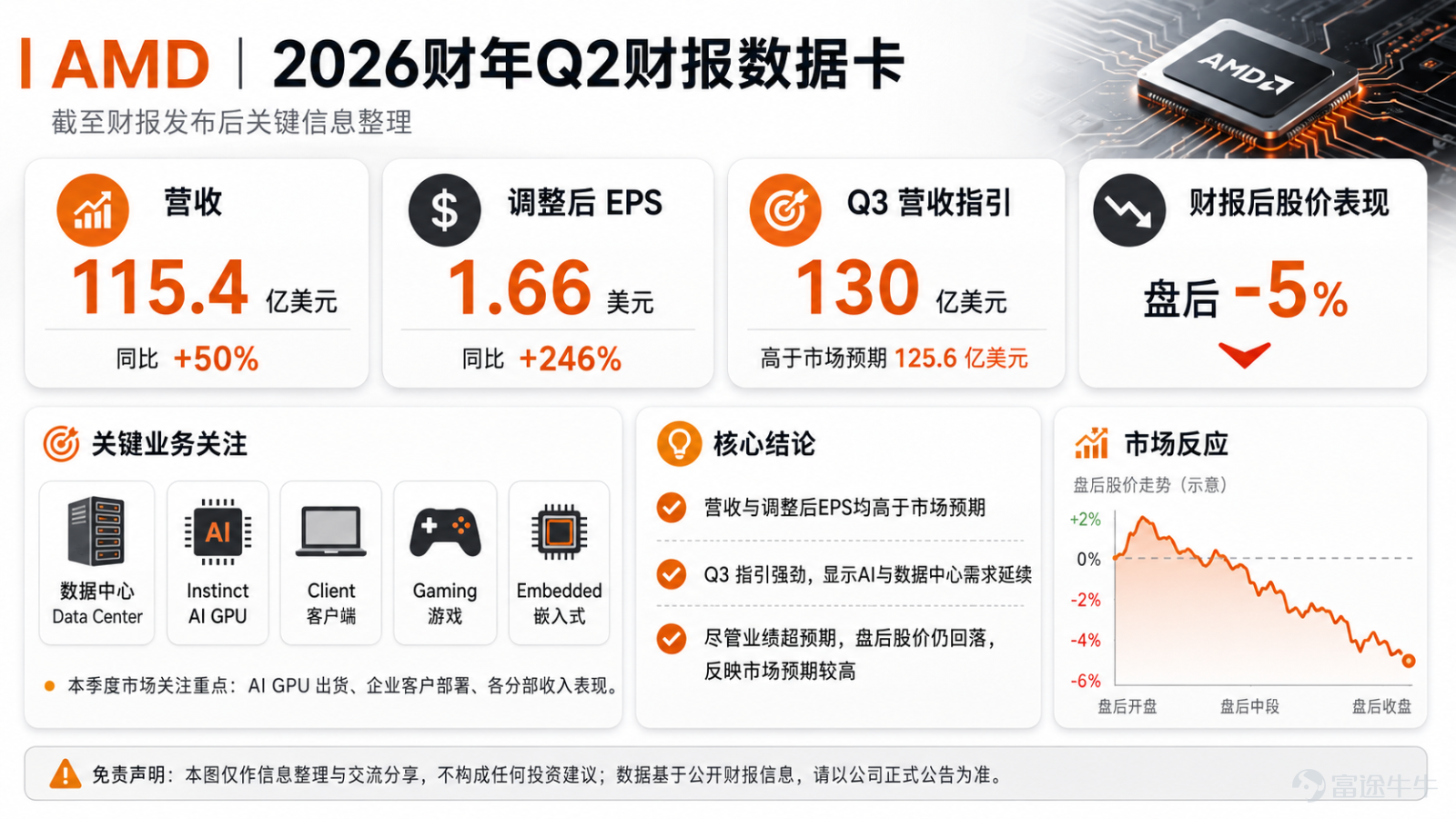
AMD just released its Q2 earnings—like a straight-A student scoring 95 on an exam only to get scolded at home for not being good enough, because the neighbor’s kid supposedly got a perfect score.
AMD delivered its best quarter in history. The company reported total revenue of $11.536 billion, a 50% year-over-year surge that set a new single-quarter revenue record. Non-GAAP net income reached $2.76 billion, up 253% year-over-year, with earnings per share of $1.66, also exceeding market expectations. The powerhouse behind this explosive performance was its Data Center segment, which generated $6.7 billion in revenue—a 107% year-over-year increase—and accounted for 58% of total revenue for the first time.

However, the stock price crashed in after-hours trading.
The reason boils down to one sentence: the market’s expectations have been continuously inflated by the AI frenzy.
AMD has signed a multi-billion-dollar server supply agreement with AI unicorn Anthropic, with deliveries expected in early 2027. Management expressed extreme optimism about the long-term outlook, forecasting server revenue growth of over 80% year-over-year in the second half of 2026 and publicly guiding for a doubling of data center sales by 2027. To support this ambition, the company sharply increased its capital expenditures this quarter to $808 million—far exceeding market expectations—demonstrating its determination to spare no expense in capturing leadership in AI infrastructure.

Yet it is precisely this aggressive investment and the controversial forward guidance that triggered market panic. Although AMD projected third-quarter revenue of approximately $13 billion—above the analyst consensus of $12.5 billion—it fell short of the most optimistic Wall Street estimates, which had ranged from $13.5 billion to $14 billion. With the stock already having doubled year-to-date, the market’s threshold for ‘positive surprises’ has been pushed to unrealistic heights, and even a few hundred million dollars of shortfall was enough to spark profit-taking sell-offs. Moreover, the hefty $800 million in capital expenditures intensified concerns about near-term margin pressure, and the CFO failed to offer sufficiently clear reassurance on the growth trajectory during the earnings call, further amplifying bearish sentiment.
Overall, AMD is firmly positioned on the right track in the AI wave, with its projected doubling of data center revenue and shipments of Helios systems signaling a substantial leap in competitiveness. However, in the near term, lofty market expectations, massive capital outlays, and NVIDIA’s formidable ecosystem moat mean AMD’s stock is bound to face significant volatility in the coming quarters. The market no longer settles for mere ‘progress’—it demands ‘overwhelming victories.’ For AMD, the key to breaking through its current valuation ceiling will lie in how effectively it can ramp up Helios production in the second half of the year and close the ecosystem gap with NVIDIA.
Risk Disclaimer: The above content only represents the author's view. It does not represent any position or investment advice of Futu. Futu makes no representation or warranty.Read more

Comments
to post a comment
10
3