
What's the Talk on US Stocks | A Quiet Week, but Are US Treasuries Poised for Turmoil?

SpaceX: Revenue surges 90%, yet shares drop 7% after hours—Wall Street’s judges are just too hard to please
Last night, SpaceX $SpaceX (SPCX.US)$ released its first quarterly earnings report since going public.
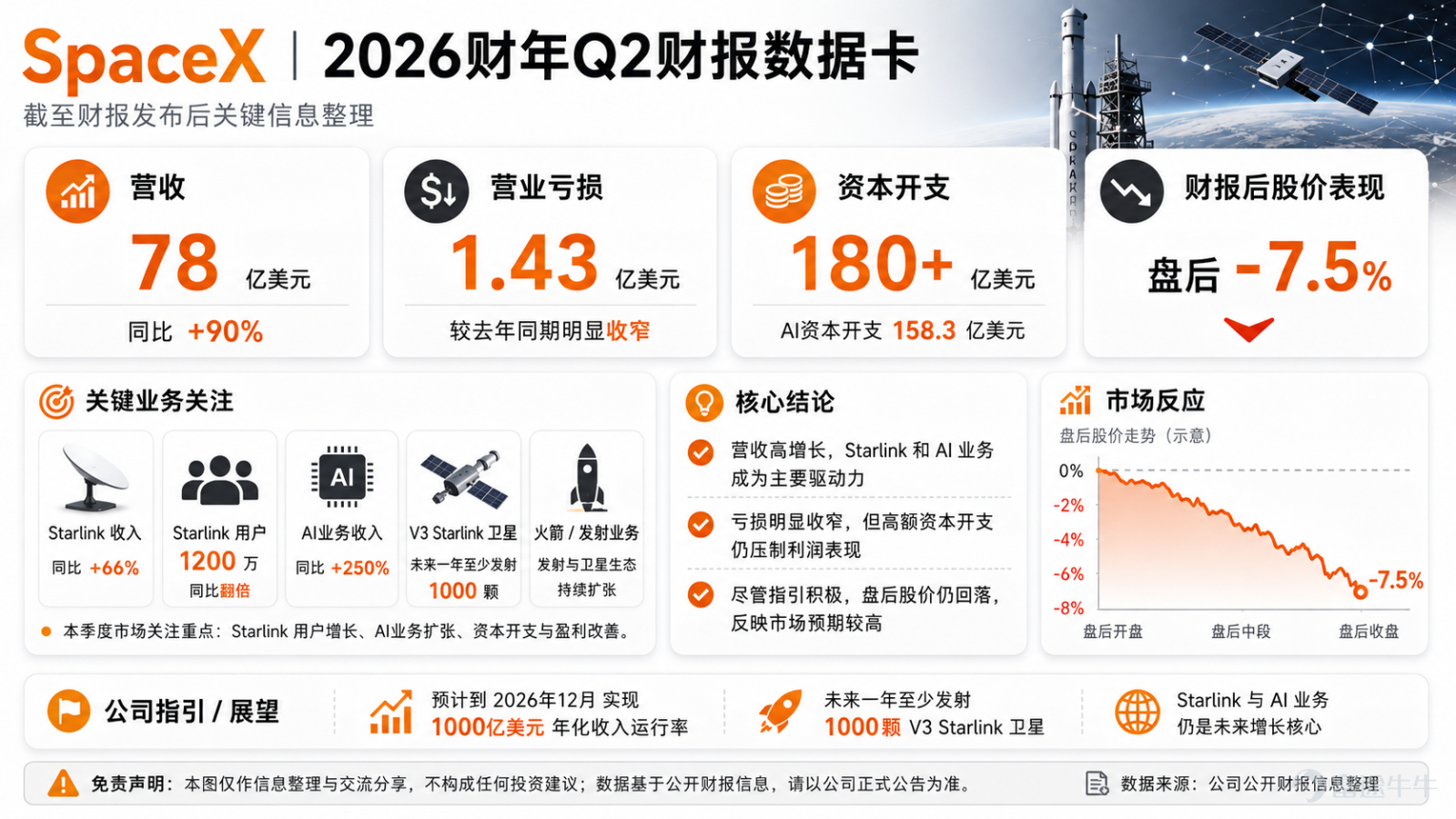
Revenue came in at $7.8 billion, up 90% from $4.1 billion a year ago. Starlink now has 12 million subscribers, doubling its user base. AI-related revenue surged 250%.
The net loss narrowed sharply from $970 million to $143 million. Impressive numbers, right? Yet the stock fell 7.5% in after-hours trading. For its first post-IPO report card, the teacher gave it a 'B.'

Where is all the money going? That’s what Wall Street is most worried about.
Capital expenditures hit $18 billion, with $15.8 billion allocated to AI. Revenue was $7.8 billion—but they’re burning through $18 billion. They’re spending more than double what they earn. On the earnings call, Musk said: 'We’ll achieve a $100 billion annualized revenue run rate by December this year and launch 1,000 V3 Starlink satellites over the next 12 months.' In plain English: 'I’m burning cash hard now, but I’ll make a lot more later.' The pie is big enough—but it takes time to bake. The problem is Wall Street’s patience is running thin; ask them to wait six months, and they’ll just turn around and buy NVIDIA instead.

SpaceX’s dilemma: a great company in a lousy sector.
Everything SpaceX is doing is right—Starlink users doubled, AI revenue jumped 250%, and losses narrowed significantly. But it’s operating in the least-favored corner of today’s U.S. equity market: capital-intensive, high capex, and long payback periods. This earnings season, the winners have all been light-asset, high-margin, cash-generative companies. The ones getting hammered are those promising 'a beautiful future but expensive today.' SpaceX walked straight into that crossfire.
First, can the cash burn stop?
With $18 billion in capital expenditures on the table, the market wants to see if this can narrow in the second half of the year. If it does, it fits the classic 'burn-to-grow' playbook. If not, pressure will persist.
Second, how will the company deliver on its target of RMB 100 billion in annualized revenue?
There isn’t much time left until year-end—four months to hit RMB 100 billion. Growth rates each quarter must not falter. If they miss it, the narrative falls apart.
Third, the V3 satellite launch schedule.
One thousand satellites per year—that’s nearly three per day on average. Whether they can launch on schedule directly affects capital market confidence in the company.
Three scenarios:
🚀 Bull case: RMB 7.8 billion in revenue proves the business model works; narrowing losses show capital burn is efficient. RMB 100 billion in annualized revenue is within reach. Any dip is a golden buying opportunity.
📉 Bear case: Cash burn is twice as fast as revenue generation, Starlink is still subsidized, and there’s no sign yet of the Mars project. When will it become profitable? The math just doesn’t add up.
🍿 Base case: When it drops a lot, someone buys the dip; when it rallies too much, someone sells into strength. Musk keeps baking pies, and the market eats them while complaining. That’s just this stock’s fate.
Sometimes it’s not that you’re not excellent—it’s that the judges’ tastes have changed. Now the judges don’t want ‘a beautiful future’—they want ‘beauty right now.’ SpaceX, your beauty is just a bit too ahead of its time.

Drop a comment below—would you ride this rocket or not? 🚀
Risk Disclaimer: The above content only represents the author's view. It does not represent any position or investment advice of Futu. Futu makes no representation or warranty.Read more


Comments
to post a comment
8