HK Stock Market Barometer | HK stocks continue to fluctuate and pull back! How much room for recover

Traditional ETFs: Indices appear calm on the surface, but capital is actually rotating from high-dividend stocks into tech and growth sectors
On August 4, the Hong Kong ETF market showed no particularly dramatic index movements: Tracker Fund of Hong Kong (2800) $TRACKER FUND OF HONG KONG (02800.HK)$ fell 0.53%, while CSOP Hang Seng Tech Index ETF (3033) $CSOP Hang Seng TECH Index ETF (03033.HK)$ rose 0.21%.
However, focusing only on these two largest ETFs can easily obscure the day’s true capital rotation.
The most notable shift that day wastech and growth sectors continued to attract capital, while previously stable high-dividend, dividend-yield, and financial heavyweight sectors began to give back gains.
Tech ETFs didn’t surge significantly, but their relative strength is improving
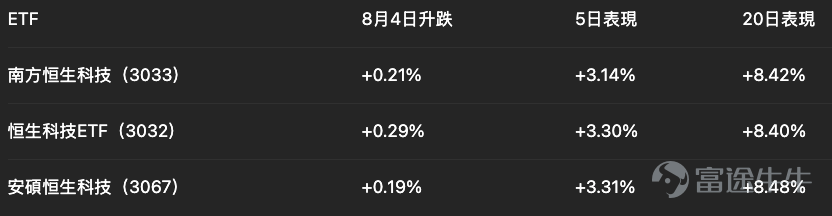
On August 4, CSOP Hang Seng Tech Index ETF (3033) recorded HK$13.92 billion in trading volume, remaining the second most actively traded ETF in the market. It gained 3.14% over 5 days, 1.44% over 10 days, and 8.42% over 20 days.
Regarding similar products:

The returns of the three products are very close, reflecting that the key differences lie not in direction but in trading depth, bid-ask spreads, fund size, and the platform used by individual investors.
3033 has a significantly higher trading volume, making it more suitable for investors prioritizing intraday liquidity; 3032 saw relatively high volume on the day, indicating heightened trading activity compared to its own average; 3067 had lower trading volume on the day, but its short-to-medium-term performance has not noticeably lagged.
Notably, Hang Seng Tech-related ETFs are still down double digits year-to-date. Thus, the recent rebound appears more like a gradual recovery from lows rather than overheating at elevated levels. As long as the short-term upward momentum isn’t quickly reversed, tech ETFs still have room to outperform Hang Seng Index ETFs.
Biotech is starting to show activity but hasn’t yet formed a broad breakout.
Huaxia Hang Seng Healthcare ETF (3069) $ChinaAMC Hang Seng Biotech ETF (03069.HK)$ On August 4, it rose 2.37%, with a trading volume of HK$761.3 million and a volume ratio of 1.27, significantly outperforming the Hang Seng Tech Index.
However, 3069 gained only 0.35% over 5 days, was still down 0.28% over 10 days, and up 3.12% over 20 days. This suggests capital is beginning to return to biotech but hasn’t yet built into a sustained trend.
For investors, this means that 3069 currently resembles an early signal of sector rotation. Only if trading volume sustains and the 5-day and 10-day performance improves in tandem can this short-term move be upgraded to a sign of broader sector strength. If volume contracts again after just one day of gains, it may still be merely a rebound driven by individual stocks.
China's growth sectors have rebounded sharply—the key risk now is getting lured in by the single-day gain.
On August 4, traditional ETFs with larger gains were concentrated in China 5G, ChiNext, STAR 50, and semiconductors:
However, most of these products still posted negative returns over the past 10 and 20 days. Taking 3191 as an example, it gained 3.89% on the day, but was down 8.47% over 5 days, 18.96% over 10 days, and 25.16% over 20 days.
Therefore, the sharp single-day gain primarily indicates temporary relief from selling pressure, not a completed trend reversal.
What truly deserves attention is whether they can hold onto relatively higher levels during the next pullback. Only if the retracement narrows and trading volume doesn’t sharply decline will it signal that capital is shifting from short-term bottom-fishing to establishing positions.
High-Yield and Dividend ETFs: Not Suddenly Losing Value, But Short-Term Crowding Is Cooling Off
On August 4, high-yield ETFs broadly retreated:
– Ping An Hong Kong High Dividend (3070) $Ping An of China CSI HK Dividend ETF (03070.HK)$ down 1.98%;
– Fubon CSI 300-Hang Seng-HK High Dividend (3190) $Fubon Hang Seng Shanghai-Shenzhen-Hong Kong (Selected Corporations) High Dividend Yield Index ETF (03190.HK)$ down 1.63%;
– Fullgoal Hang Seng HK Dividend ETF (3031) $Fullgoal HangSeng HK High Dividend ETF (03031.HK)$ down 1.49%;
– Global X Hang Seng High Dividend (3110) $Global X Hang Seng High Dividend Yield ETF (03110.HK)$ down 0.95%.
Most of these ETFs have still posted gains of roughly 6% to 9% over the past 20 days, so the decline on August 4 does not indicate that the income-investing thesis has suddenly broken down—rather, it reflects normal profit-taking following recent concentrated inflows.
At this stage, the key question isn't whether high-yield ETFs are still worth buying, but rather what your investment objective is.
If the goal is long-term income generation, a single-day decline may not represent a significant change; however, if the objective is short-term capital appreciation, the relative momentum of high-dividend sectors has already started lagging behind that of technology and certain growth sectors.
Today's summary: August 4 did not see broad-based risk escalation or de-escalation. Instead, capital is gradually rotating from previously crowded high-dividend stocks toward technology, biotechnology, and deeply oversold growth sectors.
When selecting traditional ETFs, investors should not focus solely on single-day gains. Factors such as trading liquidity, portfolio positioning, alignment of short- to medium-term returns, and whether the product aligns with income or growth objectives are often more important than a one-day performance ranking.
Risk Disclaimer: The above content only represents the author's view. It does not represent any position or investment advice of Futu. Futu makes no representation or warranty.Read more


Comments
to post a comment
4