
Hong Kong stocks are rebounding—what sectors deserve attention?

Hang Seng Index rebounds, tech index holds up: market conditions haven't deteriorated yet, but it's no longer a case of 'buying everything'
There was a fairly clear signal in Hong Kong stocks yesterday:The Hang Seng Index started to rebound, while tech stocks continued to hold firm.
Hang Seng Index $Hang Seng Index (800000.HK)$ It fell 0.6% to close at 25,852 points, slightly below the 5-day moving average; meanwhile, the Hang Seng Tech Index rose 0.21%, marking its third consecutive gain and approaching the 60-day moving average and the upper Bollinger Band. Judging solely by the indices, it appears to be just a 'market pullback'; however, looking at individual stocks, the divergence in strength among banking, energy, tech, and healthcare sectors is becoming increasingly pronounced.
Therefore, today I won’t simply say 'still bullish on the Hang Seng Index' or 'the market is starting to weaken.' A more practical statement would be:
The rebound structure remains intact, but the market has shifted from buying broad indices to picking individual stocks.
The Hang Seng Index currently has an upside probability score of 66, still leaning upward. However, 25,500 is the first support level, with resistance levels at 26,091 and 26,269. The current price sits in the upper-middle range—above support but not yet breaking through resistance.
In this kind of market environment, the biggest mistake is chasing rallies or selling into dips impulsively.
Warrant open interest also reflects growing market divergence. Call warrant open interest for the Hang Seng Index increased by 7.13%, while bear warrant open interest rose by 7.74% on the same day; put warrant open interest for the Hang Seng Tech Index surged by 20.22% in a single day. In other words, some investors are still betting on further gains, while others have started positioning for a pullback.
Today, let's just look directly at three of the most representative stocks.
HSBC $HSBC HOLDINGS (00005.HK)$ : After hitting a new high, it pulled back slightly—the key point isn’t the 1% drop.
HSBC fell 1.01% yesterday, but still reached a new all-time high during the session. Both call and put open interest increased, with bull warrant open interest rising for two consecutive days, while bear warrant open interest decreased by 11.32%.
This set of data doesn’t mean the market suddenly turned from bullish to bearish; rather, some participants are starting to hedge at these elevated levels, while others are still betting the uptrend isn’t over yet.
HSBC is currently trading at HK$166.50, with an upside probability score of 80 points, indicating overall strength. However, the current price is very close to both the support level at HK$164.70 and the resistance level at HK$168.20.
So for HSBC today, here’s how I’d handle it:
– If it holds above HK$164.70: the uptrend remains intact;
– If it breaks above HK$168.20: only then would there be grounds to target HK$171.50.
– Broke below HK$164.70: The next level to watch is HK$162.20.
In other words, the focus now isn't on whether HSBC is good or bad, but rather waiting for it to choose a direction between HK$164.70 and HK$168.20.
For bullish exposure, consider Morgan Stanley CBBC 15690 with an effective leverage of approximately 6.9x; if you wish to reduce time decay impact, consider UBS Group Bull Certificate 62382 with leverage around 9.9x. However, at this level, I wouldn’t choose products that are too close to the spot price or with excessively high leverage, as even a slight further pullback in the stock price could cause significant volatility in these products.
CNOOC fell 0.67% yesterday, marking its third consecutive decline, and has broken below both the 5-day and 10-day moving averages. Open interest in put warrants has risen for seven straight days, while bull warrant open interest dropped by 10.37% in a single day.
On the surface, bearish sentiment appears stronger.
However, looking at the price, CNOOC is currently trading at HK$23.58, with support at HK$23.54 and resistance at HK$23.68—both very close to the current price.
At such a juncture, the simplest approach is:
Turn bullish only if it breaks above HK$23.68; turn bearish only if it falls below HK$23.54.
If it reclaims above HK$23.68, the next resistance level is at HK$24.10; if it breaks below HK$23.54, the next support level will be HK$23.20.
For bullish exposure, consider Macquarie CBBC 13880, with an effective leverage of approximately 7.3x; for bearish exposure, watch UBS Group CBBC 15583, with leverage of about 3.9x.
Some investors may consider 3.9x leverage too low, but when market direction is unclear, slightly lower leverage isn’t necessarily a bad thing. At least you won’t get shaken out by price fluctuations as the stock oscillates between HK$23.54 and HK$23.68.
ICBC $ICBC (01398.HK)$ The risk-reward ratio remains favorable, but short-term momentum has clearly weakened
ICBC fell 3.14% yesterday, marking its third consecutive decline and breaking below both the 5-day and 10-day moving averages. Bullish CBBC street inventory has declined for five straight days, and call warrant open interest has also decreased.
ICBC is currently trading at HK$7.26, with an upside risk-reward score of 56 points—still not distinctly bearish. However, the share price is now stuck between support at HK$7.235 and resistance at HK$7.29, leaving short-term direction undecided.
This precisely illustrates one point:
Risk-reward ratio is meant to help identify direction, not to prompt immediate entry.
Only if ICBC rebounds above HK$7.29 would its outlook start to improve again; if it breaks below HK$7.235, the next support level would be HK$7.12.
For bullish exposure, consider CITIC Securities CBBC 15108, with leverage of approximately 8.2x; for bearish exposure, refer to UBS Group CBBC 13328, with leverage of about 10.6x.
But there's no need to rush on either side. It's more practical to wait and see whether HK$7.235 or HK$7.29 is breached first, rather than guessing the direction while price remains in the middle of the range.
How would I view it today?
The Hang Seng Index’s rebound isn’t over yet as long as it doesn’t break below 25,500 points; however, resistance is approaching between 26,091 and 26,269 points, and the risk-reward ratio for chasing further gains is declining.
On an individual stock basis:
– HSBC remains strong, but it must first clear HK$168.20;
– CNOOC’s direction remains unclear; the range between HK$23.54 and HK$23.68 serves as the key boundary;
– ICBC has weakened in the short term; it’s unwise to be overly eager to bet on a rebound below HK$7.29.
Today, the most important thing isn’t 'picking the single most promising stock,' but first identifying which support level might be broken and which resistance level might be breached—then selecting suitable products accordingly.
First assess whether the underlying stock meets the necessary conditions, then evaluate whether the derivative product offers value. Don’t reverse this sequence.
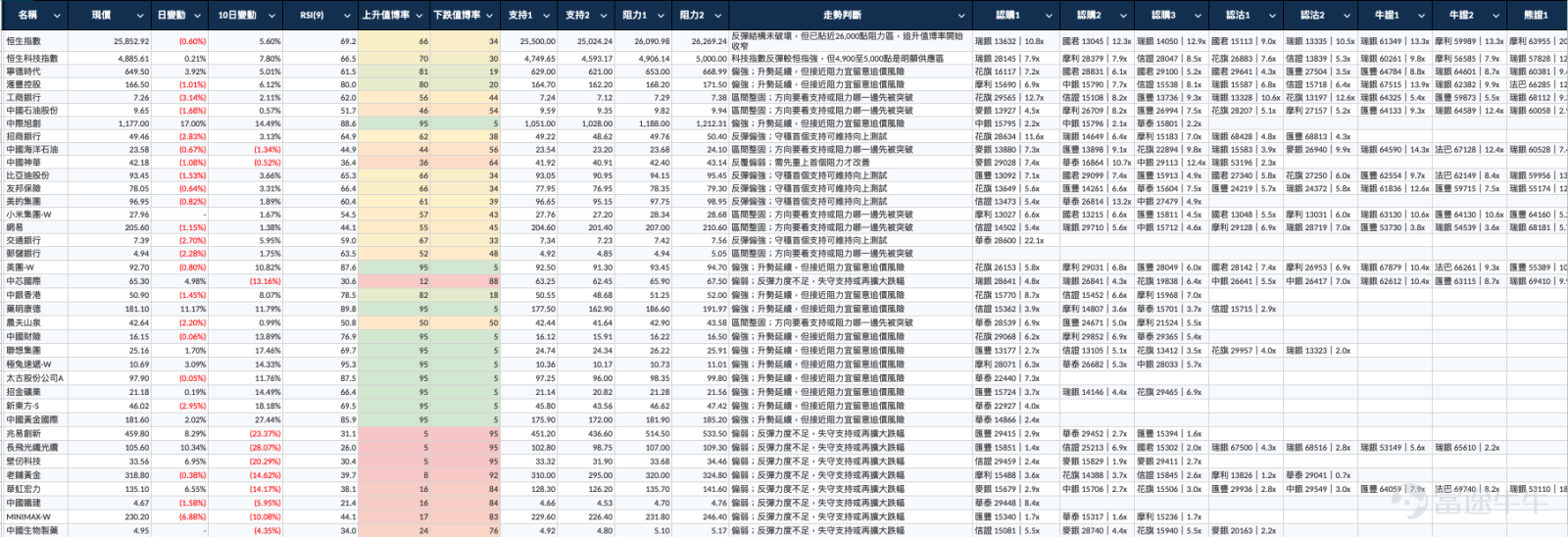
This week’s 'Warrants and Callable Bull/Bear Contracts (CBBC) Product Overview' has compiled the upside/downside risk-reward ratios, two-tier support/resistance levels, key price-level statuses, and comparable warrant and CBBC products for the Hang Seng Index, Hang Seng Tech Index, and multiple Hong Kong-listed stocks. Investors can first use this overview to screen stocks worth monitoring, then compare leverage ratios and strategic purposes across different products—avoiding the pitfall of selecting a product solely based on its low price or high leverage while overlooking the underlying stock’s position and product-specific risks.
For those interested in comparing more individual stocks and their representative products, please download the 'Warrants and Callable Bull/Bear Contracts (CBBC) Product Overview – August 4, 2026' for reference.

Risk Disclaimer: The above content only represents the author's view. It does not represent any position or investment advice of Futu. Futu makes no representation or warranty.Read more

Comments
to post a comment
2