Gold prices break above USD 4,400—can the precious metals rally accelerate?

Gold Is Not a "War Hedge": How Can One Strait Generate Two Opposing Trades? [Gold · EP01]
On August 3, U.S. President Trump stated he would push for a new round of negotiations with Iran on issues including the Strait of Hormuz.; On the same day, international oil prices fell significantly, while spot gold remained above USD 4,000 per ounce.$Crude Oil Futures (OCT6) (CLmain.US)$
Unsupported feature.
Please use the mobile app.
Unsupported feature.
Please use the mobile app.
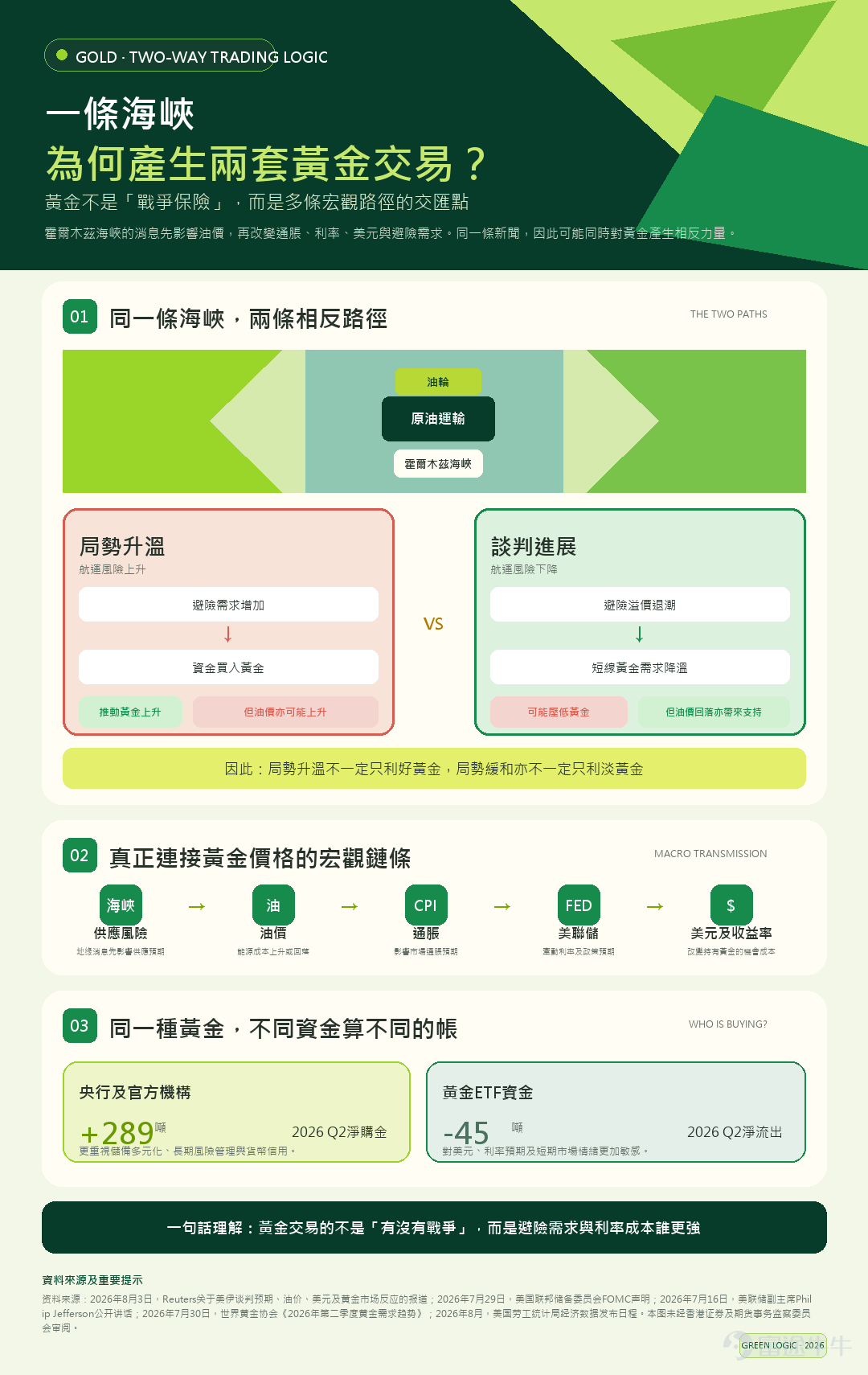
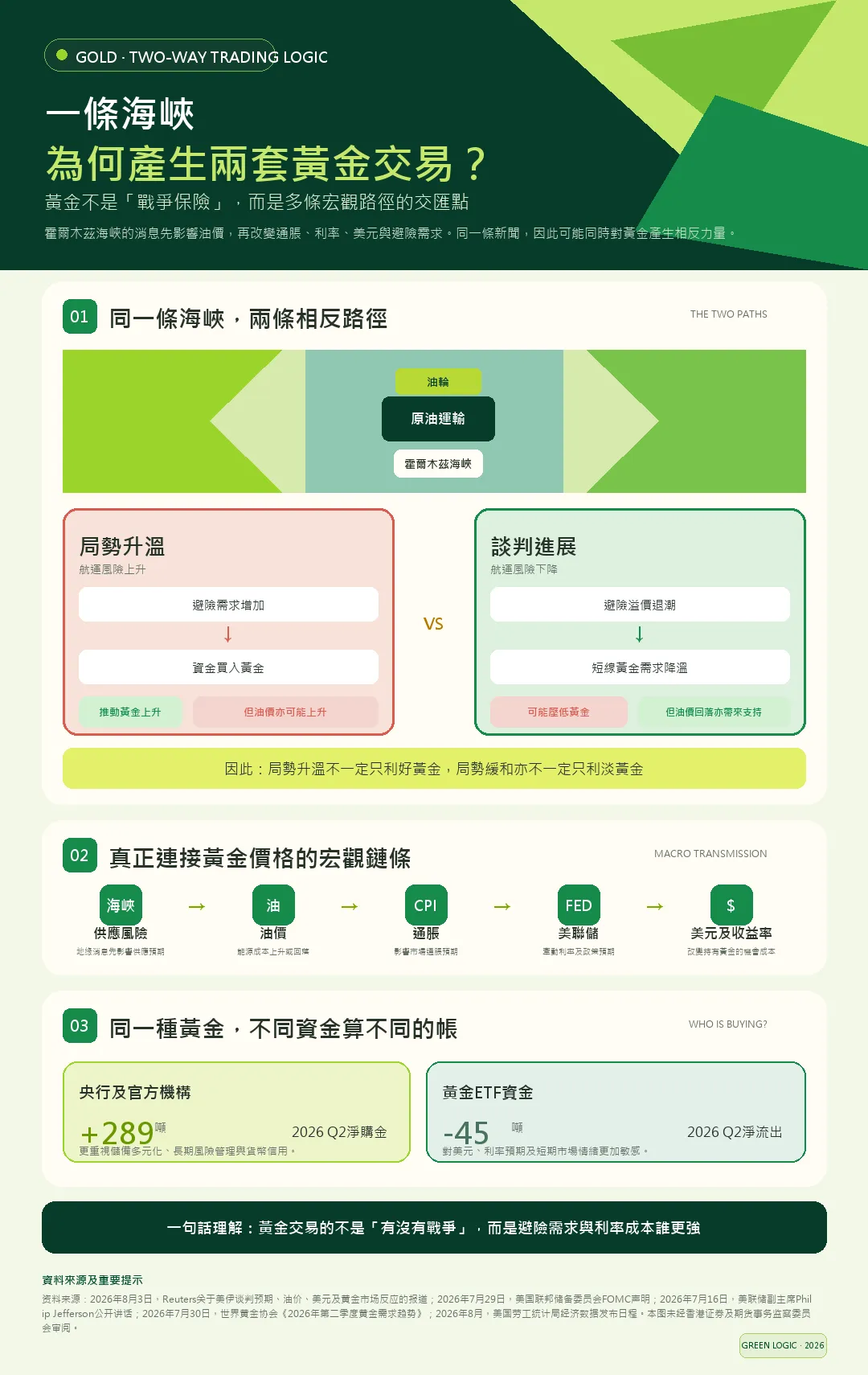
Amid shifting dynamics, the Strait of Hormuz connects not only oil transportation but also influences inflation, Federal Reserve policy, the U.S. dollar, and Treasury yields through oil prices.Thus, the same geopolitical news may simultaneously exert opposing effects on gold. Reuters noted that falling oil prices eased energy-driven inflation and the risk of persistently high interest rates, while a weaker dollar provided support for gold.
This means gold does not simply follow a rule of 'rising when tensions escalate and falling when tensions ease,' but rather reflects a rebalancing between safe-haven demand and interest rate costs.
📊 Gold is not a direct barometer of war risk
When geopolitical risks rise, capital may increase allocations to safe-haven assets like gold. However, if the conflict simultaneously drives up energy prices, markets will reassess inflation and monetary policy.
The Federal Reserve’s statement released on July 29 indicated that U.S. inflation remains above its long-term 2% target, with supply shocks in sectors such as energy contributing to price increases. Three committee members supported a 25-basis-point rate hike at that meeting, reflecting significant internal disagreement over inflation risks.
Therefore,A conflict could boost gold’s safe-haven appeal while simultaneously reinforcing expectations of higher interest rates through rising oil prices.The latter, if it drives the US dollar and Treasury yields higher, would increase the relative cost of holding non-yielding gold.
Gold can hedge against certain geopolitical risks, but it may not simultaneously avoid the high oil prices, elevated inflation, and rising interest rates triggered by geopolitical conflicts.
🌀 One strait linking oil prices and the Federal Reserve
Risks in the Strait of Hormuz first affect crude oil supply expectations, and subsequent oil price movements feed into inflation and interest rate pricing.
Federal Reserve Vice Chair Philip Jefferson stated on July 16 thatwhether rising energy prices would further influence longer-term inflation expectationsis a key issue for monetary policy to monitor.
If shipping risks in the strait escalate, oil prices could rise. Gold would benefit from safe-haven demand on one hand, yet face inflation and rate-hike expectations on the other.
If negotiations make progress and drive oil prices lower, safe-haven demand could cool off, but inflationary pressures and the risk of persistently high interest rates might also decline simultaneously. A Reuters market report on August 3 noted that expectations of US-Iran talks pushed oil prices down and eased market concerns about prolonged high rates.One strait affects tanker traffic—but what markets are recalibrating is the next US interest rate decision.
🎢 After the retreat of risk-aversion premiums, economic data takes center stage
As short-term risk premiums linked to U.S.-Iran tensions ease, the importance of U.S. employment and inflation data rises accordingly.
According to the U.S. Bureau of Labor Statistics’ schedule, the June JOLTS job openings report will be released on August 4, followed by the July nonfarm payrolls report on August 7. These data releases will influence market assessments of the U.S. labor market and subsequent monetary policy decisions.
Citing UBS Group analyst Giovanni Staunovo, Reuters reported that if the U.S. labor market shows signs of weakening and reduces market expectations for rate hikes this year, it could provide support for gold. Conversely, if employment and inflation data remain resilient, markets may reassess the likelihood of the Federal Reserve maintaining high rates or implementing further tightening.
Thus, after geopolitical headlines temporarily cool down, gold hasn’t lost its drivers—it has simply shifted focus from developments in conflicts tooil prices, the U.S. dollar, Treasury yields, and U.S. economic data.
🚨 The same gold, but different capital pools aren’t doing the same math
The gold market isn’t driven by a single type of capital or a uniform logic.
The World Gold Council’s 'Gold Demand Trends Q2 2026' report, published on July 30, showed that global central banks and other official institutions recorded net gold purchases of 289 tonnes in Q2, while global gold ETFs saw net outflows of 45 tonnes during the same period.
The World Gold Council believes that official sector gold buying more reflectsReserve diversification and long-term risk management, whereas ETF flows are typically more sensitive to the US dollar, interest rate expectations, and short-term market sentiment.
Some allocate to gold tohedge against multi-year reserve and macroeconomic risks; others trade gold toanticipate the next US economic data release. Both groups hold the same asset, yet they are not calculating the same equation.
From the Strait of Hormuz to US employment data, the gold market does not follow a single, linear logic.Easing geopolitical tensions weaken some safe-haven demand, while falling oil prices may reduce inflationary and interest rate pressures; official sector buying continues, yet ETF flows could retreat due to shifts in the dollar and yields.
Gold is not a simple barometer of war risk, nor an asset that reacts solely to a single news headline. While monitoring geopolitical developments, one must also continue watchingHow oil prices affect inflationas well asHow inflation influences the Federal Reserve、Pricing of the US dollar and real interest rates。
?Today's Q&A:
Many factors influence gold—among them, which one do you typically monitor first?Geopolitical tensions, oil prices, the US dollar,stillthe Federal Reserve?
Feel free to share your insights in the comments section~
Sources: Reuters report on August 3, 2026, regarding expectations for US-Iran negotiations and market reactions in oil, the US dollar, and gold; Federal Open Market Committee (FOMC) statement by the Board of Governors of the Federal Reserve System on July 29, 2026; public remarks by Federal Reserve Vice Chair Philip Jefferson on July 16, 2026; World Gold Council’s 'Gold Demand Trends Q2 2026' published on July 30, 2026; and the US Bureau of Labor Statistics’ economic data release schedule for August 2026.
Disclaimer
· The above content is provided for reference purposes only and does not constitute, nor should it be construed as, an offer, solicitation, or recommendation to buy or sell any securities, investment products, or funds. This content is intended solely for persons in jurisdictions where the distribution or provision of such content is lawful. By accessing this content, you represent and warrant that the applicable laws and regulations of your jurisdiction permit you to do so.
· Investment involves risk. Past performance is not indicative of future results. The price of fund units/shares may go up or down, and past fund performance does not guarantee future returns. Investors should refer to the relevant fund prospectus for details and risk factors. Investors may not recover the full amount of their initial investment. The value of investments and any income derived from them (if any) may be volatile and subject to significant fluctuations over short periods.
The data and information used in preparing the above content were obtained by Value Partners Fund Management (Hong Kong) Limited ("Value Partners") from sources believed to be reliable. However, no representation or warranty is made as to the accuracy or completeness of any third-party data. Any forecasts or other forward-looking statements regarding future events or performance of countries, markets, or companies are not necessarily indicative and may differ materially from actual events or outcomes. Value Partners shall not be liable for any losses incurred by any person acting upon the information contained herein.
No person may reproduce or use the above content, including but not limited to text, images, audio, and video, for any public or commercial purpose without the prior permission of Value Partners. Any modification or use of the above content may infringe upon copyrights and/or intellectual property rights held by Value Partners, where applicable.
• Issued by Value Partners Asset Management (Hong Kong) Limited. This material has not been reviewed by the Securities and Futures Commission.
Risk Disclaimer: The above content only represents the author's view. It does not represent any position or investment advice of Futu. Futu makes no representation or warranty.Read more


Comments
to post a comment
5